Castro, Che and the Cuban Revolution
Eighty-two fighters sailed from Mexico to Cuba in a yacht, and only a few of them reached the mountains. Two years later the dictator fled the island. How did it happen, and what came next?
Decisions, questions and your own progress, in the app
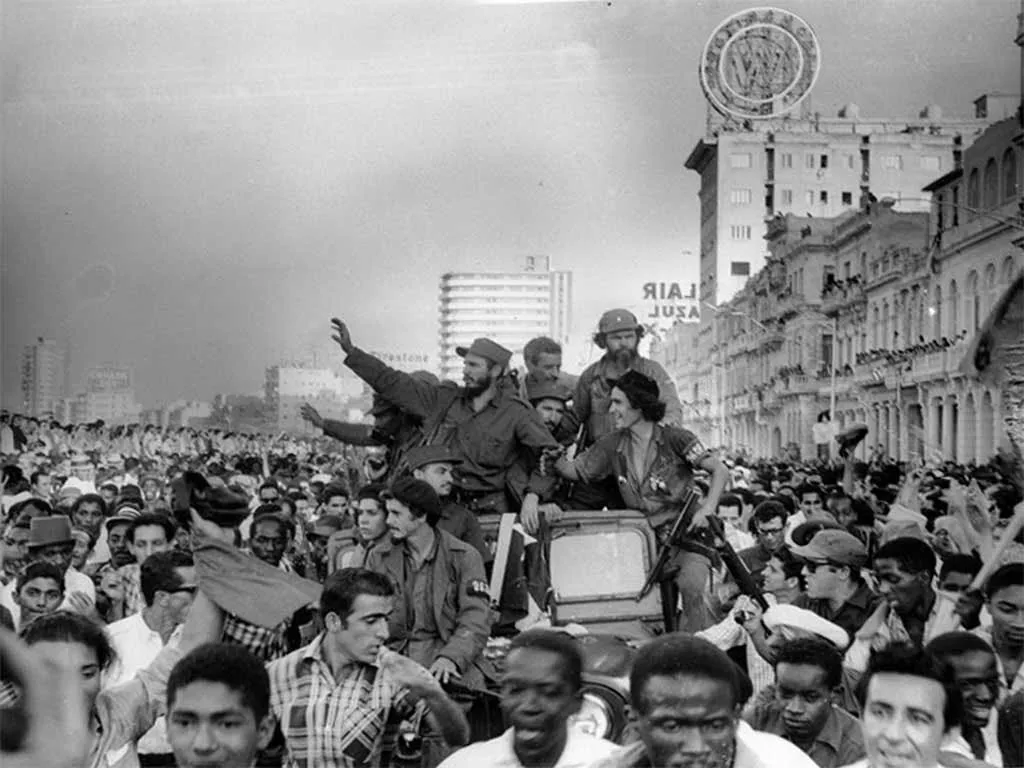
Fidel Castro's entry into Havana, 1959. Photographer unknown. Public domain in Cuba: a photograph more than 25 years after publication (PD-Cuba tag on Wikimedia Commons) · Public domain · Source page
The election that did not happen
Havana, 10 March 1952
On 10 March 1952 a military coup brings Fulgencio Batista to power in Cuba. The election due in June is cancelled.
Wikimedia Commons dates the picture at the top of this lesson to January 1959, seven years after the coup. In between, a young lawyer, Fidel Castro, was put forward for a seat in Congress, and the vote never came. What do you do when the ballot box is closed to you?
Background
The constitution of 1940
Cuba was governed under a constitution adopted in 1940. Elections were part of that system, so cancelling one was not only a matter of dates. The coup decided who held power without a ballot, and the order that came before it did not return.
This matters for the rest of the lesson. Anyone who wanted to change the regime in Cuba had to choose between the law and some other road.
Batista's government answered its opponents with force. Wikipedia estimates that between hundreds and 20,000 people were killed under his rule, notes that some historians dispute the higher figure, and cites, among others, the historian Lillian Guerra (2012).
1952
A candidate with no election
June 1952
Castro had meant to run for a seat in the House of Representatives in the June 1952 vote. The senior leaders of his party, the Ortodoxo party, refused to nominate him. Party members in Havana's poorest districts nominated him anyway.
The vote never took place. The legal route to office was closed, and the question of what to do next was left open.
The map
Cuba at a glance
Three places return in this lesson. Havana, on the north coast, is the capital and the seat of government. Santiago de Cuba lies in the east of the island. The Sierra Maestra is a range of mountains in the south-east, far from the capital.
Summer 1953
A decision point
You are Fidel Castro, a lawyer who was put forward for a seat in Congress.
Cuba, summer 1953, before 26 July.
The June 1952 vote was cancelled by the coup. The seat you were put forward for will not be filled by an election. You are a lawyer, and the law offers some roads: a case in the courts, speeches in public, and patience until the next vote, if there is one.
You also have a small circle of supporters who want to act. The government controls the army, and every road has a cost.
What do you do?
- Take the coup to the courts, speak in public, and wait for the next election. A long legal and public fight. It could win sympathy, but a regime that has cancelled one vote can cancel the next. Probably the case would be delayed, and you would remain a lawyer with no seat.
- Build a political movement quietly, and wait for a vote that may never come. Slow organising, and patience. It keeps you out of prison for longer, but gives the regime time to strengthen its hold. A movement like this can be closed down or split, and its fate depends on whether a vote ever comes.
- Attack the Moncada barracks in Santiago de Cuba on 26 July 1953, and spark a rising across the island. A surprise attack with a small force. If it succeeded, it could spark a rising across the island. If it failed, the attackers would face arrest, and the regime would search hard for the organisers.
What really happened
Attack the Moncada barracks in Santiago de Cuba on 26 July 1953, and spark a rising across the island.
The third road was taken. On 26 July 1953, 136 men attacked the Moncada barracks in Santiago de Cuba, and 24 more attacked the barracks at Bayamo the same day. The attack failed.
After the fighting, captured rebels were executed: according to Wikipedia, citing the historian Antonio Rafael de la Cova (2007), 42 at Moncada and 10 at Bayamo. In a memoir he gave to the journalist Ignacio Ramonet, Castro gives 56 across both sites. The sources do not agree on the total, and this lesson does not describe how the men died.
The coup closed the legal road, and that is where the story starts. How much Castro expected from the attack itself, and how far he expected it to spark a wider rising, is a question on which the sources do not agree.
Keep this in mind for the rest of the lesson: each choice here was made by a real person who did not know how it would end.
26 July 1953
Two barracks on one day
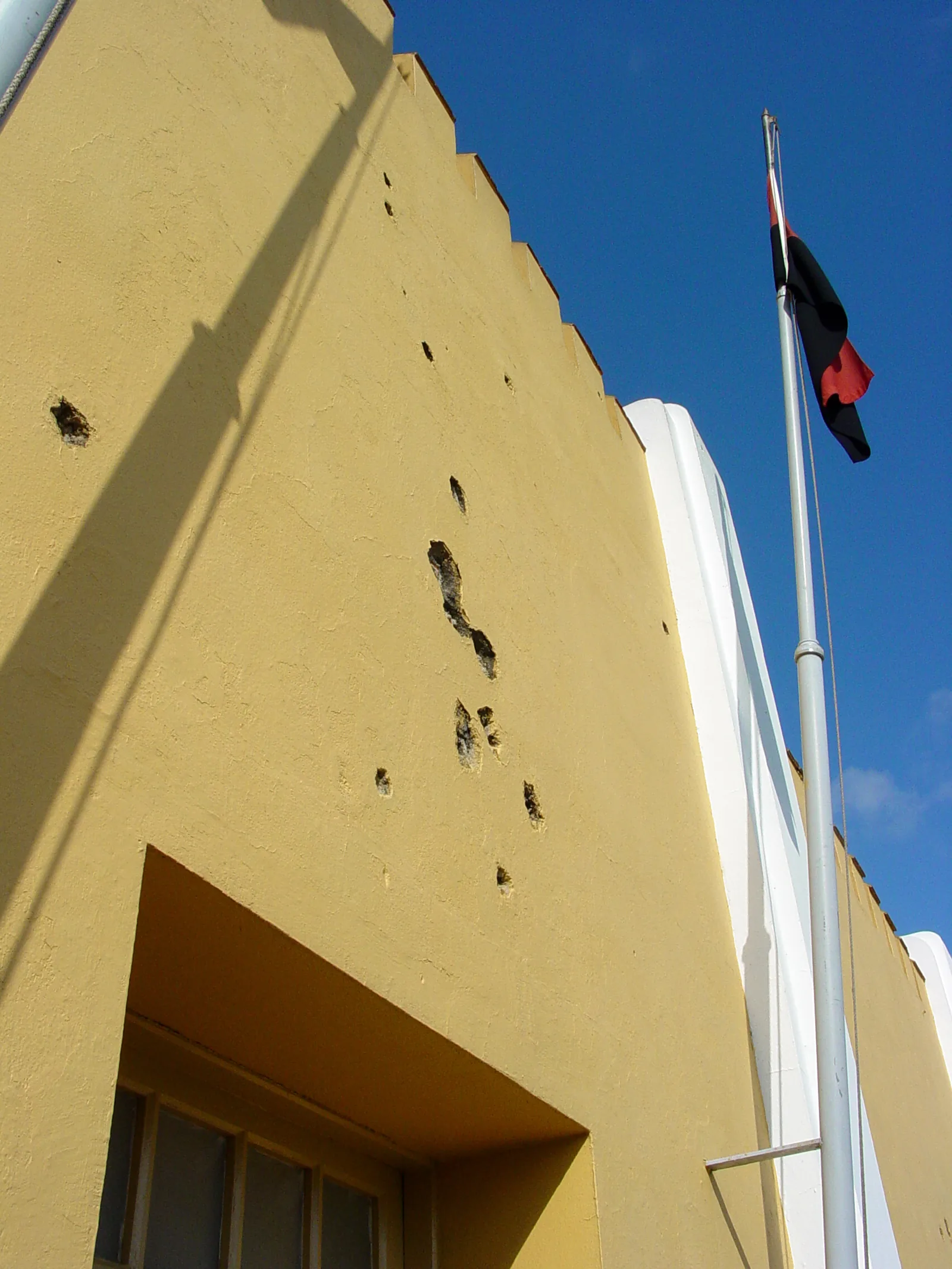
Facade of the Moncada barracks, Santiago de Cuba. Photo: Adam Jones · Adam Jones Adam63 · CC BY-SA 3.0 · Source page
Two army posts were attacked on the same day: Moncada in Santiago de Cuba, and Bayamo. On the government side Wikipedia records 15 soldiers and 3 police killed at Moncada. On the rebel side it gives 9 killed in combat and 11 wounded.
The wall in the photograph still shows bullet marks, but they are not all from 1953: the file description says they were recreated after the 1959 revolution. The photograph itself was taken decades later.
1953
Trial and sentence
The trial opened on 21 September 1953 in Santiago de Cuba. Castro had been arrested after the attack.
On 16 October he was sentenced to 15 years in prison. On the same day he gave a long speech to the judges, which later became known as History Will Absolve Me. The next chapter looks at that speech and at the text that was printed afterwards.
The defence speech and the amnesty
16 October 1953
A speech before the judges
At the sentencing Castro gave a speech that, according to Wikipedia, lasted about two hours. The historian Antonio Rafael de la Cova argues that the surviving recording runs longer than that.
The speech is a historical source, but a different kind from the documents later in this lesson. We cannot know for certain what was said word for word, because the printed text we read today was produced later, and how it was made is disputed.
Myth
History Will Absolve Me is a word-for-word record of what Castro said in court.
The truth
The printed text appeared in 1954. How it was written is unclear, and the sources do not agree on whether it matches the speech that was given.
The evidence
Wikipedia says the speech was written in prison and smuggled out page by page, and that Haydée Santamaría published it. The historian Bjarkman cites only one letter about the intention to write it. The two accounts are not the same.
1954
Who printed it, and how
The printed text came out as a pamphlet in 1954 and was distributed in Cuba. Wikipedia says it was printed in secret. The historian Peter Bjarkman says the only solid evidence of its writing is a letter from Castro to Melba Hernández, in which he says he would write such a text.
So even the writing is open to dispute. The printed version alone cannot tell us exactly what was said in court.
1955
An amnesty
In 1955 Congress passed an amnesty for political prisoners. Wikipedia says that 30 imprisoned rebels were freed after 22 months. The Wikipedia article on the Moncada attack does not name Castro in that sentence, but Castro was among those released.
The amnesty was not an acquittal. The prisoners were released by a law, not cleared of the charges.
1955
Mexico
Castro went to Mexico. In Mexico City, in 1955, he met Ernesto ‘Che’ Guevara, an Argentine doctor living there. According to Wikipedia, their first meeting was in June 1955, and Raúl Castro, Fidel's brother, introduced them.
The meeting mattered, because Guevara became one of the most powerful voices of the revolution. The later role is a story for the next chapters, and it is worth separating what happened in 1955 from what was added to it later.
The yacht and two fronts
November–December 1956
The Granma
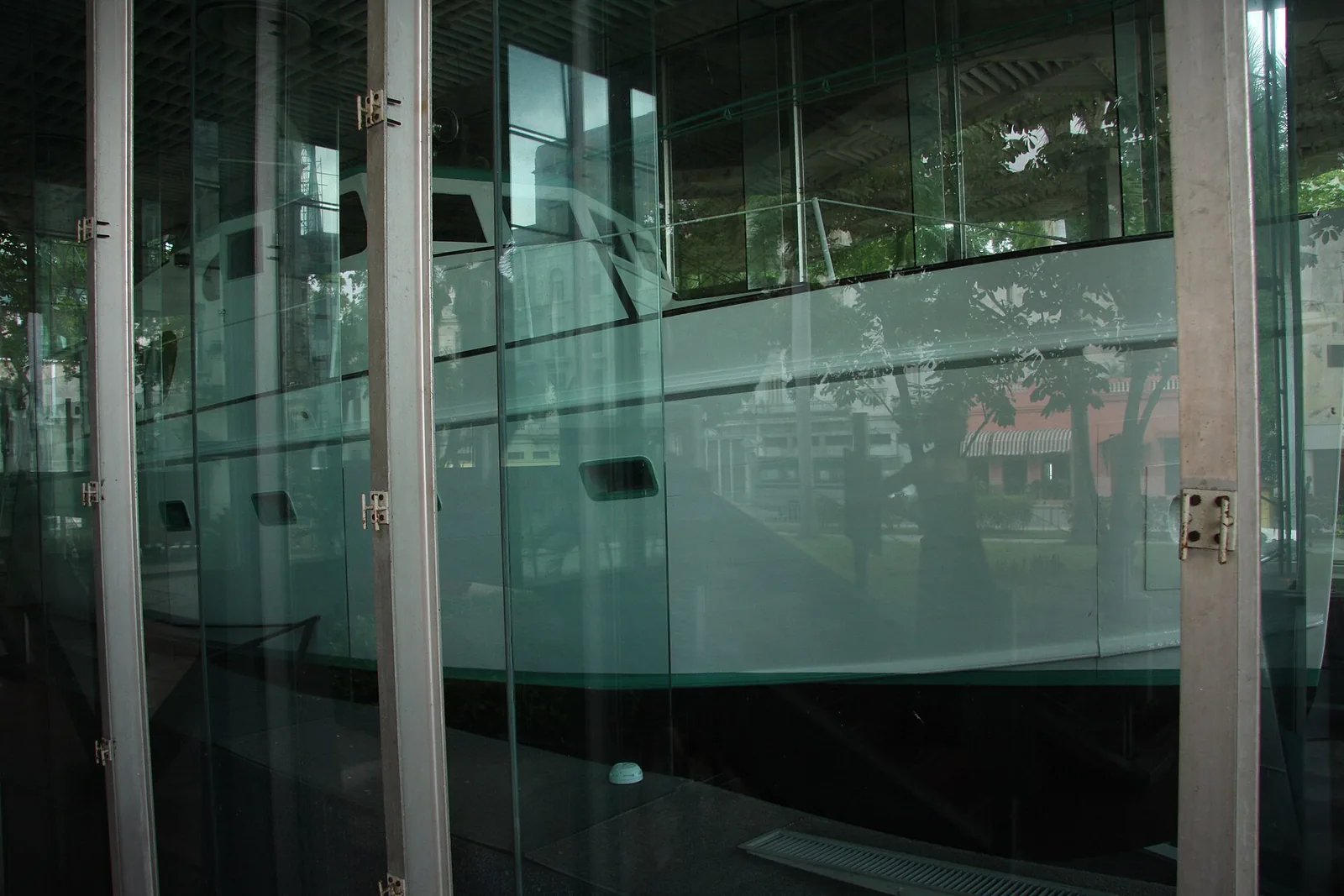
The yacht Granma in the Museum of the Revolution, Havana, 2010. Photo: Catskingloves · CC BY-SA 3.0 · Source page
On 25 November 1956, at Tuxpan in Mexico, 82 men boarded the yacht Granma. They landed on 2 December at Playa Las Coloradas, near Niquero, two days late because of the weather.
The yacht itself is kept today in the Museum of the Revolution in Havana. The photograph above was taken there, decades after the voyage, not at the landing.
5 December 1956
Alegría de Pío
On the afternoon of 5 December the group was ambushed at Alegría de Pío. Many men were killed or captured. Wikipedia's infobox gives 67 killed, citing a 2022 edition of The Che Guevara Reader. When the group scattered, only some of the men reached the mountains.
Myth
Only twelve men survived the Granma and walked into the Sierra Maestra.
The truth
Wikipedia prefers a figure of about twelve. But the same article gives a list of 21 named survivors. The numbers do not agree, so the count is disputed rather than settled.
The evidence
With 82 men aboard, 67 killed at Alegría de Pío and 12 survivors, the figures add up to 79, not 82. The sources do not explain the difference.
A decision point
You are Fidel Castro, in your camp in the Sierra Maestra.
Sierra Maestra, February 1957.
Your group is small. Only a few men are still with you in the mountains since the December landing, and even their number is disputed. Outside the mountains almost nobody knows you are still fighting.
A newspaper report is what would make your name known. Herbert L. Matthews of The New York Times asks to come and interview you. He would write what he sees and print it in a major American paper.
What do you do about the reporter?
- Refuse all reporters and stay out of sight. The group stays unseen. Probably the government's version would go unanswered in the papers that reach you, and you give up the chance to speak.
- Allow the interview in the mountains, and tell the reporter who you are and what you want. A story in a foreign newspaper would make you a public figure outside Cuba. The risk: the reporter might reveal where you are, and the government would learn more about your camp.
- Refuse a visit, but send a written statement through an intermediary. A statement would reach the paper, but a reporter who never met you would be free to describe you as he liked, and readers would have no close view of you.
What really happened
Allow the interview in the mountains, and tell the reporter who you are and what you want.
The interview was chosen. Matthews interviewed Castro in the Sierra Maestra on 17 February 1957, and his articles ran in The New York Times on 24, 25 and 26 February. A US record written decades later (FRUS, 1955–57, vol. VI, doc. 290) says Matthews portrayed Castro as a reform-minded leader who wanted the 1940 constitution restored.
What Matthews saw, and whether he was given a fair picture of the group's strength, is disputed. Some writers claim that Castro misled him about the numbers, but the sources available to this lesson do not settle the question.
The sources record that the interview happened, but they do not record Castro's reasons in his own words. So whether it was a wise step remains open.
Look at what each option made possible. Hiding protected the camp, but left the story to others. The interview put the camp at risk, but gave it a voice.
13 March 1957
The Presidential Palace
On 13 March 1957 members of the Directorio Revolucionario 13 de Marzo stormed the Presidential Palace in Havana. Their leader, José Antonio Echeverría, died in a shootout at a radio station in Havana.
The action was separate from the struggle in the mountains. The city had a front of its own, with leaders and a plan of its own.
12 July 1957
The Sierra Maestra Manifesto
The Sierra Maestra manifesto signed in the mountains is dated 12 July 1957, but its closing line carries the date 28 July. It was signed by Castro, Felipe Pazos and Raúl Chibás. It promised general elections within one year, and that power would pass at once to the winner.
This promise comes back later in the lesson. Remember that the manifesto was written during a war, not while a government was in power.
30 July 1957
Frank País
On 30 July 1957 Frank País, the urban coordinator of the 26th of July Movement, was killed in Santiago de Cuba. The Santiago police shot him and Raúl Pujol. Wikipedia also says he led a four-day uprising in Santiago that started on 30 November 1956, in the same weeks as the Granma voyage.
Wikipedia adds that his group joined the 26th of July Movement after Castro's release. So the city and the mountain were two fronts, and the article presents them as one movement.
The rifles and the flight
A decision point
You are William P. Snow, Deputy Assistant Secretary of State for Inter-American Affairs.
Washington, March 1958.
The Cuban government bought 1,950 Garand rifles from the United States. The government was fighting an armed opposition in the mountains and the cities, and the rifles would strengthen its army. The question of whether to keep selling arms had gone to the Secretary of State, John Foster Dulles, on 17 January 1958.
Congress was then debating the Mutual Security legislation. You must recommend a course of action.
What do you recommend to the Secretary?
- Keep selling arms to the government as before. Arms keep flowing, and the government's army stays strong. The United States would probably be seen as the supplier of the regime during the war. The risk: damage to its reputation in the region, and open support for a government facing a revolt.
- Suspend the shipments for now, as a temporary measure. A temporary pause. It signals doubt without formally breaking the relationship. The government would be angry, but the policy could be reviewed later. Probably the pause would last only as long as the review.
- Suspend the shipments, and tie the decision to the vote on the Mutual Security bill in Congress. The decision would become a bargaining chip in Congress. Probably it would look like a political game, and it would depend on the fate of the bill. If the bill failed, policy might change for reasons unconnected with Cuba.
What really happened
Suspend the shipments for now, as a temporary measure.
The second option was taken. On 14 March 1958 the Department suspended temporarily a shipment of 1,950 Garand rifles bought by the Cuban government, and asked the Defense Department to stop further arms shipments. Dulles initialled his approval of the recommendation.
A note of 26 March from Joseph N. Greene, writing to Snow, said the Secretary did not approve tying the decision to the progress of the Mutual Security bill. So the third option was rejected.
The sources checked for this lesson explain what was done, but do not fully explain why a temporary pause was chosen. What is clear is that the Secretary did not want the decision tied to the debate in Congress.
Notice the wording. The memo does not speak of a ban or an embargo. It speaks of a temporary suspension of one shipment, so what was actually decided is clear only when you read the text itself.
Source: Sales of Arms to Cuba
The Department already (March 14) has suspended temporarily a shipment of 1,950 Garand rifles which had been purchased by the Cuban Government
This is an internal paper for the Secretary. It was written to decide what to tell Congress and the public, and it refers to a suspension already made on 14 March.
- Who wrote the document, and for whom? A deputy assistant secretary, writing for the Secretary. Not for the public and not for the Cuban government. Its readers are people who must decide quickly.
- Why does it say ‘suspended temporarily’? The words suggest a pause, not an end. Wording like this keeps options open, and it is easier to defend before Congress. This is a reading of the words, not proof of intent.
- What is missing from the memo? It does not say what the government would do without the rifles, or what the rebels would gain. It is a picture of the decision, not of the war. The sentence itself does not use the word ‘embargo’, which later historians applied to the measure.
Late December 1958
Santa Clara
The Battle of Santa Clara, according to Wikipedia, ran from 28 December 1958 to 1 January 1959. Guevara's column left Caibarién on 28 December. The article says that his men used tractors from the university's agronomy school to raise the rails, and that Batista's armoured train was derailed.
Wikipedia gives no date for the derailment, so it is not fixed here.
Myth
Che led the revolution.
The truth
Castro led the revolution's general command. Guevara was promoted to second-in-command, and led the column that took Santa Clara. He was a central figure, but not the leader.
The evidence
The Wikipedia article on Guevara. Ask yourself why his name stuck to the revolution more than the name of its general command.
24 December 1958 – 1 January 1959
Batista's exit
On 24 December 1958 Batista met the army officer Eulogio Cantillo. On 30 December Castro was informed of what had been arranged. According to Wikipedia, Batista left Camp Columbia in Havana at about 3 a.m. on 1 January 1959, for the Dominican Republic.
A resignation had been announced shortly before that. What was said and when it was agreed is described differently in the sources.
Myth
Castro toppled Batista by taking Havana.
The truth
Batista left the country before Castro entered Havana. The meeting with Cantillo on 24 December and the notice on 30 December came before the flight on 1 January 1959. Castro entered Havana on 8 January.
The evidence
Wikipedia's article on the triumph of the revolution gives this order, and History.com gives 1 January as the date of the flight. What decided the outcome: Santa Clara, the army's collapse, or Castro's arrival in the capital? The question is open, and you will have to weigh it.
Havana, and the new state
Source: Entry into Havana
A photograph by an unknown photographer. Wikimedia Commons dates it to 8 January 1959 and tags it public domain. The file's listed source is a social-media account, not an archive.
Castro entered Havana on 8 January 1959. Wikipedia uses that date in two articles, while some other websites give 7 or 9 January. This lesson uses 8 January.
- What can you see in the picture? A jeep loaded with men in uniform moves slowly through a dense crowd on a wide street. A bearded man in a cap raises his arm, and the crowd presses in on every side.
- Who took it, and what is left out of the frame? The photographer is unknown, so we cannot tell why this moment was taken or what was left outside it. The picture shows a moment of celebration, not the months before it or what followed.
- Why does a picture like this keep coming back? Because it tells a clear story: a triumphant entry. One picture becomes a symbol, and that is what has happened to this one. When you see it in a book, ask what it stands for and what it leaves out.
January 1959
The revolutionary courts
Within days of entering the city, the new government passed a law on 10 January 1959 that legalised the death penalty, and revolutionary tribunals began to sit and to pass death sentences. A revolutionary tribunal was a special court that moved faster than the ordinary courts. According to Wikipedia, these courts were made up of two or three army officers, an assessor and a local citizen.
Wikipedia says that Guevara ran the La Cabaña prison from January to June 1959, and mentions one public execution he ordered, of a former army colonel, on 7 January 1959.
The land and the reckoning
A decision point
You are Fidel Castro, at the head of the revolutionary government in Havana.
Havana, spring 1959.
Who owns the land in the countryside is a central question for the new government. Some large holdings belong to foreigners, including Americans.
In the Sierra Maestra manifesto of July 1957, which you signed, you promised general elections within a year. Now you must decide whether to pass a land law at once, or to wait for a vote that could settle it.
What do you do about the land?
- Leave the land as it is, and let the owners keep their holdings. The landowners, foreign owners among them, keep their land, and the farmers go on working land they do not own. Those who expected change would see a weak government. Probably the tension over land would continue.
- Pass a law that limits large holdings and gives land to the farmers who work it. Farmers gain land, and large owners, foreign ones among them, lose it. The law would probably be seen as a move against American interests, and the state would have to run the transfer itself.
- Postpone the law until an elected body can decide it. A vote would give the law legitimacy, but the farmers would wait, and the government would have to hold the present situation in the meantime. Probably the wait would be long, and it would depend on when the vote came.
What really happened
Pass a law that limits large holdings and gives land to the farmers who work it.
The Cuban Cabinet passed an agrarian reform law in May 1959, and according to Wikipedia it took effect in June. The law limited how much land one owner could hold. Sources differ on the size of the limit, so this lesson gives no figure.
The sources checked for this lesson do not say how the owners and the farmers reacted in the months that followed. The American record in the next step describes the decision from outside.
The sources record the law, but not how owners and farmers reacted to it.
Ask yourself what waiting would have cost, and who would have paid for it.
Source: The Agrarian Reform Law
On May 17, the Cuban Cabinet promulgated an Agrarian Reform Law.
The law concerns agrarian reform. This is an editorial note, written later by American historians who summarised documents. It is not a document from 1959, so it records what was done without saying how it was lived by those affected.
- Who wrote the note, and from where? Later American historians, working from their own government's documents. They were not writing at the time, and their view is that of observers tracking the effect on American property.
- What does the note say the law does? Nothing beyond the date and the fact that the law was proclaimed. What it did to the land and to the farmers is a question for other sources.
- Whose voice is missing? The landowners, the farmers, and the Cuban officials who drafted the law. The note was written from outside, so look for the voices of those who lived under the law.
October–December 1959
Huber Matos
Huber Matos, a senior officer of the revolution, wrote a letter of resignation dated 19 October 1959. Castro sent Camilo Cienfuegos, another senior commander, to arrest him within days. On 15 December 1959 Matos was sentenced to 20 years in prison, and he was released only in 1979.
The letter itself is not quoted here. The words that accounts attribute to Castro in this dispute are themselves disputed, and this lesson does not use them.
17 April 1961
The Bay of Pigs
Two days before the landing, aircraft struck airfields in Cuba. On the night of 17 April 1961, a force of Cuban exiles, Brigade 2506, which the United States had trained and backed, landed at Playa Girón in the Bay of Pigs.
On 16 April Castro spoke at a tribute to the victims of the air strikes. Cuban state media, which is not independent, describes that speech as the moment the revolution was declared socialist. But Wikipedia notes an earlier speech, in late 1959, that spoke of socialism, so whether April 1961 was the first such declaration is disputed.
2 December 1961
A Marxist-Leninist
In a speech on 2 December 1961 Castro declared himself a Marxist-Leninist. History.com and the marxists.org archive date the speech to that day. Wikipedia notes that in 1957 Castro kept his views hidden, and that in 1959 he denied being a communist.
Keep the difference between what he said at one moment and what he declared at the end of the road. The debate about when the revolution became communist rests on exactly that difference.
The debate and the final quiz
What followed
- 10 March 1952 Batista's coup. The June election is cancelled.
- 26 July 1953 The attacks on Moncada and Bayamo fail. The 26th of July Movement takes its name from the date.
- 1955 An amnesty for political prisoners. Castro in Mexico, where he meets Guevara.
- 2 December 1956 The Granma lands on the coast of Cuba. Most of the men are killed or captured in the following days.
- 12 July 1957 The Sierra Maestra Manifesto promises general elections.
- 14 March 1958 The United States suspends a shipment of 1,950 Garand rifles to Batista's government.
- 1 January 1959 Batista leaves Cuba.
- June 1959 The agrarian reform law takes effect (3 June, according to Wikipedia). In December Huber Matos is sentenced to 20 years.
- 30 August 1960 Cuba nationalises three oil refineries owned by Americans.
- January 1961 The United States tightens its embargo on Cuba.
- 17 April 1961 The Bay of Pigs invasion.
- 2 December 1961 Castro declares himself a Marxist-Leninist.
Did the revolution turn communist from the start?
Did Castro plan communism from the start, or was the revolution pushed that way under pressure? The sources allow both readings.
- One reading: planned from the start On this reading Castro planned the move to communism from the start, and pressure from outside only shaped the way it happened.
- The other reading: pressure from outside On this reading Castro did not plan communism from the start. The revolution was pushed that way by hostility from the United States.
This lesson does not decide between them. Books to read before you decide: Hugh Thomas (1971), Louis A. Pérez Jr., Samuel Farber (2006) and Lillian Guerra (2012). What would change your mind: what Castro said in 1957, 1959 and 1961, or what the United States did between 1958 and 1961? And what would not?
Check yourself
On what date did Batista's coup cancel the June 1952 election?
Answer: 10 March 1952. Correct. The coup of 10 March 1952 cancelled the June election.
Check yourself
How many men boarded the Granma at Tuxpan?
Answer: 82. Correct. 82 men boarded at Tuxpan on 25 November 1956.
Check yourself
Where did the Granma land on 2 December 1956?
Answer: Playa Las Coloradas, near Niquero. Correct. The landing was at Playa Las Coloradas, two days late because of the weather.
Check yourself
On what date did the United States suspend a shipment of 1,950 Garand rifles to Cuba?
Answer: 14 March 1958. Correct. The Department suspended the shipment on 14 March 1958.
Check yourself
On what date did Batista leave Cuba?
Answer: 1 January 1959. Correct. Batista left Camp Columbia at about 3 a.m. on 1 January 1959.
Check yourself
On what date did Castro declare himself a Marxist-Leninist?
Answer: 2 December 1961. Correct. According to marxists.org and History.com, the speech and the declaration were on 2 December 1961.
Terms
- coup A seizure of power by a small group, usually military, outside the normal legal process.
- amnesty A law that frees a group of prisoners or pardons them, without judging each case on its merits.
- manifesto A public statement by a movement or a leader that sets out its aims and its plans.
- revolutionary tribunal A special court set up by a new regime, which works faster than the ordinary courts.
- embargo An official ban on trade, or on selling certain goods, to a particular country.
- agrarian reform A law that changes who owns farmland, usually by limiting large holdings and passing land to farmers.
- Marxism-Leninism A form of communism based on Marx as interpreted by Lenin: a leading party, state ownership of the economy, and one-party rule.
Sources
- Foreign Relations of the United States, 1955–1957, vol. VI, doc. 290 (editorial note on Herbert Matthews's interview with Castro)
- Foreign Relations of the United States, 1958–1960, vol. VI, doc. 41: memorandum from William P. Snow to John Foster Dulles, 24 March 1958
- Foreign Relations of the United States, 1958–1960, vol. VI, doc. 306 (editorial note, May–October 1959)
- Fidel Castro, History Will Absolve Me (speech at sentencing, 16 October 1953; printed 1954)
- Herbert L. Matthews, articles in The New York Times, 24, 25 and 26 February 1957
- Manifiesto de la Sierra Maestra, 12 July 1957 (closing line dated 28 July 1957), Spanish text
- Fidel Castro, speech of 2 December 1961, as dated by the marxists.org archive
- Hugh Thomas, Cuba (New York: Harper & Row, 1971)
- Louis A. Pérez Jr., Cuba: Between Reform and Revolution (New York: Oxford University Press)
- Samuel Farber, The Origins of the Cuban Revolution Reconsidered (Chapel Hill: University of North Carolina Press, 2006)
- Lillian Guerra, Visions of Power in Cuba: Revolution, Redemption, and Resistance, 1959–1971 (Chapel Hill: University of North Carolina Press, 2012)
- Wikipedia, "Attack on the Moncada Barracks"
- Wikipedia, "Landing of the Granma"
- History.com, "Castro declares himself a Marxist-Leninist"
- Wikipedia, "Fulgencio Batista" (citing Guerra 2012 and others)
- Wikipedia, "Che Guevara" (citing Castañeda 1998)
Image credits
- Fidel Castro's entry into Havana, 1959. Photographer unknown. Public domain in Cuba: a photograph more than 25 years after publication (PD-Cuba tag on Wikimedia Commons) · Public domain · Source page
- Facade of the Moncada barracks, Santiago de Cuba. Photo: Adam Jones · Adam Jones Adam63 · CC BY-SA 3.0 · Source page
- The yacht Granma in the Museum of the Revolution, Havana, 2010. Photo: Catskingloves · CC BY-SA 3.0 · Source page


