The Third Punic War: Carthage destroyed
“Carthage must be destroyed,” Cato kept saying. In 146 BC the city burned for days, and a Roman general, we are told, wept as he watched.
Decisions, questions and your own progress, in the app
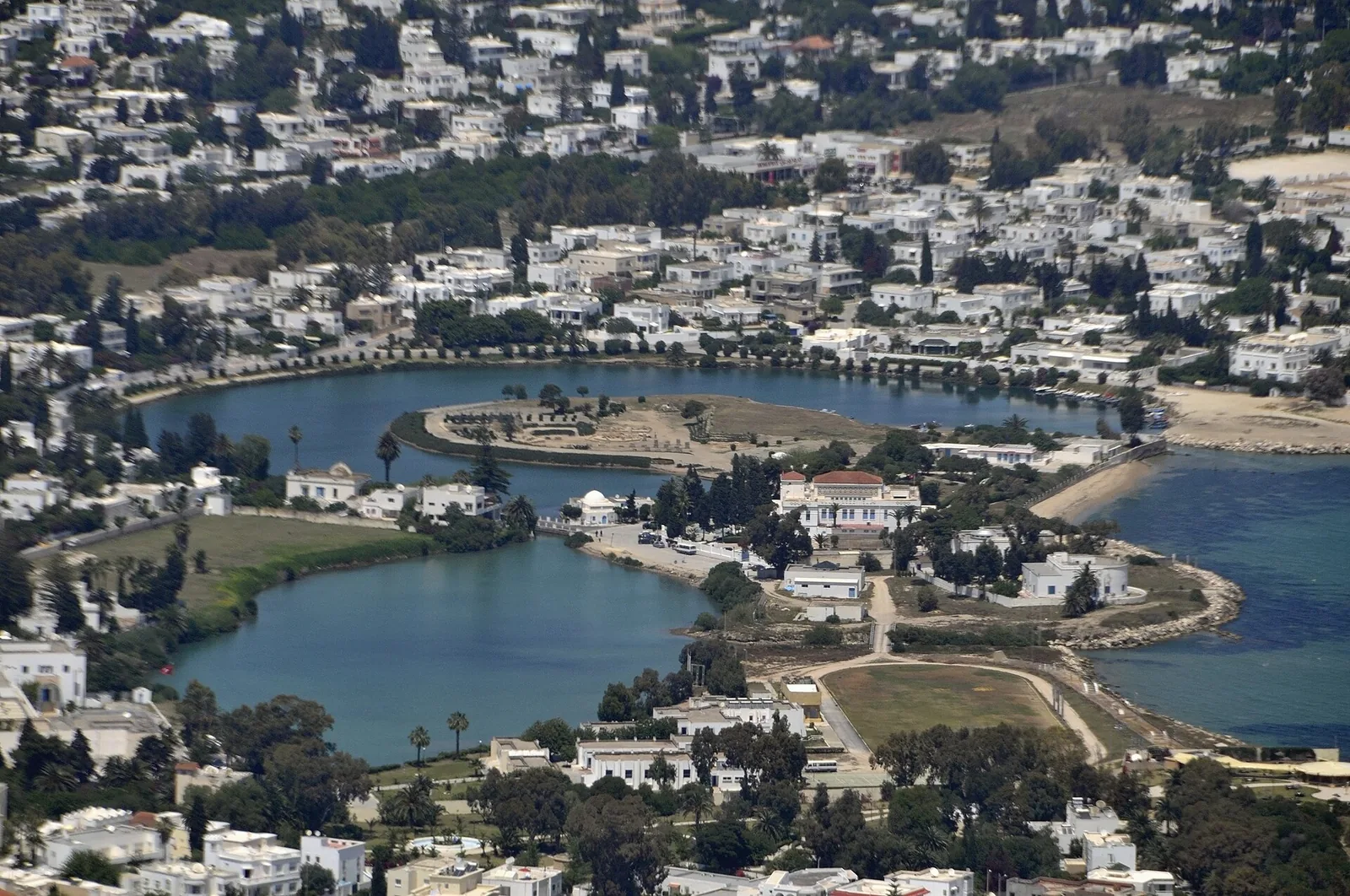
The Punic ports at Salammbô, Carthage, Tunisia, 2010. Photo: Citizen59 · CC BY 3.0 · Source page
The city on fire
A general in tears
Spring, 146 BC. A Roman general stands on a height above a burning city. For six days and nights his soldiers have fought from house to house up the streets of Carthage. Now the fire is spreading.
The general is Scipio Aemilianus, about 38 years old. Beside him stands his friend and old teacher, the Greek historian Polybius. As he watches, Scipio weeps, and quotes a line of Homer about the fall of Troy. Then he says something strange: he is afraid that one day the same will happen to Rome.
Three years earlier, Carthage had handed Rome all its weapons without a fight. How did it end in fire? And how much of what you may have heard, about salt and a famous Latin slogan, is true?
Our witnesses
A friend of the winner
Almost everything we know about this war comes from the winning side. Polybius was there: a Greek politician taken to Rome as a hostage in 167 BC, who became the tutor and close friend of young Scipio and went with him to Africa. He wrote his history for Greek readers, and he admired Scipio.
Polybius’s account of these years survives only in fragments. The fullest story we have is by Appian, a Greek from Alexandria who wrote about 290 years later and followed Polybius closely. No Punic account survives. When a Carthaginian speaks in this lesson, a Greek or a Roman has put the words in his mouth.
Publius Cornelius Scipio Aemilianus
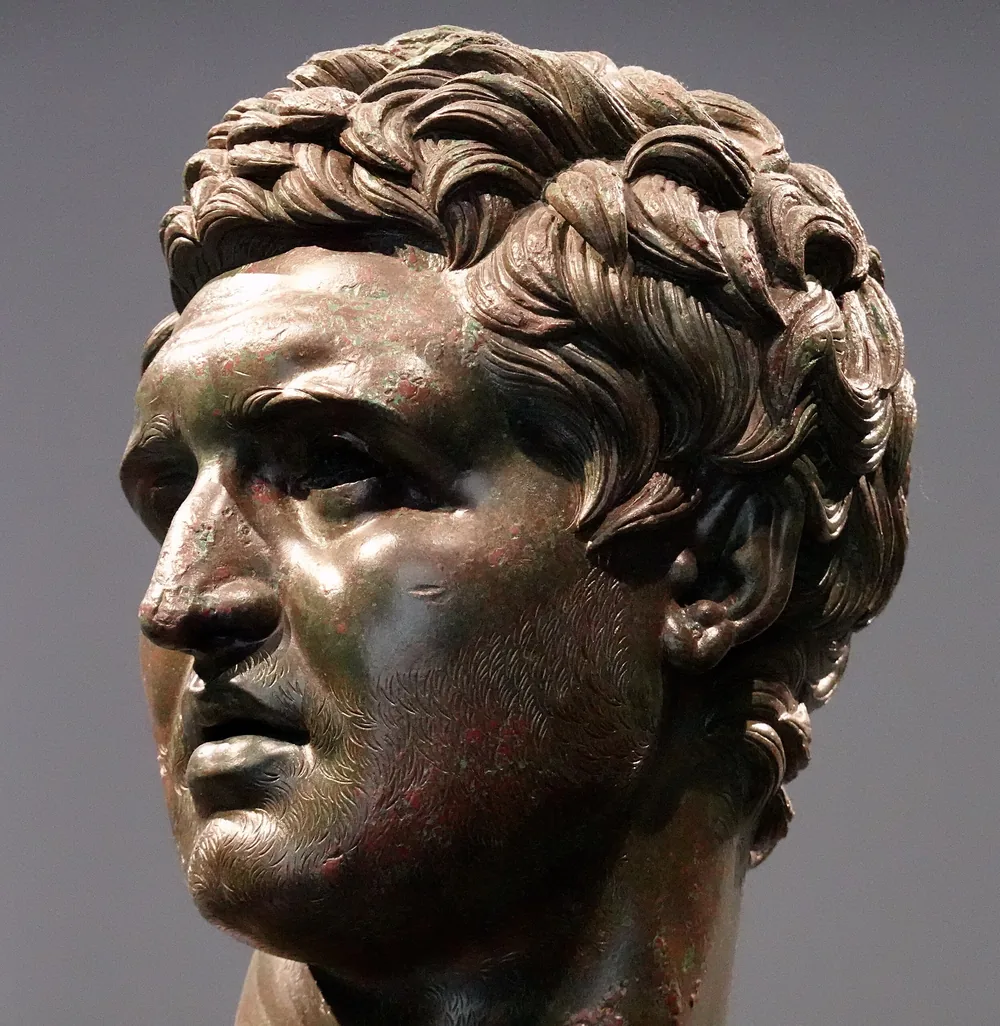
Bronze statue of a ruler, the ‘Terme Ruler’ (detail), 2nd century BC. Palazzo Massimo alle Terme, National Roman Museum, Rome. Photo: Prof. Mortel · CC BY 2.0 · Source page
A general’s son adopted into Rome’s most famous family, who destroyed Carthage and wept as he did it.
- Born: 185 or 184 BC, Rome, son of the general Lucius Aemilius Paullus
- Died: 129 BC, Rome, at home, found dead in bed one morning; rumours of murder were never proved
- Won: Pydna, 168 BC, aged 17, in his father’s army; Carthage, 146 BC; Numantia, 133 BC
- Lost: Nepheris, 149 BC: the consul’s attack failed; Scipio, a tribune, saved the trapped cohorts
“You are more like robbers than soldiers.”
Rich again
Background
Fifty years after Zama
As we saw in the last lesson, the peace of 201 BC left Carthage its city and its farmland in what is now northern Tunisia, but took its fleet, its elephants and its empire. It had to pay Rome 10,000 talents of silver over fifty years, and it could not go to war, not even in Africa, without Rome’s permission.
Carthage recovered fast. Appian writes that, ‘blessed with peace’, it ‘advanced greatly in population and wealth by reason of the fertility of her soil and the profits of her commerce’. By 191 BC it offered to pay off the whole debt at once. Rome refused and kept the yearly payments. Archaeologists have found the new houses of these years on the slopes of the Byrsa, the citadel hill.
Background
The old king next door
The real problem was next door. Masinissa, king of the Numidians, had fought for Rome at Zama, and the peace treaty let him claim any land that had once belonged to his ancestors. For fifty years he used that clause to take Carthaginian land; each time Carthage appealed to Rome, and lost.
Polybius, no enemy of Rome, says plainly why: the Carthaginians ‘always came off second best at Rome, not because they had not right on their side, but because the judges were convinced that it was in their own interest to decide against them’.
In 150 BC, with Masinissa besieging one of its towns, Carthage lost patience. It sent an army of about 25,000 men under a general named Hasdrubal. Young Scipio, in Africa on army business, watched the battle from a hill ‘as one views a spectacle in a theatre’. The Carthaginians were trapped, starved and cut down as they surrendered. Worse, Carthage had gone to war without Rome’s permission.
Marcus Porcius Cato, ‘the Elder’
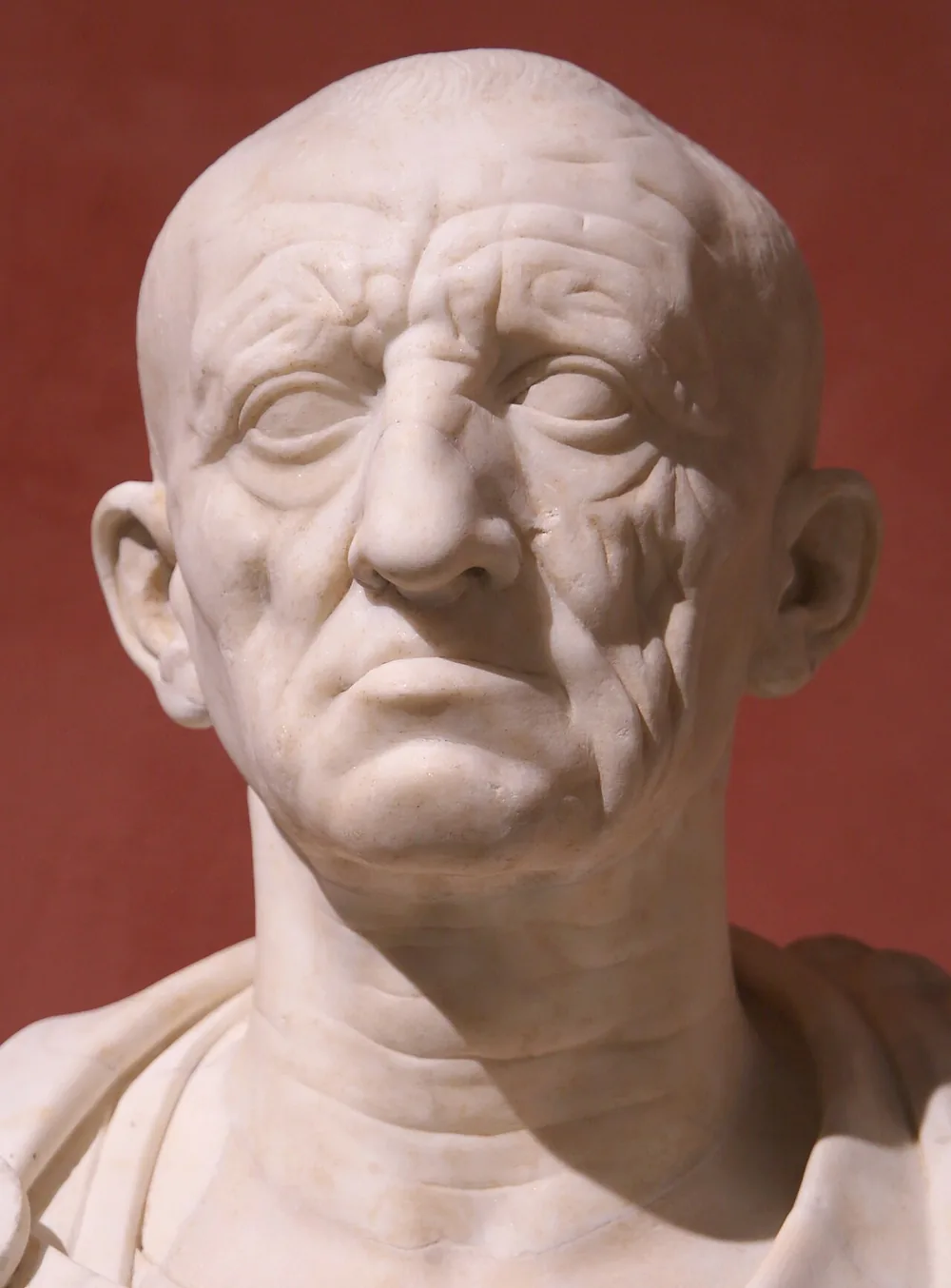
Portrait of a man, the so-called ‘Old Man of Otricoli’, c. 50 BC, on a modern bust. Torlonia Collection, Rome. Photo: Sailko · CC BY 3.0 · Source page
A farmer’s son who rose to guard Rome’s morals, and spent his last years demanding that Carthage be destroyed.
- Born: 234 BC, Tusculum, near Rome, to a farming family
- Died: 149 BC, Rome, at about 85, in the first year of the war he had demanded
- Won: Campaign in Spain as consul, 195 BC; Thermopylae, 191 BC: led the march round the enemy’s flank; Pressed for Carthage’s destruction, 153–149 BC; Rome went to war in 149
- Lost: Died before Carthage fell
“In my opinion, Carthage must be destroyed.”
Source: A fig from Carthage
“…it is said that Cato contrived to drop a Libyan fig in the Senate, as he shook out the folds of his toga, and then, as the senators admired its size and beauty, said that the country where it grew was only three days’ sail from Rome.”
“Publius Scipio Nasica, on the contrary, when called upon for his vote, always ended his speech with this declaration: ‘In my opinion, Carthage must be spared.’”
About 152 BC Cato led an embassy to Carthage and came home alarmed by its wealth and its stores of arms. His chief opponent, Scipio Nasica, argued the opposite, Plutarch says: a rival ‘not strong enough to conquer Rome, nor yet weak enough to be despised’ would keep the Roman people in check. Historians call this idea metus Punicus.
- Plutarch writes about 250 years later and begins ‘it is said’. How sure can we be that the fig really fell? Not very: such stories gather round famous men. Pliny tells it too, in a book about fruit trees. Its point may still be true: Carthage was close, and rich.
- What is the fig supposed to prove? That Carthage was near and flourishing: fresh fruit could reach Rome in three days, and so could an army. It is an argument from fear, made with a prop, not evidence.
- Cato and Nasica both argue about Rome: its safety, its discipline. What is missing from both arguments? Anything Carthage had actually done to Rome. Both treat Carthage as a means to Roman ends.
Myth
Cato ended every speech with the Latin words ‘Carthago delenda est’: ‘Carthage must be destroyed’.
The truth
Cato probably did demand, again and again, that Carthage be destroyed: several ancient writers say so. But no ancient text has these three Latin words. Plutarch reports the demand in Greek; Latin writers give it in their own words. The neat slogan, and the longer ‘Ceterum censeo Carthaginem esse delendam’ (‘Besides, I think Carthage must be destroyed’), were shaped by modern writers and schoolbooks.
The evidence
Plutarch, Cato 27.1; Pliny, Natural History 15.74; Florus 1.31.4. C. E. Little, Classical Journal 29 (1934).
Three demands
A decision point
You are a Roman senator.
Rome, winter 150–149 BC
News from Africa: Carthage has broken the treaty and fought Masinissa, and lost an army doing it. Its envoys are here to apologise. They have condemned their own generals to death, and they ask what they must do. And Utica, Carthage’s neighbour, has just offered Rome its harbour.
Cato, now 84, has told you for two years that Carthage is rich, armed and three days away. Scipio Nasica answers that a rival keeps Rome disciplined. Masinissa is 88; if Rome does nothing, he may take Carthage himself and become master of Africa. And the Greek world is watching how Rome treats a beaten enemy.
How do you vote?
- Vote for war, with orders to destroy the city Carthage will probably be crushed: it has no fleet and has just lost an army. But war on a city that is begging for peace needs a pretext the world will accept, and a rich, walled city may not fall quickly.
- Accept the apology: fine Carthage and keep it weak Carthage survives as a weakened client, as Nasica wants. But it stays rich and resentful, Cato’s warnings go on, and Masinissa may keep nibbling until he takes the city himself.
- Demand that the Carthaginians leave the coast and live inland A Carthage without harbours could never threaten Rome by sea. But a people of the sea is unlikely to agree to uproot itself, and the demand may lead to war anyway.
- Stay out, and let Masinissa deal with Carthage Rome spends nothing. But if Masinissa takes Carthage, an ambitious Numidian kingdom with Carthage’s wealth and harbours will sit across the sea from Sicily.
What really happened
Vote for war, with orders to destroy the city
The Senate voted for war. Appian says the consuls sailed with ‘secret orders not to desist from the war until Carthage was razed to the ground’. In public, though, Rome announced no such aim. It would make its demands one at a time.
Polybius says the Romans ‘had long ago made up their minds to act thus, but they were looking for a suitable opportunity and a pretext that would appeal to foreign nations’. Carthage’s war on Masinissa gave them the pretext. Why they wanted war is still argued; the debate at the end of this lesson sets out the views.
149 BC
Hostages, then weapons
Carthage’s envoys in Rome did the only thing left: they surrendered their city by deditio in fidem, putting everything into Rome’s ‘good faith’. The Senate promised Carthage its freedom, its laws and its land, if it sent 300 children of noble families as hostages within 30 days and obeyed the consuls. Polybius notes that ‘there was no mention of the city’, which ‘caused serious anxiety and surprise’.
The hostages sailed, their mothers clinging to the ships. The consuls landed at Utica and gave the second order: hand over every weapon. Carthage obeyed. Polybius says it gave up ‘more than two hundred thousand suits of mail and two thousand catapults’. Then its envoys were called back to Utica for the last order.
A decision point
You are one of Carthage’s envoys.
The Roman camp at Utica, 149 BC
Your city has given Rome 300 children and every weapon it had. Now the consul Censorinus reads the Senate’s final order: ‘Yield Carthage to us, and betake yourselves where you like within your own territory at a distance of at least ten miles from the sea, for we are resolved to raze your city to the ground.’
Carthage has stood by the sea for over 600 years: its harbours, its temples, your ancestors’ graves. Censorinus answers your pleas coldly: ‘We consider you to be Carthage, not the ground and buildings where you live.’ You have no weapons and no fleet. Outside the walls, the condemned general Hasdrubal still has some 20,000 men.
What do you advise your city to do?
- Obey: abandon the city and move inland The people live, and Rome may keep its promise of freedom and laws. But Carthage as a city and a sea power ends for ever, and its people start again as farmers in a new town under Rome’s eye.
- Refuse, and defend the city with whatever it can make Without weapons, the city must arm itself from nothing behind its great walls. Defeat will probably mean death or slavery for everyone in it. But the walls are strong, and the Romans have not come ready for an assault.
- Ask for time to send envoys to Rome again Time is the one thing you can still win. The Senate is unlikely to change its mind, but every week lets the city prepare quietly, if it decides to fight.
What really happened
Refuse, and defend the city with whatever it can make
When the envoys brought the order home, the city exploded in grief and rage. Men who had advised surrender were torn apart. That same day the council declared war, freed the slaves to fight and recalled Hasdrubal, the general it had condemned. The consuls refused a truce, but waited, expecting the city to give in.
For the Carthaginians, Appian suggests, leaving the sea meant losing everything that made them Carthaginians: their gods, their graves, their trade. So the temples became workshops. Every day, Appian says, the city made 100 shields, 300 swords and 1,000 catapult missiles, and ‘for strings to bend them the women cut off their hair’.
Three years of siege
149–148 BC
Two years of failure
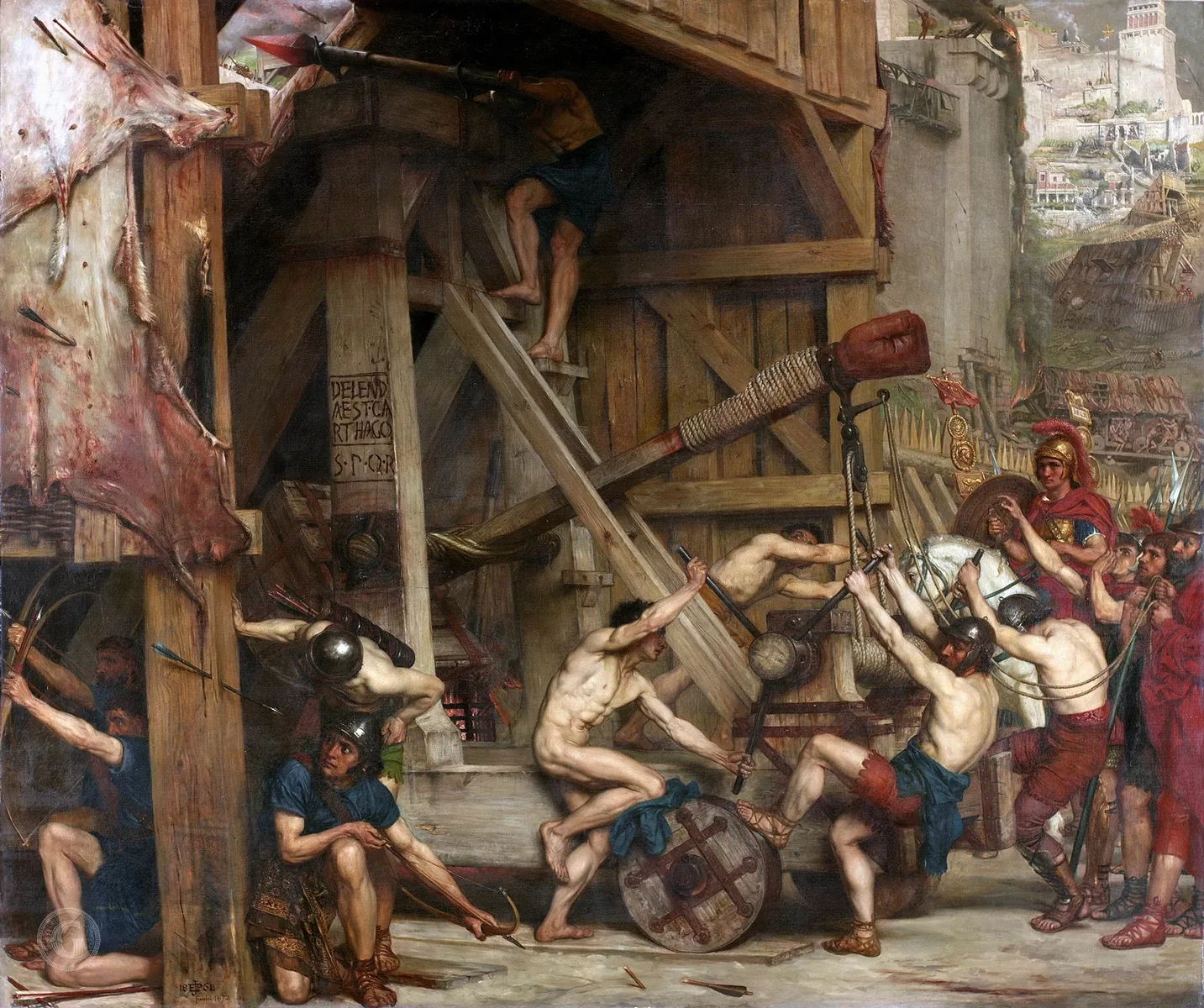
Edward John Poynter, The Catapult, 1868. Laing Art Gallery, Newcastle upon Tyne · Public domain · Source page
The consuls Manilius and Censorinus expected an easy job: an unarmed city. They found a fortress. On the landward side a triple wall crossed the isthmus, the neck of land joining Carthage to Africa; Appian says each wall was 45 feet high. When Censorinus’s rams smashed a breach, the Romans poured in and were thrown back by men with stones and clubs. One young officer kept his men in order and covered the retreat: Scipio Aemilianus, then a military tribune.
Fever swept the Roman camp. Hasdrubal’s army held the fortress of Nepheris across the gulf and beat off a Roman attack. In 149 Cato died in Rome; in 148 Masinissa died too. Inside Carthage, Hasdrubal, the boetharch, took command and had his rival beaten to death with benches in the council.
147 BC
The people’s choice
By early 147 BC the Roman people were angry and impatient. Soldiers’ letters home praised the young officer who had saved men at the breach and at Nepheris. Scipio was standing for a junior office, and at about 37 he was too young to be consul. The people elected him consul anyway, and gave him Africa as his command. The Senate gave way.
He arrived in time to rescue a Roman force trapped inside a neglected stretch of the walls above the sea cliffs. Then he turned on his own army, sent away the traders and hangers-on, and restored discipline.
Hasdrubal, the boetharch
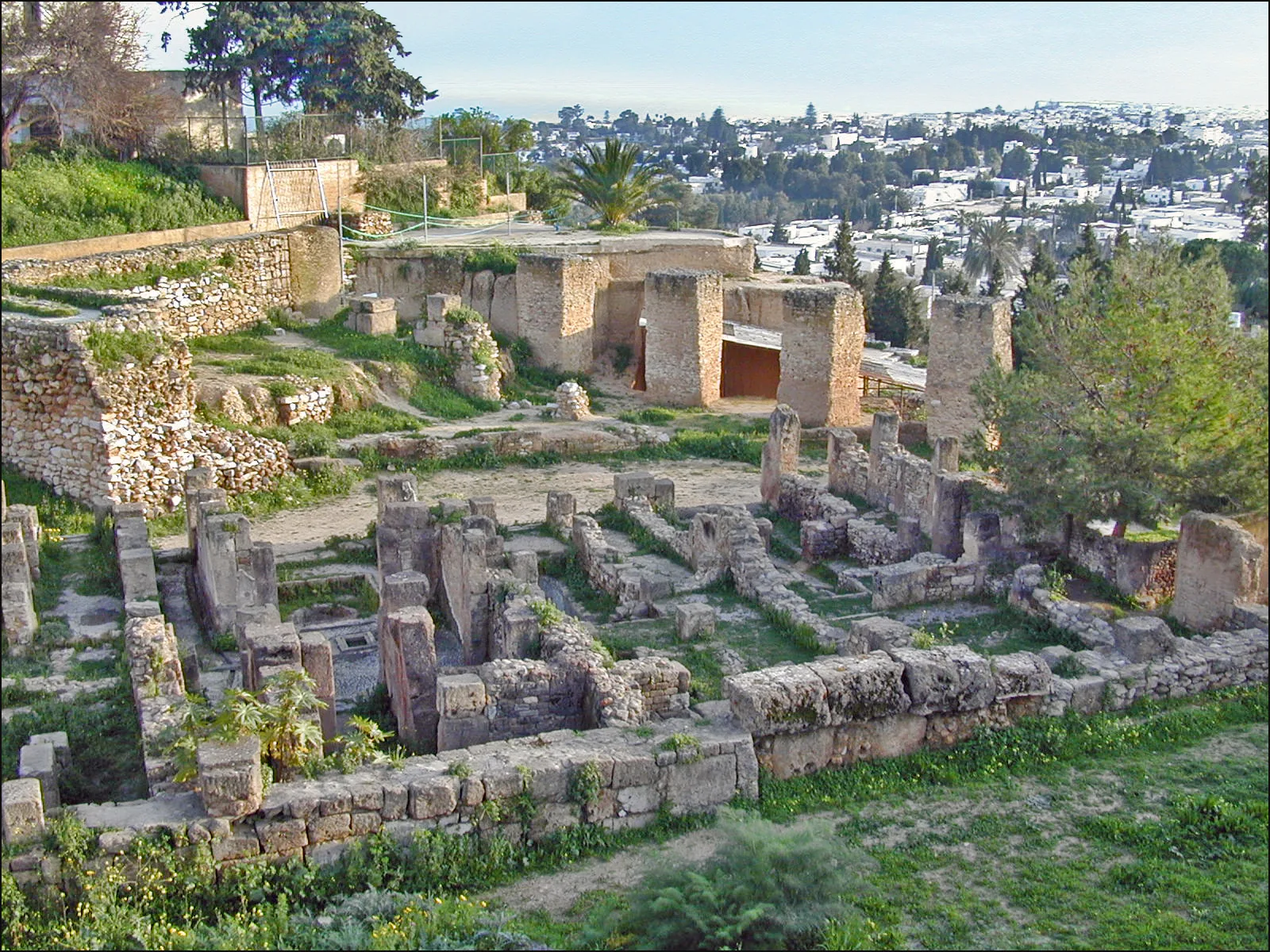
Punic houses and Roman foundation piers on the Byrsa hill, Carthage, 2003. Photo: Jean-Pierre Dalbéra · CC BY 2.0 · Source page
The general who defended Carthage to the last day, and then begged for his life.
- Born: unknown, probably Carthage
- Died: after 146 BC, unknown, Scipio spared his life; no reliable source tells his end
- Won: Nepheris, 149 BC: beat off the consul Manilius
- Lost: Against Masinissa, 150 BC: his army starved and destroyed; Carthage, 146 BC
“…the day would never come on which Hasdrubal would look at the same time on the sun and on his city being consumed by fire.”
A decision point
You are Scipio Aemilianus, consul.
Before Carthage, spring 147 BC
For two years Roman armies have thrown themselves at Carthage and failed. The triple land wall is too strong to storm. Yet the city still eats: food slips in by sea past your ships, and by land from the countryside, where Hasdrubal’s allies still hold Nepheris.
You have one year in command. If you fail, another consul will take the army, and the glory. Hasdrubal has hinted, through the Numidian prince Gulussa, that he might talk.
How do you take Carthage?
- Storm the land wall at once, with everything you have If it works, the war ends this year, under your command. But the same wall has beaten two consuls, and a bloody failure would end your command and your name.
- Seal the city off by land and sea, and starve it Slow but sure: a city this size cannot feed itself for long. But it means huge works under fire, and months you may not have.
- Offer Hasdrubal terms for surrender It might save many lives and end the war quickly. But the people of Carthage would have to agree, and the Senate wants the city destroyed, not spared.
What really happened
Seal the city off by land and sea, and starve it
Scipio chose to starve the city, while keeping a private offer open to Hasdrubal: his life, his family’s, and ten talents of his fortune. Hasdrubal refused. In twenty days and nights Scipio’s men dug and walled a line across the whole isthmus, cutting the land route. Then Scipio turned to the sea and began a stone mole to block the way into the harbours.
Polybius, who was with Scipio, shows a careful general, not a gambler; remember that he admired him. Most modern historians agree that the blockade, more than courage at the walls, decided the siege.
The siege of Carthage: who fought whom
149–146 BC
Carthage, on the coast of today’s Tunisia
Rome
- Commanders: Manius Manilius and Lucius Marcius Censorinus, consuls, 149 BC, Lucius Calpurnius Piso, 148 BC, Scipio Aemilianus, with Gaius Laelius, 147–146 BC
- Strength: 80,000 foot and about 4,000 horse; 50 quinqueremes and 100 smaller warships (149 BC) (Appian); probably far fewer: two consular armies, four legions with their allies, perhaps 40,000–50,000 (Modern reckoning)
- Losses: no total recorded (Ancient sources)
Carthage
- Commanders: Hasdrubal the boetharch, Hasdrubal, Masinissa’s grandson, commander in the city until 148 BC
- Strength: 700,000 people in the city (Strabo (c. AD 20)); a few hundred thousand at most (Modern estimates); a field army of 20,000, later 30,000, under Hasdrubal (Appian); arms handed over in 149 BC: over 200,000 suits of mail, 2,000 catapults (Polybius)
- Losses: 50,000 men and women came out of the Byrsa and surrendered (Appian); 25,000 women and 30,000 men surrendered (Orosius (5th c. AD)); 36,000 men surrendered (Florus (2nd c. AD))
No Carthaginian figures survive. Those who surrendered were sold as slaves; the number of dead is unknown.
Outcome: Carthage was taken by storm in spring 146 BC and destroyed. Its land became the Roman province of Africa.
Appian wrote nearly 300 years later, and his figures are often inflated; Strabo’s 700,000 is far more than the city could hold. Only Polybius’s list of weapons comes from a writer of the time.
The siege of Carthage
149–146 BC
149–146 BC. Two Roman consuls try to take Carthage, whose triple wall crosses the isthmus. The city can still get food by sea and from the countryside, and Hasdrubal's army holds Nepheris. At stake: the fate of the city.
One reconstruction, after Appian, Punica 95–131, who follows the eyewitness Polybius. The harbours follow H. R. Hurst’s excavations (1994) and the city S. Lancel (1995). The coast and the Sebkha Ariana are today’s; the lake shore south of the city is drawn further east than today, as it probably was, since Appian describes only a narrow tongue of land between lake and sea.
Uncertain: the line of the triple land wall and of Scipio’s siege lines (drawn here across the narrowest dry ground, about 5 km west of the Byrsa; others draw them closer to the city); where the mole began and where the new channel was cut; the site of the agora. Appian’s compass directions do not fit the ground. Units are not to scale.
Phases of the battle
- 149 BC: the consuls fail Manilius attacks the triple wall across the isthmus, Censorinus the weak angle by the lake. He breaks through, but the Romans who rush in are thrown back; Scipio, a military tribune, covers their retreat. Carthaginian fire-ships nearly destroy the Roman fleet. Hasdrubal’s army waits at Nepheris, some 25–30 km away.
- Spring–summer 147: the isthmus closed Scipio first rescues a Roman force trapped inside the walls, then raids Megara by night and pulls back. In twenty days and nights his army digs trenches across the isthmus, about 4.5 km, with a wall and a watchtower facing the city. No food can now come in by land.
- Summer 147: the mole and the new channel To stop ships slipping in, Scipio builds a stone mole from the tongue of land towards the harbour mouth. In secret, the Carthaginians dig a new channel from the naval harbour straight out to sea and build ships from old timber. One dawn, about fifty triremes sail out.
- Autumn 147: the quay taken After a sea battle that lasts until evening, the Carthaginian ships crowd back towards the quay outside the city wall. Scipio attacks the quay; Carthaginians swim across by night, naked, to burn his siege engines. In the end he takes it, walls it and puts 4,000 men on it. In winter Nepheris falls too.
- Spring 146: six days to the Byrsa Hasdrubal sets fire to the merchant harbour. Laelius scales the naval harbour wall, and Scipio takes the agora beside it. Up three streets of six-storey houses the Romans fight from roof to roof for six days and nights. On the seventh day, 50,000 people come out of the Byrsa and surrender.
The strategy
- Romans: The consuls first tried to storm the wall and break it open quickly. When that assault was beaten back, Scipio means to cut the city's supply from both sides: trenches across the isthmus to stop food by land, and a stone mole to block the harbour mouth, before taking the quay and the harbours.
- Carthaginians: The Carthaginians send fire-ships against the Roman fleet. In secret a new channel is dug from the naval harbour to the open sea, and ships are built from old timber to break out. Food keeps coming from the countryside while Hasdrubal's allies hold Nepheris.
What decided it: Scipio won first by cutting supply: the trench across the isthmus stopped food by land, the mole and the taken quay stopped ships by sea, and Nepheris fell in winter. Only then did six days of house-to-house fighting end in the surrender of the Byrsa.
A decision point
You are Hasdrubal, commander of Carthage.
The temple of Eshmun on the Byrsa, spring 146 BC, the seventh day
For six days the Romans have fought their way up the three streets from the harbours to the citadel, house by house. This morning Scipio agreed to spare everyone who left the Byrsa, except deserters, and about 50,000 men and women walked out.
You are left in the temple with your wife, your two young sons and about 900 Roman deserters, who know Scipio will show them no mercy. You have sworn, many times, that you would never see the sun shine on Carthage in flames. A year ago Scipio offered you your life.
What do you do?
- Keep your vow: stay in the temple to the end You die as you promised, and your name becomes a story of defiance. Your wife and children die with you.
- Slip out alone and surrender to Scipio You will probably live. But you abandon your family and the men who fought beside you, and your enemies will tell the story.
- Go out and try to bargain for your family and the deserters Scipio has already refused mercy to deserters; at most you might save your wife and sons. And once you are outside, the deserters may not wait for your bargain.
What really happened
Slip out alone and surrender to Scipio
Hasdrubal slipped out secretly with an olive branch and threw himself at Scipio’s feet. Scipio spared him and showed him to the deserters, who heaped reproaches on him and set the temple on fire around themselves. Appian says Hasdrubal’s wife appeared above the flames in her finest clothes, cursed her husband as a traitor, killed her two sons, threw them into the fire and followed them.
We cannot know what Hasdrubal thought: no Carthaginian told his story. Polybius, who was there, despised him as a boaster who held feasts while his people starved. Even the wife’s name is lost.
How do we know?
Source: What the Greeks said
“There were some who approved the action of the Romans, saying that they had taken wise and statesmanlike measures in defence of their empire.”
[Others said:] “…This, they said, savoured more of a despot’s intrigue than of the principles of a civilized state such as Rome, and could only be justly described as something very like impiety and treachery.”
Polybius, writing after 146 BC, reports four views he heard in Greece about Rome’s treatment of Carthage: two for Rome, two against. The critics complained that Rome had made its demands ‘one at a time’, keeping the rest secret. He does not say which view he holds.
- Polybius was Scipio’s friend and had lived in Rome for years. Why might he put the criticism in other people’s mouths? It let him record what Greeks really said without attacking his patrons himself. Quoting ‘others’ is safer than speaking for yourself.
- The last view in his list says Rome broke no law, because Carthage had surrendered to Rome’s good faith. Why might the order of the views matter? The last word often carries weight: it may hint at Polybius’s own view, while still letting the critics speak.
- Which arguments are about power, which about morals, and which about law? ‘Wise and statesmanlike measures’ is about power and safety; ‘impiety and treachery’ is about morals; the defence that Carthage had surrendered is about law.
Source: Tears over Carthage
“Scipio, beholding this spectacle, is said to have shed tears and publicly lamented the fortune of the enemy.” (Appian)
“Turning round to me at once and grasping my hand Scipio said, ‘A glorious moment, Polybius; but I have a dread foreboding that some day the same doom will be pronounced on my own country.’” (Polybius)
In Appian, Scipio also quotes Homer’s Iliad: ‘The day shall come in which our sacred Troy… shall perish all.’ Appian wrote about 290 years later, but says Polybius ‘wrote this down just as he heard it’.
- Polybius saw this himself. Does that make the scene certain? It makes it likely that Scipio said something like this. But Polybius was his friend and teacher, and the scene shows Scipio as wise and humane in victory, just as Polybius wanted him remembered.
- For whom does Scipio weep? Partly for Carthage, but in both versions mostly for Rome: he fears that every empire, his own included, will fall one day. It is a reflection on Fortune, a favourite Greek theme, more than pity for the people being enslaved below him.
- The two versions differ. Which is likely closer to what was said, and why? Probably the Polybius fragment, by the man who heard it. But Appian’s longer version, with its list of fallen empires, probably comes from Polybius too, polished in the retelling; we cannot tell where one ends and the other begins.
Source: Children of Carthage
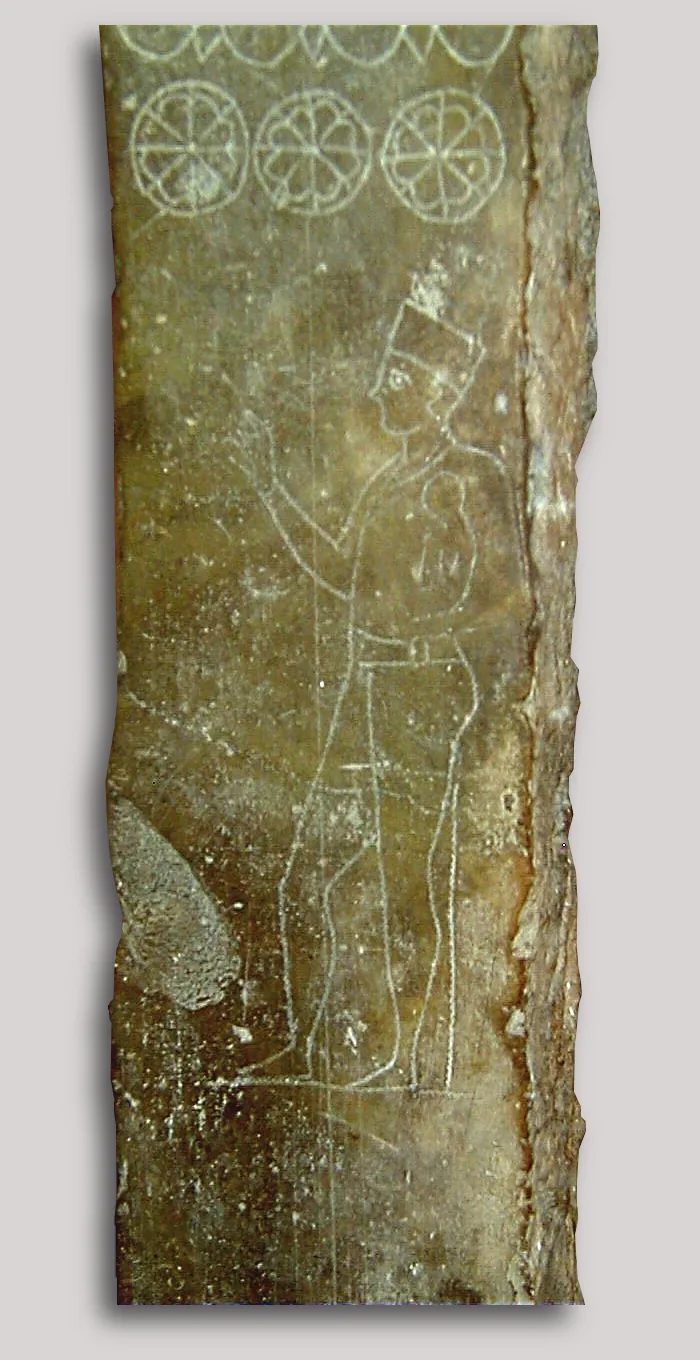
Stele of the ‘priest with a child’, from the tophet of Carthage, 4th–3rd century BC. Bardo National Museum, Tunis. Photo: Pascal Radigue · CC BY-SA 3.0 · Source page
Stele from the tophet of Carthage, 4th–3rd century BC. Bardo National Museum, Tunis
Greek and Roman writers said the Carthaginians sacrificed children to their gods. Diodorus, a Greek writing around 30 BC, tells that during a crisis in 310 BC the city burned 200 children of noble families before a bronze statue. Near the harbours, archaeologists found the tophet: thousands of urns holding the burnt bones of babies and young animals, buried under stones like this one, from the 8th century BC until 146 BC.
- Who tells us about child sacrifice, and when? Only outsiders: Greek, Roman and later Christian writers, many hostile to Carthage. No Carthaginian text describes it. That does not make it false, but it must be tested against other evidence.
- The carving shows a man holding a child. What could it mean? A priest with a child about to be offered, a father presenting a child to the gods, or a prayer for a child. The picture alone cannot decide; scholars tend to read it according to what they already think the tophet was.
- What can the bones show that texts and pictures cannot? How old the children were. One team (2010) found that many were stillborn or died around birth, as in a cemetery; another (2011) argued that many lived for weeks, which fits sacrifice. Many scholars now think sacrifice did happen, at least sometimes; the question is not settled.
After Carthage
146 BC
Ashes and a curse
146 BC
For days the soldiers plundered the city. Scipio invited the cities of Sicily to take back the statues Carthage had carried off generations before. The survivors were sold as slaves. Later writers say the fire burned for seventeen days.
Ten senators arrived with the Senate’s orders: whatever still stood was to be destroyed, no one was to live there, and anyone who rebuilt the Byrsa or Megara was cursed. Carthage’s land became the province of Africa, governed from Utica. That same year another Roman army destroyed the great Greek city of Corinth. Scipio came home to a triumph and took the name his adoptive grandfather had earned at Zama: Africanus.
Myth
After destroying Carthage, the Romans ploughed it over and sowed the ground with salt, so that nothing would ever grow there again.
The truth
No ancient writer mentions salt. Appian lists what the Senate decreed: the ruins levelled, nobody to live there, curses on anyone who rebuilt, ‘but it was not forbidden to go upon the ground’. Salt was precious, and no army could salt a whole territory. The story first appears in books of the 1800s, perhaps borrowed from the Bible, where Abimelech sows the city of Shechem with salt (Judges 9:45). And the land was not dead: within 25 years Rome sent colonists to farm it.
The evidence
Appian, Punica 135; Cicero, On the Agrarian Law 1.5 and 2.51. R. T. Ridley, ‘To Be Taken with a Pinch of Salt’, Classical Philology 81 (1986).
After the fire
- 146 BC Africa becomes a Roman province; Masinissa’s sons keep Numidia next door.
- 133 BC Scipio destroys Numantia in Spain. In Rome his brother-in-law, the tribune Tiberius Gracchus, is killed in a riot.
- 129 BC Scipio is found dead in his bed. Rumours of murder are never proved.
- 122 BC Gaius Gracchus founds a colony, Junonia, on Carthage’s land. It soon fails.
- 112–105 BC War with Jugurtha, Masinissa’s grandson. A new general, Gaius Marius, makes his name: the next lesson.
- c. 40 BC The historian Sallust argues that once Carthage was gone, Rome lost the fear that had kept it united, and fell into greed and civil war.
- 29 BC Octavian, soon to be called Augustus, carries out Julius Caesar’s plan and founds a Roman colony on the site. Roman Carthage becomes one of the greatest cities of the western empire.
- AD 439 and 698 The Vandals make Carthage their capital; in 698 it falls to the Arabs, and nearby Tunis grows in its place.
- AD 1985 The mayors of Rome and Carthage sign a symbolic peace treaty.
Why did Rome destroy Carthage?
Carthage had lost its fleet and its empire fifty years before. Why did Rome go to such lengths to wipe it out?
- A. E. Astin, Scipio Aemilianus (1967) and Cato the Censor (1978); A. M. Eckstein, Mediterranean Anarchy (2006) Real fear. Carthage was rich again, its war harbour rebuilt, its stores of arms enormous, and Masinissa was nearly ninety: a Numidian king holding Carthage could be worse than Carthage itself. Cato’s report from the city expressed real alarm, not only rhetoric. Eckstein adds that in a world without law between states, every power struck at possible rivals before they grew strong. Rome was harsh, but not unusual.
- W. V. Harris, War and Imperialism in Republican Rome, 327–70 B.C. (1979) No real threat. A city with ten warships and no allies could not endanger Rome. Roman nobles needed wars: for glory, triumphs, plunder and slaves, and for the careers they built on them. The fear was a pretext. Polybius himself says Rome had decided long before and was only looking for an excuse.
- Ben Kiernan, ‘The First Genocide: Carthage, 146 BC’ (2004) A planned annihilation. The secret orders to raze the city, the demand to abandon it and the destruction of 146 show an intent to destroy a people, which Kiernan calls the first genocide. His critics answer that the 50,000 survivors were enslaved, not killed, and that Censorinus’s words, ‘we consider you to be Carthage’, show the target was the city as a power, not its people.
Was Carthage destroyed as a calculated act of security, out of the ordinary greed of an ancient empire, or as something worse? The Greeks Polybius quotes were already arguing about it in 146 BC.
What do you know now?
Check yourself
In 191 BC Carthage offered to pay off its whole war debt to Rome at once. What happened?
Answer: Rome refused and kept the yearly payments. Right. Livy says the Senate would take no money before it fell due, so the payments ran on for fifty years.
Check yourself
Why did Carthage’s war against Masinissa in 150 BC matter so much?
Answer: The peace of 201 forbade Carthage to make war without Rome’s permission, so Rome had its pretext. Right. Polybius says Rome had long been looking for a pretext ‘that would appeal to foreign nations’. A broken treaty was one.
Check yourself
What was Rome’s third and last demand at Utica in 149 BC?
Answer: Abandon the city and settle at least ten miles from the sea. Right. Censorinus said Rome was ‘resolved to raze your city to the ground’. Carthage refused and prepared to fight.
Check yourself
How did Scipio finally take Carthage?
Answer: He cut it off by land and sea, then stormed the harbours and fought up to the Byrsa. Right. The line across the isthmus, the mole and the capture of the quay starved the city; the assault of spring 146 came through the harbours.
Check yourself
Which statement about the salt is true?
Answer: No ancient writer says the Romans sowed salt; the story appears in the 1800s. Right. Appian describes the curse on rebuilding but no salt, and Rome sent colonists to farm the land within 25 years.
Check yourself
Scipio wept as Carthage burned. According to Polybius, what did he fear?
Answer: That one day the same fate would fall on Rome. Right. ‘Some day the same doom will be pronounced on my own country.’ He was thinking about the rise and fall of empires.
Terms
- Punic The Roman word for Carthaginian, from Poeni, ‘Phoenicians’. Carthage was founded by settlers from Tyre, in today’s Lebanon, and its people spoke Punic, a language close to Hebrew.
- Byrsa The citadel hill of Carthage, about a kilometre from the harbours. The temple of Eshmun, a god of healing, stood on its top.
- cothon A harbour dug out of the land. At Carthage, the round naval harbour, reached only through the merchant harbour, with sheds for warships round its rim and on its central island.
- mole A dam of heavy stones built out into the sea. Scipio’s mole was meant to block the way into Carthage’s harbours.
- deditio in fidem Surrender ‘into the good faith’ of Rome. A people handed over its land, cities, temples and tombs, and Rome then decided what to give back. Legally, nothing was left to bargain with.
- boetharch The Greek title Appian gives Hasdrubal: ‘commander of the auxiliaries’. The Punic title behind it is unknown.
- tophet The biblical name archaeologists gave to a sacred enclosure at Carthage. From the 8th century BC to 146 BC, urns of burnt bones of babies and young animals were buried there under stone markers.
- province A territory outside Italy ruled by a Roman governor and paying tax to Rome. Africa became one in 146 BC.
- metus Punicus Latin for ‘fear of Carthage’: the idea that a strong rival kept Rome disciplined and united. Plutarch says Scipio Nasica argued it in the 150s BC; the historian Sallust made it famous a century later.
- consul One of the two magistrates elected each year to lead Rome’s government and armies. The law set a minimum age of about 42 for candidates.
- military tribune One of six senior officers in each Roman legion, often a young man of a noble family at the start of his career.
- triumph A victory parade through Rome, granted by the Senate to a winning general, with his captives and booty carried before him.
- Polybius A Greek politician and historian, taken to Rome as a hostage, later the tutor and friend of Scipio. He wrote for Greek readers.
- Scipio Aemilianus The Roman general who destroyed Carthage in 146 BC. Polybius was his tutor and close friend.
- Scipio Nasica A Roman politician who argued that a rival Carthage would keep Rome disciplined.
- Masinissa King of the Numidians, who fought for Rome at Zama and claimed Carthaginian land.
- Numidians Peoples and kingdoms of North Africa, neighbours of Carthage.
- Cato An elderly Roman senator who kept demanding that Carthage be destroyed.
- Censorinus A Roman consul. He gave Carthage's envoys the final order: yield the city and let it be razed.
- Manilius A Roman consul who led the army against Carthage together with Censorinus.
- Hasdrubal A Carthaginian general. He led the defence during the siege and in the end surrendered to Scipio.
- Appian A Greek historian from Alexandria who wrote about 290 years after the war and followed Polybius closely.
- Plutarch A Greek historian and biographer, who wrote lives of famous Greek and Roman men.
- Diodorus A Greek writer, around 30 BC, who told of children burned in Carthage.
- Homer An ancient Greek poet, author of the Iliad, a poem about the war of Troy.
- Suda A Byzantine dictionary that kept entries from older Greek writers, Polybius among them.
- Utica A city by the sea next to Carthage. During the war it offered Rome its harbour.
- Nepheris A Carthaginian fortress across the gulf, where Hasdrubal's army held out against Rome.
- Zama A battle site in North Africa, where Rome won. The peace of 201 BC followed.
- Corinth A great Greek city, destroyed by a Roman army in the same year as Carthage.
- Abimelech A figure in the Bible who, according to the story, sowed salt over the city of Shechem.
- Augustus The first Roman emperor. In his time the new Roman city of Carthage was laid out.
- Senate A council of Roman nobles and politicians that set the city's policy.
- Ceterum censeo A Latin sentence attributed to Cato, meaning roughly: besides this, Carthage must be destroyed. Its familiar wording was shaped by modern writers.
- Serge Lancel A French archaeologist who dug in Carthage from 1974, finding traces of the destruction of 146 BC.
Sources
- Appian, Punica (The Punic Wars) 67–136, trans. H. White, The Roman History of Appian of Alexandria (London: Macmillan, 1899)
- Polybius, Histories 31.21, 36.1–16, 38.7–8 and 38.19–22, trans. W. R. Paton, Polybius vol. VI (Loeb Classical Library, 1927)
- Plutarch, Life of Cato the Elder 26–27, trans. B. Perrin, Plutarch’s Lives vol. II (Loeb Classical Library, 1914)
- Pliny the Elder, Natural History 15.74–76, trans. J. Bostock and H. T. Riley (London: Bohn, 1855)
- Livy 36.4 and Periochae 47–51; Florus, Epitome 1.31–32; Orosius, Histories against the Pagans 4.22–23; Strabo, Geography 17.3.14–15; Diodorus Siculus 20.14; Sallust, Catiline 10 and Jugurtha 41; Cicero, On the Agrarian Law 1.5, 2.51
- A. E. Astin, Scipio Aemilianus (Oxford: Clarendon Press, 1967)
- A. E. Astin, Cato the Censor (Oxford: Clarendon Press, 1978)
- W. V. Harris, War and Imperialism in Republican Rome, 327–70 B.C. (Oxford: Clarendon Press, 1979)
- Serge Lancel, Carthage: A History, trans. A. Nevill (Oxford: Blackwell, 1995)
- Adrian Goldsworthy, The Punic Wars (London: Cassell, 2000)
- Richard Miles, Carthage Must Be Destroyed: The Rise and Fall of an Ancient Civilization (London: Allen Lane, 2010)
- Dexter Hoyos, Mastering the West: Rome and Carthage at War (Oxford: Oxford University Press, 2015)
- H. R. Hurst, Excavations at Carthage: The British Mission, vol. II.1, The Circular Harbour, North Side (Oxford: Oxford University Press for the British Academy, 1994)
- A. M. Eckstein, Mediterranean Anarchy, Interstate War, and the Rise of Rome (Berkeley: University of California Press, 2006)
- Ben Kiernan, ‘The First Genocide: Carthage, 146 BC’, Diogenes 51.3 (2004), 27–39
- R. T. Ridley, ‘To Be Taken with a Pinch of Salt: The Destruction of Carthage’, Classical Philology 81 (1986), 140–146
- C. E. Little, ‘The Authenticity and Form of Cato’s Saying “Carthago Delenda Est”’, Classical Journal 29 (1934), 429–435
- J. H. Schwartz, F. Houghton, R. Macchiarelli and L. Bondioli, ‘Skeletal Remains from Punic Carthage Do Not Support Systematic Sacrifice of Infants’, PLoS ONE 5.2 (2010), e9177
- P. Smith, G. Avishai, J. A. Greene and L. E. Stager, ‘Aging cremated infants: the problem of sacrifice at the tophet of Carthage’, Antiquity 85 (2011), 859–874
Image credits
- The Punic ports at Salammbô, Carthage, Tunisia, 2010. Photo: Citizen59 · CC BY 3.0 · Source page
- Bronze statue of a ruler, the ‘Terme Ruler’ (detail), 2nd century BC. Palazzo Massimo alle Terme, National Roman Museum, Rome. Photo: Prof. Mortel · CC BY 2.0 · Source page
- Portrait of a man, the so-called ‘Old Man of Otricoli’, c. 50 BC, on a modern bust. Torlonia Collection, Rome. Photo: Sailko · CC BY 3.0 · Source page
- Edward John Poynter, The Catapult, 1868. Laing Art Gallery, Newcastle upon Tyne · Public domain · Source page
- Punic houses and Roman foundation piers on the Byrsa hill, Carthage, 2003. Photo: Jean-Pierre Dalbéra · CC BY 2.0 · Source page
- Stele of the ‘priest with a child’, from the tophet of Carthage, 4th–3rd century BC. Bardo National Museum, Tunis. Photo: Pascal Radigue · CC BY-SA 3.0 · Source page


