Canossa: the emperor and the pope, 1077
January 1077: the excommunicated king of Germany waits three days, barefoot, before the gates of a fortress in Italy for the pope to open them.
Decisions, questions and your own progress, in the app
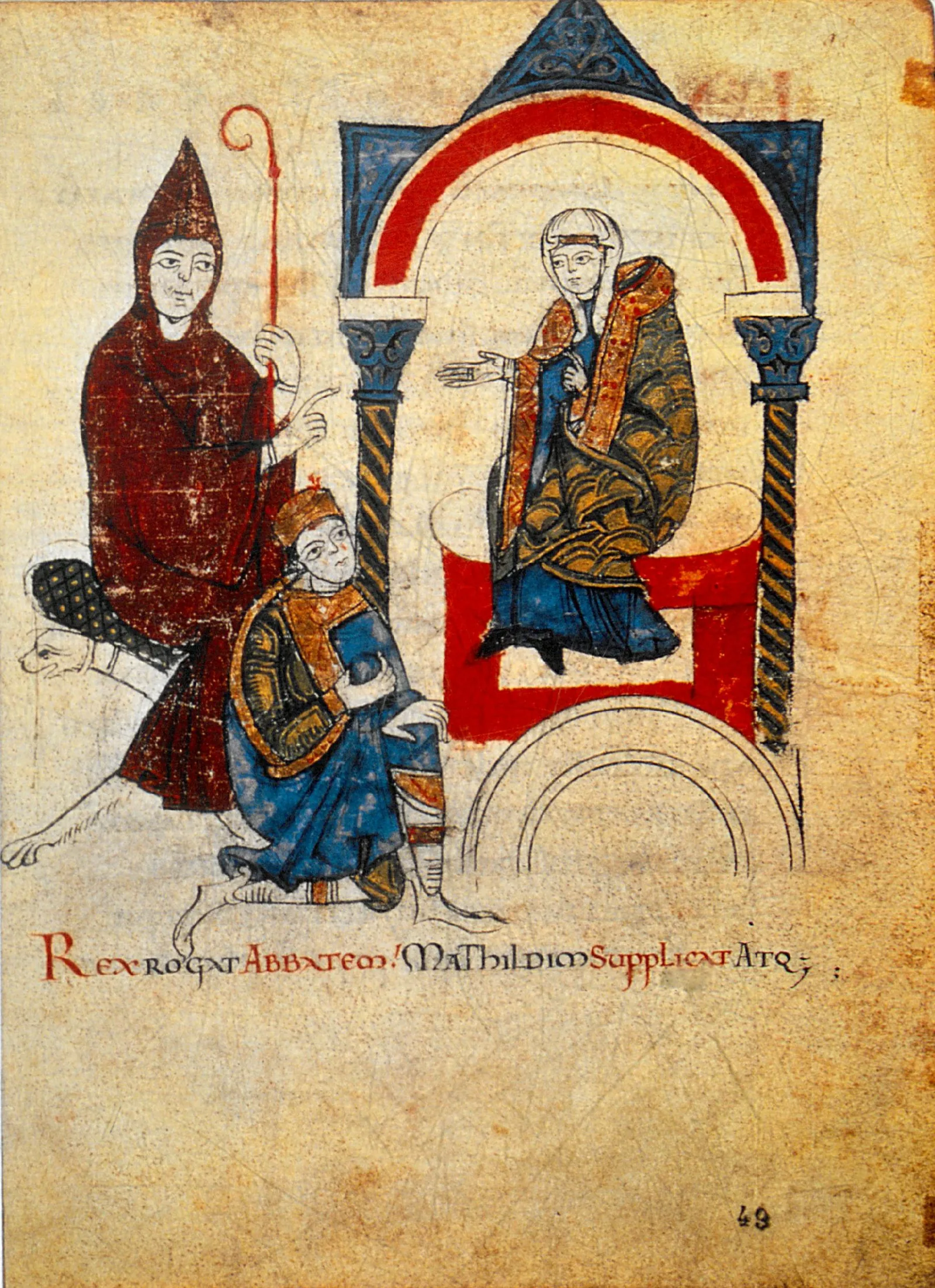
Donizo, miniature in the Vita Mathildis, c. 1115. Vatican Library, Ms. Vat. lat. 4922, fol. 49v · Public domain · Source page
A king outside the gate
A king outside the gate
January 1077. In a castle on a hill in the Apennines, in northern Italy, the king of Germany stands outside the gate. He is alone, without his crown, barefoot and dressed in wool, and he asks the pope for forgiveness.
The pope is on the other side of the wall. The Church has put the king outside its community, which makes him excommunicated: he may not receive the sacraments, and his soul is in danger. To many people he is no longer a king.
What had a powerful king done to end up here, and what did the pope do when he stood before him? This is the story of Canossa.
Henry IV
A king made king as a child, who fought the Saxons and the pope, stood at the gate of Canossa, and in the end was forced to give up his crown to his son.
- Born: 11 November 1050, Probably Goslar, Saxony
- Died: 7 August 1106, Liège, Lower Lorraine, Died aged 55, after his son Henry V's revolt had forced him from the throne. Buried at Speyer.
- Won: Homburg on the Unstrut, 1075; Rome, 1084
- Lost: Gregory’s second excommunication, March 1080; His son’s revolt, 1105: forced to abdicate
“Henry, king not through usurpation but through the holy ordination of God, to Hildebrand, at present not pope but false monk.”
Background
A king aged five
1056
Henry was born on 11 November 1050, probably at Goslar in Saxony, son of the emperor Henry III and of Agnes of Poitou. As a small child he was elected king of Germany at Tribur. On 17 July 1054, at about three, he was crowned at Aachen. A king of that age is still a child, and power lies with others.
On 5 October 1056 his father died; Henry was five. His mother Agnes ruled in his name as regent, and much of the power passed to bishops and princes. In 1062 Archbishop Anno of Cologne took the boy from his mother in the coup at Kaiserswerth, and for years the Church’s men educated and advised him.
On 29 March 1065, aged 14, he was declared of age at Worms: he was girded with a sword, the sign that he governed in his own right. From then on he was answerable for what was done in his name.
Reform, Saxons and the ring
Background: Saxony
Anger in Saxony
9 June 1075
In the 1070s Henry did not have an army that could be sent quickly everywhere. In Saxony, among the hills and forests, anger grew at the king’s demands, at the castles he built and at the taxes he raised, and in 1073 a revolt broke out.
On 2 February 1074 the Treaty of Gerstungen was signed to restore peace, but it did not hold for long. On 9 June 1075 the armies met at Homburg on the river Unstrut, and the king of Germany won. The death tolls in the chronicles differ widely, so we cannot know the exact cost.
The victory strengthened Henry, but it left him with a second war, already starting in Rome.
The reform
A cleaner Church
In the eleventh century many churchmen lived like rich lords. Three things worried the reformers. The first was simony: buying or selling a church office as if it were property. The second was marriage among priests, which the reformers condemned. The third was the lay investiture of church offices by secular rulers.
Many reformers saw investiture as the root of the trouble. The ceremony went like this: the ruler gave a bishop the ring and the staff, the signs of spiritual office, and often also the lands and rights that went with the post. Whoever chooses the bishop, the reformers asked, is the one who really shapes the Church.
Gregory VII
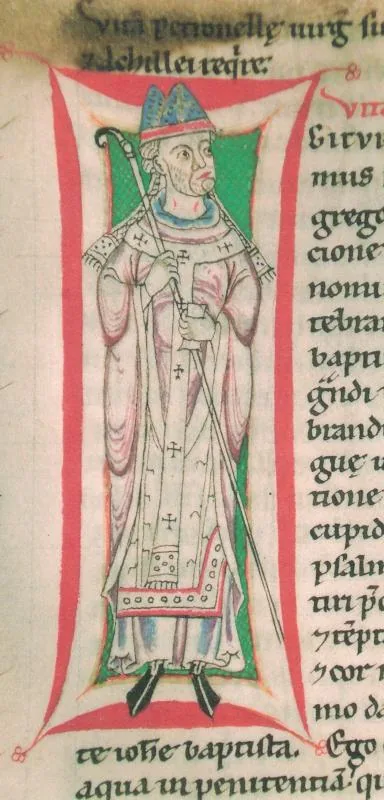
Paul of Bernried, Vita Gregorii VII, first half of the 12th century. Heiligenkreuz Abbey Library, Cod. 12, fol. 181v · Public domain · Source page
A monk of Rome who had served popes for decades, elected pope in 1073, who demanded that the Church be free of secular rulers.
- Born: c. 1015–1025, Probably Soana (Sovana), in Tuscany; sources differ
- Died: 25 May 1085, Salerno, southern Italy, Died in exile at Salerno, under the protection of the Normans who had taken him out of Rome.
- Won: The reform synods of 1075 and 1076 in Rome
- Lost: Forced to leave Rome in 1084
“we are not otherwise bound to the king save that, by word alone as is our custom, we have said that he might have hopes from us”
Milan
Who appoints the archbishop of Milan?
Milan was the largest city of northern Italy, and its Church was split. Townspeople, craftsmen and young priests, known as Patarines, demanded that the city be cleaned of married priests and simony. A split opened between the city and its own archbishop.
In 1075 Henry named Tedald archbishop of Milan, ignoring the candidate the pope supported. Gregory forbade the bishops who were to consecrate Tedald to do so, and summoned Tedald to Rome to explain his appointment.
In December 1075 Gregory also sent Henry a sharp letter warning that he would not receive the favour of God or of the apostolic blessing unless he changed course. The letter came before Worms.
Source: The 27 claims about the pope’s power
A short summary, not a word-for-word quotation: 1. The Roman Church was founded by God alone. 12. The pope may depose emperors. 19. No one may judge the pope. 27. He may release the subjects of unjust rulers from their fealty.
The list is in Gregory VII’s register, under the year 1075. It is not a public proclamation, but a private list of statements.
Written in the register, not issued as a decree. Some historians think Gregory dictated it himself; others think it was added to the register later, perhaps drawing on Cardinal Deusdedit’s collection of canons (1087), which some scholars find similar.
- Who wrote the list, and who saw it? We do not know for certain. It was never published, and it sits in the pope’s private register. It was not a document the princes read in public.
- Which claim would most anger an emperor? Number 12, that the pope may depose emperors, and number 27, that he can release subjects from their oaths. Both strike directly at a king’s authority.
- What is missing from the list? It says nothing about education, poverty or Christendom’s enemies abroad. It is about power alone. Read it as a programme, not as a description of what happened in 1075.
Worms, January 1076
A decision point
You are Henry IV, king of Germany, aged 25.
January 1076, Worms on the Rhine
In your hands is a letter that reached you from Rome in December 1075. Gregory VII has warned that you will not receive the blessing of God or of the apostolic see unless you change your course, especially at Milan and over the appointment of bishops. You know that he holds the greatest spiritual authority in the Christian world.
Your bishops in Germany are as angry with him as you are. Some see him as a man who humiliates the German Church. They are ready to gather with you at Worms, and they expect you to decide what to do.
But Gregory has not yet pronounced any sentence against you. He still asks to talk with Henry.
What do you do?
- Depose Gregory at Worms and declare that he is no longer pope. A bold move that could turn the crisis into a war between rival popes. Some bishops would follow you, others would see you as a usurper, and the Romans would not give up. The dispute would probably last for years.
- Send envoys to Rome to negotiate, and promise to accept Gregory’s ruling on Milan. The crisis would probably reopen within months. Gregory would ask for more, and the German bishops who wanted a strong king would feel betrayed. A reasonable step that buys time, but leaves the question of appointments open.
- March on Rome with an army and force the pope to crown you and drop the Milan dispute. Force might succeed, but it would take months, and the Romans and the Normans of southern Italy could not be relied upon. An army in Italy in 1076 would leave Saxony and Swabia, where resistance was already strong, exposed.
What really happened
Depose Gregory at Worms and declare that he is no longer pope.
Henry met German bishops at Worms in January 1076. Many of them broke with Gregory, and on 24 January Henry sent him a letter calling him a “false monk”. Henry did not stay in the middle ground.
Henry wanted to stop the pope from meddling in church affairs that he regarded as his to govern. The bishops stood with him, and as a king who felt insulted he did not want to be seen taking orders. Historians debate how hard the bishops pushed him, but the decision was his.
Source: Henry’s letter to Gregory
“Henry, king not through usurpation but through the holy ordination of God, to Hildebrand, at present not pope but false monk.”
“Such greeting as this hast thou merited through thy disturbances ... thou hast trodden them under foot like slaves ignorant of what their master is doing.”
The letter was written by a king to a pope, but its wording suggests it was meant for a wider audience. It was designed to humiliate, so it is one side’s case. Henry’s account of the bishops and of Gregory’s conduct is a claim, not neutral evidence.
- Why does Henry call Gregory “Hildebrand” and not “pope”? It is a deliberate insult: the name denies that his election was lawful and uses the name he bore as a monk, before he became pope.
- Who else was the letter meant for, besides Gregory? The bishops, the princes and the Romans, who might hear of it.
- Which claim here is hard to check? The claim that the bishops were trampled and shamed. That is Henry’s version, and we do not have the bishops’ own evidence in the same detail.
Ban, princes and mountains
February 1076
The ban
22 February 1076
On 22 February 1076, at the Lenten synod in Rome, Gregory VII excommunicated Henry, placing him outside the Church. He also released Christians from the oaths they had sworn to the king.
In Germany the bishops who had broken with the pope at Worms were now at risk. The princes had an opening: the ban gave them a reason to oppose the king without appearing to rebel against God.
A decision point
You are a German prince at Tribur, in October 1076.
October 1076, Tribur on the Rhine
The king is excommunicated, and many of his subjects no longer feel bound to him. The Church has told them they owe him no duty, and now you sit with the pope’s legate and with other princes.
The princes disagree. Some want to replace the king at once; others fear civil war. The pope has been invited to a diet at Augsburg on 2 February 1077. If you abandon Henry you will need a candidate, and you will want the pope’s approval for him.
What do you propose?
- Elect a new king at once. Civil war would probably break out at once. The princes would split between candidates, and Henry’s supporters would fight them. The war might be short, but there is no agreement on who should be king.
- Give Henry a year to lift the ban, or lose the crown, and invite the pope to Augsburg. The king stays king for now, and the pope becomes the judge. If Gregory comes to Augsburg, he will judge Henry. If not, the princes can act. A cautious plan that depends entirely on the pope’s decision.
- Confirm Henry as king and demand his submission at once. Henry would probably refuse. Recognising an excommunicated king while the ban stood would clash with the pope’s sentence, and would make the princes the king’s defenders against the pope.
What really happened
Give Henry a year to lift the ban, or lose the crown, and invite the pope to Augsburg.
At Tribur the princes agreed that Henry would lose the crown unless the ban was lifted within a year, and invited the pope to a diet at Augsburg for February 1077. They did not elect a new king.
The princes wanted to use the pope’s authority against the king without fully giving up the monarchy. The deadline gave Henry a chance to repent and kept the pope as judge. Historians note that the princes had their own rivalries, and that the pope’s word carried more weight than their own votes.
December 1076
Over the mountains in winter
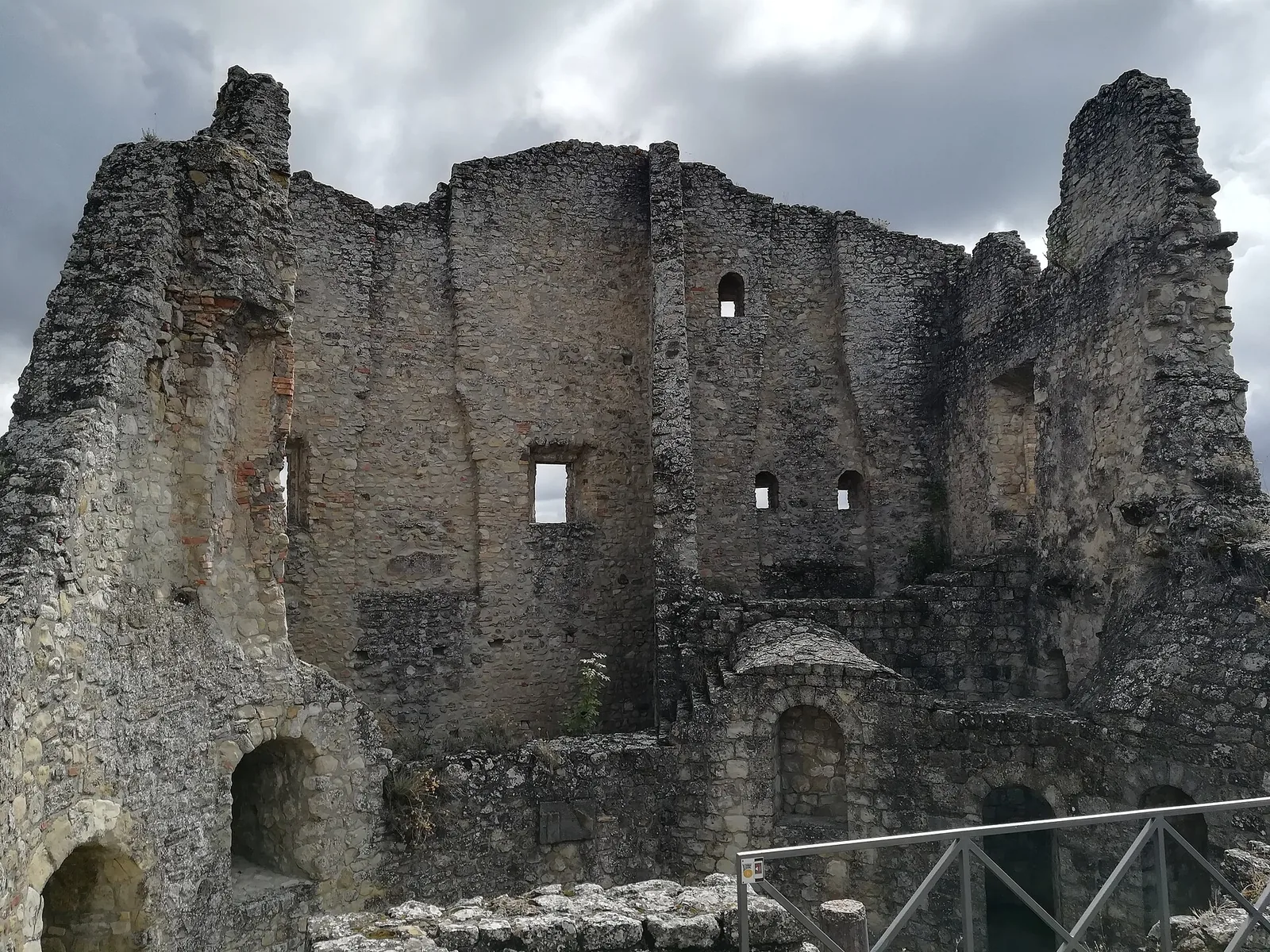
Photo: SIG SG 510, Wikimedia Commons (CC0) · CC0 · Source page
Henry left Germany and made his way south towards Italy. The Swabian nobles refused to open the usual passes, so he went through Burgundy and climbed to Mont Cenis in the depth of winter, with his wife Bertha and his son Conrad. It was a hard journey, and no one knew whether he would arrive.
Gregory himself later wrote that he had come into Lombardy expecting an escort to bring him over the pass to Germany. The escort never came. He then stayed at Canossa, the castle of Matilda, and waited there.
A decision point
You are Henry IV, in December 1076, before the mountain crossing.
December 1076, at the foot of the Alps
In Germany the princes have given you until about 22 February, a year after the ban, to free yourself from the ban, or they will choose another king. The pope has been invited to Augsburg and seems to be heading there. The passes on your road are held by your enemies.
Your envoys have offered full satisfaction and begged for absolution, but the pope is still delaying, and the princes in Germany are counting the days. If you return now to Germany you will fight without the Church’s pardon and without any security.
What do you do?
- Cross the mountains, go to the pope, and seek absolution on his terms. The best way to end the ban quickly, but it humiliates the king and may fail. While you are in Italy, the princes in Germany might choose another king.
- Return to Germany with your army and crush the princes who oppose you by force. You might manage it, but many princes and bishops would refuse to fight for an excommunicated king, and the pope would still be the judge. A war against princes without the Church’s support would be hard and long.
- Descend into Italy by force, with local Lombard allies, and compel the pope to receive you without conditions. Dangerous: a fight against the pope and his supporters in Italy, with the Lombards divided and Matilda on the other side. It might also prove the princes right about you: that you are a tyrant.
What really happened
Cross the mountains, go to the pope, and seek absolution on his terms.
Henry crossed the mountains in the winter of 1076–77, with his family and only a few followers, and did not come to Italy with an army. He reached Canossa, where the pope was staying, and asked to be received.
Henry needed absolution to keep his crown in Germany, and the journey was the only way to meet the pope before the Augsburg date. According to Gregory’s letter, Henry first sent suppliant envoys, and only then came himself. Historians ask whether he expected absolution to be easy, or already knew he would have to submit.
Canossa, January 1077
25–28 January 1077
Three days at the gate
Three days
Henry came to Canossa, a fortress of Matilda of Tuscany in the Apennines. According to Gregory’s own letter, he came “of his own accord, with a few followers, showing nothing of hostility or boldness”. The pope would not receive him at once, and sent his answers through envoys.
Henry “laid aside all the belongings of royalty” and waited three days outside the gate, barefoot and dressed in wool. Gregory writes that he did not stop pleading with many tears, until everyone present was moved to pity. Some who watched cried out that the pope was showing cruelty rather than apostolic severity.
On the fourth day, 28 January, the gate opened. Henry was received back into communion, with sponsors named in the letter and the confirmation of the abbot of Cluny, of Matilda and of Countess Adelaide.
The terms
An oath, not a surrender
According to Gregory’s letter, Henry swore that within the term set by the pope he would “do justice according to his judgment or conclude peace according to his counsels”, unless an absolute impediment stood in the way. He also promised safe conduct to the pope and to anyone travelling with him.
This was not a surrender of the crown. Henry bound himself to submit to the Church’s judgment, but Gregory himself wrote that he was otherwise bound to the king only by a word of hope: “we have said that he might have hopes from us”.
The walk to Canossa later became a symbol of humiliation, but in legal terms it was a negotiated settlement with terms.
A decision point
You are Gregory VII, at Canossa, in the last days of January 1077.
January 1077, Canossa
The king has been standing outside the gate for three days. Inside the fortress you have Matilda, the abbot of Cluny and Countess Adelaide, and all of them plead with you to forgive him.
In Germany the princes are waiting for you at Augsburg. If you refuse, they may elect a new king before you arrive. If you forgive without conditions, you will be accused of serving the king’s interests and of losing control of the matter.
This is the moment when the dispute could end, or go on for years.
What do you decide?
- Refuse absolution and keep the ban in force until the Augsburg assembly. The princes might elect a new king quickly, and the pope would look like the man who sent the king to ruin. The judging role would stay with you, but the danger of war would grow.
- Forgive at once, out of pity, without demanding a written oath. Henry would be restored with no clear obligation, the princes would see the pope as a tool in the king’s hands, and the reform would lose its leverage.
- Forgive on condition that the king swears to accept your judgment at Augsburg. The king and the Church would probably be reconciled, and the judgment would stay with the pope. The princes might feel cheated, but the oath would bind Henry and be sworn before witnesses.
What really happened
Forgive on condition that the king swears to accept your judgment at Augsburg.
Gregory absolved Henry on 28 January 1077, after the penance, in return for Henry’s commitment to accept the pope’s judgment in future. He told the princes that he had yielded to the pleas of those present and owed the king nothing beyond that.
According to his letter, Gregory gave way to Henry’s persistent repentance and to the pleas of those present. Historians debate whether the mercy was genuine, whether Matilda and the Lombards pressed him, or whether he wanted to keep the judgment in his own hands. Probably all of these played a part.
Source: Gregory’s letter to the German princes
“he came at length of his own accord, with a few followers, showing nothing of hostility or boldness, to the town of Canossa where we were tarrying.”
“having laid aside all the belongings of royalty, wretchedly, with bare feet and clad in wool, he continued for three days to stand before the gate of the castle.”
Gregory wrote to the princes who supported him, to explain what had happened. It is a public account from one side of the dispute, written to justify his decision, and it presents his own pity and reluctance with care.
- Why does Gregory insist that he was not bound to Henry? So that the princes do not think the pope has made an alliance with the king. He stresses that his promise was only a hope, not a binding commitment.
- According to the letter, what moved Gregory to forgive? The persistence of Henry’s repentance and the pleas of everyone present. The letter says some present cried out that Gregory was being cruel, so it presents mercy as the result of pressure rather than a cold decision.
- What is left out of the letter? The letter does not mention snow or cold, and it does not explain what was agreed behind closed doors. To learn more we must read other sources with care.
After Canossa
1077–1080
One king against another
October 1080
Henry had received absolution, but not peace. The princes did not wait for the Augsburg assembly, which did not meet as planned. In March 1077 at Forchheim they chose the anti-king Rudolf of Rheinfelden, duke of Swabia, and Germany was plunged into a long civil war.
Gregory hesitated for a long time, but on 7 March 1080 he excommunicated Henry a second time, declared him deposed, and recognised Rudolf as the lawful king. In October 1080 the armies met at the battle on the Elster near Hohenmölsen: Rudolf’s side won the field, but Rudolf himself was mortally wounded and died within days.
The war went on. Neither side could finally win it, and neither could force its crown on the other.
1080–1084
A king against a pope
At Brixen in June 1080 German bishops declared Gregory deposed and elected as pope Wibert of Ravenna, who took the name Clement III. Gregory remained the pope recognised by most of the Church, but the emperor now had an antipope of his own.
Henry went back to Italy in 1081 and laid siege to Rome for years. In March 1084 he entered the city. Clement III was enthroned at the Lateran, and at Easter, 31 March, he crowned Henry emperor. Gregory held out in the Castel Sant’Angelo.
Then Robert Guiscard’s Norman army came, in late May 1084. The Normans entered the city, Henry withdrew, and the Normans sacked large parts of Rome. The Romans turned against Gregory, who left with the Normans for Salerno, in the south.
1085 and after
The death of the pope, the end of the king
Gregory VII died at Salerno on 25 May 1085, in exile. He never saw Canossa again, nor a settlement. The papacy passed after an interval to other popes, and the struggle over investiture went on.
Henry had no peace either. His eldest son Conrad, crowned king in 1087, rebelled in 1093. A second son, Henry V, revolted in 1104 and forced his father to abdicate in 1105. Henry IV died at Liège on 7 August 1106 and was later buried at Speyer.
The settlement
The Concordat of Worms, 1122
On 23 September 1122 the emperor Henry V and Pope Calixtus II agreed the Concordat of Worms. In Germany bishops and abbots were to be elected in the presence of the emperor, who would grant the regalia before consecration, while the Church would give the ring and staff.
The First Lateran Council confirmed the settlement in 1123. It ended the first phase of the dispute, but did not decide whether the Church or the emperor was supreme.
Myth
Henry stood barefoot in the snow for three days outside the gate, a humiliated king who lost, and ever since “going to Canossa” has meant kneeling before a greater power.
The truth
Gregory’s letter, written by the other side, confirms bare feet, wool and three days at the gate. It does not mention snow. Lampert of Hersfeld, who was hostile to Henry, describes a harsh midwinter crossing of the Alps and says the king fasted as well as going barefoot. More important, Henry won his absolution, kept his crown for years and fought on until he died. The walk to Canossa was a negotiation, not the end of the war. The phrase “to go to Canossa” became famous through Bismarck: on 14 May 1872 he told the Reichstag, “Nach Canossa gehen wir nicht” (“We will not go to Canossa”), during the quarrel with the Catholic Church.
The evidence
Gregory VII’s letter to the German princes, 28 January 1077 (see the source step above). I. S. Robinson, Henry IV of Germany, 1999, for the political context.
The order of events
- 1073 Gregory VII becomes pope.
- 9 June 1075 Henry defeats the Saxons at Homburg on the Unstrut.
- 24 January 1076 The synod of Worms; Henry writes to Gregory “false monk”.
- 22 February 1076 Gregory excommunicates Henry.
- October 1076 Tribur: a year to lift the ban, or lose the crown.
- 28 January 1077 Canossa: Gregory absolves Henry.
- March 1077 Forchheim: Rudolf of Rheinfelden chosen as anti-king.
- 7 March 1080 Gregory excommunicates and deposes Henry a second time.
- 1084 Henry enters Rome; Clement III crowns him emperor; the Normans sack the city.
- 25 May 1085 Gregory VII dies at Salerno.
- 7 August 1106 Henry IV dies at Liège.
- 23 September 1122 The Concordat of Worms.
Defeat or masterstroke?
Was Canossa a defeat for Henry, or a victory?
- The hostile chroniclers and the later German tradition Canossa was humiliation: the king knelt before a monk, the princes saw him beaten, and the story was kept alive for centuries until it became a phrase in the language.
- Some historians who stress Henry’s political skill Henry gained absolution, which removed the ban that justified the princes’ revolt. On this reading the princes lost their pretext, and the walk was a calculated step, not a retreat.
A second question: was this a turning point in the relation of Church and state? Some see the investiture dispute and the Concordat as the beginning of a separation of the two powers. Others see a truce, with the question of which power stood above the other still open.
Final quiz
Check yourself
Who wrote the account in which Henry stands three days outside the gate, barefoot and in wool?
Answer: Gregory VII himself, in his letter to the German princes. Right. The letter was written within days of the event, by the pope, who was the other party. It is not a neutral witness, but it is a direct and early one.
Check yourself
What was the Dictatus papae?
Answer: A private list of 27 claims about the pope’s power, copied into Gregory’s register. Right. It is a list kept in the register, not a public proclamation, and it is debated who wrote it.
Check yourself
Why did the princes at Tribur (October 1076) not elect a new king at once?
Answer: They preferred a deadline: Henry could lift the ban within a year, and the pope was invited to Augsburg. Right. That is the plan they adopted. It kept the judgment with the pope and gave the king one chance.
Check yourself
What did the Concordat of Worms (1122) settle?
Answer: The procedure for electing bishops, and what the Church gave and what the emperor gave. Right. The settlement set who elects, who gives the ring and staff, and who grants the temporal rights.
Check yourself
Which statement about the battle of Homburg on the Unstrut (1075) is correct?
Answer: Henry defeated the Saxons, and the death tolls in the chronicles differ widely. Right. The victory is recorded, but the numbers do not agree, so the exact cost cannot be known.
Check yourself
Which claim about the phrase “to go to Canossa” is most accurate?
Answer: The phrase became known through Bismarck’s speech of 1872, and it is used for a humiliating submission. Right. The speech came during the quarrel with the Catholic Church, and the phrase remained in the language as a symbol of humiliation.
Terms
- investiture The ceremony in which a ruler gave a bishop or abbot the ring and staff, the signs of spiritual office, and often the lands and rights that went with it. Lay investiture, which the reformers wanted abolished, was seen as lords controlling the Church.
- simony Buying or selling a church office or a sacred thing. The name comes from Simon Magus, who offered the apostles money for the power of the Holy Spirit (Acts 8).
- excommunication Exclusion from the Church community: the person may not receive the sacraments, and the Church taught that his soul was in danger. It was both a spiritual and a political weapon.
- antipope A man set up as pope against the one recognised by most of the Church, often with an emperor’s backing. Clement III, chosen in 1080, was the antipope of Henry IV.
- anti-king A king chosen by rival princes against a reigning king. Rudolf of Rheinfelden was chosen in 1077 as anti-king to Henry IV.
- Dictatus papae “Dictates of the pope”: a list of 27 claims about papal power, copied into Gregory VII’s register in 1075. It is a private list, not a public proclamation.
- concordat An agreement between the Church and a secular ruler. The Concordat of Worms (1122) settled investiture and the election of bishops in Germany.
- Patarines An urban reform movement in Milan, of townspeople and younger priests, against married and simoniacal clergy. It was backed by the papacy.
- diet An assembly of the princes of the German kingdom, summoned by the king or, in a crisis, by the princes themselves. Decisions on war, peace and the succession were taken there.
- regalia The rights and property that went with a bishopric or abbey from the king: lands, castles, tolls and the rights of government. Granting the regalia gave the king a means of control over bishops.
- Matilda of Tuscany A powerful noblewoman from Tuscany who backed the pope. The fortress of Canossa was hers.
- Cluny A great monastery in France that led a reform movement within the Church.
- Lampert of Hersfeld A monk of Hersfeld who wrote a chronicle covering 1056 to 1077. He was hostile to Henry.
- Deusdedit A cardinal who gathered a collection of canons, or church laws, in 1087.
- Tedald A churchman whom Henry named archbishop of Milan, against the pope's candidate.
- Rudolf of Rheinfelden Duke of Swabia, chosen at Forchheim as an anti-king against Henry.
- Henry V Son of Henry IV. He rebelled against his father in 1104, forced him to abdicate in 1105, and signed the Concordat in 1122.
- Conrad Eldest son of Henry IV. Crowned king in 1087, he rebelled against his father in 1093.
- Calixtus II A pope who agreed the Concordat of Worms with the emperor Henry V in 1122.
- Robert Guiscard A Norman leader. His army reached Rome in 1084 and freed Pope Gregory.
- Forchheim A town in Germany where princes chose Rudolf as anti-king in 1077.
- Brixen A town in Tyrol where German bishops met in 1080 and declared Gregory deposed.
- Worms A German city. Henry met German bishops there in 1076. The 1122 Concordat is named after it.
- Augsburg A German city. The princes invited the pope there to a diet in 1077.
- Mont Cenis A mountain pass in the Alps, which Henry crossed in midwinter on his way to Italy.
- Salerno A city in southern Italy, where Gregory VII died in exile in 1085.
- Lateran Palace A palace in Rome where the popes lived. In 1084 the antipope Clement III was enthroned there.
- apostolic see The papal office, the pope's seat as head of the Church. By tradition it goes back to the apostle Peter.
- legate A special representative sent by the pope to act for him.
- penance An act of sorrow to atone for a sin, such as fasting, walking barefoot or begging.
- absolution Formal forgiveness of sins, given by the Church.
- synod A formal meeting of bishops and priests that discusses Church matters.
- archbishop A senior bishop who oversees the other bishops in a large region.
- chronicle A historical account, written by a monk or priest, that records events year by year.
Sources
- Gregory VII to the German princes, 28 January 1077, Register IV.12, English version by Ernest F. Henderson, Select Historical Documents of the Middle Ages (London: George Bell and Sons, 1896); Avalon Project, Yale Law School
- Henry IV to Gregory VII, 24 January 1076, MGH Leges II, English version by Ernest F. Henderson, Select Historical Documents of the Middle Ages (London: George Bell and Sons, 1910); Internet Medieval Sourcebook
- Dictatus papae, in the register of Gregory VII under 1075; edition by Erich Caspar, Das Register Gregors VII., MGH Epistolae selectae 2 (1920–23)
- Lampert of Hersfeld, Annals, trans. Ian S. Robinson, The Annals of Lampert of Hersfeld (Manchester: Manchester University Press, 2015)
- I. S. Robinson, Henry IV of Germany, 1056–1106 (Cambridge: Cambridge University Press, 1999)
- H. E. J. Cowdrey, Pope Gregory VII, 1073–1085 (Oxford: Oxford University Press, 1998)
- H. E. J. Cowdrey, The Register of Pope Gregory VII, 1073–1085: An English Translation (Oxford: Oxford University Press, 2002)
- Peter H. Wilson, Heart of Europe: A History of the Holy Roman Empire (Cambridge, MA: Belknap Press of Harvard University Press, 2016)
Image credits
- Donizo, miniature in the Vita Mathildis, c. 1115. Vatican Library, Ms. Vat. lat. 4922, fol. 49v · Public domain · Source page
- Paul of Bernried, Vita Gregorii VII, first half of the 12th century. Heiligenkreuz Abbey Library, Cod. 12, fol. 181v · Public domain · Source page
- Photo: SIG SG 510, Wikimedia Commons (CC0) · CC0 · Source page


