Camp David: from the Knesset to a peace treaty, 1977–1979
In 1967 Israel took the Sinai from Egypt. In September 1978 the leaders of both countries are guests of the American president at a mountain retreat in Maryland, in separate cabins. Nobody yet knows whether they will leave with a peace.
Decisions, questions and your own progress, in the app
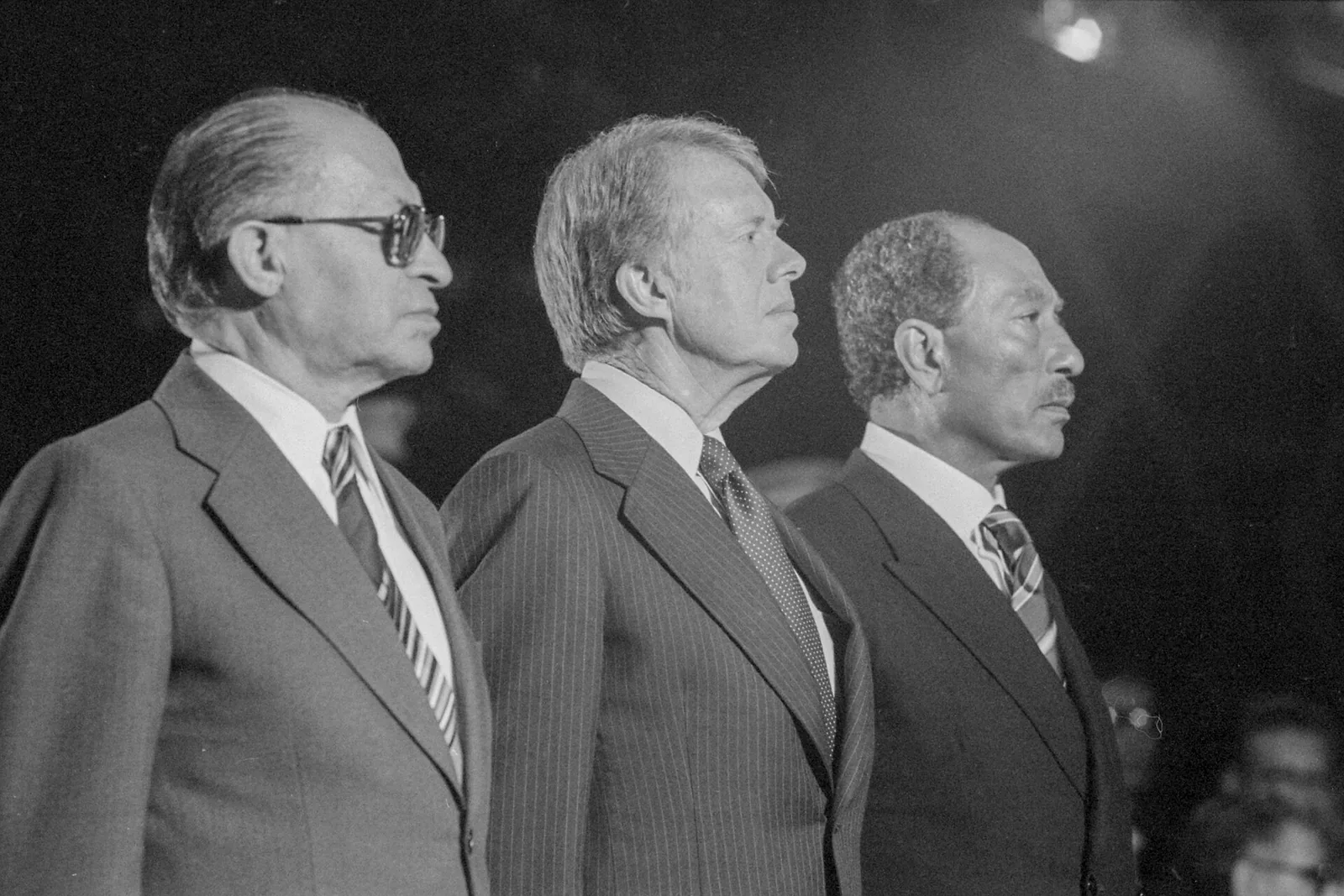
Bill Fitz-Patrick, photograph, Camp David, 7 September 1978 (Wikimedia Commons) · Public domain · Source page
The scene
A mountain retreat, September 1978
In 1967 Israel took the Sinai desert from Egypt. Eleven years later, the leaders of both countries are staying in separate cabins in the Maryland hills, as guests of the American president.
Will they leave with a peace? Nobody knows yet.
Where
A presidential retreat
Camp David is the presidential retreat in Catoctin Mountain Park, in Maryland. President Eisenhower renamed it when he took office in 1953. It is a place of cabins among the trees.
In September 1978 the American president, Jimmy Carter, chose it for a closed meeting. The two leaders he had invited had been stuck in talks for months.
Menachem Begin
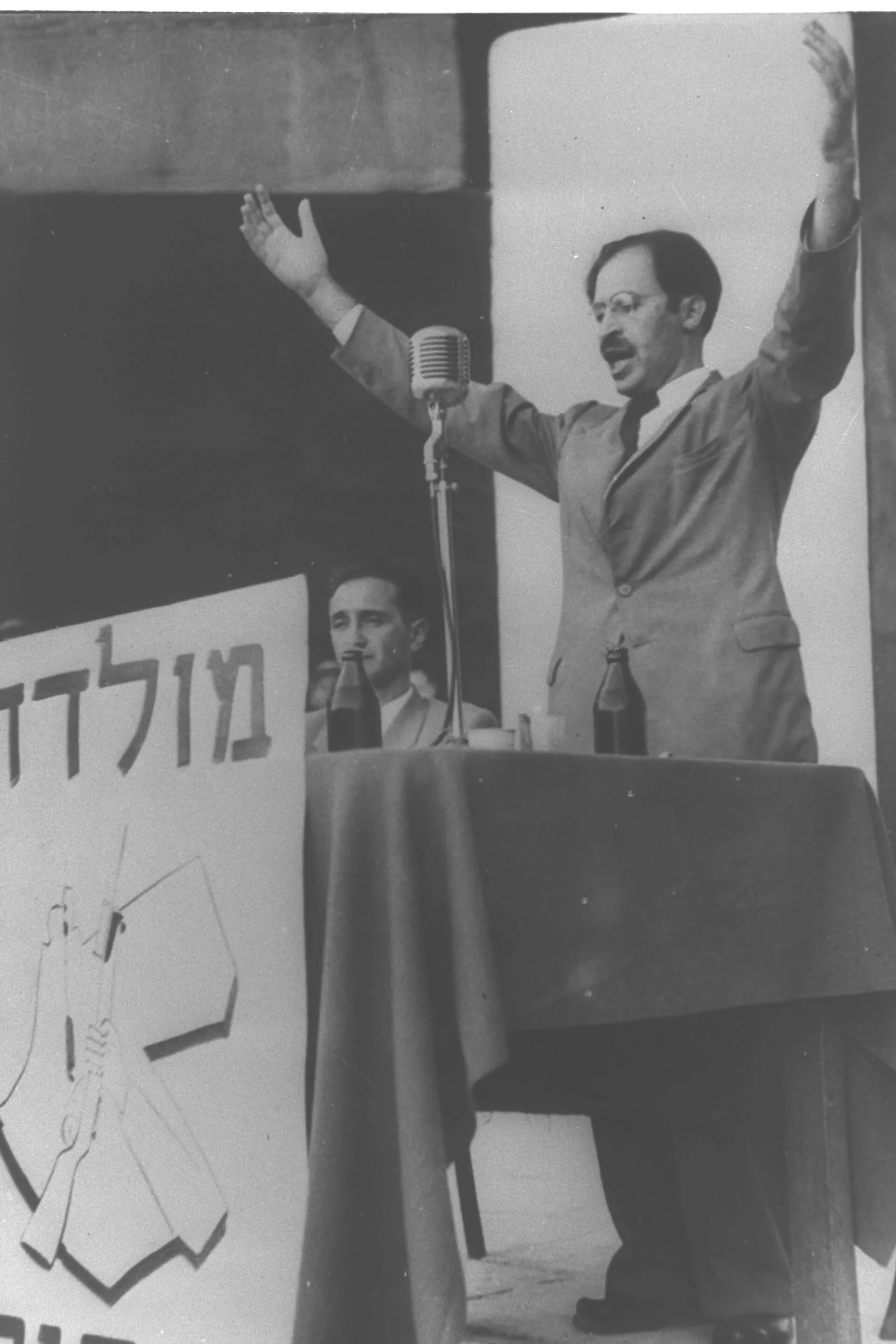
Israeli Government Press Office photographer, Menachem Begin speaking, 14 August 1948 (Wikimedia Commons) · Public domain · Source page
A Zionist from an early age, leader of the Herut party, and prime minister of Israel from 1977 to 1983.
- Born: 16 August 1913, Brest-Litovsk
- Died: 9 March 1992
This is the price of peace with Egypt. I have no choice, I must decide.
The road to it
Background
A desert taken in 1967
In the Six-Day War of 1967, Israel took the Sinai peninsula from Egypt. Egypt wanted it back, and it did not return to Egypt until 1982.
Israel built settlements there: Jewish communities on land it held. One of them was Yamit, a town on the northern coast, near Rafah. Accounts of its size differ.
The offer
A speech in Cairo
On 9 November 1977 Anwar Sadat, the president of Egypt, told the People's Assembly in Cairo that he was ready to go to the ends of the earth, even to the Knesset, the Israeli parliament. The World Jewish Congress reports his words, and the English wording is a summary, not the Arabic original.
The offer had conditions. Sadat tied it to a conference in Geneva, with the superpowers and the Arab parties at the table, and to the rights of the Palestinians.
A decision point
You are Anwar Sadat, president of Egypt.
November 1977, Cairo.
Your offer is public. It is tied to a conference in Geneva and to the rights of the Palestinians. Your Arab partners expect Egypt to stand with them.
A visit to Jerusalem would be a face-to-face meeting with the Israeli parliament. You would go alone, and your own people would judge you for it.
What do you do?
- Keep to the Geneva plan. Insist that every Arab party and the superpowers meet together first. Probably the Arab front holds, but the talks stay where they are. Israel has no reason to move, and your offer stays a demand, not a deal.
- Go to Jerusalem and speak to the Knesset yourself, in person. Probably Israel and the world hear you at once. But your Arab partners will call it a betrayal, and you will go alone.
- Make the speech in Cairo, then wait for Israel to make the first move. Probably nothing moves for months. The offer stays words, and Israel can answer as it likes, or not at all.
What really happened
Go to Jerusalem and speak to the Knesset yourself, in person.
Sadat chose the second. On 20 November 1977 he addressed the Knesset in Jerusalem. The meeting at Camp David came ten months later.
Historians describe the visit as a political risk at home. Sadat's own reasons are in his autobiography, which this lesson does not quote.
The event
20 November 1977
In the Knesset
On 20 November 1977 Sadat spoke in the Knesset in Jerusalem, to the Israeli members.
According to a summary of the speech, he called for a peace agreement reached at Geneva, for Israel to withdraw from the land it took in 1967, and for the Palestinians to decide their own future.
Nothing was signed that day. The talks that followed moved slowly.
1977–1978
Stuck
Four questions
After Jerusalem, the two governments kept talking, but they did not agree. The Office of the Historian at the US State Department says the two sides were stuck on four questions: the West Bank, Gaza, the airbases in the Sinai, and the settlements.
The United States was the mediator. One option was shuttle diplomacy: carrying each side's offers between Cairo and Jerusalem. Another was a wide conference in Geneva.
A decision point
You are Jimmy Carter, president of the United States.
1978, before the talks begin on 5 September.
Both sides are stuck on the same four questions: the West Bank, Gaza, the Sinai airbases and the settlements. Neither leader can give way without a fight at home.
As mediator, you can change how the two sides meet, but you cannot make either of them give ground.
How do you break the deadlock?
- Shuttle between Cairo and Jerusalem, carrying each side's offers, and let the embassies do the work. Probably slow but safe. Each side keeps its public face, but the talks can drag on for months, and one unacceptable phrase can end them.
- Call a wide conference in Geneva, with every party and the superpowers at one table. Probably a public stage, where each side plays to its own audience and little is settled.
- Invite both leaders to a closed retreat at Camp David until they agree or give up. Probably the best chance of a deal, and the biggest risk: a failure in private still leaves two leaders who have dug in, and a public failure for you.
What really happened
Invite both leaders to a closed retreat at Camp David until they agree or give up.
Carter chose the third. The talks at Camp David ran from 5 to 17 September 1978. Carter hosted both leaders, and Cyrus Vance, the secretary of state, took part.
Carter's own account of his choice is not quoted here. What is clear is that the talks were stuck, and that a closed retreat was the option that put both leaders in one place.
Camp David
Two documents
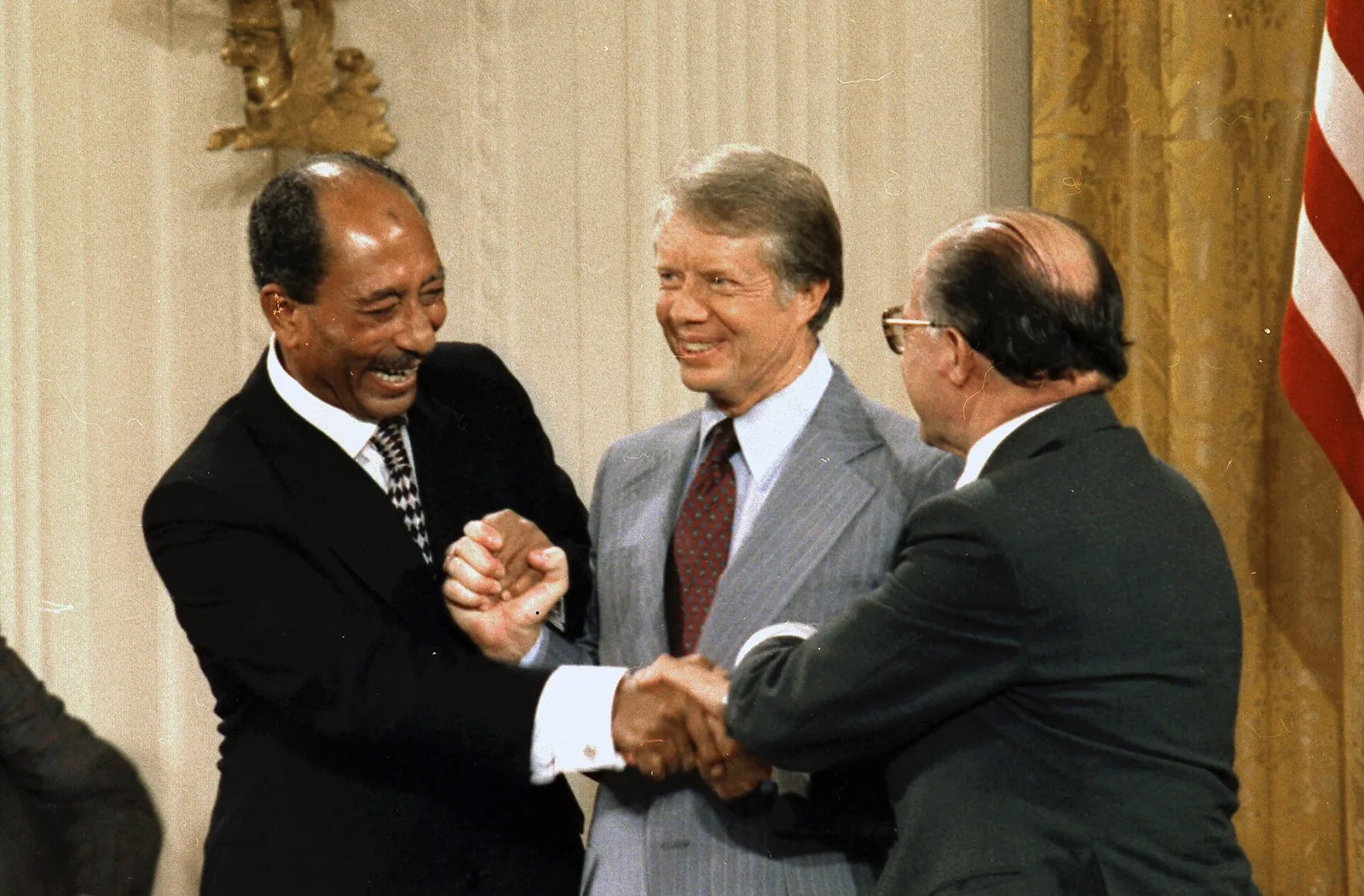
Photograph of 17 September 1978, photographer not known (Wikimedia Commons) · Public domain · Source page
17 September 1978
From 5 to 17 September 1978 the two leaders stayed at Camp David. Carter reportedly met each of them separately, in their cabins, several times.
On 17 September they signed two documents. The first was a Framework for Peace in the Middle East. The second was a Framework for the conclusion of a peace treaty between Egypt and Israel. Begin and Sadat signed; Carter was present.
Only the second led straight to a treaty. The first, on the Palestinians, stalled.
What we really know
Source: The Framework, 17 September 1978
Paraphrase: Israel's military government in the West Bank and Gaza would withdraw once an elected self-governing authority existed. The transition would last no more than five years. Palestinian representatives should take part in the talks on final status. The text says nothing about Jerusalem.
Written by the governments of Egypt, Israel and the United States during the talks, and signed by Begin and Sadat, with Carter present. Each government had to sell it at home.
- Who wrote it, and who is missing from it? The governments of Egypt, Israel and the United States wrote it. The Palestinians did not sign, and the text says nothing about Jerusalem.
- Which parts have dates, and which are only a plan? The Sinai withdrawal has a time frame: between three and nine months after the peace treaty is signed. The Palestinian part promises a transitional period of at most five years, and then only talks.
- Why write a text so vague? One likely reason: it had to pass at home. A vague text lets each government read it its own way. That helps a deal pass, but it leaves the hard questions open.
Myth
Camp David made peace for the whole region, Palestinians included.
The truth
It led to a peace treaty between Egypt and Israel. The first framework set out autonomy for the West Bank and Gaza, but the talks on it stalled, and the Palestinians did not sign.
According to History.com, the UN never formally accepted the first framework, and self-rule came only with the Oslo Accords, in 1993.
The evidence
The Office of the Historian says the autonomy talks stalled after Palestinian representatives refused to take part. Both Frameworks were signed only by Egypt and Israel.
A decision point
You are Menachem Begin, prime minister of Israel.
Camp David, September 1978.
Carter and Sadat want the settlements in Sinai removed as part of any deal. You personally want to keep them.
Whatever you agree at Camp David must go to the Knesset.
What do you promise?
- Keep the Sinai settlements, and refuse any deal that removes them. Probably the talks end without a treaty. Sadat's offer and the American effort are wasted, and the settlements stay in Sinai for now, at the cost of peace.
- Promise, in writing, that every settlement in Sinai will be removed. Probably the deal goes through, but your own coalition is put under strain, and the Knesset never gets a chance to decide the question.
- Refuse to commit in advance, and leave the question to the Knesset. Probably the vote becomes a long and bitter debate, but the deal can still pass, and the parliament has the last word.
What really happened
Refuse to commit in advance, and leave the question to the Knesset.
Begin chose the third. He would not commit in advance to removing the settlements. The Knesset debated for about 17 hours, and approved a package that included their removal.
Begin's own view was that the settlements mattered to him, and that the price of peace was worth paying (Time, paraphrased). He told the Knesset that the question belonged to the parliament, not to him alone.
Source: Begin's closing statement to the Knesset, September 1978
Paraphrase: Begin tells the Knesset that the government serves the parliament and does not rule it, and that the Knesset will decide the question of the settlements. He defends the Frameworks as the basis for peace with Egypt.
A speech written to win a vote, so it defends the Frameworks and says little about the doubts.
- Who is speaking, and to whom? Begin, to the members of the Knesset, to win their vote. The public reads the speech too, through the press.
- What does a speech written to win a vote leave out? The doubts. Time reports a dispute over a freeze on new West Bank settlements: Washington said five years, and Begin said three months.
- Can you check the claim against the vote? Partly. The Knesset approved the package, 84 for, 19 against and 17 abstentions, according to the JTA.
What followed, and the quiz
March 1979
The price
1.3 billion a year
On 26 March 1979 Egypt and Israel signed the peace treaty in Washington, with Carter present, on the North Lawn of the White House.
Within days the Arab League responded. In Baghdad, from 27 to 31 March, the foreign ministers of 18 Arab states and the PLO suspended Egypt's membership and relations, halted aid to it, and moved the headquarters of the Arab League from Cairo to Tunis.
The aid was tied to the agreements. According to History.com, the United States committed about $1.3 billion a year in military aid to Egypt, and $3 billion a year to Israel. Sources differ on where that aid was written down.
What followed, in order
- Oct–Dec 1978 Sadat and Begin share the Nobel Peace Prize. The ceremony is in Oslo on 10 December.
- 26 Mar 1979 Egypt and Israel sign the peace treaty in Washington.
- 27–31 Mar 1979 The Arab League suspends Egypt and moves its headquarters from Cairo to Tunis.
- 6 Oct 1981 Sadat is killed in Cairo during a military parade.
- Apr 1982 The official evacuation of Yamit begins on 23 April, according to the Jewish Virtual Library. Israeli control of Sinai ends by late April 1982.
- 1989 Egypt is readmitted to the Arab League.
- 1993 The self-rule that the first framework described begins only with the Oslo Accords, according to History.com.
Did Camp David make a real peace?
Did the Frameworks bring peace, or only a treaty between two states?
- Kenneth W. Stein, Heroic Diplomacy (1999) Stein argues that personal leadership and American mediation made the deal possible. He says the process was shaped by the conflicting goals of the regional states and the superpowers, and by the decisive roles of the four leaders in his title: Sadat, Kissinger, Carter and Begin.
- William B. Quandt, Camp David: Peacemaking and Politics (2016 reissue) Quandt was on the staff of the National Security Council during the 1978 talks. According to the publisher's summary, the accords were praised as groundwork for peace between Egypt and Israel, but criticised for not reaching a comprehensive settlement, including the Palestinian question. That summary is all this lesson has read of the book.
Did the Palestinian clause fail by design, or because the two sides could not agree? The Office of the Historian says the gaps on Palestinian self-government and on the settlements were never bridged, and that Carter then named special negotiators.
Check yourself
What did Begin do about the Sinai settlements at Camp David?
Answer: He refused to commit in advance and left it to the Knesset.. Correct. He would not promise removal before the parliament had decided, and the Knesset approved a package that included it.
Check yourself
Which option did Carter choose to break the deadlock?
Answer: A closed retreat at Camp David, with both leaders.. Correct. Carter hosted both leaders at Camp David, and the talks ran from 5 to 17 September 1978.
Check yourself
What did the two Frameworks of 17 September 1978 set out?
Answer: A treaty for Egypt and Israel, and a Palestinian self-rule plan that stalled.. Correct. The first framework set out a plan for self-government whose talks stalled, and the second set the path to the treaty.
Check yourself
What did the Arab League do to Egypt after the treaty was signed in March 1979?
Answer: It suspended Egypt and moved its headquarters to Tunis.. Correct. At Baghdad, from 27 to 31 March 1979, the ministers suspended Egypt and moved the headquarters.
Check yourself
On what date did the evacuation of Yamit begin?
Answer: 23 April 1982.. Correct. The official evacuation began on 23 April 1982, according to the Jewish Virtual Library.
Check yourself
What do historians disagree about in the Palestinian clause of the Frameworks?
Answer: Whether the Palestinian clause failed by design, or by disagreement.. Correct. This is the open question the Office of the Historian leaves, and the answer is not settled.
Terms
- Knesset The Israeli parliament. Its members vote on laws and on agreements with other states.
- settlement A community of Israeli civilians built on land Israel took in 1967, such as the West Bank or Sinai. At Camp David the settlements in Sinai were a central dispute.
- Yamit A town of Israelis on the northern Sinai coast, near Rafah. It was evacuated in April 1982, when Israel gave Sinai back to Egypt.
- Sinai A desert peninsula between Egypt and Israel. Israel took it from Egypt in 1967 and returned it in 1982.
- mediator A third party that helps two sides negotiate without taking either side's part.
- shuttle diplomacy A mediator carries messages between two sides who do not meet face to face. Each side keeps its public position.
- framework An outline agreement: it sets principles and steps, and leaves the details to later talks.
- treaty A formal agreement between states, signed by their governments. A peace treaty ends a state of war between them.
- autonomy Self-government for a region or a people inside a larger state, with its own elected bodies and powers.
- Arab League A grouping of Arab states, with its headquarters in Cairo until 1979. In March 1979 it suspended Egypt and moved its headquarters to Tunis.
- Catoctin Mountain Park A hilly, wooded park in Maryland. Camp David lies inside it.
- presidential retreat A quiet place away from the capital, where the US president rests and hosts guests in private.
- Maryland A US state on the East Coast, next to Washington. Camp David is there.
- Dwight Eisenhower An American general in World War II who later became US president.
- Jimmy Carter US president who hosted the leaders of Egypt and Israel at Camp David and guided the talks.
- Cyrus Vance The US secretary of state, who took part in the Camp David talks.
- Menachem Begin Israel's prime minister at the time of Camp David. He refused to commit in advance to removing the settlements.
- Anwar Sadat President of Egypt. He addressed the Knesset in Jerusalem and later signed a peace treaty with Israel.
- Geneva A city in Switzerland. Sadat wanted a wide conference there, with the superpowers and the Arab parties.
- People's Assembly Egypt's parliament, in Cairo. Sadat told it he was ready to go to the ends of the earth.
- World Jewish Congress An international organization that represents Jewish communities around the world.
- Time A famous American weekly news magazine.
- Brookings Institution An American research institute in Washington that studies policy and the economy.
- Rafah A town on the border between Egypt and the Gaza Strip.
- US State Department The US foreign ministry, in charge of relations with other countries.
- Oslo Accords Agreements from 1993 between Israel and the PLO that gave Palestinians partial self-rule.
- The Arabist A blog about Egypt and the Arab world.
- Superpower A very large, powerful country whose influence reaches the whole world. In 1978 this meant the US and the Soviet Union.
- JTA The Jewish Telegraphic Agency, a news agency that reports Jewish news worldwide.
Sources
- Framework for Peace in the Middle East and Framework for the Conclusion of a Peace Treaty between Egypt and Israel, 17 September 1978 (Avalon Project, Yale Law School)
- Menachem Begin, statement at the close of the Knesset debate on the Camp David agreements, September 1978 (Jewish Virtual Library)
- Foreign Relations of the United States, 1977–1980, vol. IX, documents 239 and 242 (Office of the Historian, US Department of State)
- “Momentous step toward Mideast peace: Knesset approves Camp David accords by vote of 84-19 and 17 abstentions”, JTA, 29 September 1978
- William B. Quandt, Camp David: Peacemaking and Politics (Washington, DC: Brookings Institution Press, 2016; Brookings Classics reissue)
- Kenneth W. Stein, Heroic Diplomacy: Sadat, Kissinger, Carter, Begin and the Quest for Arab-Israeli Peace (Routledge, 1999)
- History.com, “Camp David Accords”
- Office of the Historian, US Department of State, “Camp David Accords, 1977–1980”
- “Clearing the Way for Peace”, Time, 9 October 1978
- G. David Miller and Susan Gilson, “Middle East Regional Cooperation: A Thirty-Year Assessment”, Foreign Policy Journal, 14 October 2010
- Issandr El Amrani, post on The Arabist, 2012 (on the aid and the treaty text)
Image credits
- Bill Fitz-Patrick, photograph, Camp David, 7 September 1978 (Wikimedia Commons) · Public domain · Source page
- Israeli Government Press Office photographer, Menachem Begin speaking, 14 August 1948 (Wikimedia Commons) · Public domain · Source page
- Photograph of 17 September 1978, photographer not known (Wikimedia Commons) · Public domain · Source page


