Caesar I: the rise
Kidnapped by pirates, buried in debt, mocked as a dandy: how a young aristocrat climbed to the top in Rome.
Decisions, questions and your own progress, in the app
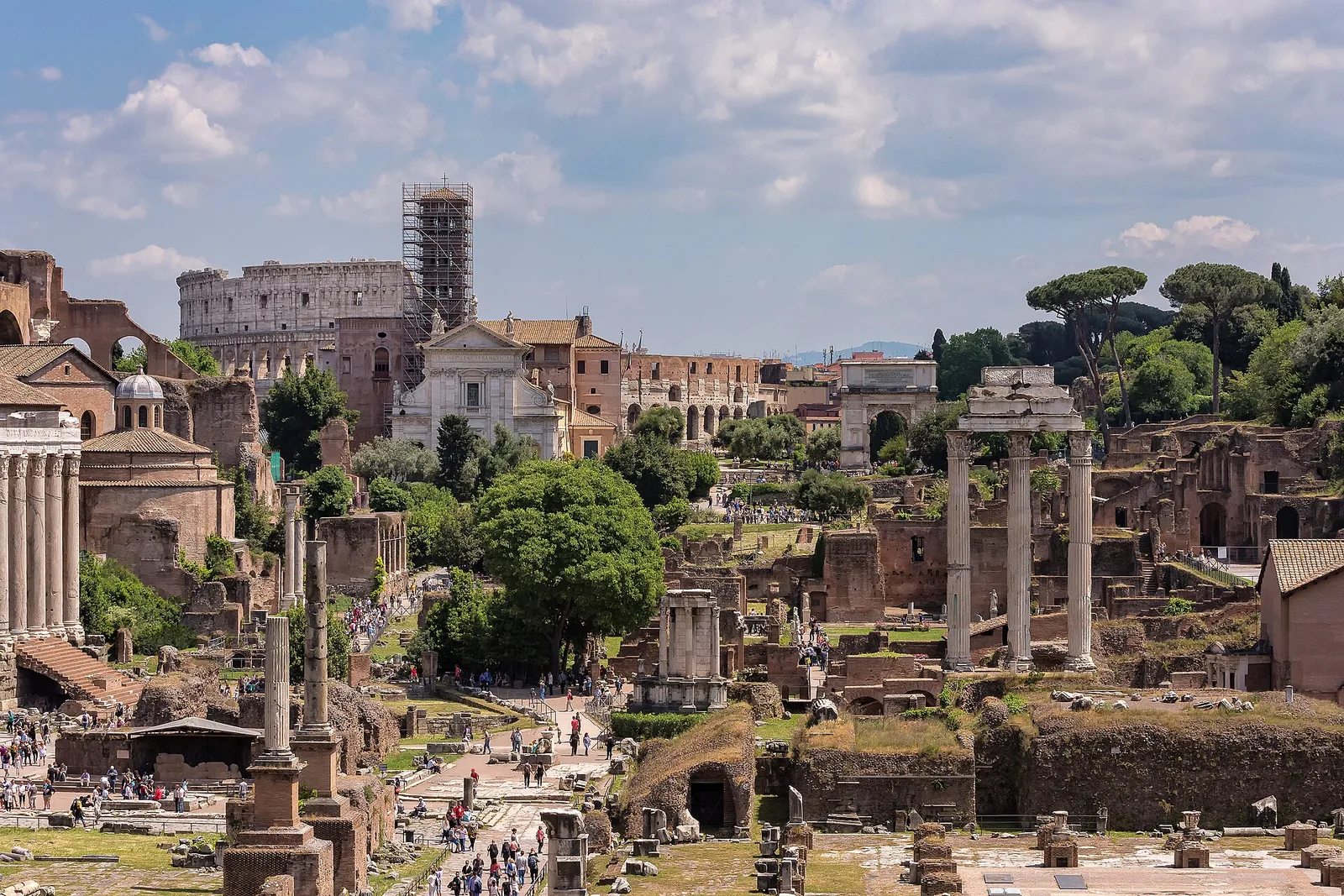
The Roman Forum, looking east, 2016 · Stefano Lovato · CC BY 2.0 · Source page
A name that became a title
The Caesar who was no emperor
Kaiser in German, tsar in Russian, keisar in Hebrew. All these words for the ruler of an empire are the surname of one Roman family. And the man who made the name famous was never an emperor for a single day.
He was born in 100 BC into an old but far from wealthy family. At 18 he was hiding from a dictator’s soldiers, at about 25 he was a prisoner of pirates, and in his late thirties one lost election would have ruined him. At 40 he was consul, the highest office in Rome, with the city’s two most powerful men tied to him.
How did a young man from the losing side of a civil war climb to the top? And how much of the legend of the young Caesar really happened?
Our witnesses
Witnesses who knew the ending
Almost nothing Caesar wrote before 58 BC survives, so we see the young Caesar only through other people’s eyes.
Only one witness wrote at the time: Cicero, whose private letters to his friend Atticus were kept. Sallust, a Caesarian who lived through these years, wrote about twenty years after the events. Plutarch and Suetonius, who give us most of the stories, wrote some 160 to 180 years later, under emperors who carried Caesar’s name.
All of them knew how the story ended: a dictator, murdered. So every anecdote about the young man may be shaped by the man he became. At every turn ask: who told this, and when?
Gaius Julius Caesar
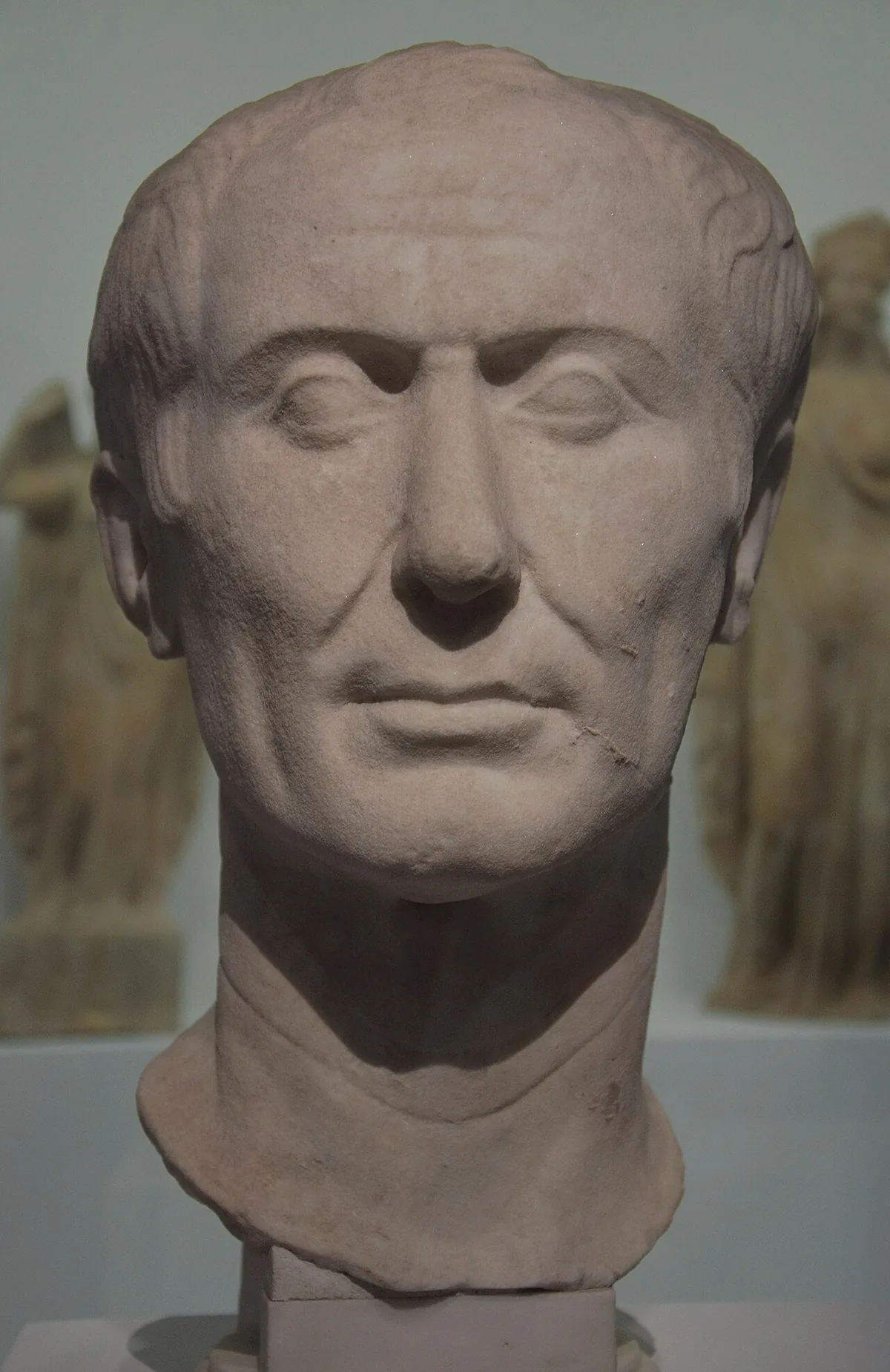
The Tusculum head, marble. Museo di Antichità, Turin; photographed on loan at the Grand Palais, Paris, 2014 · Carole Raddato · CC BY-SA 2.0 · Source page
A patrician from an old, faded family who climbed to the top on debts, daring and the Roman people, and was consul at forty.
- Born: 12 or 13 July 100 BC, Rome; he grew up in the Subura district
- Died: 15 March 44 BC, Rome, in the Senate hall beside Pompey’s theatre, stabbed to death by senators at a meeting of the Senate
- Won: The conquest of Gaul, 58–50 BC (Alesia, 52); Pharsalus, 48 BC; Zela, 47 BC; Thapsus, 46 BC; Munda, 45 BC
- Lost: Gergovia, 52 BC; Dyrrhachium, 48 BC
“I would rather be first here than second at Rome.”
A noble without money
Background
Descended from a goddess, raised in the Subura
Gaius Julius Caesar was born in Rome on 12 or 13 July 100 BC. The Julii were patricians, of Rome’s oldest nobility. They claimed descent from Iulus, son of the Trojan Aeneas, and so from the goddess Venus herself.
But the pedigree was bigger than the purse. In Caesar’s branch only a few had ever reached the consulship. His father rose to praetor and died suddenly in 85 BC, when his son was 15. According to Suetonius, Caesar lived at first “in a modest house” in the Subura, a crowded, noisy district below the hills. His mother, Aurelia, from a family of consuls, brought him up.
Myth
Caesar was born by caesarean section, and the operation is named after him.
The truth
No ancient source says so. In the ancient world the operation was done only on a mother who had died or was dying, to save the child. Caesar’s mother, Aurelia, lived another 46 years. The name is older than he was, too: a Sextus Julius Caesar was praetor as early as 208 BC.
The evidence
Pliny the Elder (Natural History 7.47) tells of the first of the family “cut” from his mother’s womb: a legend about an ancestor, not about our Caesar. The term “caesarean” is early modern (François Rousset, 1581), perhaps from the Latin caedere, “to cut”. Suetonius, Divus Iulius 26; Livy 27.21–22.
An uncle, and a father-in-law
Marius’s nephew
Caesar’s aunt Julia was the wife of Gaius Marius, the “new man” who had saved Rome from the Cimbri and Teutones. When Marius and his ally Cinna took Rome in 87 BC, they named the 13-year-old boy priest of Jupiter. It was a great honour with a trap in it: the priest’s taboos would have closed any military career.
In 84 BC, at 16, Caesar broke off an engagement to a rich girl of an equestrian family and married Cornelia, daughter of Cinna, consul four times. They had a daughter, Julia. Through his aunt and through his wife, Caesar was now bound to Marius’s side.
Then, in 82 BC, Sulla won, and, as we saw in the last lesson, posted lists of proscription in the Forum.
A decision point
You are Gaius Julius Caesar, aged 18.
Rome, 82 or 81 BC
Your uncle Marius is dead, his son has killed himself, and your father-in-law Cinna was murdered by his own soldiers. Hundreds of names hang on Sulla’s lists in the Forum.
Sulla is testing the young nobles of the losing side. Pompey, a rising commander of 24, has already divorced his wife at Sulla’s wish to marry Sulla’s stepdaughter. Now the order comes to you: divorce Cornelia, your wife of two years.
Your mother’s family, the Cottae, stand well with Sulla. You have a priesthood, little money and no army.
What do you do?
- Divorce Cornelia, as Pompey did You are probably safe at once, and Sulla’s men may even open doors for you. But you become one more of Sulla’s creatures, and you throw away the name of Marius, which might one day have won you the people.
- Refuse, and trust your mother’s family to protect you Sulla strips you of what you have, and you must hide. Everything depends on whether your relatives can win a pardon before his men find you.
- Refuse and slip out of Italy at once, to wait abroad You escape the search parties, but without a pardon you are an exile, like the Marians who fled to Sertorius in Spain. Your property and your career in Rome are probably lost.
What really happened
Refuse, and trust your mother’s family to protect you
He refused. Sulla took away his priesthood, Cornelia’s dowry and his family inheritances. Caesar went into hiding in the Sabine hills, sick with malaria, changing house almost every night. One of Sulla’s patrols caught him, and he bought his freedom for two talents.
In the end the Vestal Virgins and two of his relatives, Mamercus Aemilius and Aurelius Cotta, begged Sulla to pardon him. Sulla gave way, and according to Suetonius added a warning: “in this Caesar there is more than one Marius.”
Plutarch explains the refusal by the tie to Marius, Velleius by courage. Historians add calculation: his mother’s family stood well with Sulla, so he could risk more than others.
Sulla’s warning is almost too good to be true: the men who wrote it down knew how the story ended. One thing is certain: losing the priesthood freed Caesar from its taboos and opened his road to the army.
The sea and the ladder
81–78 BC
A crown of oak leaves, and gossip about a king
After his pardon Caesar joined the staff of the governor of the province of Asia, in what is now western Turkey. The governor sent him to Nicomedes IV, king of Bithynia, to fetch ships. Caesar lingered at the king’s court, and at once a rumour was born that he was the king’s lover.
In 80 BC, at the storming of Mytilene on Lesbos, Caesar won the “civic crown”, an oak wreath for saving the life of a Roman citizen in battle. When its wearer came to the games, even the senators rose for him. In 78 BC, hearing that Sulla was dead, he went home.
77–75 BC
Learning to speak
In Rome Caesar prosecuted a former governor for squeezing his subjects, as ambitious young nobles did. The man was acquitted, but the speech made Caesar’s name.
To perfect his speaking he sailed for Rhodes, to study with Apollonius Molon, the most famous teacher of rhetoric of the day, who had also taught Cicero. On the way, in the winter of 75 or 74 BC, near the islet of Pharmacusa off Miletus, Cilician pirates took his ship.
A decision point
You are Caesar, about 25 years old.
The coast of Asia Minor, winter 75 or 74 BC
For nearly forty days you were held on a pirates’ island while your men went round the cities raising the ransom. The pirates asked 20 talents. You laughed and told them you were worth fifty.
You ordered them to keep quiet while you slept, read them your speeches, called them barbarians when they were not impressed, and told them, laughing, that you would crucify them all. They laughed too.
Now the ransom is paid and you are free in Miletus, with no office and no command. The governor of the province is far away, and the pirates are celebrating on their island with your money.
What now?
- Report to the governor and let Rome punish them The law is on your side, but governors move slowly and have interests of their own. The pirates probably vanish, or end up sold as slaves while the governor pockets the money.
- Let it go: you are alive, and Rhodes is waiting Safe and sensible. But you have been humiliated in public, and in Rome a man’s name is his capital.
- Man ships at Miletus and go after them yourself You have no legal command, and a fight at sea could kill you. But if it works, the story will follow you all your life.
What really happened
Man ships at Miletus and go after them yourself
He manned ships at Miletus at once, caught most of the pirates while their ships still lay at anchor off the island, took their money and locked them up at Pergamum. When the governor stalled, apparently hoping to sell them and keep the money, Caesar went back to Pergamum and crucified them, as he had promised.
Suetonius, in a chapter on Caesar’s mercy, adds a detail: “he had them crucified, since he had sworn beforehand that he would do so, but ordered that their throats be cut first.”
The story probably comes from Caesar himself, told and retold. The sources disagree on details: Plutarch puts it several years earlier, and Velleius says the cities of Asia paid the ransom.
The core is firm: capture, ransom, a private hunt, and punishment without waiting for an official. It is the first sign of a pattern: act first, ask for authority later.
73–67 BC
The first rungs of the ladder
In Rome the cursus honorum, the ladder of offices, was waiting. Caesar was elected a military tribune, and in 69 BC, at about 30, he became quaestor and entered the Senate.
That year his aunt Julia, Marius’s widow, died, and so did his wife Cornelia. At Julia’s funeral the wax masks of Marius, unseen in public since Sulla’s day, were carried in the procession, and the crowd cheered. Then Caesar went to serve in Further Spain, where, the story goes, he sighed before Alexander’s statue.
In 67 BC he married Pompeia, Sulla’s granddaughter. The same year he backed the law that gave Pompey a vast command against the pirates. According to Plutarch, the Senate’s leaders all opposed it, except Caesar.
65 BC
Buying the city
1,300 talents
In 65 BC Caesar was aedile, together with Marcus Bibulus. They paid for public games together, but Caesar took all the credit.
Caesar showed 320 pairs of gladiators, with the gear of the arena made of silver. One night he secretly set up again on the Capitol the victory monuments of Marius that Sulla had removed. Catulus, the most respected man in the Senate, warned: “No longer, indeed, by sapping and mining, Caesar, but with engines of war art thou capturing the government.”
All this cost a fortune. According to Plutarch, before he held his first office Caesar already owed 1,300 talents.
63 BC
Pontifex, or exile
Early in 63 BC the pontifex maximus, Rome’s chief priest, died. A new law said the people would elect his successor. Caesar, not yet even a praetor, stood against two far older and more respected ex-consuls, Catulus and Servilius.
Catulus offered him a large sum to withdraw. Caesar replied that he would fight on even if he had to borrow more. On election morning his mother saw him to the door in tears. He kissed her and said: “Mother, to-day thou shalt see thy son either pontifex maximus or an exile.” Exile, because if he lost, his creditors would ruin him.
He won by a landslide, even in his rivals’ own tribes, and was head of the state religion for life.
A decision point
You are Caesar, 37, praetor-elect and pontifex maximus.
5 December 63 BC, the Temple of Concord in Rome
The consul Cicero has exposed a plot. Its leader, Catiline, a bankrupt patrician, has gone to join an army of debtors in Etruria. In Rome five of his partners have been arrested. Their sealed letters and the witnesses expose plans for arson and murder.
The Senate must decide their fate. The consul-elect Silanus has proposed “the extreme penalty”, and every ex-consul has agreed. But Roman law says no citizen may be put to death without a trial before the people.
You are known as a friend of the people and Marius’s nephew, and rumour links you to Catiline. Armed young knights guard the temple.
What do you propose?
- Vote for death, with the ex-consuls You are above suspicion and on the winning side. But you have betrayed the principle you stand for, a citizen’s right to a trial, and the people will remember.
- Propose confiscation and life imprisonment in Italian towns A harsh sentence, but no one is killed without trial. You keep your principle and your popularity, at the risk of being called the plotters’ friend.
- Propose holding them under guard until Catiline is beaten Tiberius Nero proposed something like this that day; in Plutarch and Appian it is Caesar’s own proposal. It sounds prudent, but your opponents will say the city cannot wait while Catiline has an army.
What really happened
Propose confiscation and life imprisonment in Italian towns
Caesar proposed that their property be confiscated and that they be imprisoned for life in the strongest towns of Italy; so say Sallust and Cicero, while Plutarch and Appian speak of custody only until Catiline was beaten, then a trial. His speech swung the Senate, and Silanus said he had really meant something milder. Then Cato rose, demanded death, and carried the house. That evening the five were strangled in the prison below the Capitol.
As Caesar left, young knights of Cicero’s guard drew swords on him, and friends shielded him. He did not return to the Senate for the rest of the year.
Historians see principle and calculation together: voting for death would have destroyed his standing with the people, and saving the plotters outright was impossible.
Caesar had warned that executing citizens without trial would set a dangerous precedent.
Three heads
62–61 BC
Above suspicion
In December 62 BC, the year he was praetor, Caesar’s house hosted the rites of the Good Goddess, the Bona Dea, from which men were barred. His wife Pompeia and his mother Aurelia received the women. Publius Clodius, a wild young patrician, slipped in dressed as a lute-girl. A maid of Aurelia’s recognised him. Cicero reported it to Atticus on 1 January 61 BC.
Caesar divorced Pompeia, yet at Clodius’s trial he said he knew nothing. Asked why, then, he had divorced his wife, he answered: “Because I thought my wife ought not even to be under suspicion.” Hence the proverb “Caesar’s wife must be above suspicion”: not a statement of trust, but a reason for divorce. Clodius was acquitted by a bribed jury.
61 BC
A general at last
In 61 BC Caesar went out to govern Further Spain. His creditors tried to hold him back, until the richest man in Rome, Crassus, stood surety for his debts. In Spain Caesar raised ten more cohorts, marched against the Lusitani and Callaici, reached the Atlantic and sailed north to Brigantium, today’s A Coruña.
His soldiers hailed him imperator, and he came home rich. Suetonius is less admiring: according to his sources, Caesar sacked Lusitanian towns even though they had opened their gates to him.
Gnaeus Pompeius Magnus (Pompey the Great)
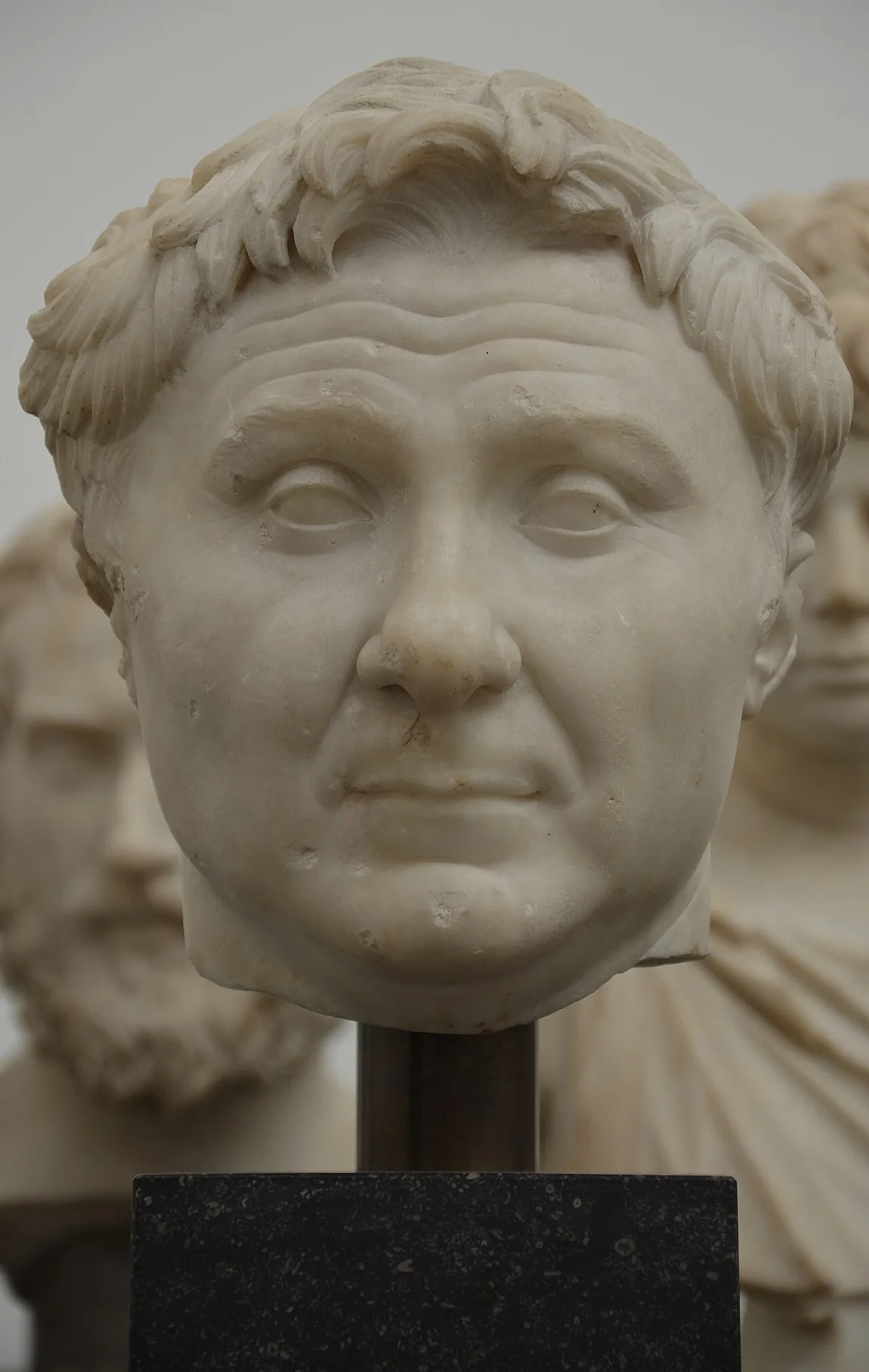
Head of Pompey, copy of about AD 30–50. Ny Carlsberg Glyptotek, Copenhagen · Carole Raddato · CC BY-SA 2.0 · Source page
The boy general who never waited his turn: three triumphs over three continents, conqueror of the pirates and of Mithridates, and in 59 BC Caesar’s son-in-law.
- Born: 29 September 106 BC, Not recorded; his family’s lands were in Picenum, eastern Italy
- Died: 28 September 48 BC, Pelusium, Egypt, killed as he stepped ashore, on the orders of the ministers of the boy-king Ptolemy XIII
- Won: Sicily and Africa, 82–81 BC; The war on the pirates, 67 BC; Mithridates, 66 BC; Jerusalem, 63 BC; Dyrrhachium, 48 BC
- Lost: Lauron, 76 BC (against Sertorius); Pharsalus, 48 BC (against Caesar)
“[He] bade Sulla reflect that more worshipped the rising than the setting sun.”
Marcus Licinius Crassus
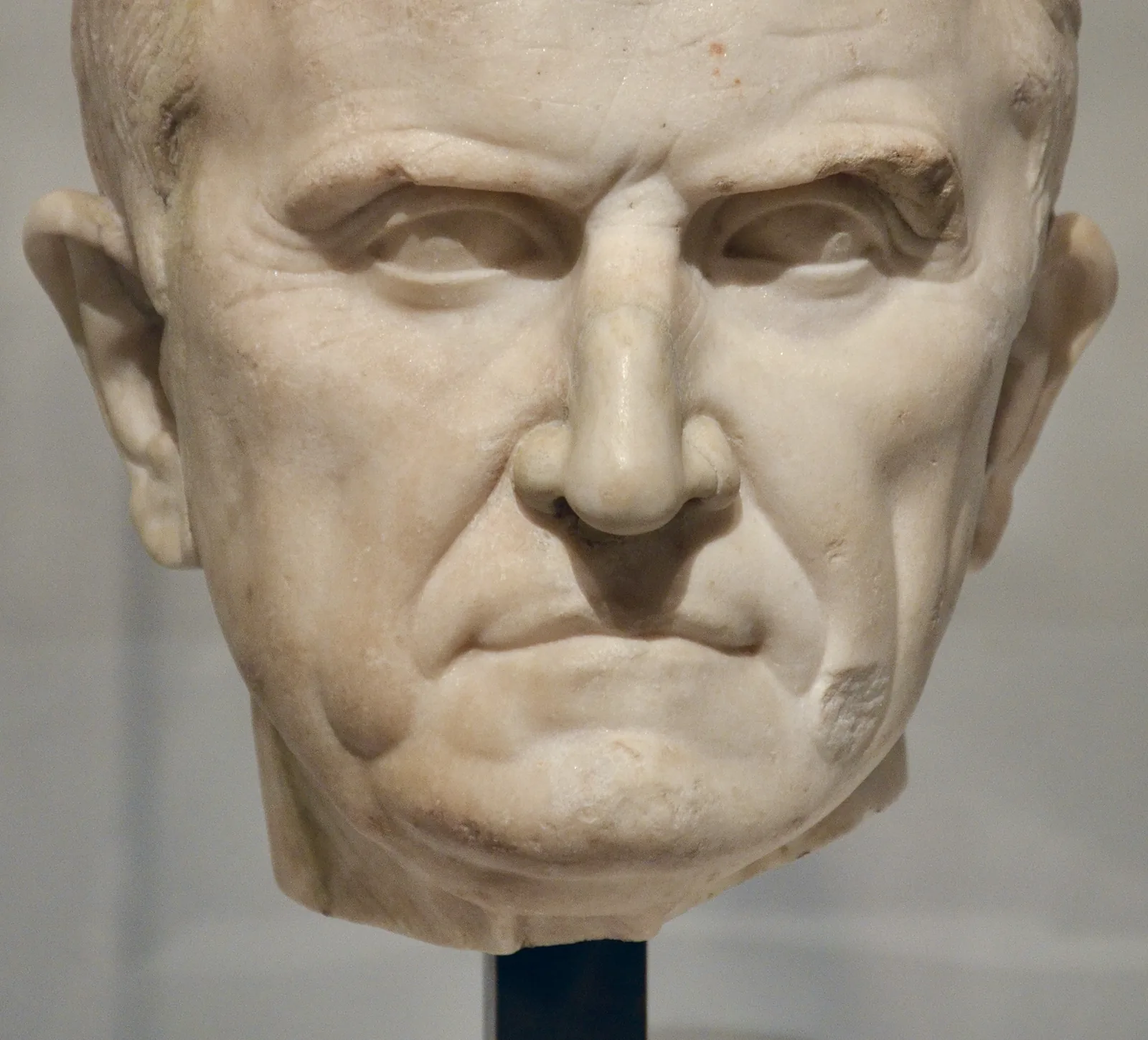
Head of a man, “Crassus” (identification uncertain), mid-1st century BC. Musée du Louvre, Paris (Ma 1220); photographed at the Grand Palais, 2014 · Carole Raddato · CC BY-SA 2.0 · Source page
The richest man in Rome, lender to many senators and guarantor of Caesar’s debts.
- Born: c. 115 BC, Probably Rome; son of a consular family
- Died: June 53 BC, Near Carrhae (Harran), in today’s south-east Turkey, killed at a parley with the Parthians, after his defeat in battle
- Won: The Colline Gate, 82 BC (his wing won); Spartacus, 71 BC
- Lost: Carrhae, 53 BC
“…that no one was rich who could not support an army out of his substance.”
A decision point
You are Caesar, aged 40, back from Spain.
Rome, summer and autumn 60 BC
You earned a triumph, but to hold it you had to wait outside the city, and to stand for consul you had to register inside it. Cato talked until sunset to block a vote on letting you stand in absence. You gave up the triumph and entered the city.
The optimates and populares have raised a bribery fund to elect Bibulus as your colleague, and the Senate has assigned next year’s consuls only the “woods and cattle-paths” of Italy: no army.
Pompey came home from the East a year and a half ago, and the Senate is blocking his settlement and the land for his veterans. Crassus wants relief for his friends, the tax-farmers of Asia. The two have been enemies for ten years.
What do you do?
- Govern as an independent and try to win the Senate over With Bibulus and Cato against you, probably every law you bring is blocked, and at the end of the year you are left with the woods.
- Ally with Pompey alone His glory and his veterans’ votes are yours, but Crassus’s money and friends are turned against you.
- Reconcile Pompey and Crassus and bind both to you, in secret If it holds, no one in Rome can stop you. But you will owe them both, and the Senate will call it a conspiracy.
What really happened
Reconcile Pompey and Crassus and bind both to you, in secret
Caesar brought the two old rivals together. According to Suetonius, they agreed “that no step should be taken in public affairs which did not suit any one of the three.” The pact was secret. The name “First Triumvirate” is modern: it was no institution or office, but a private alliance.
Plutarch saw where it led: “it was not, as most men supposed, the quarrel between Caesar and Pompey that brought on the civil wars, but rather their friendship.”
Cassius Dio reasons that with one of the two as a friend, Caesar would have had the other as an enemy; with both, he could master everyone else. Ronald Syme saw a coalition of “dynasts” that wrecked the Republic; Erich Gruen, an ordinary, temporary alliance.
59 BC
The consulship of Julius and Caesar
As consul, Caesar proposed a land law: public land in Italy for Pompey’s veterans and the city’s poor. Cato talked to wreck it, and Caesar had him dragged off to prison. Then Caesar took the law to the people’s assembly, where Pompey and Crassus stood beside him in public. The alliance was out in the open.
On voting day Bibulus tried to stop Caesar on the steps of the Temple of Castor. He was thrown down, his rods of office were broken, and a basket of dung was emptied over his head. For the rest of the year Bibulus shut himself up at home, announcing that he was “watching the sky” for bad omens, which, he claimed, made every vote invalid. Caesar ignored him and passed law after law. Wits, says Suetonius, dated documents “in the consulship of Julius and Caesar”.
59–58 BC
A daughter, a wife and a province
To bind the alliance, Caesar married his daughter Julia to Pompey, a man far older than she; according to Plutarch, it became a love match. Caesar himself married Calpurnia, daughter of the next year’s consul. Cato raged that power was being “prostituted by marriage alliances”.
A law proposed by the tribune Vatinius gave Caesar Cisalpine Gaul, in northern Italy, and Illyricum for five years, with three legions. The Senate itself added Gaul beyond the Alps and a fourth legion, fearing that the people would give him that too. As long as he held a command, he could not be prosecuted for the laws of 59. In March 58 BC he rode north, to Gaul: the next lesson.
How do we know?
Source: One story, three tellers
Suetonius: “…noticing a statue of Alexander the Great in the temple of Hercules, he heaved a sigh, and as if out of patience with his own incapacity in having as yet done nothing noteworthy at a time of life when Alexander had already brought the world to his feet, he straightway asked for his discharge.”
Plutarch: “Do you not think,” said he, “it is matter for sorrow that while Alexander, at my age, was already king of so many peoples, I have as yet achieved no brilliant success?”
Suetonius and Cassius Dio set this at Gades, today’s Cádiz, in 69 BC, when Caesar was quaestor. In Plutarch he is already governor, in 61 BC, reading a book about Alexander, and bursts into tears.
- What differs between the versions? The place, the year, and what set it off: a statue or a book, a sigh or tears. A story that moves in time was retold before it was written down.
- Does “at my age” fit Plutarch’s version? Not really. Alexander died at 32. At 31, in 69 BC, Caesar could say it; in 61 he was 39, an age Alexander never reached. Plutarch’s words fit Suetonius’s date better than his own.
- Why might Plutarch have preferred a book and tears? He paired Caesar with Alexander in his Parallel Lives, and the scene foreshadows his own comparison. An anecdote can be true in substance and still be shaped by the teller’s purpose.
Source: One speech, two reports
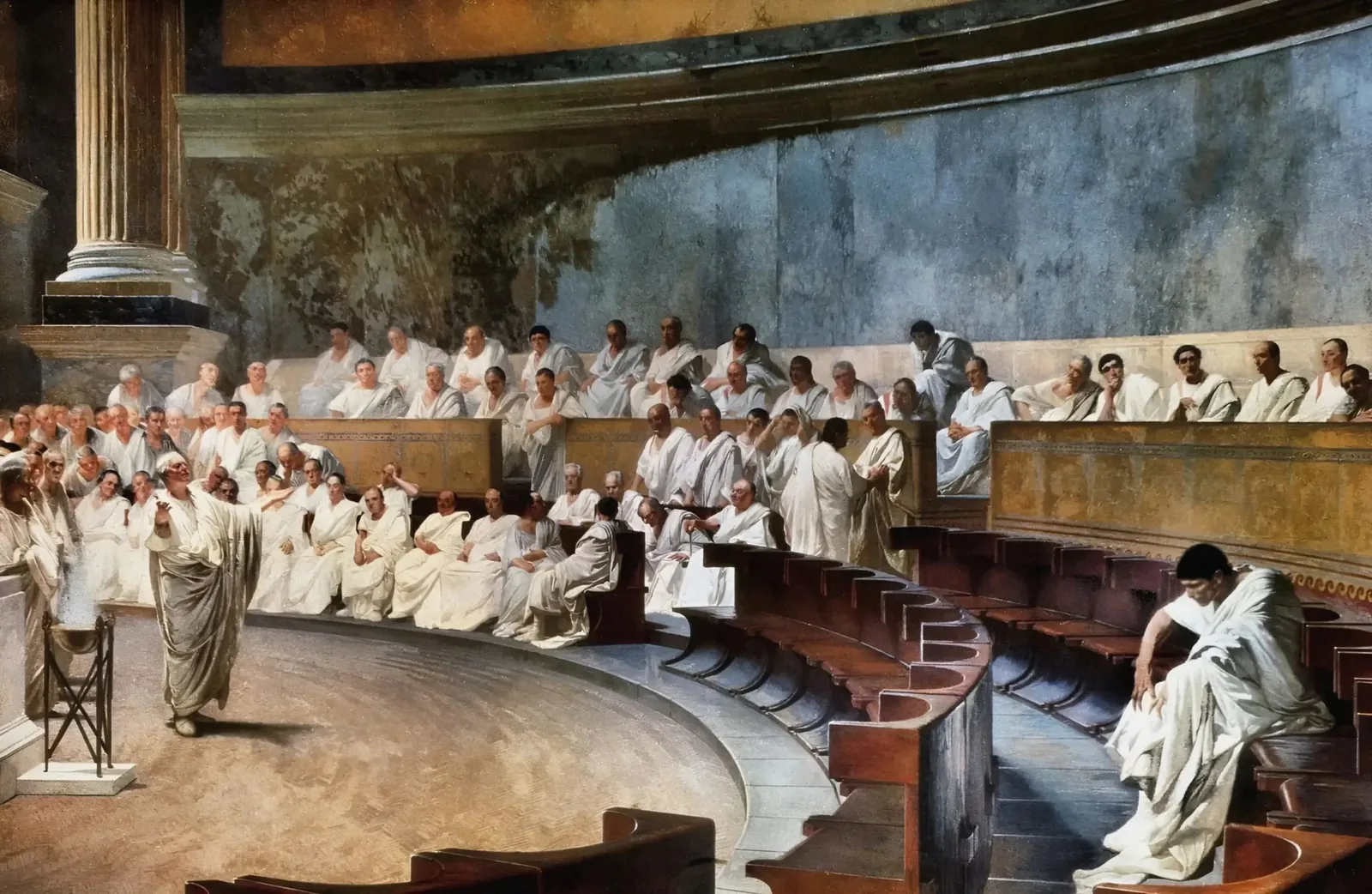
Cesare Maccari, Cicero Denounces Catiline, 1889. Palazzo Madama, Rome · Public domain · Source page
Caesar, in Sallust: “All bad precedents have originated in cases which were good; but when the control of the government falls into the hands of men who are incompetent or bad, your new precedent is transferred from those who well deserve and merit such punishment to the undeserving and blameless.”
Cicero, replying in the same session: “this most gentle and merciful man does not hesitate to commit Publius Lentulus to eternal darkness and imprisonment.”
Sallust, a Caesarian, wrote some twenty years later, after Caesar’s murder.
- Who wrote Caesar’s speech? Sallust. Ancient historians composed speeches to fit the speaker and the moment: the argument is probably Caesar’s, the words Sallust’s. Cicero, who heard the real speech, confirms the proposal.
- Is Cicero’s speech a record of that day? Not quite. In June 60 BC he told Atticus he was preparing the speeches of his consulship for publication. The text we read was published about three years after the speech, when the executions had already made him enemies, and may have been reworked.
- What does each want you to think of Caesar? Sallust: a statesman of law and mercy. Cicero: a “merciful” man whose mercy is harsher than death.
Source: A name on a coin
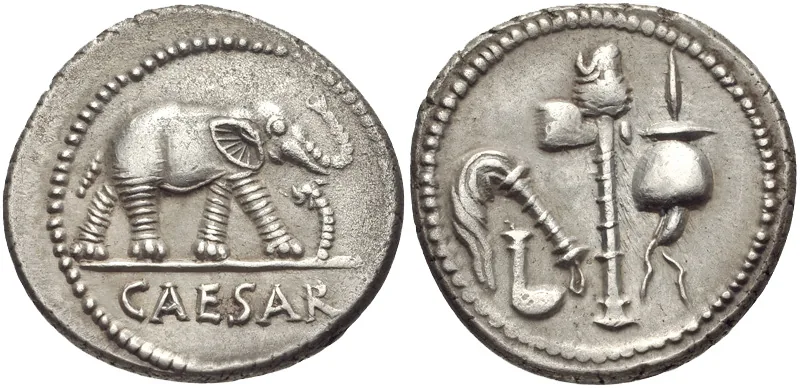
Denarius of Julius Caesar, 49–48 BC (Crawford 443/1) · Classical Numismatic Group (CNG) · CC BY-SA 2.5 · Source page
“…he who first received the name of Caesar was called by this name, either because he slew in battle an elephant, which in the Moorish tongue is called caesai, or because he was brought into the world after his mother’s death and by an incision in her abdomen…”
The coin was struck for Caesar’s soldiers in 49–48 BC.
- What does the coin say, with a single word? The name, and the priesthood: the other side shows the tools of the pontifex maximus. A coin passes from hand to hand: this is advertising aimed at soldiers.
- Which came first, the coin or the explanation? The coin. The elephant explanation was written four centuries later, and its author may have reasoned back from coins like this one. Ancient etymologies are mostly guesses.
- And how did Caesar himself explain his family’s greatness? Not by an elephant or an operation, but by gods and kings. In his aunt’s eulogy, says Suetonius, he traced the family to Venus, so that it had “the sanctity of kings” and “the claim to reverence which attaches to the Gods”.
What came of it
After 59 BC
- 58 BC Cicero is exiled under Clodius’s law against those who killed citizens without trial. Caesar leaves for Gaul.
- 58–50 BC The Gallic Wars give Caesar what he lacked in 60: a loyal army, wealth and glory.
- 56 BC At Luca the three renew their alliance; in 55 a law extends Caesar’s command.
- 54 BC Julia dies in childbirth, and with her the personal tie between Caesar and Pompey.
- 53 BC Crassus is killed at Carrhae. The three become two.
- 49 BC Caesar crosses the Rubicon rather than return as a private man who could be prosecuted for the acts of 59.
- 44 BC Dictator for life, then murdered on the Ides of March.
- 27 BC onward His heir rules as Augustus, and “Caesar” becomes a title: Kaiser, tsar, keisar.
Myth
Julius Caesar was the first Roman emperor.
The truth
In this lesson’s years he was an elected magistrate of a working republic: every magistracy for one year, with a colleague who could block him. The “imperator” of 61 BC was only a soldiers’ salute. Later he was dictator, and at last “dictator for life”, but never emperor. The first emperor was his adopted son, Augustus, from 27 BC.
The evidence
Plutarch, Caesar 12.4; Suetonius, Divus Iulius 76. In 45 BC he took Imperator as a permanent first name (Dio 43.44), a step toward its later meaning, but an emperor’s powers came only with Augustus. His name became a title because his heirs took it: from the Greek Kaisar it reached even the Hebrew of the rabbis.
Was the rise planned?
Was the young Caesar already aiming at sole power, or did his ambitions grow with each success?
- Theodor Mommsen, History of Rome, vol. 3 (1856) For Mommsen, Caesar was the one creative genius Rome produced, “a statesman in the deepest sense of the term” from early youth. He had one aim, the renewal of Rome, and pursued it first as demagogue and conspirator, then as monarch. The plots, the debts and the pact of 60 BC were stages on the way.
- Matthias Gelzer, Caesar: Politician and Statesman (1921) Gelzer sees a Roman noble who played the aristocracy’s game of offices, friendships, debts and clients better and more ruthlessly than anyone. His ambitions grew with each success. His rise is explained by the Roman system, not by a plan made in youth.
- Christian Meier, Caesar (1982) Meier sees an outsider: a man pursuing his own dignity against a Senate that would not make room for him, in a republic in a crisis no one knew how to solve. He had no programme for a new order. He won power without knowing what to do with it.
The stories of “more than one Marius” and the tears before Alexander were written by men who knew the ending. Cicero’s letters of 60 and 59 BC, written without that knowledge, do fear a despotism, but from Pompey; Caesar appears as his partner, not the coming master. Whom do you believe?
What do you know now?
Check yourself
What did Caesar lose by refusing to divorce Cornelia?
Answer: The priesthood of Jupiter, the dowry and his inheritances, and almost his life. Right. Sulla took all of these, and Caesar hid, sick, in the hills until his relatives and the Vestal Virgins won him a pardon.
Check yourself
What did Caesar do after the pirates released him?
Answer: Manned ships at Miletus without any command, caught them and crucified them. Right. He acted as a private man, and when the governor stalled, he crucified them himself, as he had promised them in captivity.
Check yourself
Why do the words “at my age” in Plutarch’s version of the Alexander story raise a doubt?
Answer: Plutarch sets the scene in 61 BC, when Caesar was 39, and Alexander died at 32. Right. The words fit Suetonius’s date, 69 BC, when Caesar was 31, better.
Check yourself
What did Caesar propose in the debate on Catiline’s partners?
Answer: Confiscation and life imprisonment in Italian towns, without execution. Right. So in Sallust, and Cicero, who answered him that day, confirms it.
Check yourself
What was the “First Triumvirate”?
Answer: A private, secret alliance of Caesar, Pompey and Crassus, with a modern name. Right. No law created it, and it had no office or powers. It came into the open only when Pompey and Crassus stood beside Caesar in the assembly.
Check yourself
Why is it hard to believe Caesar was born by caesarean section?
Answer: In the ancient world it was done only on a dead or dying mother, and his mother lived another 46 years. Right. Aurelia ran his house in 62 BC and died in 54. And the name Caesar was older than he was.
Terms
- patrician A member of one of Rome’s oldest noble families. By Caesar’s time it gave prestige and some priestly rights, not wealth or power.
- cursus honorum The “course of honours”: Rome’s ladder of elected offices, each for one year and with a minimum age: quaestor, aedile (optional), praetor (judge, then governor), consul.
- quaestor The first rung: a finance officer in Rome or beside a provincial governor. Since Sulla, every quaestor entered the Senate for life.
- aedile A magistrate in charge of the city: streets, markets and public games. A chance to buy popularity with money.
- consul One of the two elected heads of Rome, for one year. Each could block what the other did.
- pontifex maximus Head of the priests of Rome’s state religion, for life. Not a pope: a political office held by a senator, with an official house in the Forum.
- flamen Dialis The priest of Jupiter, bound by taboos: he could not ride a horse, look on an army drawn up for battle, or sleep away from his own bed three nights running.
- proscription A posted list of outlaws: anyone could kill them for a reward, and their property was sold. Sulla posted such lists in 82–81 BC.
- optimates and populares Not parties but styles: the optimates (“the best men”) upheld the Senate’s authority; the populares worked through the people’s assembly and its tribunes.
- imperator A title soldiers shouted for a victorious general. It opened the way to ask for a triumph and gave no power over Rome. Our word “emperor” comes from it, but only later.
- triumph The victory parade through Rome, granted by the Senate: the highest honour a Roman could win. The general had to wait outside the city until his day.
- talent A Greek weight of about 26 kilograms of silver, used to count large sums: about 6,000 denarii. A Roman soldier then earned about 112 denarii a year.
- Sallust A Roman writer who supported Caesar. He wrote about twenty years after the events.
- Plutarch A later writer who wrote Parallel Lives of famous Greeks and Romans. Many stories about Caesar come from him.
- Suetonius A Roman writer who was secretary to the emperor Hadrian. He quoted gossip and hostile pamphlets about Caesar.
- Cassius Dio A senator and consul of the early 3rd century AD. He gives the fullest account of 63–59 BC, but adds motives of his own.
- Macrobius A later writer from the early 5th century AD. He gives 12 July as Caesar's birthday.
- Sulla A Roman general who won in 82 BC and then ruled Rome as dictator. He published lists of men condemned to death.
- Marius A Roman general, the 'new man' who saved Rome from the Cimbri and Teutones. He was married to Caesar's aunt Julia.
- Cinna A Roman consul, ally of Marius and Caesar's father-in-law. He was murdered by his own soldiers.
- Catiline A bankrupt patrician who led a plot to burn and murder in Rome. He went to join an army of debtors in Etruria.
- Clodius A wild young patrician. He slipped into the women's rite at Caesar's house, dressed as a lute-girl. He was acquitted by a bribed jury.
- Catulus A former consul, older and more respected than Caesar. He ran against Caesar for pontifex maximus and offered him money to withdraw.
- Crassus The richest man in Rome. He stood surety for Caesar's debts and later became his partner in power.
- Cicero A Roman writer and politician. His private letters to Atticus survive as a witness account of the time.
- Atticus Cicero's friend, to whom Cicero's private letters were sent. The letters survive.
- Nicomedes IV King of Bithynia, at whose court the young Caesar stayed while he was sent to fetch ships.
- Cilicia A region on the south coast of today's Turkey, home of the pirates who seized Caesar's ship.
- Pergamum A city in today's Turkey where Caesar held the pirates, then crucified them as he had promised.
- Mytilene A town on the island of Lesbos. At its storming Caesar won the civic crown, an oak wreath for saving a citizen's life in battle.
- Gades A port in southern Spain, today's Cádiz. There, according to Suetonius and Cassius Dio, Caesar sighed before a statue of Alexander.
- tax farmer A man or company that bought from the Roman state the right to collect taxes in a province, and profited from it.
- Vestal Virgin A Roman priestess of the goddess Vesta, who kept the city's sacred fire and vowed to stay a virgin.
- tribune In Rome, an elected official who protected ordinary citizens, or a senior officer in a legion.
- praetor A senior office in Rome, below consul. Its holders often ran the courts.
- wax masks Wax masks of a family's ancestors, kept at home and carried in funeral processions.
- Bona Dea A Roman rite for women only, held at Caesar's house. Men were not allowed to attend.
Sources
- Suetonius, Divus Iulius 1–23, 45–54, 74, trans. J. C. Rolfe, Suetonius vol. I (Loeb Classical Library, 1914)
- Plutarch, Caesar 1–14, trans. B. Perrin, Plutarch’s Lives vol. VII (Loeb Classical Library, 1919)
- Plutarch, Pompey 14, 25, 46–48, 53 (vol. V, 1917); Crassus 2 (vol. III, 1916); Cato the Younger 22–24, 32 (vol. VIII, 1919), trans. B. Perrin (Loeb)
- Sallust, The War with Catiline 49–55, trans. J. C. Rolfe (Loeb Classical Library, 1921)
- Cassius Dio, Roman History 37.37, 37.52–58, 38.1–12, 43.20, 47.18, trans. E. Cary (Loeb Classical Library, 1914–17)
- Velleius Paterculus, Roman History 2.41–44, trans. F. W. Shipley (Loeb Classical Library, 1924)
- Appian, Civil Wars 2.8–14, trans. H. White (Loeb Classical Library, 1913)
- Cicero, Letters to Atticus 1.12, 1.16, 2.1, 2.3, 2.19, in The Letters of Cicero vol. 1, trans. E. S. Shuckburgh (London: George Bell, 1899)
- Cicero, Fourth Speech against Catiline 7–10, trans. C. D. Yonge (London: Bohn, 1856)
- Historia Augusta, Aelius 2.3–4, trans. D. Magie, Scriptores Historiae Augustae vol. I (Loeb Classical Library, 1921)
- Pliny the Elder, Natural History 7.47, 16.12–14, 33.53, trans. J. Bostock and H. T. Riley (London: Bohn, 1855–57); Macrobius, Saturnalia 1.12.34; Livy 27.21–22
- Adrian Goldsworthy, Caesar: Life of a Colossus (New Haven and London: Yale University Press, 2006)
- Christopher Pelling, Plutarch: Caesar. Translated with an Introduction and Commentary (Oxford: Oxford University Press, 2011)
- Matthias Gelzer, Caesar: Politician and Statesman, trans. P. Needham (Oxford: Blackwell, 1968; German original 1921, 6th ed. 1960)
- Christian Meier, Caesar, trans. D. McLintock (London: HarperCollins, 1995; German original Berlin: Severin und Siedler, 1982)
- Erich S. Gruen, The Last Generation of the Roman Republic (Berkeley: University of California Press, 1974)
- Ronald Syme, The Roman Revolution (Oxford: Clarendon Press, 1939)
- Theodor Mommsen, The History of Rome, Book V, trans. W. P. Dickson (London: Bentley, 1862–66; German original 1856)
- Robin Seager, Pompey the Great: A Political Biography, 2nd ed. (Oxford: Blackwell, 2002)
- Allen Mason Ward, Marcus Crassus and the Late Roman Republic (Columbia: University of Missouri Press, 1977)
- Philip de Souza, Piracy in the Graeco-Roman World (Cambridge: Cambridge University Press, 1999)
- W. Jeffrey Tatum, The Patrician Tribune: Publius Clodius Pulcher (Chapel Hill: University of North Carolina Press, 1999)
- Michael H. Crawford, Roman Republican Coinage (Cambridge: Cambridge University Press, 1974), no. 443/1
- E. Badian, “Caesar’s cursus and the intervals between offices”, Journal of Roman Studies 49 (1959), 81–89
- Lily Ross Taylor, “Caesar’s Early Career”, Classical Philology 36 (1941), 113–132
Image credits
- The Roman Forum, looking east, 2016 · Stefano Lovato · CC BY 2.0 · Source page
- The Tusculum head, marble. Museo di Antichità, Turin; photographed on loan at the Grand Palais, Paris, 2014 · Carole Raddato · CC BY-SA 2.0 · Source page
- Head of Pompey, copy of about AD 30–50. Ny Carlsberg Glyptotek, Copenhagen · Carole Raddato · CC BY-SA 2.0 · Source page
- Head of a man, “Crassus” (identification uncertain), mid-1st century BC. Musée du Louvre, Paris (Ma 1220); photographed at the Grand Palais, 2014 · Carole Raddato · CC BY-SA 2.0 · Source page
- Cesare Maccari, Cicero Denounces Catiline, 1889. Palazzo Madama, Rome · Public domain · Source page
- Denarius of Julius Caesar, 49–48 BC (Crawford 443/1) · Classical Numismatic Group (CNG) · CC BY-SA 2.5 · Source page


