Caesar III: civil war, dictatorship, the Ides of March
He crossed the Rubicon, beat Pompey, became dictator for life, and was stabbed 23 times.
Decisions, questions and your own progress, in the app
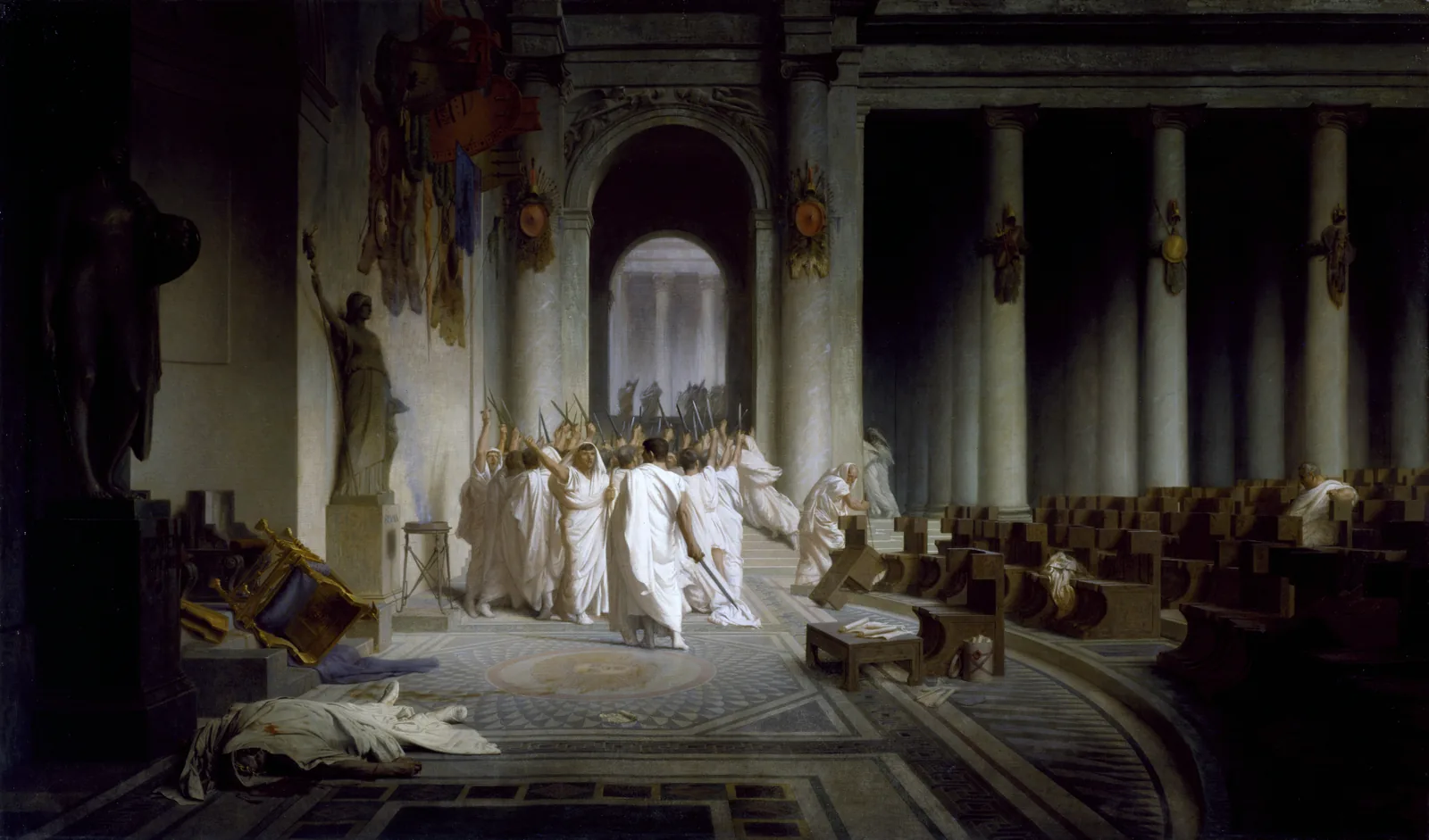
Jean-Léon Gérôme, The Death of Caesar, 1859–1867. Walters Art Museum, Baltimore · Public domain · Source page
Sixty days
Twenty-three wounds
Rome, 15 March 44 BC, late morning. A man of fifty-five sits down on a golden chair in a hall built by his dead rival. Minutes later he lies at the foot of that rival’s statue, stabbed 23 times.
He is Gaius Julius Caesar. In five years of civil war he had won every campaign, pardoned almost every enemy he caught, rebuilt the calendar and been named dictator for life. Then the men he had pardoned killed him. How did it come to this?
Background
A river, a law, a war
After eight years in Gaul, Caesar’s command was running out. His enemies, the optimates led by Cato, now joined by Pompey, the greatest general of the age, meant to put him on trial the moment he became a private citizen. ‘They would have it so,’ Caesar said later, on the field of Pharsalus.
On 7 January 49 BC the Senate declared an emergency against him. Days later he crossed the Rubicon, the border of Italy, with a single legion; that night has its own lesson.
Gaius Julius Caesar
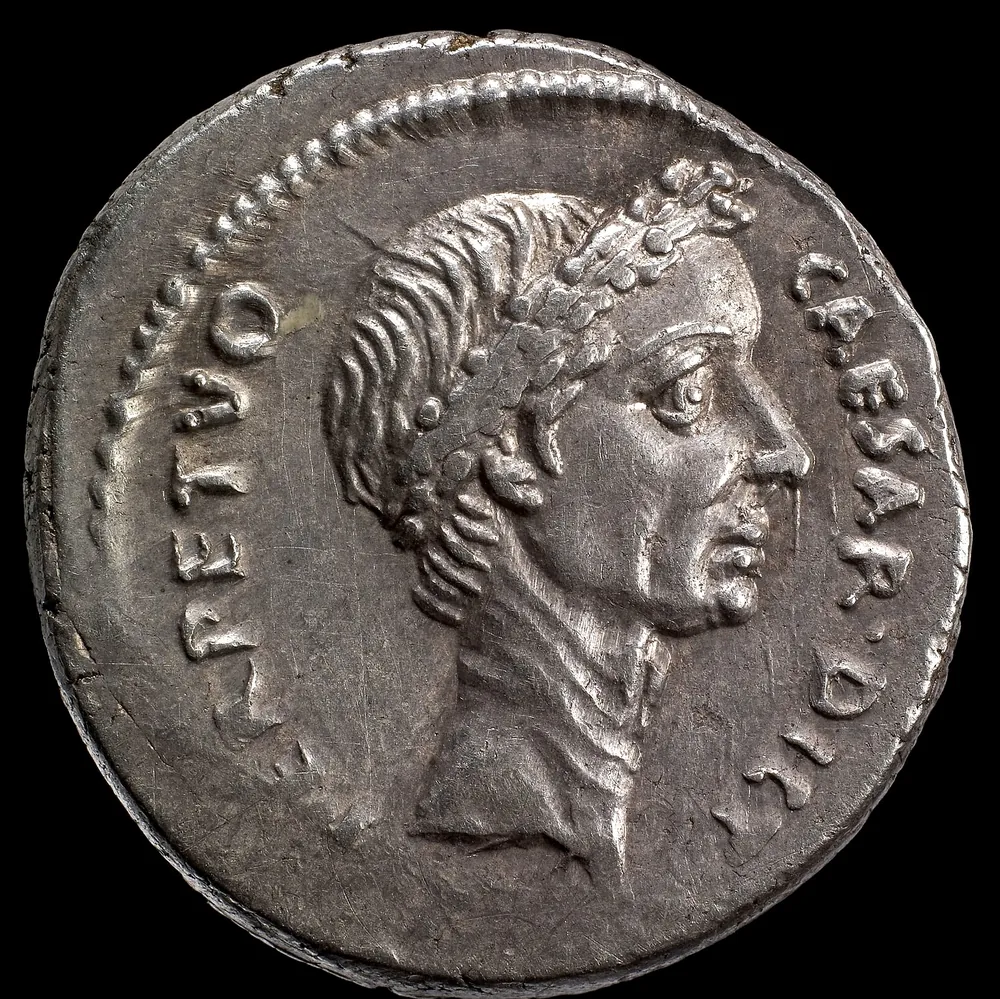
Denarius of Julius Caesar, Rome, 44 BC (moneyer L. Aemilius Buca). Winckless collection. Photo: Andrew McCabe · CC BY 2.0 · Source page
A debt-ridden aristocrat who conquered Gaul, won a civil war on three continents, pardoned his enemies and was killed by them.
- Born: July 100 BC, Rome, into the patrician Julian family
- Died: 15 March 44 BC, The Curia of Pompey, Rome, stabbed by senators in a conspiracy of more than sixty men
- Won: Alesia, 52 BC; Ilerda, 49 BC (without a battle); Pharsalus, 48 BC; Zela, 47 BC; Thapsus, 46 BC; Munda, 45 BC
- Lost: Gergovia, 52 BC; Dyrrhachium, 48 BC
“I came, I saw, I conquered.”
A decision point
You are Gnaeus Pompeius Magnus, Pompey the Great.
January–February 49 BC, in southern Italy
Caesar is across the Rubicon and racing south. Town after town opens its gates to him. You once boasted that wherever you stamped your foot in Italy, armies would spring up. Now a senator asks you to stamp.
In Italy you have two legions that served under Caesar until last year, and raw recruits. Your best army, seven legions, is in Spain. But the East owes you twenty years of favours, and the fleet is yours.
What do you do?
- Stand and fight in Italy with the troops you have You would keep Rome and your honour, at first. But pitting raw recruits and legions loyal to Caesar against his veterans is a gamble: whole garrisons might change sides, and one lost battle could end the war in a week.
- Leave Italy for Greece, raise the East and use the fleet to cut Italy off You would save your army and gain time and the wealth of the East. But you would hand Caesar Rome, the treasury and the look of a lawful government, and you would leave as a fugitive.
- Try to reach your veteran army in Spain You would join your best troops. But by land Caesar stands between you and Spain, the voyage is long, and the East’s resources would go unused.
- Negotiate: both of you give up your armies It might stop the war. But Cato and the consuls have already rejected such an offer, and you would face Caesar alone in Rome’s politics.
What really happened
Leave Italy for Greece, raise the East and use the fleet to cut Italy off
Pompey left Rome on 17 January; the consuls fled so fast that they left the treasury behind. At Corfinium about thirty cohorts that Pompey did not relieve went over to Caesar. On 17 March Pompey sailed from Brundisium (Brindisi) for Greece. Italy was lost in about sixty days, without a battle.
Cicero wrote that Pompey’s policy was that of Themistocles: ‘He considers that the master of the sea must be master of the empire.’ Most historians see sound strategy and costly politics: the Republic’s defenders now looked like refugees, and Caesar, in Rome, looked like the government.
A decision point
You are Gaius Julius Caesar.
February 49 BC, Corfinium, the morning after its surrender
Corfinium has surrendered. In your hands are Domitius Ahenobarbus, named by the Senate to replace you in Gaul, other senators and knights, and their war chest.
Everyone over forty remembers Sulla’s victory in 82: lists of the condemned in the Forum, a reward for every head. Italy is waiting to see whether you are another Sulla.
What do you do with the prisoners?
- Execute or exile the leaders, as Sulla would have done Dangerous enemies would be gone. But every neutral in Italy would conclude that you are a new Sulla, and fight you out of fear.
- Keep them as hostages to bargain with Pompey Useful bargaining chips, perhaps. But every prisoner becomes a grievance, and the towns still waiting to choose would see a jailer.
- Release them all, and give back their money The neutrals and the towns would be reassured. But the men you free are free to fight you again.
What really happened
Release them all, and give back their money
Caesar let them all go unharmed and even returned the public money Domitius had brought. Mercy became declared policy, his clemency, and he kept to it at Ilerda, Pharsalus and after. Domitius fought him again; Brutus and Cassius, pardoned in 48, would lead his murderers.
Soon after, in a letter his agents passed around, Caesar called it ‘a new way of conquering’. It was mercy and calculation together, with a catch proud Romans felt at once: to pardon a man, you must have the power to judge him.
49 BC
An army without a leader
Caesar did not chase Pompey but turned west, ‘to meet an army without a leader’, as he told his friends, and to return ‘to meet a leader without an army’.
At Ilerda (Lleida) in Spain, in summer 49, he out-marched Pompey’s generals, cut them off from water and forced them to surrender without a pitched battle. Again he let them go. In Africa, though, his officer Curio was trapped by King Juba of Numidia and killed with almost his whole army.
Greece: the wall and the plain
Spring–summer 48 BC
Walling in a bigger army
In January 48 Caesar slipped across the Adriatic with seven legions, past Pompey’s fleet; Antony brought four more in April. Near Dyrrhachium (Durrës, in Albania) Caesar tried something strange: with fewer men, he walled in Pompey’s larger army with more than 20 km of earthworks.
Then Pompey broke out by the sea, where Caesar’s line was unfinished. Caesar’s counter-attack collapsed in panic: 960 men lost, most of them, he admits, trampled in their own ditches. ‘To-day victory had been with the enemy,’ he said, in Plutarch’s telling, ‘if they had had a victor in command.’ Caesar slipped away inland, into Thessaly.
August 48 BC
Agamemnon, King of Kings
Pompey followed Caesar into Thessaly and joined his father-in-law, Metellus Scipio, who brought legions from Syria. Pompey’s plan was to avoid battle and let hunger finish Caesar.
The senators in his camp would not wait. They mocked him as ‘Agamemnon, and King of Kings’, and quarrelled over Caesar’s offices before the victory. On 9 August Pompey led his army down onto the plain near Old Pharsalus, and Caesar turned back to fight.
Pharsalus: who fought whom
9 August 48 BC, by the Roman calendar, then running ahead of the seasons
The plain of the river Enipeus, near Old Pharsalus, Thessaly (Greece)
Caesar’s army
- Commanders: Julius Caesar (right wing, with the 10th legion), Gnaeus Domitius Calvinus (centre), Mark Antony (left wing)
- Strength: 80 cohorts, 22,000 men; 1,000 horse (Caesar, Civil War); not quite 30,000 foot, 1,000 horse (Eutropius (4th century AD)); about 22,000 legionaries, 1,000 Gallic and German horse, a few light troops (Modern estimate)
- Losses: 200 soldiers and about 30 centurions (Caesar); 1,200 (Appian, citing ‘some authorities’)
After years of war Caesar’s legions were far below strength: about 275 men a cohort.
Pompey’s army and the Senate’s
- Commanders: Pompey (left wing, by Caesar’s account), Metellus Scipio (centre), Titus Labienus (cavalry)
- Strength: 110 cohorts, 45,000 men plus about 2,000 recalled veterans; 7,000 horse (Caesar); 45,000 foot, 7,000 horse (Plutarch); about 36,000–45,000 legionaries, 5,000–7,000 horse, several thousand archers and slingers (Modern estimate)
- Losses: about 15,000 killed, over 24,000 surrendered (Caesar); not more than 6,000 soldiers (Asinius Pollio, a Caesarian officer at the battle (in Plutarch))
Outcome: A decisive victory for Caesar. Pompey’s army breaks and he escapes to the sea with a handful of horsemen. Most of the survivors surrender the next day and are pardoned.
Caesar is the winner and the only eyewitness whose full account survives. His own officer Pollio counted 6,000 Pompeian dead, not 15,000, and Caesar may have inflated Pompey’s army too.
The battle of Pharsalus
9 August 48 BC, from morning to midday
On 9 August 48 BC, in Thessaly, Pompey leads his larger army down onto the plain near Pharsalus, because his senators will not wait. Caesar has about half the men. The two armies form their lines, with Pompey’s cavalry on the open flank.
One common reconstruction, after Caesar, Civil War 3.84–99, Frontinus 2.3.22 and J. D. Morgan (1983), who places the battle north of the river Enipeus, between the two camps near Old Pharsalus. Other scholars put it south of the river, near the town of Pharsalus. Caesar puts Pompey on his own left wing; Plutarch puts him on the right. Positions, distances and frontages are approximate.
Phases of the battle
- The lines form Pompey anchors his right on the river and masses all his cavalry on his open left. Caesar, with half the men, thins his ranks and hides six cohorts, a ‘fourth line’, behind his right.
- The legions charge Pompey orders his infantry to stand still, so that the attackers arrive exhausted. Caesar’s veterans halt halfway, get their breath, then charge. Pompey’s line holds.
- Labienus’s cavalry attacks Pompey’s plan unfolds: 7,000 horsemen under Labienus drive back Caesar’s 1,000 and begin to swing round his right flank.
- The fourth line strikes Caesar gives the signal. The six hidden cohorts charge the horsemen, using their javelins as spears. The cavalry flees to the hills, and the archers and slingers are cut down.
- Collapse The cohorts wheel into the rear of Pompey’s left, and Caesar sends in his third line. Pompey’s whole army flees. At midday the camp falls, and Pompey escapes towards the sea.
The strategy
- Caesar’s army: Caesar thins his line and hides six cohorts, a ‘fourth line’, behind his right, because his cavalry is far smaller than Labienus’s. When the enemy horse rides round the flank, the hidden line charges them and then wheels into the rear of Pompey’s left.
- Pompey’s army: Pompey anchors his right on the river and masses his cavalry on the open left, by Caesar’s account. He orders his infantry to stand still so that the attackers arrive exhausted. Labienus’s horse drive back Caesar’s cavalry and begin to swing round Caesar’s right flank.
What decided it: What decided it was that Caesar’s six hidden cohorts charged Labienus’s horse as it swung round the flank, then wheeled into the rear of Pompey’s left, and Caesar sent in his third line. Pompey’s whole army fled, and at midday the camp fell.
9 August 48 BC
‘Spare your fellow citizens’
Pompey rode back to his camp and sat in his tent, stunned. When Caesar’s men broke in at midday, he slipped out by the rear gate and rode for the sea. The victors found tables laid for a victory feast.
Caesar, Suetonius writes, ‘cried out, “Spare your fellow citizens.”’ The next morning about 24,000 Pompeians surrendered, and he pardoned them all. Among those who wrote asking for pardon was a young senator whom he welcomed with joy: Marcus Junius Brutus.
28 September 48 BC
A dead man does not bite
Pompey sailed to Egypt. The boy-king Ptolemy XIII was about thirteen, and his advisers did the sums: whichever general they helped, the other would be their enemy. The king’s tutor, Plutarch says, settled it: a dead man does not bite.
On 28 September, as Pompey rose to step ashore from a small boat at Pelusium, a Roman who had once served under him stabbed him in the back, while his wife watched from the ship. Days later Caesar landed at Alexandria and was brought Pompey’s head. He turned away and wept; whether the tears were real, Romans argued even then.
Egypt, Pontus, Africa, Spain
Alexandria, 48–47 BC
A queen in a bed-sack
Caesar stayed in Alexandria to settle a quarrel and collect a debt. Egypt’s throne had been left jointly to Ptolemy XIII and his sister Cleopatra, then about 21, but his men had driven her out. Caesar would judge between them.
Cleopatra could not get through her brother’s army, so she came by boat at nightfall. In Plutarch’s telling she lay inside a bed-sack, and her friend Apollodorus carried it in to Caesar. By morning she had an ally.
Then the city rose. For months Caesar, with about 4,000 men, was besieged in the palace quarter. He burned the Egyptian fleet in the harbour and was rescued by a relief army from Syria that included 3,000 Jewish soldiers. In March 47 Ptolemy drowned in the Nile, and Cleopatra ruled as Rome’s ally. That summer she bore a son, Caesarion, ‘little Caesar’.
Cleopatra VII
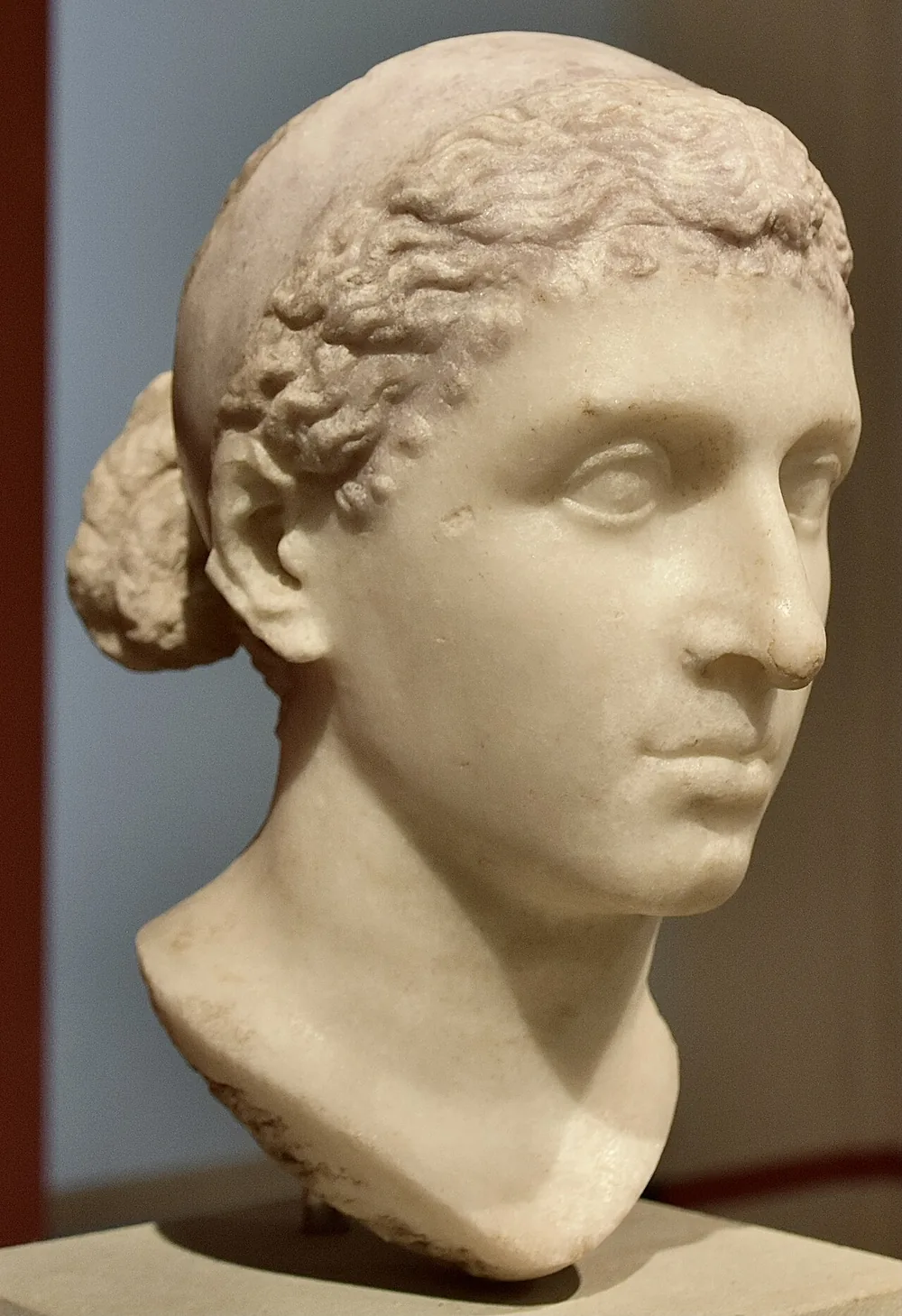
Head of Cleopatra VII, c. 40–30 BC. Antikensammlung, Altes Museum, Berlin. Photo: Richard Mortel · Richard Mortel (edited by Neoclassicism Enthusiast) · CC BY 2.0 · Source page
The last Ptolemaic queen of Egypt, who won Caesar as her ally in Alexandria and was living in his villa in Rome when he was killed.
- Born: 69 BC, Probably Alexandria
- Died: August 30 BC, Alexandria, by her own hand after Octavian took Egypt (see the lesson on Actium)
- Won: Restored to the throne with Caesar’s help, 47 BC
- Lost: Driven out by her brother’s court, 49–48 BC; Actium, 31 BC
“Converse with her had an irresistible charm.”
Myth
Caesar burned the great Library of Alexandria, and with it most of the knowledge of the ancient world.
The truth
Caesar set fire to the Egyptian ships in the harbour. The fire spread to the docks and burned warehouses that seem to have held books, perhaps 40,000 rolls. The Library itself went on working: Strabo, who lived in Alexandria about twenty years later, describes its institute, the Museum, as active. It declined slowly, over centuries.
The evidence
Caesar mentions only the ships. Seneca, quoting a lost book of Livy, gives 40,000 books. Plutarch and Dio, 150 and 250 years later, say ‘the library’, though Dio’s Greek may mean book depots by the harbour. Later writers inflated the loss to 700,000 rolls, and the tale that Arab conquerors burned it in AD 642 first appears around 1200.
47 BC
Came, saw, conquered
While Caesar was trapped in Alexandria, Pharnaces, son of Rome’s old enemy Mithridates, seized Pontus on the Black Sea. In the summer of 47 Caesar destroyed his army near Zela, in modern Turkey, in about four hours. He reported it in three words: Veni, vidi, vici, ‘I came, I saw, I conquered’.
Back in Italy his veterans mutinied for their pay. Caesar ended it, Suetonius says, ‘with a single word’: he called them ‘citizens’ instead of ‘soldiers’.
Africa, 46 BC
The man who refused to be pardoned
Pompey’s party regrouped in Africa under Metellus Scipio, with King Juba and his elephants. On 6 April 46, at Thapsus in today’s Tunisia, Caesar smashed them; his veterans cut down even men trying to surrender.
In the port of Utica, Cato, Caesar’s most stubborn enemy, helped everyone who wished to flee by sea, read Plato’s dialogue on the soul, and stabbed himself. He would not live by Caesar’s clemency. ‘Cato,’ Caesar said, as Plutarch reports, ‘I begrudge thee thy death; for thou didst begrudge me the preservation of thy life.’ Dead, Cato became the Republic’s martyr.
46–45 BC
Four triumphs and one last battle
In the late summer of 46 Rome watched four triumphs within a month: over Gaul, Egypt, Pontus and Africa, officially none over Romans. Vercingetorix, captured at Alesia six years before, was paraded and executed. A placard for Pontus read: ‘I came, I saw, I conquered’. Every citizen received 400 sesterces, 100 of them for the delay.
The war was not over. Pompey’s sons raised 13 legions in Spain. At Munda, on 17 March 45, Caesar’s line began to give way, and he ran forward on foot to rally it. ‘He had often striven for victory,’ Plutarch writes, ‘but now first for his life.’ He won, and Labienus, his old officer turned enemy, was killed. The triumph for Spain was openly a triumph over Romans, and it was resented.
Dictator for life
46–44 BC
Fixing time itself
Caesar was now dictator, for ten years and then, from early 44, for life. He enlarged the Senate to about 900 with his own men, Gauls among them, and founded colonies for veterans and the poor at Carthage and Corinth.
His most lasting work was the calendar. The Roman year had 355 days, and the priests, who were meant to add extra months, had done it so badly that harvest festivals fell long before the harvest. As pontifex maximus, advised by the astronomer Sosigenes, Caesar made 46 BC 445 days long to catch up with the sun. From 1 January 45 the year had 365 days, with an extra day every fourth year: the Julian calendar.
Honours poured in: a golden chair, a statue among the ancient kings, the title ‘Father of his Country’, and his birth month, Quintilis, renamed Iulius: July. And he kept pardoning.
A decision point
You are Gaius Julius Caesar, dictator for life.
15 February 44 BC, the Lupercalia, in the Forum
You sit on the speakers’ platform in the Forum, on a golden chair, in a victor’s purple. It is the Lupercalia, an old festival when young men run half-naked through the city. One runner, your fellow consul Mark Antony, climbs up to you holding a diadem, the white band of Eastern kings.
Rome has hated the word ‘king’ since it drove out its last one, in 509 BC. Three weeks ago, when the crowd hailed you as rex, you answered that you were Caesar, not Rex. In a month you leave for a war in Parthia that may last three years.
What do you do with the diadem?
- Accept the diadem You would be what many already think you are. The East understands kings, and many of the poor might cheer. But the nobility would see the Republic openly abolished, and some of them would see it as a duty to kill you.
- Refuse it publicly, and stay dictator for life The crowd would cheer the refusal, and perhaps the rumour would die. But you would keep a king’s power under another name, and your enemies would say the whole scene was staged.
- Refuse it, and lay down the dictatorship, as Sulla did You would win honour and calm the Senate. But once your power was gone, your enemies could put you on trial or kill you, and your reforms could be undone.
What really happened
Refuse it publicly, and stay dictator for life
Caesar pushed the diadem away. Cicero says the people groaned at the offer and applauded the refusal. Caesar sent the diadem to Jupiter on the Capitol, Rome’s only king, had the refusal written into the official calendar, and stayed dictator for life.
Nobody knows what he meant: a test of the crowd staged with Antony, a refusal meant to bury the rumour, or Antony’s own idea. Cassius Dio wrote that people suspected Caesar wanted the title but wished to be compelled to take it. Either way, it reassured no one: a dictator for life already had a king’s power.
Marcus Junius Brutus
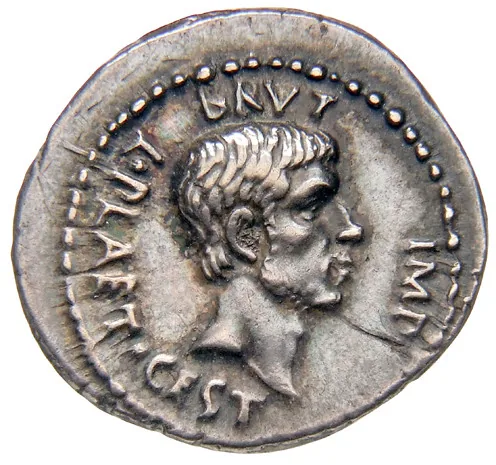
Denarius of Brutus (moneyer L. Plaetorius Cestianus), 43–42 BC, obverse. Münzkabinett, Staatliche Museen zu Berlin. Photo: Reinhard Saczewski · Public domain · Source page
A senator and philosopher who fought against Caesar, was pardoned and promoted by him, and then led his murder in the name of liberty.
- Born: Probably 85 BC, Probably Rome
- Died: October 42 BC, Philippi, Macedonia, by his own hand after his defeat (see the lesson on Actium)
- Won: First battle of Philippi (on his wing), 42 BC
- Lost: Pharsalus (on Pompey’s side), 48 BC; Second battle of Philippi, 42 BC
“Brutus was the only conspirator against Caesar who was impelled by the splendour and by what seemed to him the nobility of the enterprise.”
A decision point
You are Marcus Junius Brutus, praetor of Rome.
February–March 44 BC, Rome
Four years ago you fought for Pompey at Pharsalus. Caesar spared you, sought you out, made you a governor and then praetor, and has promised you the consulship. Your mother Servilia was once his lover.
But your uncle and father-in-law Cato chose death over Caesar’s pardon, and your family claims descent from the Brutus who drove out Rome’s last king. Every morning there are notes on your praetor’s chair: ‘Thou art asleep, Brutus.’ Cassius is asking you to join a plot.
What do you do?
- Join, and give the plot your name The plot would gain what it lacks: a man everyone believes is honest. But you would be the killer of your benefactor, and Caesar’s soldiers and the crowd are not on your side.
- Refuse, stay loyal and wait for your consulship You would be safe, rich and consul in 41. But you would serve a king in all but name, and others might strike without you.
- Warn Caesar Caesar would be grateful, and perhaps safe. But your friends would die, and you would start a purge that wrecks his clemency.
What really happened
Join, and give the plot your name
Brutus joined. With Cassius and Decimus Brutus, one of Caesar’s own generals, he led a conspiracy of more than sixty men, many of them Pompeians whom Caesar had pardoned. He insisted on one thing: only Caesar would die. Killing Antony, he argued, would turn justice into a faction’s coup. Antony lived.
Ancient writers already disagreed about motives: Appian and Dio stress envy and wounded pride, while Antony himself, Plutarch says, believed Brutus alone acted from conviction. To a Roman noble, living by a master’s favour was a kind of slavery.
15 March 44 BC
The Ides of March
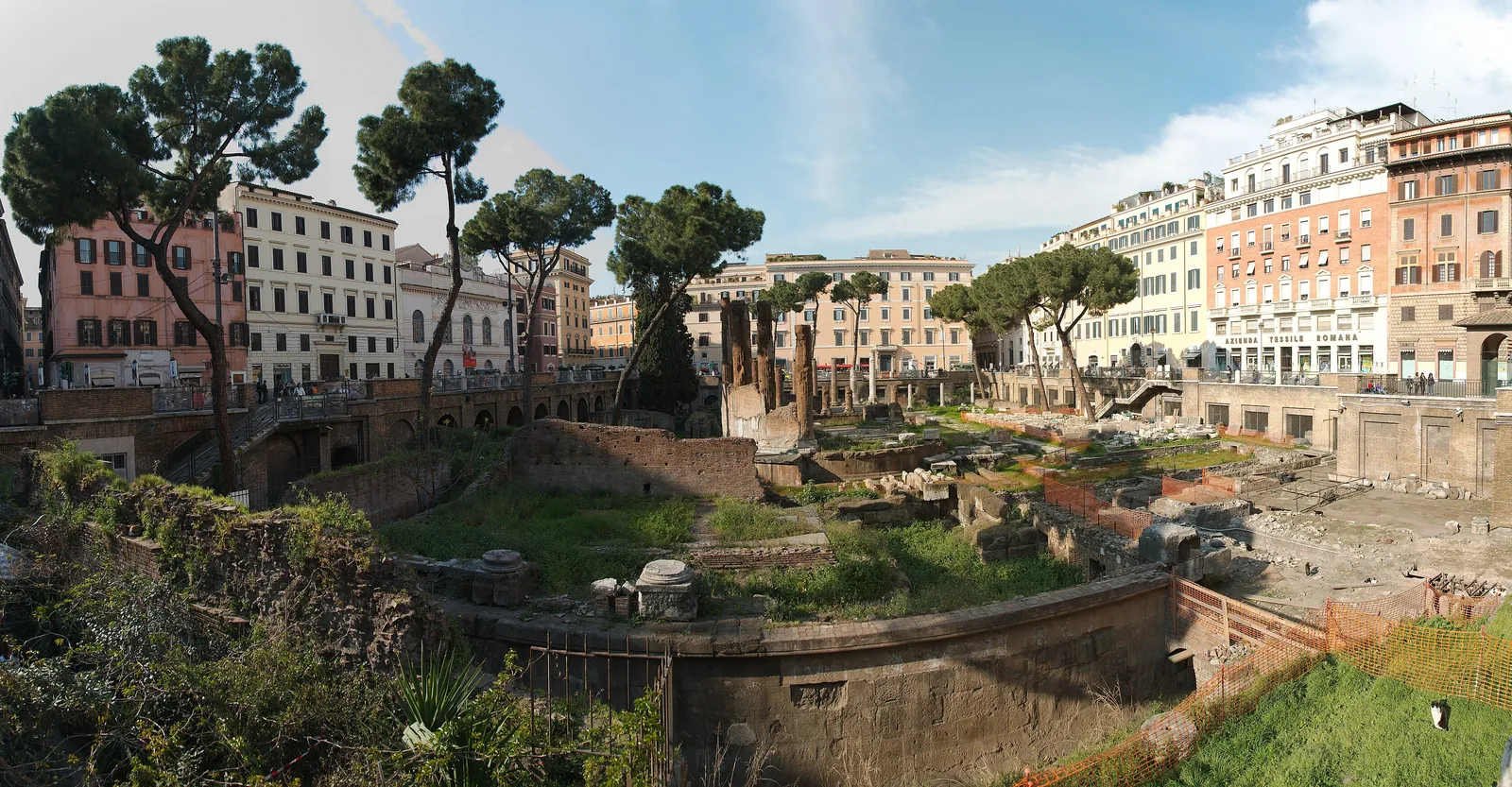
Largo di Torre Argentina, Rome, seen from the south, 2009. Photo: Matthias Kabel · CC BY-SA 3.0 · Source page
There were warnings, or so the stories say. A soothsayer, Spurinna, had warned Caesar of danger no later than the Ides of March. That morning Caesar joked that the Ides had come; Spurinna replied, Suetonius writes, ‘that they had of a truth come, but they had not gone.’
The Senate met in the curia of Pompey, a hall attached to the theatre he had built. Outside, Trebonius kept Antony talking. Inside, Tillius Cimber pulled Caesar’s toga from his shoulders: the signal. Casca struck first, at the neck. Then daggers came from every side, and in the crush the conspirators wounded one another.
Caesar pulled his toga over his head and fell at the foot of Pompey’s statue. He had 23 wounds; in the opinion of a doctor, Antistius, only one was fatal. The senators fled, and for some time the body lay there alone, until three slaves carried it home.
Myth
Caesar’s last words were ‘Et tu, Brute?’, ‘You too, Brutus?’
The truth
No ancient source has those words. Suetonius says Caesar died ‘uttering not a word, but merely a groan at the first stroke’, adding that ‘some have written’ that he said to Brutus, in Greek, kai su, teknon: ‘You too, my child?’ Cassius Dio calls the silent death the truest account.
The evidence
Shakespeare, Julius Caesar, act 3, first performed in 1599: ‘Et tu, Brute? Then fall, Caesar!’ Shakespeare did not coin it (an English play printed in 1595 has it), and set the murder on the Capitol; it happened in Pompey’s hall on the Field of Mars.
March 44 BC
The tyranny lives
The killers marched to the Capitol with daggers raised, calling the people to freedom. The people did not come. On 17 March the Senate voted a compromise: no punishment for the killers, but Caesar’s acts would stand.
Then the will was read: 300 sesterces for every citizen, and as heir his 18-year-old great-nephew, Gaius Octavius, adopted as his son. At the funeral Antony had the Senate’s honours for Caesar read out, with the senators’ oath to protect him. The crowd burned the body in the middle of the Forum on a pyre of benches, then ran with torches to the killers’ houses.
Within weeks Brutus and Cassius had left Rome, and Cleopatra sailed home. Cicero wrote: ‘the tyranny lives though the tyrant is dead!’
How do we know?
Source: Caesar reports his own battle
“But our men, when the signal was given, rushed forward with their javelins ready to be launched, but perceiving that Pompey’s men did not run to meet their charge, having acquired experience by custom, and being practised in former battles, they of their own accord repressed their speed, and halted almost midway, that they might not come up with the enemy when their strength was exhausted…”
Caesar writes about himself in the third person, as ‘Caesar’, and calls his soldiers ‘our men’.
- Why would a general write about himself as ‘Caesar’, not ‘I’? It sounds like a neutral report, not a memoir. The dry style is part of the argument: it invites you to trust him.
- Caesar says he lost 200 men. His own officer Pollio counts 6,000 Pompeian dead, not 15,000. What does that teach about a winner’s numbers? Winners round the enemy’s losses up and their own down. Check against an independent witness where one exists; where none does, the figure is a claim.
Source: ‘A new way of conquering’
“Let us see if by moderation we can win all hearts and secure a lasting victory, since by cruelty others have been unable to escape from hatred and to maintain their victory for any length of time except L. Sulla, whose example I do not intend to follow. This is a new way of conquering, to strengthen one’s position by kindness and generosity.”
Written to his two agents in Rome two weeks after Corfinium. They copied it to Cicero, who sent it on to his friend Atticus.
- This is a private letter. Or is it? His agents copied it to Cicero, the most talkative man in Rome. It is a policy statement dressed as a private note.
- Mercy ‘to strengthen one’s position’: is that a moral argument or a strategic one? Both, openly. And notice who decides whom to pardon: the pardoner. To a proud senator, forgiveness from an equal was a humiliation.
Source: The doctor’s report
“When he saw that he was beset on every side by drawn daggers, he muffled his head in his robe… And in this wise he was stabbed with three and twenty wounds, uttering not a word, but merely a groan at the first stroke… And of so many wounds none turned out to be mortal, in the opinion of the physician Antistius, except the second one in the breast.”
Suetonius, secretary to the emperor Hadrian, wrote about 165 years after the murder, with access to the imperial archives.
- Which words show Suetonius weighing his sources? ‘In the opinion of the physician Antistius’. He names an expert instead of deciding himself, and elsewhere flags a doubtful story with ‘some have written’.
- Only one wound in 23 was fatal. What does that suggest about the attack? Many blows were wild or symbolic: every conspirator wanted his share in the deed, and they even wounded one another.
Source: Murder on a coin
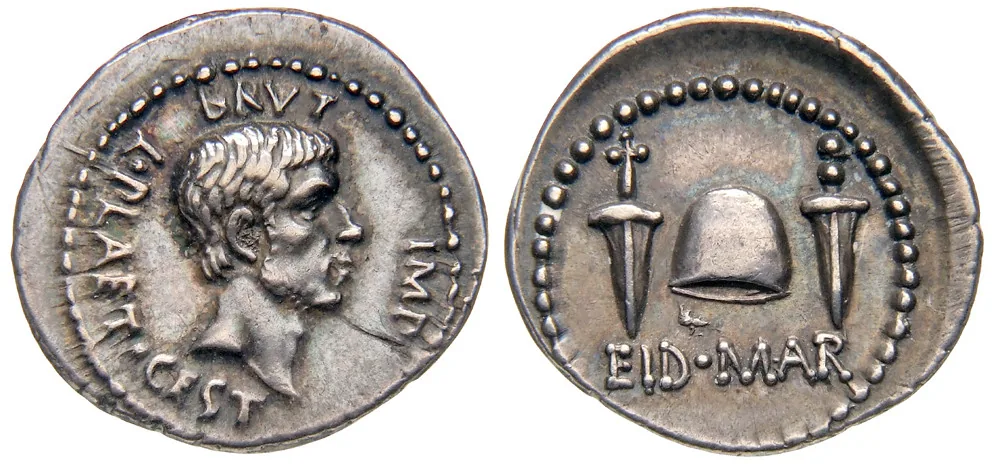
Denarius of Brutus (moneyer L. Plaetorius Cestianus), 43–42 BC. Münzkabinett, Staatliche Museen zu Berlin. Photo: Reinhard Saczewski · Public domain · Source page
“Brutus stamped upon the coins which were being minted his own likeness and a cap and two daggers, indicating by this and by the inscription that he and Cassius had liberated the fatherland.”
On this denarius: Brutus’s head, and on the other side a cap between two daggers and the letters EID MAR, ‘on the Ides of March’. It was struck in the East, probably to pay his soldiers.
- What does the cap mean? A freed slave received a felt cap, the pileus. The killers claim they freed Rome; the daggers show how.
- Brutus put his own face on the coin. Who was the first living Roman to do that? Caesar, in 44 BC, on coins like the one on his card. The ‘liberator’ copied the tyrant’s most kingly habit.
What came of it
The man who pardoned, and the heir who did not
- 44 BC Quintilis is renamed Iulius: July. A comet shines for seven days, and Romans take it for Caesar’s soul.
- 43 BC Antony, Octavian and Lepidus publish lists of the condemned, as Sulla had. Cicero is murdered. Caesar’s clemency is abandoned.
- 42 BC Caesar is declared a god. At Philippi Brutus and Cassius are defeated and take their own lives.
- 31–30 BC Actium: Octavian defeats Antony and Cleopatra (the next lesson).
- 29 BC A temple of the Deified Julius rises in the Forum, where his body was burned.
- 27 BC Octavian becomes Augustus and rules alone, behind the Republic’s forms, until his death in AD 14.
- 1582 Pope Gregory XIII corrects the Julian calendar.
- Centuries later His name becomes a title: Kaiser in German, Tsar in Russian, keisar in Hebrew.
King, or the Republic’s undertaker?
Did Caesar destroy a working Republic, or bury one that was already dead?
- Theodor Mommsen, History of Rome (1856) Caesar was a creative genius who knowingly replaced a rotten aristocracy with a popular monarchy serving all citizens and provincials. He was right, and his murder was a tragic mistake.
- Christian Meier, Caesar (1982) The Republic was in a ‘crisis without alternative’: everyone saw it failing, and no one could imagine anything to replace it. Caesar was a brilliant outsider who could win power but had no programme for a new order, so the nobles could neither accept him nor replace him.
- Erich Gruen, The Last Generation of the Roman Republic (1974) The Republic’s institutions were still working in the 50s BC. It was not doomed by long decay: the civil war that began in 49 destroyed it. The Republic fell because of the war, not the war because the Republic had fallen.
And did Caesar want the crown? Stefan Weinstock argued that he planned a god-like monarchy on Eastern lines; Elizabeth Rawson doubted it, and Plutarch already says many honours were pressed on him by flatterers and enemies. We have not one word from Caesar about what he meant to build after Parthia. Suetonius reports the view of his own day, that Caesar abused his power and was justly slain; but he lists his greatness beside it.
Last word
Caesar’s own prophecy
Caesar used to say, Suetonius writes, that if anything befell him the commonwealth would have no peace, but would be plunged into civil war under much worse conditions. He was right. The killers meant to restore the Republic and opened thirteen more years of war. The man who pardoned his enemies was killed by men he had pardoned; his heir, who began with lists of the condemned, died in his bed after more than forty years as sole ruler.
What do you know now?
Check yourself
Why did Pompey leave Italy in 49 BC without a battle?
Answer: To save his army, and fight Caesar with the East and the fleet. Right. Cicero called it Themistocles’ plan: the master of the sea is master of the empire. The price was political: Rome was left to Caesar.
Check yourself
What did Cato do at Utica, and why?
Answer: He killed himself, so as not to live by Caesar’s pardon. Right. To him, accepting a pardon meant admitting that Caesar had the right to judge. His death made him the Republic’s martyr.
Check yourself
At Pharsalus, what stopped Labienus’s 7,000 horsemen?
Answer: Six cohorts Caesar had hidden behind his right wing. Right. The ‘fourth line’ charged the horsemen, then wheeled into the rear of Pompey’s left.
Check yourself
What really burned at Alexandria in 48 BC?
Answer: Ships, docks and warehouses by the harbour, perhaps with 40,000 books; the Library went on working. Right. Strabo, who lived in the city about twenty years later, describes the Museum as active. The Library declined slowly, over centuries.
Check yourself
Why did Caesar’s refusal of the diadem at the Lupercalia not reassure his enemies?
Answer: Because as dictator for life he already had a king’s power, without the title. Right. And several writers suspected that the whole scene had been staged with Antony.
Check yourself
Where do the words ‘Et tu, Brute?’ come from?
Answer: From Shakespeare’s play, 1599. Right. No ancient source has them. Suetonius gives, as a rumour, words in Greek: kai su, teknon.
Terms
- legion The main unit of the Roman army: on paper about 4,800 foot soldiers in ten cohorts. Caesar’s veteran legions were often far below that strength.
- cohort A tenth of a legion, about 480 men at full strength. At Pharsalus Caesar’s cohorts averaged fewer than 300.
- optimates ‘The best men’: the conservative senators, led by Cato, who defended the Senate’s control and saw Caesar as a danger to the Republic.
- clemency Caesar’s policy of pardoning defeated Romans and letting them keep their property. His friends called it mercy; his enemies saw the favour of a master to his subjects.
- dictator A Roman emergency office: one man with supreme power, for six months at most. Caesar was made dictator for ten years in 46 BC and for life early in 44.
- triumph A victory parade through Rome granted by the Senate: the general rode in a chariot behind his prisoners and loot. It was meant for victories over foreign enemies, not over Romans.
- Julian calendar Caesar’s calendar, in force from 1 January 45 BC: 365 days, with an extra day every fourth year. Our Gregorian calendar is a correction of it made in 1582.
- pontifex maximus Rome’s chief priest, who was also in charge of the calendar. Caesar was elected in 63 BC and held the post until his death.
- Ides The middle day of the Roman month: the 15th in March, May, July and October, the 13th in the other months.
- curia A meeting hall of the Senate. In 44 BC the Senate house in the Forum was being rebuilt, so the Senate met in the Curia of Pompey, a hall attached to the theatre he had built.
- diadem A white band tied round the head: the badge of the Hellenistic kings of the East, and to Romans the unmistakable sign of a king.
- denarius Rome’s standard silver coin. Generals struck denarii to pay their soldiers, and used them to tell those soldiers who they were.
- Sulla A Roman general who won a civil war in 82 BC and published lists of men condemned to death.
- Cato A stubborn Roman senator, Caesar's most determined enemy. He chose death over Caesar's pardon.
- Domitius Ahenobarbus A Roman commander the Senate named to replace Caesar in Gaul. Caesar let him go after he was captured at Corfinium, and he fought Caesar again.
- Metellus Scipio A Roman commander and father-in-law of Pompey. He brought legions from Syria and later led Pompey's side in Africa.
- Juba King of Numidia in North Africa. He backed Pompey against Caesar.
- Curio An officer of Caesar's who was trapped by King Juba in Africa and killed with almost his whole army.
- Labienus An old officer of Caesar's who switched to the enemy side and was killed at Munda.
- Casca One of the conspirators who killed Caesar. He struck the first blow, at the neck.
- Spurinna A soothsayer who warned Caesar of danger no later than the Ides of March.
- Augustus Caesar's heir, first called Gaius Octavius. He became Rome's first sole ruler.
- Ptolemy XIII The boy-king of Egypt, who inherited the throne together with his sister Cleopatra. His men drove her out.
- Josephus A Jewish historian who wrote in Rome about 140 years after the events in Egypt.
- Plutarch A later writer who wrote about the lives of famous Romans and Greeks. Many stories about Caesar come from him.
- Suetonius A Roman writer who wrote about 165 years after Caesar's murder. He had been secretary to the emperor Hadrian.
- Cassius Dio A later writer. In his account Cleopatra won Caesar with her looks and her talk, with no trick at all.
- Vercingetorix The leader of the Gauls who revolted against Caesar. He was captured at Alesia, paraded through Rome and executed.
- Pharsalus A plain in Thessaly where Caesar beat Pompey in 48 BC.
- Dyrrhachium A port in today's Albania, also called Durrës. There Caesar tried to wall in Pompey's army and suffered heavy losses.
- Thapsus A town in today's Tunisia, where Caesar crushed Pompey's supporters in 46 BC.
- Munda A place in Spain where Caesar beat the army of Pompey's sons in 45 BC.
- Thessaly A region of northern Greece. Caesar retreated there, and Pompey followed him before the battle at Pharsalus.
- Senate The top council of Rome, made up of senior and influential men. In 49 BC it declared an emergency against Caesar.
- toga A long wrapped garment worn by Roman citizens, especially on formal occasions.
- proscription A public list of people condemned to death. Whoever killed one of them was given a reward.
- the Forum Rome's central square, where speeches, rituals and trials took place.
Sources
- Caesar, Civil War 1.1–3.112 (esp. 1.15–28, 3.41–99, 3.102–112), trans. W. A. McDevitte and W. S. Bohn (London, 1851; New York: Harper & Brothers, 1869)
- [Caesar], Alexandrian War 1–33, 65–78; African War 79–98; Spanish War 27–31
- Cicero, Letters to Atticus 9.7C, 9.10, 10.8, 11.6, 14.9, trans. E. O. Winstedt (Loeb, 1913–1918)
- Cicero, Second Philippic 84–91, trans. C. D. Yonge (London: George Bell & Sons, 1903)
- Suetonius, Life of the Deified Julius 30–89, trans. J. C. Rolfe (Loeb, 1914)
- Plutarch, Caesar 35–69; Pompey 57–80; Brutus 5–20, 29; Cato the Younger 66–72; Antony 11–14, 27, trans. B. Perrin (Loeb, 1916–1920)
- Appian, Civil Wars 2.35–148, trans. H. White (Loeb, 1913)
- Cassius Dio, Roman History 41–44 and 47.25, trans. E. Cary (Loeb, 1916–1917)
- Frontinus, Stratagems 2.3.22, trans. C. E. Bennett (Loeb, 1925)
- Josephus, Jewish Antiquities 14.127–144, trans. W. Whiston (1737)
- Seneca, On Tranquillity of Mind 9.5; Strabo, Geography 17.1.8; Pliny, Natural History 18.211; Eutropius 6.19–25
- William Shakespeare, Julius Caesar (first performed 1599; printed 1623), 1.2 and 3.1
- Adrian Goldsworthy, Caesar: Life of a Colossus (New Haven: Yale University Press, 2006)
- Christian Meier, Caesar, trans. David McLintock (London: HarperCollins, 1995; German ed. Berlin: Severin und Siedler, 1982)
- Matthias Gelzer, Caesar: Politician and Statesman, trans. Peter Needham (Oxford: Blackwell, 1968)
- Ronald Syme, The Roman Revolution (Oxford: Clarendon Press, 1939)
- Erich S. Gruen, The Last Generation of the Roman Republic (Berkeley: University of California Press, 1974)
- Theodor Mommsen, Römische Geschichte, vol. III (Leipzig: Weidmann, 1856); English trans. W. P. Dickson, The History of Rome (1862–1866)
- Elizabeth Rawson, ‘Caesar: civil war and dictatorship’, in J. A. Crook, A. Lintott and E. Rawson (eds), The Cambridge Ancient History, 2nd ed., vol. IX (Cambridge University Press, 1994), 424–467
- Stefan Weinstock, Divus Julius (Oxford: Clarendon Press, 1971)
- Robin Seager, Pompey the Great: A Political Biography, 2nd ed. (Oxford: Blackwell, 2002)
- Barry Strauss, The Death of Caesar: The Story of History’s Most Famous Assassination (New York: Simon & Schuster, 2015)
- Kathryn Tempest, Brutus: The Noble Conspirator (New Haven: Yale University Press, 2017)
- Duane W. Roller, Cleopatra: A Biography (Oxford University Press, 2010)
- Denis Feeney, Caesar’s Calendar: Ancient Time and the Beginnings of History (Berkeley: University of California Press, 2007)
- Melissa Barden Dowling, Clemency and Cruelty in the Roman World (Ann Arbor: University of Michigan Press, 2006)
- Roger S. Bagnall, ‘Alexandria: Library of Dreams’, Proceedings of the American Philosophical Society 146.4 (2002), 348–362
- J. D. Morgan, ‘Palaepharsalus: the battle and the town’, American Journal of Archaeology 87 (1983), 23–54
- M. H. Crawford, Roman Republican Coinage (Cambridge University Press, 1974), nos. 480 and 508/3
Image credits
- Jean-Léon Gérôme, The Death of Caesar, 1859–1867. Walters Art Museum, Baltimore · Public domain · Source page
- Denarius of Julius Caesar, Rome, 44 BC (moneyer L. Aemilius Buca). Winckless collection. Photo: Andrew McCabe · CC BY 2.0 · Source page
- Head of Cleopatra VII, c. 40–30 BC. Antikensammlung, Altes Museum, Berlin. Photo: Richard Mortel · Richard Mortel (edited by Neoclassicism Enthusiast) · CC BY 2.0 · Source page
- Denarius of Brutus (moneyer L. Plaetorius Cestianus), 43–42 BC, obverse. Münzkabinett, Staatliche Museen zu Berlin. Photo: Reinhard Saczewski · Public domain · Source page
- Largo di Torre Argentina, Rome, seen from the south, 2009. Photo: Matthias Kabel · CC BY-SA 3.0 · Source page
- Denarius of Brutus (moneyer L. Plaetorius Cestianus), 43–42 BC. Münzkabinett, Staatliche Museen zu Berlin. Photo: Reinhard Saczewski · Public domain · Source page


