Caesar II: the Gallic Wars to Alesia
Eight years, a million dead by one ancient count, and a siege in which the besiegers were besieged themselves.
Decisions, questions and your own progress, in the app
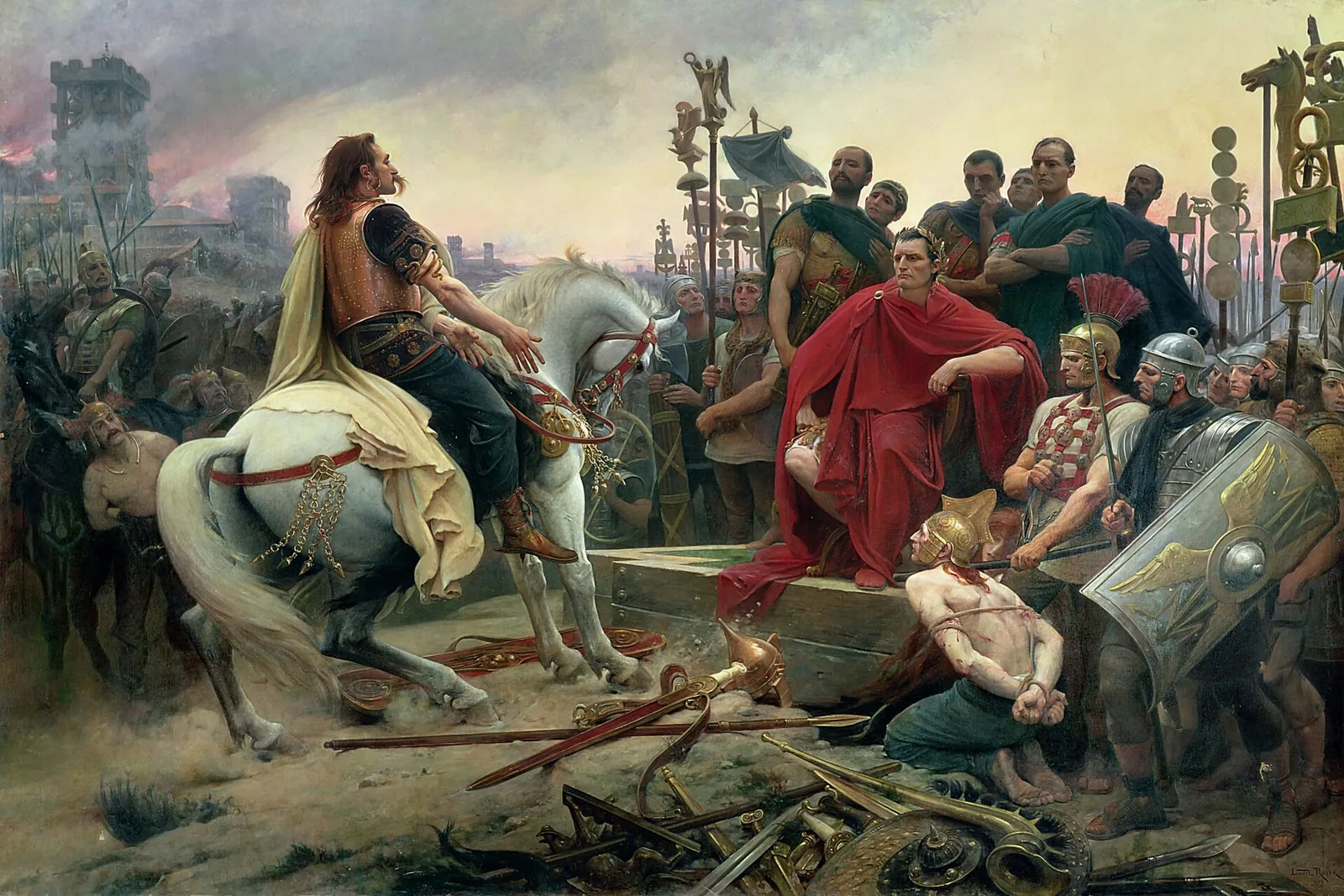
Lionel Royer, Vercingetorix Throws Down His Arms at the Feet of Julius Caesar, 1899. Musée Crozatier, Le Puy-en-Velay · Public domain · Source page
Walls facing both ways
The besiegers besieged
Late summer, 52 BC, a hill in Burgundy. Inside its walls are, by one count, 80,000 Gauls and their leader, Vercingetorix. Around it, Roman soldiers have dug a ring of ditches, stakes and towers some 15 kilometres long.
Behind their backs runs a second ring, 21 kilometres long, facing outwards. All Gaul is coming to break the siege; Caesar has built himself a fortress with an enemy on both sides.
How did a Roman governor get here, six years after arriving with four legions? And why do we know almost all of it from one witness, Caesar himself?
Julius Caesar
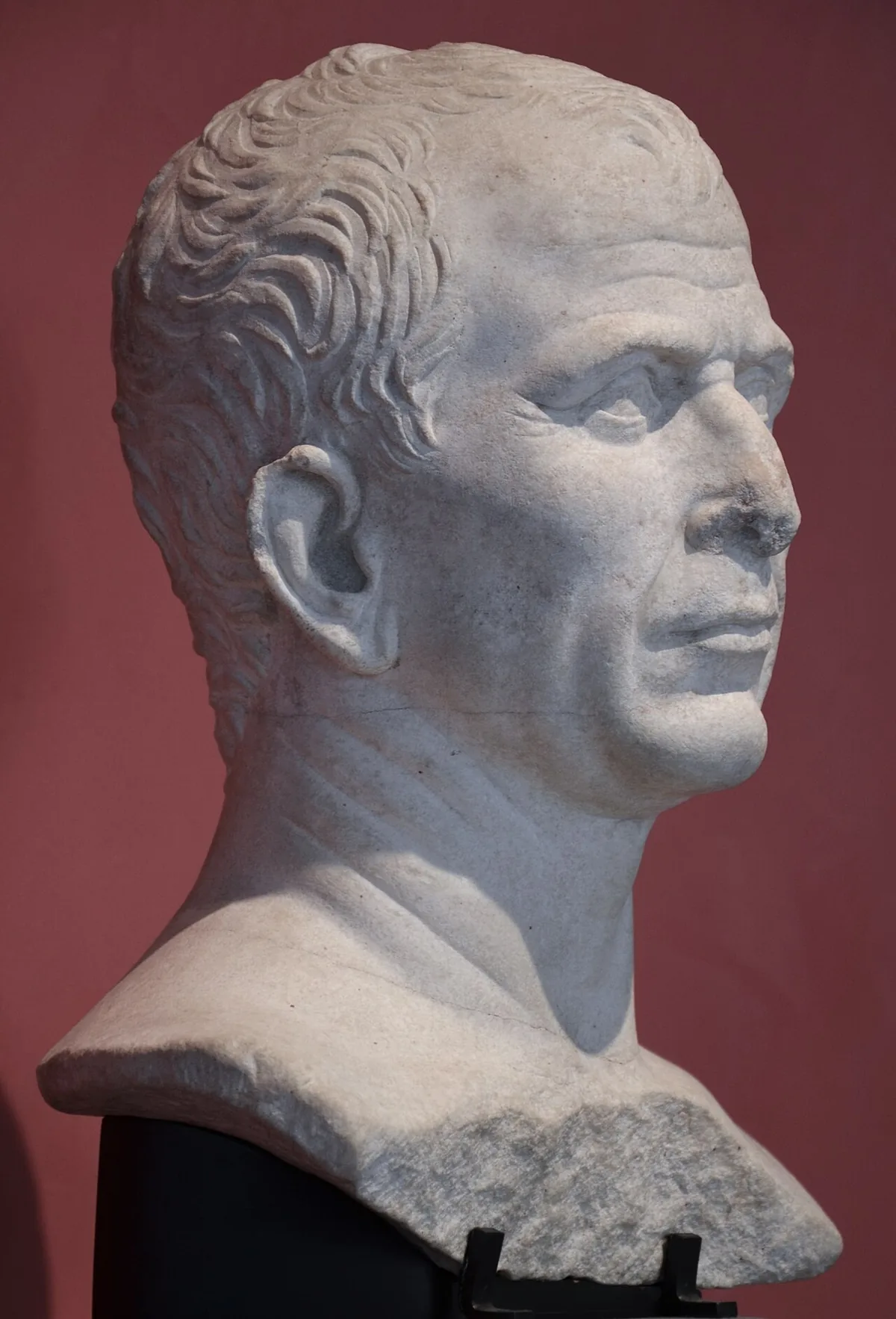
Marble bust found in the Rhône at Arles, possibly Julius Caesar, 1st century BC. Musée départemental Arles antique. Photo: Carole Raddato · CC BY-SA 2.0 · Source page
A proconsul who turned a five-year command into the conquest of all Gaul, and wrote the only full account of it himself.
- Born: July 100 BC, Rome
- Died: 15 March 44 BC, Rome, at a meeting of the Senate, stabbed by senators (the next lesson)
- Won: Bibracte, 58 BC; Against Ariovistus, 58 BC; The Sabis (Sambre), 57 BC; Avaricum, 52 BC; Alesia, 52 BC; Uxellodunum, 51 BC
- Lost: Gergovia, 52 BC; Fifteen cohorts lost under his legates, 54 BC
“…he required in his soldiers forbearance and self-command, not less than valour and magnanimity.”
Our witness
The general writes the war
Almost everything we know about the conquest of Gaul comes from Caesar's Commentaries: seven short books, one for each year from 58 to 52 BC, written in plain Latin and in the third person, “Caesar did this, Caesar ordered that”, like a neutral report.
They were not neutral. The books were read in Rome while Caesar's future was argued over. Defeats are other men's fault, victories come from his speed, and enemies are huge and treacherous, so every war looks just.
Yet thousands of his officers and soldiers wrote home, so he could not invent battles, and excavation has confirmed the places, the events and the siege works. The spin is in the numbers, the blame and what is left out.
Gaul, and six years of war
Background
Sixty peoples, not one Gaul
“All Gaul is divided into three parts,” Caesar's book begins. In fact Gaul was some sixty peoples, each with its own council and its own feuds. The Aedui of Burgundy were Rome's old friends; their rivals, the Arverni and the Sequani, were not. Since 121 BC Rome had also held the south, the Province.
These were not villagers in huts. They lived in oppida, walled towns with streets and workshops; they struck gold coins, wrote in Greek letters and drank Italian wine by the shipload. Their druids judged disputes and taught that after death the soul passes into another body.
Myth
The Gauls were wild village folk in winged helmets who hauled menhirs about, saved only by a magic potion.
The truth
That is Astérix, a comic of 1959 that gently mocks modern France. Real Gallic helmets had no wings, and the menhirs were raised thousands of years before Caesar, who himself calls Avaricum “the fairest city of almost the whole of Gaul”.
The evidence
Excavations at Bibracte, Gergovia and Alesia: walls, streets, mints and tens of thousands of Italian wine jars. Caesar, Gallic War 6.14 (writing in Greek letters) and 7.15.
58 BC
A migration and a king
368,000
As the last lesson told, Caesar left Rome in March 58 BC as proconsul of three provinces, with four legions, vast debts and five years to make a name.
The first chance came at once. The Helvetii, from today's Switzerland, burned their villages and set off west for new land. Caesar followed them at the request of the Aedui and beat them near Bibracte. He says lists found in their camp counted 368,000 people; modern historians think there were far fewer. Then he drove Ariovistus, a Germanic king settled in Gaul, back across the Rhine, although only a year before, in Caesar's own consulship, the Senate had hailed him as king and friend of Rome.
A decision point
You are Julius Caesar.
Summer 57 BC, on the river Sabis (the Sambre), in the land of the Nervii
You have marched into northern Gaul with eight legions. Warned that the Nervii would strike your leading legion among its baggage, you now march with six legions in front, ready to fight, and the baggage and two new legions behind.
The six are digging the night's camp on a hill above the river. Suddenly the whole Nervian army bursts out of the woods across the water, splashes through the shallows and charges uphill. Your men are scattered, cutting turf and fetching timber; there is no time even to put on helmets.
What do you do?
- Sound the recall: everyone back to the unfinished camp to wait for the last two legions Gathering thousands of scattered men in one place takes time the enemy is not giving you. They would probably be caught on the move, crowded behind half-dug ditches, with the Nervii already among them.
- Let each legion form up and fight where it stands, trusting your officers and their drill Within minutes there are several separate fights along the slope. Some legions win quickly; others, with no one to see the whole field, are soon in deep trouble.
- Abandon the camp and fall back on the baggage and the rear legions A retreat downhill with an enemy at your heels easily turns into a rout. The baggage column on the road would be caught too, and the story told in Rome would be of a flight.
What really happened
Let each legion form up and fight where it stands, trusting your officers and their drill
The legions formed up where they stood, each on its own. On the left the Ninth and Tenth won and took the Nervian camp across the river. On the right the Twelfth and Seventh were surrounded, and their centurions were falling.
Caesar went there himself: “having therefore snatched a shield from one of the soldiers in the rear (for he himself had come without a shield), he advanced to the front of the line” (Gallic War 2.25). Labienus sent the Tenth back, the rear legions arrived, and the Nervii fought almost to the last man.
Caesar's scouting had failed; his army's training saved him, as he admits. But his book lingers on his own charge with a borrowed shield: a scene historians accept, and exactly the picture he wanted Rome to see.
56–54 BC
A sea, a river and an ocean
In 56 BC the seafaring Veneti of Brittany held Roman officers sent to collect grain. Caesar destroyed their fleet, put their council to death and sold the rest as slaves. That spring, at Luca in northern Italy, he and his partners Pompey and Crassus agreed to extend his command by five years. After that, says Suetonius, he “did not let slip any pretext for war, however unjust and dangerous it might be”.
In 55 BC, when two Germanic peoples crossed the lower Rhine, Caesar seized their leaders during talks and fell on their camp, women and children included; in Rome, Cato proposed handing him over to the Germans.
Then came two shows of power. Caesar bridged the Rhine in ten days, crossed, and pulled the bridge down behind him. In 55 and 54 BC he sailed to Britain, the first Roman army to cross the Ocean; the Senate voted twenty days of thanksgiving. Cicero remarked that the island held not a pennyweight of silver.
54–53 BC
A daughter, a legion and a partner
In late summer 54 BC Caesar's daughter Julia, Pompey's wife, died in childbirth. She had been the strongest personal tie between the two men.
That winter a poor harvest forced Caesar to spread his legions out. Ambiorix, a chief of the Eburones, persuaded two legates, Sabinus and Cotta, that all Gaul was rising and offered them safe passage; they marched out into an ambush, and fifteen cohorts, perhaps 5,000 to 7,500 men, were destroyed. In 53 BC Caesar invited the neighbours to plunder the Eburones, so that, in his words, “the race and name of that state may be annihilated”. Ambiorix was never caught.
In June 53 BC Crassus was killed after his defeat by the Parthians at Carrhae. Of the three partners, two were left.
The year of Vercingetorix
Winter 52 BC
Rome burns, Gaul rises
In January 52 BC, with Rome in riots after the murder of the populist Clodius, Gallic chiefs heard that Caesar was held in Italy. The Carnutes struck first, killing the Roman traders at Cenabum (Orléans); shouted from field to field, the news reached the Arverni, 160 miles away, that same evening.
There a young noble, Vercingetorix, whose father had been killed for seeking a crown, raised an army of the poor and was hailed king. People after people gave him the supreme command.
Caesar hurried back over the Cévennes through snow six feet deep, and reached his legions before the rebels could stop him.
Vercingetorix
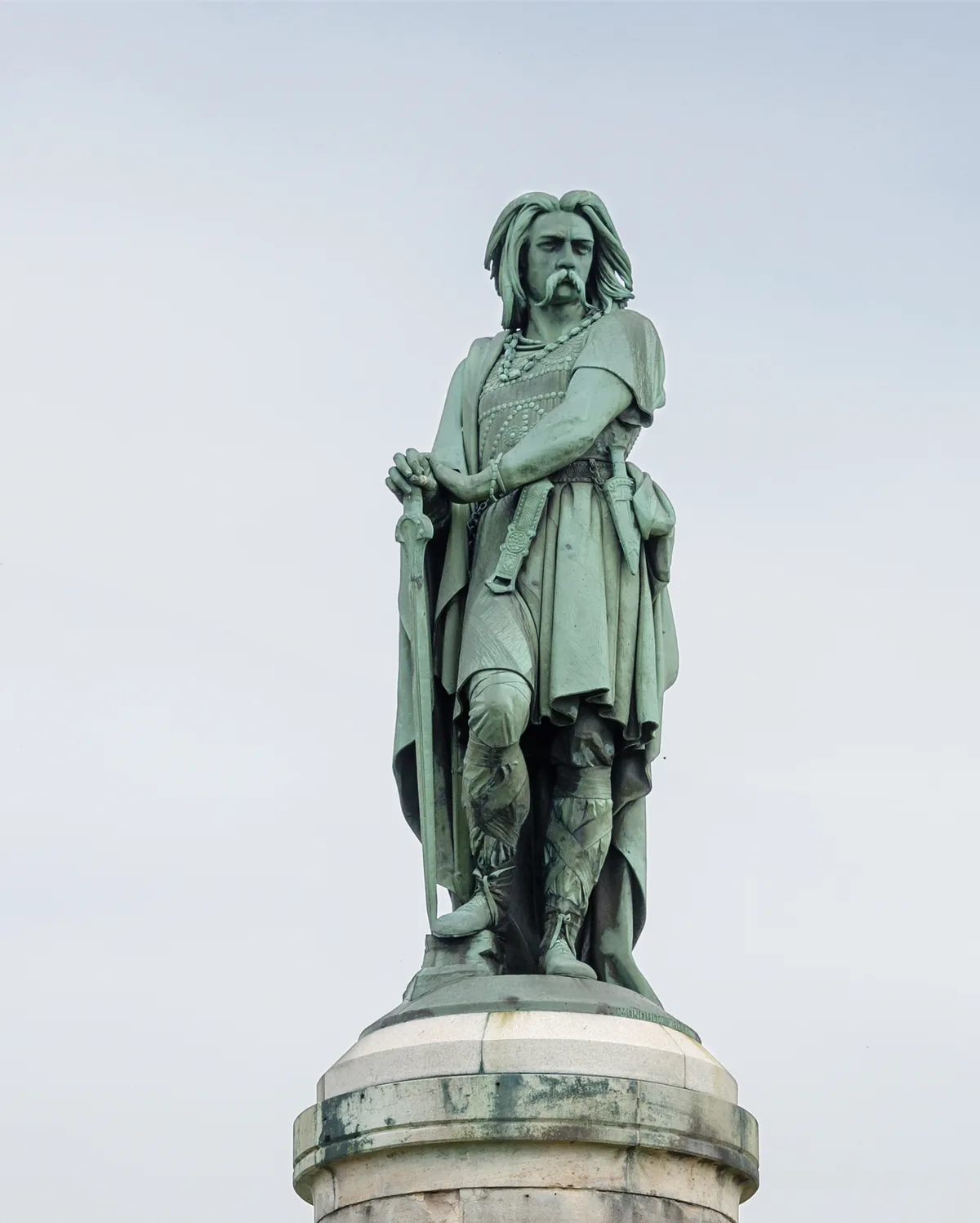
Aimé Millet, Vercingetorix, 1865, Alise-Sainte-Reine. Photo: Myrabella · CC BY-SA 4.0 · Source page
An Arvernian noble who united much of Gaul for a single year, beat Caesar once, and lost everything at Alesia.
- Born: Unknown; a young man in 52 BC, The land of the Arverni (Auvergne)
- Died: 46 BC, Rome, put to death after Caesar's triumph, after some six years in prison
- Won: Gergovia, 52 BC
- Lost: Avaricum, 52 BC; The cavalry attack on Caesar's column, 52 BC; Alesia, 52 BC
“That he had undertaken that war, not on account of his own exigencies, but on account of the general freedom.”
A decision point
You are Vercingetorix.
Early spring 52 BC, in the land of the Bituriges
Caesar is back, and in a few weeks he has taken three towns. Your infantry cannot beat the legions in open battle, and no town has yet held out against Roman siege works.
But it is the end of winter. Caesar's army must forage far and wide for grain and fodder, and you have more cavalry. The Bituriges, whose land he is entering, have one great city: Avaricum.
What do you propose?
- Seek a decisive battle now, while the alliance is eager Gallic armies had lost every open battle against the legions so far. A defeat now would probably break the young alliance before it had properly formed.
- Defend the great towns one by one, Avaricum first This plays to Rome's strength. Caesar's engineers would take one town after another, and its people with it, while your army watched from outside.
- Burn every village and every town that cannot be held, Avaricum included, and starve the Romans Perhaps the strongest plan on paper. But the Bituriges would have to burn their own great city with their own hands, and a proud people might leave the revolt rather than do it.
- Burn the villages and lesser towns, but let the Bituriges defend Avaricum The alliance holds together, and Caesar's supplies are choked. But Avaricum becomes a target he cannot resist.
What really happened
Burn the villages and lesser towns, but let the Bituriges defend Avaricum
More than twenty towns of the Bituriges were burned in one day. Avaricum was spared after its people begged on their knees; Vercingetorix gave way, Caesar says, “owing to their entreaties and the compassion of the soldiers”.
Caesar besieged it. His men went days without grain, yet in 25 days they built an 80-foot siege terrace and stormed the wall in a rainstorm, sparing no one. Of “about forty thousand, scarcely eight hundred … reached Vercingetorix in safety”.
An alliance leader is not a king: Vercingetorix could not make a proud people burn its finest city. And the plan nearly worked; Caesar admits his army went hungry. When Avaricum fell, the man who had warned against defending it gained authority.
Gergovia: who fought whom
Early summer 52 BC
The plateau of Gergovia, about 6 km south of today's Clermont-Ferrand
Caesar's army
- Commanders: Julius Caesar, His legates Gaius Fabius and Titus Sextius
- Strength: six legions, with Aeduan allies (Caesar); about 20,000–30,000 legionaries, plus allies (Modern estimate)
- Losses: “little less than seven hundred” soldiers and 46 centurions (Caesar); probably more: 46 centurions were about one in eight of all the centurions in six legions (Modern view)
Vercingetorix's Gauls
- Commanders: Vercingetorix, Teutomatus, king of the Nitiobriges
- Strength: no figure; “the forces of each state” camped around the town (Caesar); unknown; guesses vary widely (Modern estimate)
- Losses: not given (Caesar)
Outcome: A Gallic victory: the only battle in Gaul Caesar lost in person. He withdraws across the Allier, and the Aedui join the revolt.
Every ancient number comes from Caesar. He counts his own losses, but gives no headcount for either army.
The battle of Gergovia
Early summer 52 BC, one day from dawn to afternoon
Gergovia stands on a plateau some 350 metres above the plain, too strong to storm. Caesar has camped on a low rise to the south-east, with a small camp and a large one joined by a double ditch. Opposite him are Vercingetorix’s Gauls, with their camps on the slope.
After Caesar, Gallic War 7.36–53. The plateau, the camps and the double ditch as located by Napoleon III's officers (1862) and later digs: the small camp on the hill of La Roche-Blanche, the large camp on the Serre d'Orcet. Whether the ditches dug there are really Caesar's is still debated. The line of the Gauls' six-foot wall and the place of their camps on the slope are approximate. Hills from modern elevation data; positions approximate.
Phases of the battle
- Two camps and a ditch Gergovia stands on a plateau some 350 metres above the plain, too strong to storm. Caesar camps on a low rise to the south-east, takes the hill of La Roche-Blanche by night for a small camp, and joins the two with a double ditch.
- The feint Deserters report that the Gauls fear for a wooded ridge to the west. Caesar sends cavalry, mule drivers in helmets and a legion that way to fake an attack. The Gauls rush to fortify it, while his legions slip, a few at a time, into the small camp.
- Over the wall The legions storm up the slope, cross the wall and take three Gallic camps; a Gallic king escapes half-naked. Caesar sounds the retreat. The Tenth, beside him, halts; the others run on to the town wall.
- Thrown back Gallic reinforcements pour back along the plateau. The Aedui appear on the legions' flank and are taken for enemies. The legions break and run, covered by the Tenth and by cohorts from the small camp; Vercingetorix halts the pursuit at the foot of the hill.
The strategy
- Romans: Caesar says he planned only a raid on the Gallic camps on the slope. He fakes an attack on the wooded ridge to the west, and his legions slip, a few at a time, into the small camp. Many historians suspect he hoped to take the town itself.
- Gauls: Vercingetorix holds a plateau too strong to storm, with camps on the slope behind a wall. Fearing for the wooded ridge to the west, the Gauls rush to fortify it. Reinforcements are sent back along the plateau to stop any legion that crosses the wall.
- Aedui, Caesar's allies: The sources do not say what the Aedui, Caesar’s allies, intended.
What decided it: The other legions, which did not hear the retreat, ran on to the town wall, while Gallic reinforcements poured back and drove them off. When the Aedui appeared on the flank and were taken for enemies, the legions broke.
Caesar explains
The trumpet few heard
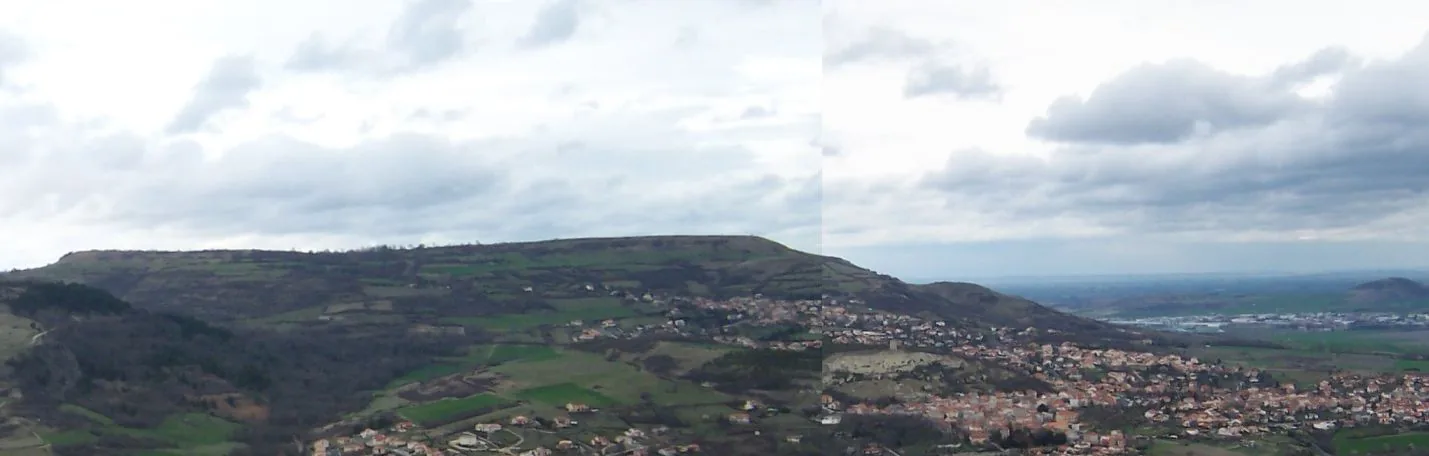
The plateau of Gergovia from Le Crest (composite photo). Photo: Dysmorodrepanis, 2007 · CC BY-SA 3.0 · Source page
Caesar insists he planned only a raid on the Gallic camps and sounded the retreat once they were taken. Only the Tenth, beside him, heard it; a large valley, he says, kept the others from hearing, and they ran on to the wall hoping for plunder.
The next day he rebuked them. Many historians suspect he had hoped to take the town and explained the failure afterwards. Within weeks the Aedui changed sides, and a council at Bibracte confirmed Vercingetorix as supreme commander.
Alesia
A decision point
You are Vercingetorix.
Late summer 52 BC, in the land of the Lingones
After Gergovia the Aedui joined the revolt. You struck Caesar's marching column with all your cavalry, and his German horsemen, hired from beyond the Rhine, broke them.
Your infantry is still whole. A day's march away stands Alesia, the hill town of the Mandubii, ringed by rivers and steep slopes. At Gergovia a strong hill beat the legions. But you know that the Romans dig.
What do you do?
- Shut yourselves in Alesia, and send the cavalry out to raise a relief army from all Gaul Caesar will have to stop and besiege you. If all Gaul comes, his army will be caught between the town and the relief. But your men and the townspeople will have only the food inside the walls.
- Split into small forces and raid his supplies through the winter Hard for Caesar to catch, but hard for you to hold together. An alliance of proud peoples, each with its own harvest to save, might drift apart within weeks.
- Turn and fight a pitched battle with your infantry Gallic infantry had never yet beaten a Roman army in open country. A defeat now would probably end the revolt at once.
- Retreat to the mountains of the Arverni, your own land Safe ground, close to Gergovia. But the peoples of the north and east might see it as desertion, and Caesar would be free to crush them one by one.
What really happened
Shut yourselves in Alesia, and send the cavalry out to raise a relief army from all Gaul
Vercingetorix led his army into Alesia: 80,000 men, Caesar says, on a hilltop of about a square kilometre. One night he sent all his cavalry out to raise every people of Gaul. There was food, Caesar says, for about thirty days. Then the Romans began to dig.
It was not a foolish plan. A hill town had beaten Caesar weeks before, and a Gallic army could not stay in the field all winter without a base: the relief army would be the hammer, Alesia the anvil. Some historians see a trap; others a fair gamble beaten by Roman engineering.
A decision point
You are Julius Caesar.
Late summer 52 BC, below Alesia
Your men are digging a ring of ditches, rampart and towers around Alesia, about 15 kilometres long. Deserters bring news: Vercingetorix's cavalry has slipped out to raise all Gaul. A relief army is coming, perhaps an enormous one.
Your ten legions are worn and under strength after six years of war, the country is hostile, and foraging is dangerous. Inside the town, the deserters say, the food will last about a month.
What do you do?
- Lift the siege and march for the Province before help arrives Your army would probably be safe. But the whole revolt would see Caesar retreat for the second time that summer, after Gergovia, and every wavering people would join it.
- Storm the town now, before help can come Gergovia showed the price of attacking a fortified hill. Even a success would cost thousands of men you will need when the relief army arrives.
- Keep only the inner ring and meet the relief army in the open Your backs would be turned to 80,000 men in the town. If they came out while you fought the relief army, you would be caught between two forces.
- Build a second ring facing outwards, as strong as the first, and stock thirty days' food Your army becomes a fortress facing both ways. But it is spread thin along more than 35 kilometres of works, and everything depends on moving reserves fast to the right place.
What really happened
Build a second ring facing outwards, as strong as the first, and stock thirty days' food
Caesar built, “against an external enemy, fortifications of the same kind in every respect”, fourteen Roman miles round. Excavations measured about 15 km for the inner line and 21 km for the outer, 100 to 150 metres apart in the plain.
Rome could not afford a second retreat, and Caesar trusted the spade as much as the sword. The double ring is often called a masterpiece; it was also a gamble, and it held partly because the attacks from inside and outside were poorly coordinated until the last day.
Source: Lilies and spurs
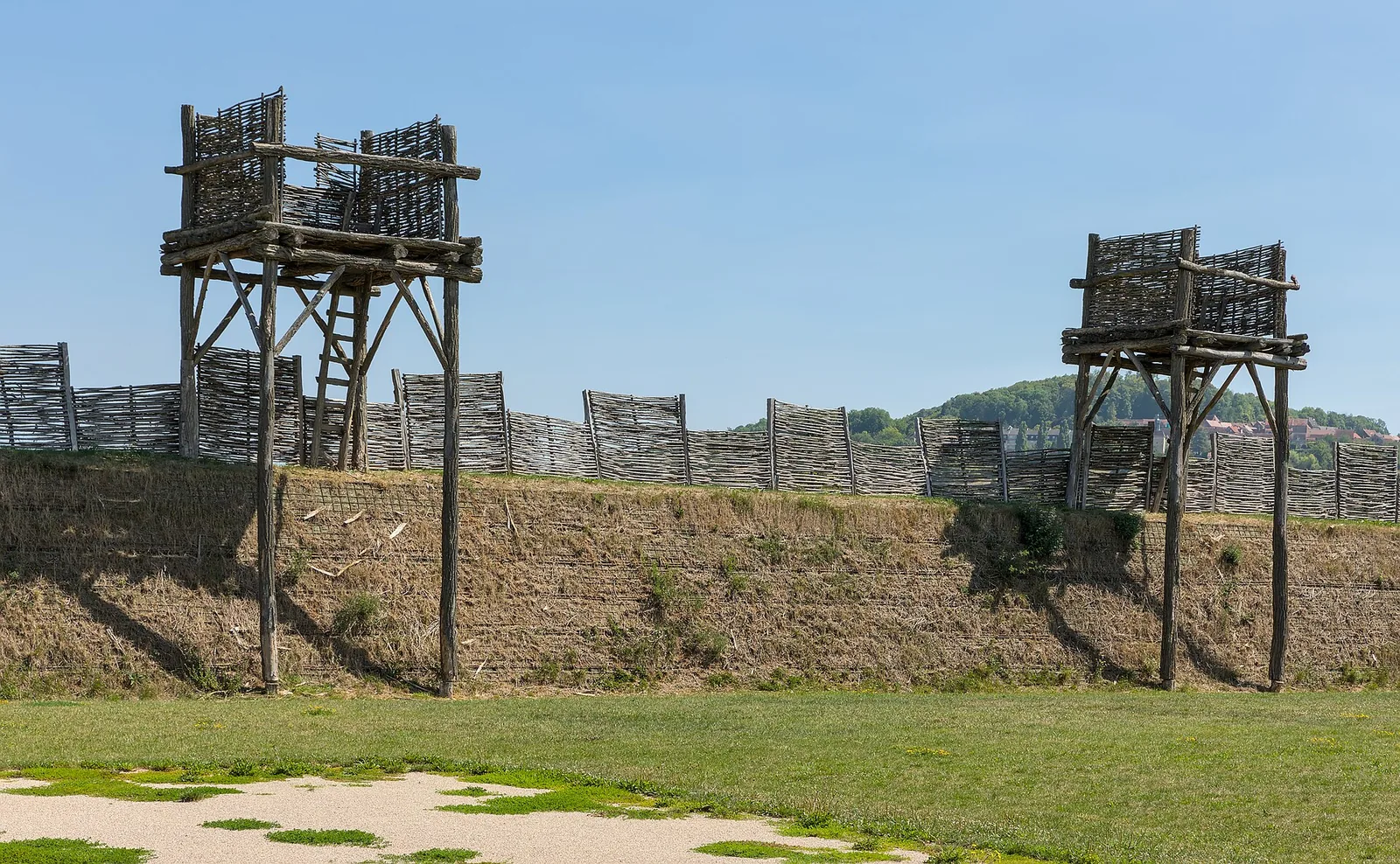
Reconstruction of the Roman siege works, MuséoParc Alésia, Alise-Sainte-Reine. Photo: Benjamin Smith, 2025 · CC BY-SA 4.0 · Source page
“Eight rows of this kind were dug, and were three feet distant from each other. They called this a lily from its resemblance to that flower. Stakes a foot long, with iron hooks attached to them, were entirely sunk in the ground before these, and were planted in every place at small intervals; these they called spurs.”
Caesar describes the works layer by layer: ditches, a rampart with towers every 80 feet, and in front of them branched stakes, hidden pits with sharpened stakes (the “lilies”) and iron-hooked spikes (the “spurs”). Excavations in the 1860s and in 1991–1997 found the lines.
- The excavators found the lines where Caesar put them, but the ditches and obstacles change with the ground. Why might Caesar describe one model section as if it ran all the way round? His readers were senators and citizens in Rome, not engineers. One clear, complete picture is easier to admire, and makes the work look even more systematic.
- What does the reconstruction show that the text cannot, and what must it guess? Scale: how high a rampart stands next to a person, how far a tower sees. But heights, towers and the woven fence are informed guesses; the ground keeps ditches and post holes, not timber.
Alesia: who fought whom
Late summer to early autumn 52 BC
Mont Auxois, above Alise-Sainte-Reine in Burgundy
Caesar's army
- Commanders: Julius Caesar, Titus Labienus, Mark Antony and Gaius Trebonius
- Strength: not given; ten legions, with German and allied cavalry (Caesar); about 40,000–70,000 in all (Modern estimate)
- Losses: not given (Caesar)
Vercingetorix's army in Alesia
- Commanders: Vercingetorix
- Strength: 80,000 chosen men (Caesar); not less than 170,000 (Plutarch); often 30,000–50,000; some accept 80,000 (Modern estimate)
- Losses: the whole army surrenders; one captive is given to each Roman soldier (Caesar)
The relief army
- Commanders: Commius the Atrebatian, Vercassivellaunus the Arvernian, Vercingetorix's cousin, Viridomarus and Eporedorix of the Aedui
- Strength: 8,000 horse and about 250,000 foot (Caesar); 300,000 (Plutarch); commonly 50,000–100,000 (Modern estimate)
- Losses: “a great slaughter”; 74 standards taken (Caesar)
Caesar first lists a quota for each people, well over a quarter of a million in all, then gives these figures as the force mustered and counted; only the Bellovaci, he says, sent fewer than asked.
Outcome: A Roman victory. The relief army breaks up and the next day Vercingetorix surrenders: the last united resistance of Gaul is over.
Every figure for the Gauls comes from Caesar or from writers who used him. Some editions read 240,000 foot instead of 250,000; few historians believe either.
The siege of Alesia
Late summer to early autumn 52 BC, about six weeks
Vercingetorix is shut in Alesia with, Caesar says, 80,000 men. The Romans dig two rings around the town: the inner faces the town, and the outer faces outwards. A relief army from all Gaul is on its way, perhaps an enormous one.
After Caesar, Gallic War 7.68–89, with the siege works as surveyed by Napoleon III's men (1861–65) and confirmed in their main lines by the Franco-German excavations of 1991–1997 (M. Reddé and S. von Schnurbein, 2001). The lines are simplified: the real inner line was about 15 km long and the outer about 21 km, because they followed the ground. Where Vercingetorix's last sally struck, and the exact course of the works in several sectors, are uncertain. Hills from modern elevation data; positions approximate.
Phases of the battle
- Two rings Vercingetorix is shut in Alesia with, Caesar says, 80,000 men. Caesar digs an inner ring facing the town and an outer ring facing outwards, with camps on the hills. The townspeople, the Mandubii, are driven out and left between the town and the inner line.
- The relief army arrives The relief army camps on the hills to the south-west, and its cavalry fills the plain. They fight from noon until sunset, when Caesar's German horsemen break them. Vercingetorix's men come down to the first ditch, then go back.
- Night attack in the plain A day later, at midnight, the relief army attacks the lines in the plain with hurdles and ladders. The hidden pits and spikes do their work, Antony and Trebonius bring men from quiet sectors, and Vercingetorix's men come out too late.
- Noon: the north camp The weak point is the north camp below Mont Réa, a hill too big to enclose. Sixty thousand picked men under Vercassivellaunus march round by night and attack it downhill at noon, while the relief cavalry threatens the plain and Vercingetorix attacks from inside.
- The red cloak Caesar sends Labienus with six cohorts, then more, then comes himself, known from afar by the colour of his cloak. His cavalry, sent round outside the outer line, strikes the Gauls from behind. Vercassivellaunus is captured with 74 standards; that night the relief army melts away.
The strategy
- Romans: Caesar builds two rings, to hold the town and the relief army at once. When the relief army attacks, he brings men from quiet sectors. At the north camp he sends Labienus, then comes himself, and his cavalry strikes the Gauls from behind.
- Vercingetorix's army: Vercingetorix plans to attack the lines from inside while the relief army attacks from outside, so the Romans face both at once.
- Relief army: The relief army tries to break the siege from outside. At midnight it attacks the lines in the plain, while sixty thousand picked men under Vercassivellaunus march round and strike the north camp downhill at noon, below Mont Réa. Its cavalry threatens the plain.
What decided it: The outer ring was the key: Caesar’s cavalry, sent round outside it, struck the Gauls from behind, and the relief army broke. That night it melted away.
The price
Between the walls
Before the relief came, the Gauls in Alesia drove out the Mandubii, the town's own people, with their wives and children, to save food. They begged at the Roman lines to be taken as slaves and fed; Caesar forbade it, and does not say what became of them. Cassius Dio, centuries later, says they died between the town and the Roman camp.
After the surrender Caesar gave every soldier one captive as plunder, keeping back about 20,000 Aedui and Arverni to win their peoples back. Rome voted him twenty days of thanksgiving.
How do we know?
Source: One surrender, four versions
Caesar: “…He orders their arms to be surrendered, and their chieftains delivered up. He seated himself at the head of the lines in front of the camp, the Gallic chieftains are brought before him. They surrender Vercingetorix, and lay down their arms.”
Plutarch, on Vercingetorix: “…after putting on his most beautiful armour and decorating his horse, rode out through the gate. He made a circuit around Caesar, who remained seated, and then leaped down from his horse, stripped off his suit of armour, and seating himself at Caesar's feet remained motionless…”
Later writers add more. In Florus, under Hadrian, Vercingetorix throws his horse's trappings and arms before Caesar, crying: “thou thyself, bravest of men, hast conquered a brave enemy.” Cassius Dio, around AD 220, has him kneel in silence, and says the two men had once been friends.
- Which account comes from someone who was there, and how long after was each one written? Only Caesar's, within a year or two. Plutarch wrote about 160 years later, Florus about 170, Dio about 270. The famous scenes grow with distance.
- Caesar won. Why would he tell his greatest moment in one dry line? His whole book works by sounding plain and factual, and understatement sounds trustworthy. Besides, Rome would see the captive king in his triumph.
- Look at the painting at the start of the lesson. Whose version did the painter follow? Plutarch's and Florus's. Painted in 1899, it shows the scene France wanted: a proud hero giving himself up for his people.
Source: A name in gold
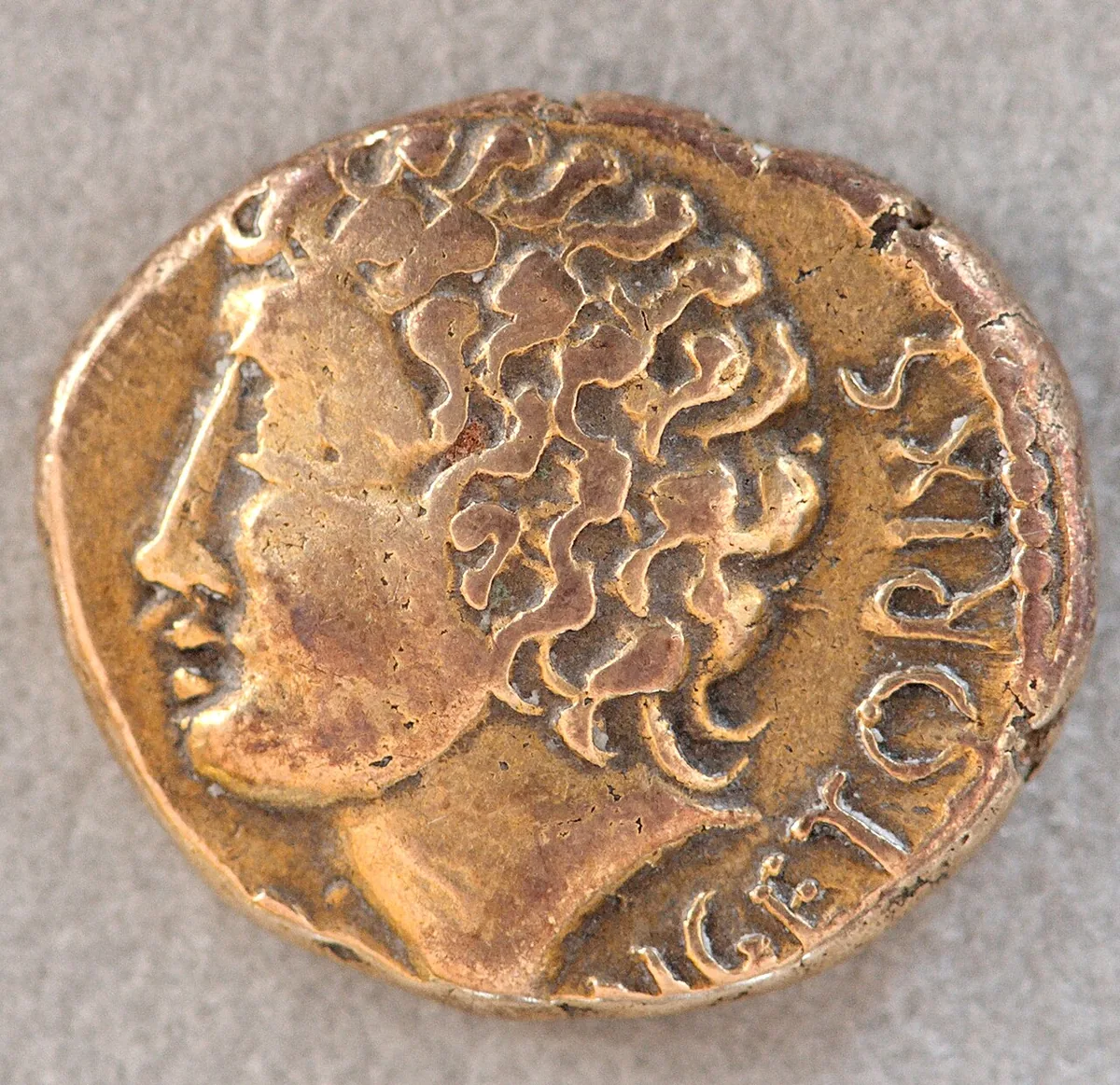
Gold stater of the Arverni inscribed VERCINGETORIXS, 52 BC. Cabinet des médailles, Bibliothèque nationale de France, Paris. Photo: Marie-Lan Nguyen · Public domain · Source page
Gold stater of the Arverni, inscribed VERCINGETORIXS, 52 BC. Cabinet des médailles, Bibliothèque nationale de France, Paris
About thirty gold staters bearing his name survive, many from a hoard found at Pionsat in the Auvergne in 1852: the only objects from his lifetime that name him.
- What does the coin prove about Vercingetorix? That he acted as a ruler: he struck gold in his own name, and had gold to pay men and allies. It is evidence from his side, not Caesar's.
- Is the head his portrait? No. The same young head appears on Arvernian coins without his name: it is a god, not a likeness. We do not know what Vercingetorix looked like.
Source: A million dead?
“…one million one hundred and ninety-two thousand men were slain by him in his battles. For my own part, however, I am not going to set it down as a subject for high renown, what was really an outrage committed upon mankind…”
Pliny, a Roman admiral who admired Caesar's genius, totals all Caesar's foreign wars, not the civil wars. Plutarch and Appian, writing later, give a million killed in Gaul and a million enslaved. No one counted; the figures go back to Caesar's own tallies.
- Where could an exact figure like 1,192,000 come from? Probably from Caesar's own records, shown at his triumphs in 46 BC. A precise number sounds like a count; it is a boast dressed as one.
- Is it the number of Gauls killed? No. It covers all his foreign wars, Gaul the largest part. Historians doubt the round million, not the scale: whole peoples were destroyed or sold.
- How does Pliny judge it, and why does that matter? As “an outrage committed upon mankind”. A Roman writing for Romans could see conquest as a crime, not only a glory. Condemnation is not only a modern view.
What came of it
51–50 BC
Hands, gold and a loyal army
Resistance flickered on for a year. At Uxellodunum, a hill fort in the south-west, Caesar cut off the defenders' water by tunnelling under their spring. When they surrendered, writes his officer Hirtius, he cut off the hands of all who had borne arms and let them live, as a warning.
By 50 BC Gaul was quiet and paid Rome 40 million sesterces a year. Caesar was immensely rich; Suetonius says he sacked towns for plunder. Above all, his veterans were loyal to him, not to the Senate, and in Rome his enemies asked how such a man could be allowed home. The next lesson follows him to the Rubicon.
Myth
Vercingetorix, the first French national hero, united all Gaul against Rome, and his statues show what he looked like.
The truth
He united part of Gaul for one year: the Remi, the Lingones and others stayed with Rome, the Aedui joined only in midsummer, and Gauls rode in Caesar's cavalry. The national hero was made in the 19th century: by Romantic historians, by Napoleon III, who paid for Millet's giant statue in 1865, and by Republican school books. No portrait of him survives.
The evidence
Caesar, Gallic War 7.63 and 7.75–76. Millet's statue on Mont Auxois (1865) and Bartholdi's in Clermont-Ferrand (1903), both with long hair and a drooping moustache. His coins show a god, not his face.
After Alesia
- 51 BC Uxellodunum falls: the last organised resistance ends.
- 49 BC Caesar crosses the Rubicon with his Gallic veterans: civil war.
- 46 BC Caesar's Gallic triumph; Vercingetorix is led through Rome, then put to death.
- 27–13 BC Augustus divides Gaul into three provinces; Lugdunum (Lyon) becomes their chief city.
- AD 48 Claudius admits Gallic nobles to the Senate; his speech survives on a bronze tablet in Lyon.
- 5th century AD The Franks take over; Gaul slowly becomes ‘Francia’, and its Latin becomes French.
- AD 1865 Napoleon III sets Millet's Vercingetorix on Mont Auxois: the Gallic hero gets his monument.
Can we trust Caesar?
How far can we believe Caesar's own account of his own war?
- Michel Rambaud, The Art of Historical Distortion in Caesar's Commentaries (1953); David Henige (1998) The Commentaries are a deliberate work of distortion. Caesar arranges the facts, leaves things out, shifts blame and uses a falsely neutral style to build a political image. Henige adds that his numbers are rhetoric and cannot be used to count anything.
- T. Rice Holmes, Caesar's Conquest of Gaul (1899; 1911); Adrian Goldsworthy, Caesar: Life of a Colossus (2006) Reliable in the main, coloured in the detail. Caesar could not invent events that thousands of his officers and soldiers saw and wrote home about, and archaeology confirms his places, his sequence of events and his siege works. The spin lies in emphasis and blame.
- Andrew M. Riggsby, Caesar in Gaul and Rome: War in Words (2006); Kathryn Welch and Anton Powell (eds), Julius Caesar as Artful Reporter (1998) The real question is not ‘true or false?’ but ‘what was it written to do?’. The Commentaries build ideas of who is Roman, who is Gallic and who is German, of just war and of Caesar's virtue, for voters in Rome. They must be read as a political text.
Nobody thinks Caesar invented Alesia, and nobody trusts his numbers. Between those two points every sentence has to be weighed: who could have checked it, and what did Caesar gain by writing it that way?
What do you know now?
Check yourself
Where does almost everything we know about the Gallic Wars come from?
Answer: From Caesar's own Commentaries. Right. Seven books by the winning general, plus an eighth by his officer Hirtius. Everything else is later, and mostly leans on them.
Check yourself
How does Caesar explain his defeat at Gergovia?
Answer: His soldiers did not hear the recall and ran on to the wall in hope of plunder. Right. He says a valley kept them from hearing, and rebuked them afterwards. Many historians suspect he had hoped to take the town himself.
Check yourself
What went wrong with Vercingetorix's scorched-earth plan?
Answer: The Bituriges begged him to spare Avaricum, he gave way, and Caesar took it. Right. An alliance leader could not force a proud people to burn its city. Avaricum fell, and of about 40,000 people barely 800 escaped.
Check yourself
Why did Caesar build a second, outer line at Alesia?
Answer: To protect the besiegers from a relief army coming from all Gaul. Right. The outer line, about 21 km long, faced outwards, and Caesar's army became a fortress facing both ways.
Check yourself
Where does the famous story of Vercingetorix throwing his arms at Caesar's feet come from?
Answer: From later writers such as Plutarch and Florus, and 19th-century painters. Right. They wrote 160 to 170 years later, and Royer's painting of 1899 made the scene famous.
Check yourself
What do modern historians think of the ‘million dead’ in Gaul?
Answer: That it is probably Caesar's boast, but the destruction was real and enormous. Right. No one really counted, and the figures go back to Caesar; but whole peoples were destroyed or sold into slavery.
Terms
- proconsul A former consul sent to govern a province with an army, usually for a year or a few. Caesar was proconsul of Gaul and Illyricum from 58 to 50 BC.
- Commentaries “Notes”: Caesar's own war reports, written in plain Latin in the third person (“Caesar did...”) and published as books. Seven books cover Gaul from 58 to 52 BC; his officer Hirtius added an eighth.
- the Province Rome's province in southern Gaul, conquered in 125–121 BC and later called Gallia Narbonensis. The name Provence comes from it.
- oppidum A fortified Gallic town on a hill or in a river bend, with walls of timber, stone and earth. The largest, like Bibracte, covered 100 hectares or more.
- druid A member of Gaul's learned class: priests, judges and teachers, exempt from war and taxes. They taught by word of mouth, so their teaching is known only from outsiders such as Caesar.
- legion Rome's main army unit: about 4,800 heavy infantry on paper, in ten cohorts. After years of war Caesar's legions were often well under strength.
- cohort A tenth of a legion, about 480 men on paper: the unit Caesar usually moved around the battlefield.
- legate A senior officer, usually a senator, to whom Caesar gave a legion or a task. Labienus, Sabinus, Cotta and Quintus Cicero were among his legates in Gaul.
- thanksgiving Days of public prayer and sacrifice to thank the gods for a victory, voted by the Senate. The more days, the greater the honour: Caesar got 15, then 20, then 20 again.
- triumph A Roman general's victory parade through Rome, with his soldiers, his spoils and his captives. Famous captives were often put to death at its end.
- stater A gold coin. Gallic staters began as copies of the gold coins of Philip II of Macedon, Alexander's father, and slowly turned into Celtic designs of their own.
- Alesia A hill town in Gaul where Caesar besieged Vercingetorix. The Romans dug a ring of fortifications around it.
- Avaricum A large town of the Bituriges in Gaul. Caesar besieged it and stormed it, sparing no one.
- Gergovia A strong hill in Gaul, where the Gauls beat Caesar's legions.
- Bibracte A town in Gaul. Caesar beat the Helvetii near it, and a council there confirmed Vercingetorix as supreme commander.
- Cenabum A Gallic town, today Orléans. There the Carnutes killed Roman traders, and the revolt of 52 BC began.
- Uxellodunum A hill fort in the south-west of Gaul. Caesar tunnelled under its spring, and when the defenders surrendered he cut off their hands.
- Helvetii A Gallic people from today's Switzerland. They burned their villages and set out west, and Caesar beat them near Bibracte.
- Nervii A people of northern Gaul. In a battle by a river they surprised the Romans and fought almost to the last man.
- Aedui A Gallic people in Burgundy and Rome's old friends. Later they switched sides and joined the revolt.
- Arverni A Gallic people, rivals of the Aedui. Vercingetorix raised his army among them when the revolt began.
- Eburones A Gallic people whose chief was Ambiorix. After the ambush of two legates, Caesar invited their neighbours to plunder them, so that their race and name would be wiped out.
- Ariovistus A Germanic king who had settled in Gaul. Caesar drove him back across the Rhine.
- Ambiorix One of the chiefs of the Eburones. He convinced two Roman legates that all Gaul was rising, and they marched into his ambush. He was never caught.
- Crassus One of three partners who shared power with Caesar and Pompey. He was killed in 53 BC after a defeat by the Parthians at Carrhae.
- Pompey A Roman politician and Caesar's partner in power. He was married to Caesar's daughter Julia.
- Cicero A Roman writer and politician who was no ally of Caesar, yet praised the plain, clean style of his books.
- Suetonius A later Roman writer who told the lives of Rome's rulers, including Caesar. He says Caesar sacked towns for plunder.
- Senate The main council of Rome, made up of senior and influential men. The Senate proclaimed days of thanksgiving and gave titles to rulers.
- consul One of the highest offices of the Roman Republic. Two men held it each year.
- centurion A Roman officer who commanded a small unit within a legion.
- Parthians A strong people east of Rome. They defeated Crassus at Carrhae.
- Pliny A Roman admiral who admired Caesar's genius. He totalled all Caesar's wars against foreign peoples.
- sestertius A Roman coin. Gaul paid Rome 40 million of them a year.
- menhir A tall standing stone that people in Europe set up thousands of years before Caesar.
- Astérix A French comic of 1959 that gently mocks modern France.
Sources
- Caesar, The Gallic War, books 1–7, and Aulus Hirtius, book 8, trans. W. A. McDevitte and W. S. Bohn (Harper, 1869)
- Plutarch, Life of Caesar 15–27, trans. Bernadotte Perrin, Plutarch’s Lives vol. VII (Loeb Classical Library, 1919)
- Suetonius, The Deified Julius 22–25, 54, 56, 67, trans. J. C. Rolfe (Loeb Classical Library, 1914)
- Cassius Dio, Roman History 40.33–43, trans. Earnest Cary, vol. III (Loeb Classical Library, 1914)
- Florus, Epitome of Roman History 1.45, trans. E. S. Forster (Loeb Classical Library, 1929)
- Pliny the Elder, Natural History 7.91–92, trans. John Bostock and H. T. Riley (Bohn, 1855)
- Appian, Gallic History (Celtica), fragments, trans. Horace White, The Roman History of Appian of Alexandria (Macmillan, 1899)
- Velleius Paterculus, Roman History 2.46–47, trans. F. W. Shipley (Loeb Classical Library, 1924)
- Adrian Goldsworthy, Caesar: Life of a Colossus (New Haven: Yale University Press, 2006)
- Andrew M. Riggsby, Caesar in Gaul and Rome: War in Words (Austin: University of Texas Press, 2006)
- Kathryn Welch and Anton Powell (eds), Julius Caesar as Artful Reporter: The War Commentaries as Political Instruments (London: Duckworth / Classical Press of Wales, 1998)
- Michel Reddé and Siegmar von Schnurbein (eds), Alésia: fouilles et recherches franco-allemandes sur les travaux militaires romains autour du Mont-Auxois (1991–1997), 3 vols (Paris: Académie des Inscriptions et Belles-Lettres, 2001)
- Michel Reddé, Alésia: l’archéologie face à l’imaginaire (Paris: Errance, 2003; 2nd ed. 2012)
- Christian Goudineau, Le dossier Vercingétorix (Arles: Actes Sud / Errance, 2001)
- Michel Rambaud, L’art de la déformation historique dans les Commentaires de César (Paris: Les Belles Lettres, 1953; 2nd ed. 1966)
- T. Rice Holmes, Caesar’s Conquest of Gaul (London: Macmillan, 1899; 2nd ed. Oxford: Clarendon Press, 1911)
- David Henige, “He came, he saw, we counted: the historiography and demography of Caesar’s Gallic numbers”, Annales de Démographie Historique 1998.1, 215–242
- Kurt A. Raaflaub, “Caesar and Genocide: Confronting the Dark Side of Caesar’s Gallic Wars”, New England Classical Journal 48.1 (2021), 54–80
- Tristan S. Taylor, “Caesar’s Gallic Genocide: A Case Study in Ancient Mass Violence”, in B. Kiernan, T. M. Lemos and T. S. Taylor (eds), The Cambridge World History of Genocide, vol. I (Cambridge University Press, 2023), 309–329
- Nico Roymans, “A Roman massacre in the far north: Caesar’s annihilation of the Tencteri and Usipetes in the Dutch river area”, in M. Fernández-Götz and N. Roymans (eds), Conflict Archaeology: Materialities of Collective Violence from Prehistory to Late Antiquity (London: Routledge, 2018), 167–181
Image credits
- Lionel Royer, Vercingetorix Throws Down His Arms at the Feet of Julius Caesar, 1899. Musée Crozatier, Le Puy-en-Velay · Public domain · Source page
- Marble bust found in the Rhône at Arles, possibly Julius Caesar, 1st century BC. Musée départemental Arles antique. Photo: Carole Raddato · CC BY-SA 2.0 · Source page
- Aimé Millet, Vercingetorix, 1865, Alise-Sainte-Reine. Photo: Myrabella · CC BY-SA 4.0 · Source page
- The plateau of Gergovia from Le Crest (composite photo). Photo: Dysmorodrepanis, 2007 · CC BY-SA 3.0 · Source page
- Reconstruction of the Roman siege works, MuséoParc Alésia, Alise-Sainte-Reine. Photo: Benjamin Smith, 2025 · CC BY-SA 4.0 · Source page
- Gold stater of the Arverni inscribed VERCINGETORIXS, 52 BC. Cabinet des médailles, Bibliothèque nationale de France, Paris. Photo: Marie-Lan Nguyen · Public domain · Source page


