The Buddha: what do we really know?
The familiar story of the Buddha was written down centuries after his death. What is left of the man himself, and how do we even know where he was born?
Decisions, questions and your own progress, in the app
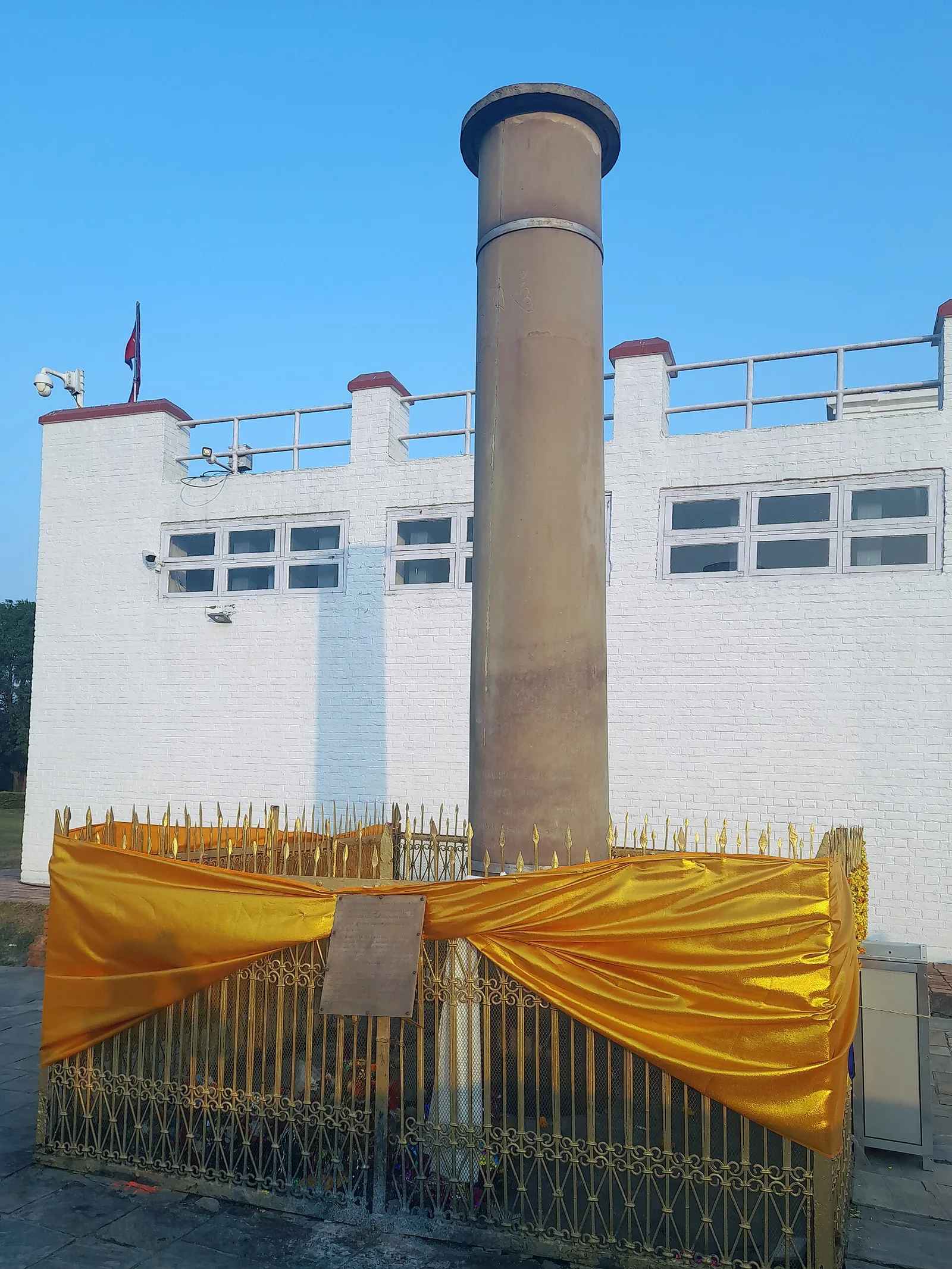
Rangan Datta Wiki, Ashoka Pillar, Mayadevi Temple, Lumbini, 2023. Wikimedia Commons. · CC BY-SA 4.0 · Source page
The place
Who was the man behind the story?
Most people know the Buddha as a prince who leaves his palace, sits under a tree and reaches awakening. It is a good story. But it reaches us through texts written centuries after his death, and part of it is legend.
What do we really know? Less than the story assumes, and more than you might think. This lesson separates the two.
Background
Where he was born
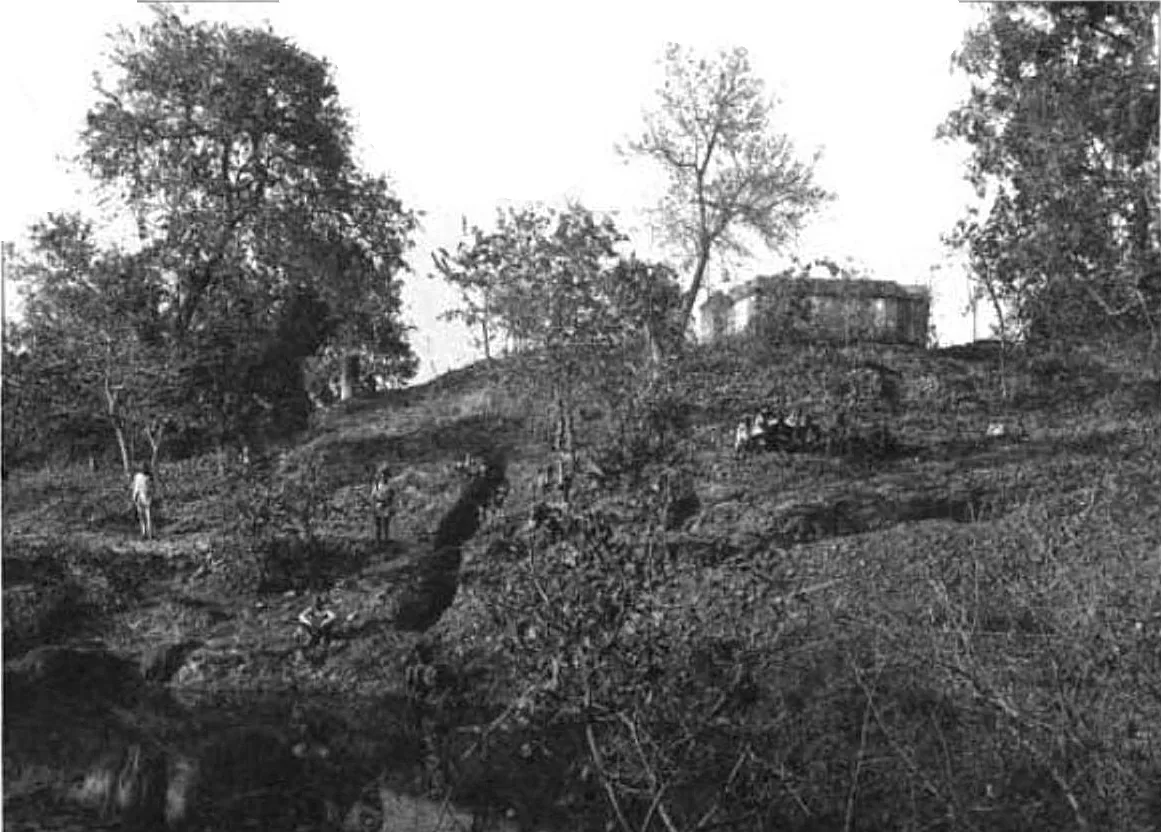
P. C. Mukherji and Vincent A. Smith, Rummindei view of the ruins from the South, 1901. Public domain. · Public domain · Source page
According to tradition, Siddhartha Gautama, later called the Buddha, was born at Lumbini. Today Lumbini is in southern Nepal, about seven kilometres from the Indian border.
So he was not born in India, as many people think. His world was the region of the Ganges: a world of clans, towns and kingdoms.
Keep three questions in mind as you read. Who wrote this down, and when? What could they have known? And what did they want you to believe?
The story everyone knows
Tradition
A palace, four sights, a choice
In the traditional story, the young prince lives in a palace, shielded from hardship. Then he rides out and sees an old man, a sick man, a corpse and a wandering holy man. Each sight shakes him.
This is tradition. The texts that tell it were written down centuries after he lived, by tradition's own account. Read it as a story with a message, not as a diary.
A decision point
You are the young prince, in the traditional story.
Tradition, not a dated record.
Your family has kept you in comfort, inside the palace walls. You have seen very little of the world beyond them.
Now you have seen suffering, and you do not know what to make of it. Your household wants you to settle into the life planned for you.
What do you do?
- Stay in the palace and accept the life planned for you. Probably a life of comfort and duty, with the question about suffering left unanswered.
- Leave the palace and search for the cause of suffering yourself. Probably a hard search with no guarantee of an answer. You would give up the security you have always known.
What really happened
Leave the palace and search for the cause of suffering yourself.
In the tradition, the prince leaves the palace. This is a traditional account: no dated source confirms the palace, the sights or the date.
The texts give the prince no words we can check. So the decision remains part of the story, not a record of what happened. Historians read it as the turning point of the tale.
A decision point
You are the same man, after years of extreme discipline and fasting.
Tradition.
You have joined teachers who practise severe fasting. For a long time you have eaten almost nothing, and your body is wasting away.
Your companions say the body must be pushed to the limit to reach the truth. Others say the body must be looked after if the mind is to focus.
Do you keep pushing the body, or change the way you practise?
- Keep the extreme fasting and push the body until the truth comes. Probably further weakness, with no guarantee that the effort brings an answer.
- Eat and recover, and look for a path between the two extremes. Probably criticism from former companions, and a slow path that is not yet clear.
- Give up the search and return to ordinary life. Probably an ordinary life, with the question left open.
What really happened
Eat and recover, and look for a path between the two extremes.
In the tradition, he gives up extreme fasting and takes the Middle Way. The Middle Way is in the first sermon the Pali texts report, but the fasting story around it is tradition, and it cannot be dated.
The Middle Way rejects two extremes: sensual indulgence and extreme self-denial. The texts present it as a first teaching, not as a story about fasting.
Check yourself
Which statement about the palace, the four sights and the decision to leave is correct?
Answer: Tradition, told in texts written long after.. Right. The palace and the sights are part of the traditional story, and the texts that tell it were written long after his life.
What the stone says
Source: Ashoka's pillar, in Hultzsch's translation
…because the Buddha Sakyamuni was born here.
Ashoka ruled from about 268 to 232 BC. This edict was set up in his twentieth regnal year, about 249 BC, and the village of Lumbini was made tax-free. The text speaks of the Buddha in the third person.
- Who wrote this text, and why? King Ashoka, who had the pillar set up. The aim was to mark and honour the place, and to set a tax exemption, not to write a biography.
- How close in time is it to the events? Closer than the Pali texts, which by tradition were written down in the 1st century BC. Even so, it was made roughly 150 to 230 years after the death dates the sources suggest.
- What is missing? Any dates for the Buddha's life, and any story of the palace or the sights. It gives a birthplace and a tax exemption, and nothing about his life.
Source: The pillar in its trench, 1896
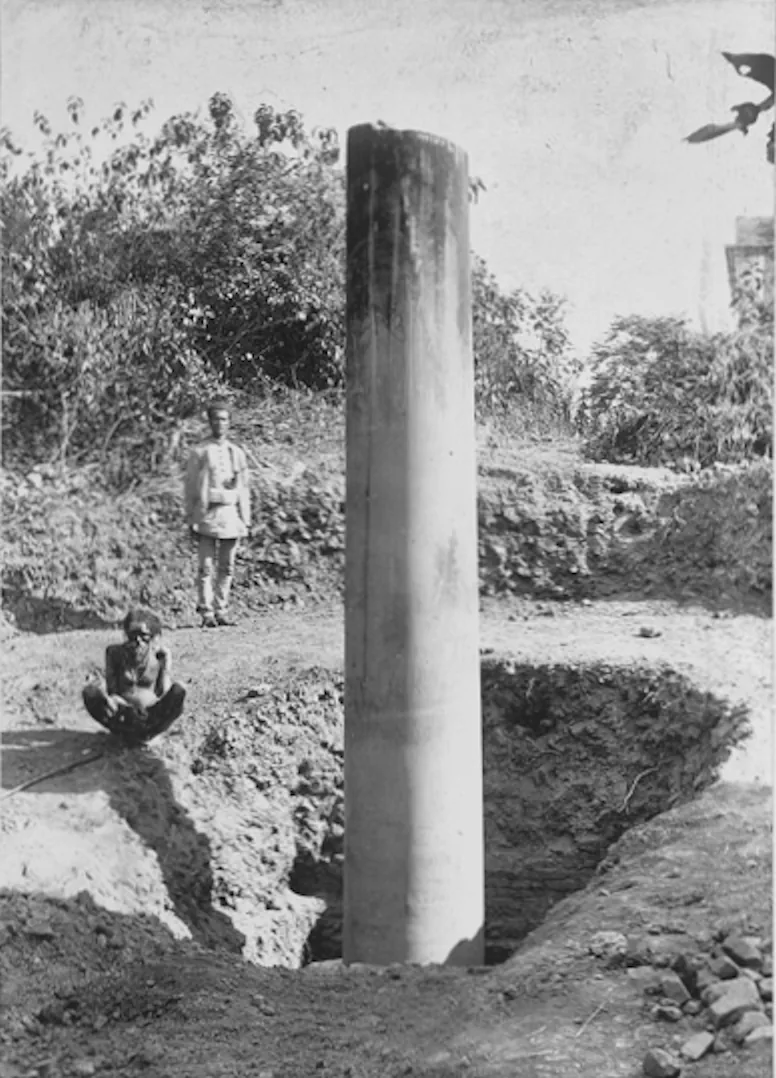
Archaeological Survey of India, Rummindei pillar of Ashoka, 1896. Public domain. · Public domain · Source page
Archaeological Survey of India, photograph, 1896
- What does the photograph show that a text cannot? The pillar standing upright in an excavation trench, beside people. It is evidence of the find and its place, not of what the inscription says.
- Who took it, and why? The Archaeological Survey of India, during the excavation of 1896. It was taken to record a find, so it documents the site, not the Buddha.
- What is still unclear from the picture alone? What the inscription says. For that you need the translated text, not the picture.
Myth
The Buddha was born in India.
The truth
He was born at Lumbini, in what is now southern Nepal, about seven kilometres from the Indian border. He lived in the Ganges region, which today lies partly in India and partly in Nepal.
The evidence
Ashoka's pillar names Lumbini as the birthplace. UNESCO listed the site as a World Heritage site in 1997.
Check yourself
What does Ashoka's Lumbini inscription establish, according to this lesson?
Answer: The birthplace of the Buddha, as the king recorded it.. Right. The inscription records the birthplace, and that is its central claim.
Dates and dispute
A decision point
You are a historian trying to date the Buddha.
Today, with three kinds of evidence.
Your first evidence is the Buddhist texts and chronicles. They give dates and long lists of events, but they were written centuries after the events, and they are religious texts.
Your second is Ashoka's pillar. It is closer in time to the Buddha, and it names a birthplace, but it gives no date for his life.
Your third is the reports of Chinese travellers who visited India many centuries later. They too were written far from the events.
What do you trust first?
- The Buddhist chronicles, because they are detailed and give dates. Probably detailed, precise dates. The risk: the detail was written centuries after the events and is hard to check.
- The pillar, for the place of birth. Treat the dates as an open question. Probably a well-grounded birthplace, but no dates for his life, so the timeline stays vague.
- Refuse to date him at all. Probably a cautious position, but with no dates to argue over and nothing to test the claims against.
What really happened
The pillar, for the place of birth. Treat the dates as an open question.
Many historians treat the pillar as strong evidence for the birthplace, while the dates stay disputed. No single source settles the year of his death.
The pillar is closer in time and names a place, but says nothing about his dates. So you can trust it on what it says, and no further.
When did he die?
Did the Buddha die about 480 BC, or about 400 BC?
- The long chronology: about 480 BC The traditional dates, about 563 to 483 BC, fit this view. For a long time the date was widely treated as settled.
- The later chronology: about 400 BC Many scholars argue for a death about 400 BC. Japanese scholars have proposed 400, 386 and 368 BC, as alternatives to the older figure.
In a 1986 booklet, Heinz Bechert argued that none of the relevant sources can be relied on as evidence for the exact dates. In 1988 he organised a symposium at Hedemunden, near Göttingen, from 11 to 18 April. The proceedings appeared from 1991. The whole argument is about chronology. Until new evidence appears, the honest answer is a range, not a date.
Check yourself
Why is it hard to fix the Buddha's exact dates?
Answer: Because the texts that give dates are late, and scholars disagree.. Right. The texts were written long after the events, and scholars propose different death dates: about 480 BC against about 400 BC.
What came after
What came after
- about 268 BC Ashoka begins to reign. His reign is dated about 268 to 232 BC.
- about 249 BC The Lumbini pillar is set up in Ashoka's twentieth regnal year. The village of Lumbini is made tax-free.
- 1st century BC (by tradition) The Pali texts are first written down on palm leaves in Sri Lanka, at Aluvihara. Before that they were kept by memory.
- 1896 The pillar is found in December 1896, and the Archaeological Survey of India photographs it in its trench.
- 1925 Hultzsch publishes the inscription, in translation, in a new edition of Ashoka's inscriptions.
- 1988 A symposium at Hedemunden, near Göttingen, takes up the dating of the Buddha. The question is still open.
- 1997 UNESCO lists Lumbini as a World Heritage site.
Check yourself
What can Ashoka's pillar tell us about the Buddha, and what can it not?
Answer: It names Lumbini as his birthplace, with no dates for his life.. Right. The inscription makes one clear claim about the birthplace, and no claim about the dates of his life.
Check yourself
Why do scholars treat the Pali Canon as later than the Buddha?
Answer: It was kept by memory for a long time before it was written down.. Right. By tradition the texts were recited from memory, and first written down only in the 1st century BC.
Check yourself
Which label fits the palace, the four sights and the decision to leave?
Answer: Tradition, told in later texts.. Right. These are part of the traditional life story, and this lesson labels them as such.
Terms
- Pali Canon The collection of early Buddhist texts in the Pali language. By tradition they were kept in memory for a long time, and first written down in Sri Lanka in the 1st century BC.
- oral tradition Knowledge passed from mouth to mouth, by memory rather than in writing. By tradition, the early Buddhist texts were kept this way.
- edict An official announcement by a ruler, often carved in stone. Ashoka's pillar inscriptions are edicts of this kind.
- regnal year A year counted from the start of a king's reign. The Lumbini pillar is dated this way.
- chronology The ordering of events in time, and the dates that fix it. Here: working out the year the Buddha died.
- Middle Way A teaching in the Pali texts: avoid two extremes, sensual indulgence and extreme self-denial.
- Lumbini The village where, by tradition, Siddhartha Gautama was born. Today it is in southern Nepal, about seven kilometres from the Indian border.
- Nepal A country next to India, with Lumbini in its south.
- Ganges A great river in India. The region of the river was the Buddha's world, a world of clans, towns and kingdoms.
- Ashoka's pillar A pillar set up by Ashoka. It names a birthplace and is close in time to the Buddha, but gives no date for his life.
- Ashoka A ruler of ancient India who ruled from about 268 to 232 BC. He set up an edict that made Lumbini tax-free.
- Harry Falk A scholar who argues that Ashoka's inscription is authentic, meaning original and not rewritten.
- The first sermon The first sermon reported in the Pali texts. The Middle Way appears in it.
- Chronicles Written records of events in order. They were written centuries after the events, and they are religious texts.
- Extreme fasting Very harsh fasting, where people eat almost nothing. Some teachers believed the body must be pushed to the limit to reach the truth.
- Dated source A source whose date of writing can be fixed. Without one, it is hard to know what really happened.
- Third person A way of speaking about someone else, not to the reader. The inscription speaks of the Buddha this way.
- Chinese travellers Travellers from China who visited India many centuries after the Buddha and wrote about what they saw. Their reports were written far from the events.
- Wandering holy man A holy man who wanders from place to place with no fixed home.
- Tax exemption A relief from paying tax. The village of Lumbini was given such an exemption, by an edict of Ashoka.
- Pali The language in which many early Buddhist texts were written, including the Pali Canon.
Sources
- Ashoka, Lumbini pillar inscription, trans. E. Hultzsch, Inscriptions of Asoka: New Edition (Oxford, 1925), p. 164
- Samyutta Nikaya 56.11 (Dhammacakkappavattana Sutta), trans. Thanissaro Bhikkhu, Access to Insight
- Heinz Bechert (ed.), The Dating of the Historical Buddha = Die Datierung des historischen Buddha (Göttingen: Vandenhoeck & Ruprecht, from 1991)
- Archaeological Survey of India, photograph of the Rummindei pillar of Ashoka, 1896 (Wikimedia Commons)

Image credits
- Rangan Datta Wiki, Ashoka Pillar, Mayadevi Temple, Lumbini, 2023. Wikimedia Commons. · CC BY-SA 4.0 · Source page
- P. C. Mukherji and Vincent A. Smith, Rummindei view of the ruins from the South, 1901. Public domain. · Public domain · Source page
- Archaeological Survey of India, Rummindei pillar of Ashoka, 1896. Public domain. · Public domain · Source page

