Simón Bolívar: the man who freed half a continent
Bolívar lost again and again, fled into exile and came back. In 1819 he crossed the Andes and won at Boyacá. How did he do it, and what became of his dream of union?
Decisions, questions and your own progress, in the app
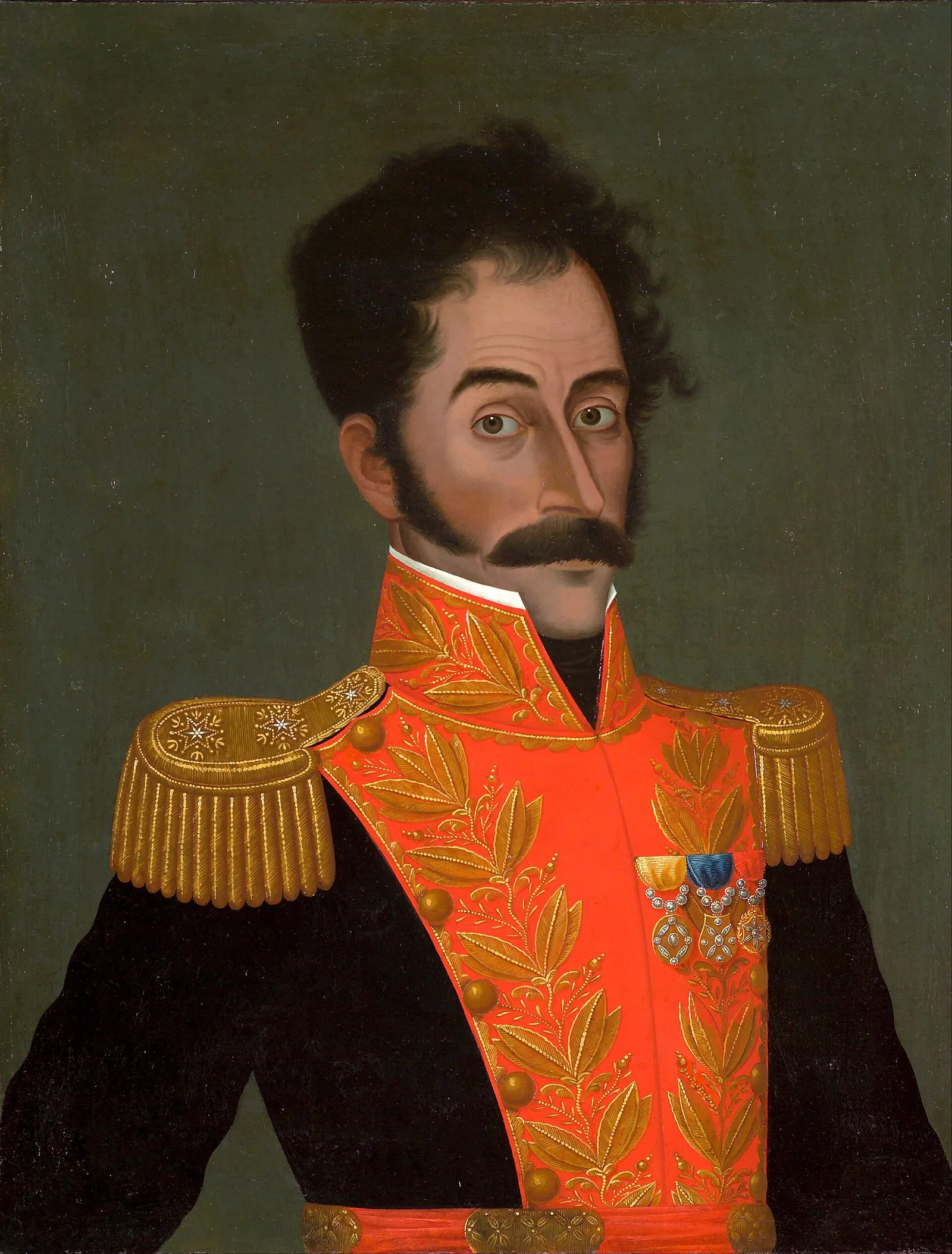
José Gil de Castro, about 1823. Museo de Arte de Lima · Public domain · Source page
The young man from Caracas
Rome, 1805
Rome, summer 1805. A young man of twenty-two from Caracas climbs a hill outside the old city. It is not one of Rome’s famous seven hills. It is Monte Sacro, the Sacred Mount.
With him is his old teacher, Simón Rodríguez. The legend says that on this hill he swore to free his homeland from Spanish rule. Many schoolbooks in Latin America tell the story.
But how do we know it happened? And what exactly was said up there?
Background
Two funerals before the age of nine
Simón Bolívar was born in Caracas on 24 July 1783, into a rich creole family. Creoles were people of Spanish descent born in the Spanish American colonies. They were wealthy and respected, but the top posts in government usually went to men born in Spain.
His father died in 1786, when Simón was two and a half. His mother died in 1792, about three weeks before his ninth birthday. He was an orphan before he turned nine.
Background
The teacher who stayed
In 1793 Bolívar enrolled at a school run by Simón Rodríguez, and from 1795 he studied with him full-time. Rodríguez brought the ideas of the Enlightenment into the classroom, and he stayed in Bolívar’s life for many years.
In 1799 Bolívar went to Madrid. In 1802 he married María Teresa del Toro, from a wealthy Caracas family. She died in Caracas on 22 January 1803, about eight months after the wedding, while he was in Europe. He later told one of his companions that he had sworn never to marry again.
Rome
Milan, 1805
The three of them, Bolívar, Rodríguez and a relative of his late wife, reached Milan on 26 May 1805. That day Napoleon Bonaparte was crowned King of Italy in the city, and they saw the ceremony for themselves.
The oath
The oath on the hill
In August 1805, about three months after Milan, Bolívar and Rodríguez climbed Monte Sacro. The sources give the date as 15 or 18 August.
The best witness is Rodríguez, who was there. Bolívar himself wrote about the visit eighteen years later. In a letter to Rodríguez dated 19 January 1824, he asked:
“Do you remember when we went together to Monte Sacro in Rome, to swear over that holy ground the liberty of our country?” (Our translation from the Spanish.)
The letter proves that the visit happened. It does not prove what was said there.
Myth
On Monte Sacro the young Bolívar swore the famous oath of liberty, word for word, as the textbooks print it.
The truth
The visit is well attested: Rodríguez was there, and Bolívar’s 1824 letter, written to him, recalls it. The words are not attested. The famous speech is a later text. It is printed with a date line of 1805, but we have no early document that confirms its wording.
The evidence
The letter speaks of the place and of the act of swearing, not of the wording. A 2005 article that prints the speech relies on Rodríguez’s account and the 1824 letter, not on its wording. It is a familiar rule of history: a text written long after an event tells us what people believed, not necessarily what was said that morning.
Juntas and an earthquake
Spain, 1808
A king who is not free
In 1807 and 1808 Napoleon Bonaparte’s armies invaded the Iberian Peninsula. In May 1808 Spain’s king, Ferdinand VII, was forced to give up the throne. Napoleon put his own brother, Joseph, on it. The old king stayed in French hands.
News of this reached Caracas in July 1808. For every colony the question was simple and impossible at once: whom do we obey when our king is gone or held captive?
Caracas, 1810
A junta in Caracas
In 1810 news reached Caracas of a new council of rule in Spain. On 19 April the creoles deposed the Spanish governor and set up a Supreme junta. It claimed to rule in the name of the captive king.
Among the young men who pushed for change was Simón Bolívar, aged twenty-six, from one of the wealthy families. He was not yet a general. Like many of his generation, he wanted change.
1811
The First Republic
In 1811 the new congress declared a republic. The creoles had moved from ruling in the king’s name to ruling in their own. On 13 July 1811 militias were called up.
The republic was fragile. Many places beyond Caracas stayed loyal to Spain, and its leaders did not always agree.
26 March 1812
The earthquake
On 26 March 1812 an earthquake struck Caracas and almost totally destroyed the city. Many people read it as a punishment from God for the break with Spain.
The republic was weakened, and the royalists who backed the Spanish king took their chance. The First Republic fell in 1812.
December 1812
The Cartagena Manifesto
On 15 December 1812, in the port city of Cartagena in New Granada, Bolívar wrote a long document. It is now called the Cartagena Manifesto.
Its question was a painful one: why had the patriots lost, and what should come next? He would return to that question again and again in the years ahead.
The fall of the republic
1813
The Admirable Campaign
In 1813 Bolívar tried to win back the republic by force. His supporters called his march the Admirable Campaign, because his first successes came quickly.
At Trujillo, in western Venezuela, on 15 June 1813, he issued a decree that became one of the hardest documents of the war. It is known as the Decree of War to the Death.
Source: The Decree of War to the Death
“Spaniards and Canary Islanders, you will die, though you be neutral, unless you actively espouse the cause of America’s liberation. Americans, you will live, even if you have trespassed.”
The decree offers life to Americans even if they have broken the law, and threatens Spaniards with death even when they are neutral. It was written in a war that was already savage on both sides. According to the historian Karen Racine (2013), both sides practised the war to the death.
- Who is threatened by the decree, and who is promised life? Spaniards and Canary Islanders are threatened with death, even if they stay neutral. Americans are promised life, even if they have broken the law.
- Who is the decree written for: the Spaniards, the Americans, or both? Both. It frightens the Spaniards, and it promises Americans life even if they have broken the law.
- What does the decree leave out, and what can we not tell from it? It does not say what would happen to prisoners in practice, and it gives no numbers of the dead. We know the text, but not always how far it was carried out.
1813–1814
No mercy on either side
The decree was not written in a vacuum. In this war both sides killed prisoners, and we have no reliable figures for the victims.
Some accounts report that Spanish prisoners were executed in Caracas and La Guaira in February 1814, and some of them attribute the order to Bolívar. The accounts do not agree on numbers, and we have found no source that confirms the details.
1814
Boves and Caracas
In 1814 the Second Republic fell. Bolívar had restored it in 1813. A royalist army under José Tomás Boves beat the republican forces, and on 16 July 1814 the royalists returned to Caracas.
Each time power changed hands in those years, the dead, the prisoners and the fear stayed behind.
1815
Exile
Bolívar left Venezuela. On 14 May 1815 he reached Kingston, the capital of Jamaica, a British island in the Caribbean Sea.
He was an exile, with no army and little money. He had watched two republics fall one after another. Now he had to think again about how to win back power.
Exile, and a first choice
December 1815
Cartagena falls
On 6 December 1815 Cartagena, the patriot port in New Granada, fell to a large Spanish army. That army had been sent across the Atlantic to win back the colonies.
Britain, which Bolívar hoped would help, had made no commitment.
Kingston, 1815
A letter to an Englishman
In September 1815, a few months after reaching Kingston, Bolívar wrote a long letter. It is known today as the Jamaica Letter. It answered a British merchant, Henry Cullen, but it was written as if to an English gentleman. Its real reader was the British government.
Source: The Jamaica Letter
“we are neither Indian nor European, but a species midway between the legitimate proprietors of this country and the Spanish usurpers.”
Bolívar wrote this in exile, with no army and no base. It offers Britain a way of seeing Spanish America: a new people, and a range of political systems, from federal states and central republics to, in the largest regions, monarchies.
- Who is the letter addressed to, and who is its real reader? An English gentleman in Kingston, probably an official. The real reader is the British government, which he is trying to persuade.
- Why does he write that the people of America are neither Indian nor European? It is a political claim. He argues that the people of America form a new people, belonging neither to the Spaniards nor to the Indigenous peoples. A new people can demand a government of its own.
- What does he ask of Britain? Protection. He hopes that a liberal nation will shield the new states until they are strong enough to stand alone. He writes this when he has no army at all.
A decision point
You are Simón Bolívar, in Kingston, Jamaica.
December 1815, after the fall of Cartagena
Cartagena has fallen to the Spanish. You have no army and not much money. Britain has not committed itself to your cause. In September you wrote to an English gentleman and asked for British support.
A messenger now brings an offer from Haiti. Its president, Alexandre Pétion, offers arms and men so that you can return to the coast of Venezuela. His condition: the end of slavery in the lands you win back.
What do you do?
- Stay in Jamaica, keep writing to Britain and wait for its support You might receive polite letters and some partial help. But with no army and no base on the mainland, you stay out of the game. Britain has not committed itself to this war, and your supporters in Venezuela would drift away with time.
- Accept Haiti’s offer and promise to end slavery in the lands you win back You would probably receive arms and men. A promise to end slavery would set you against landowners and creoles who depend on enslaved labour. You could return to the mainland, but at a price.
- Give up the fight: live quietly in exile, write, and never return The war would go on without you. Someone else would fill the gap, and you would probably stay outside the future of the states that followed.
What really happened
Accept Haiti’s offer and promise to end slavery in the lands you win back
Bolívar chose the second option. He reached southern Haiti on 24 December 1815 and met Pétion on 2 January 1816. Pétion gave him arms and men, and Bolívar promised to abolish slavery in the lands he would free.
Bolívar had no easy choice. Britain had not moved, and Haiti offered real help. Historians differ: some see the promise to end slavery as a sincere commitment, others as the price of arms and men. The sources we read do not settle the question (see the go-deeper panel).
Back to the mainland
1816
Back on the coast
In 1816 Bolívar returned to the coast of Venezuela with help from Haiti. Pétion gave him arms and men. The sources do not agree on the numbers, so we give none.
The campaign did not go smoothly. On 22 August 1816, at Guiria on the coast, other patriot leaders removed Bolívar from command.
1816
The proclamation
That same year Bolívar issued a proclamation that promised freedom to enslaved people who joined the patriot cause. Historians disagree on the date: early June or July 1816.
The sources also disagree about the 1813 decree after that. One account says the proclamation annulled it. Another says it stayed in force until 26 November 1820, when a treaty signed at Trujillo turned the war into a regular war between armies.
1817
Angostura
In 1817 Bolívar took Angostura, a town on the Orinoco river, and made it the centre of patriot government. Today the town is called Ciudad Bolívar.
Myth
Bolívar freed South America alone, and the victories were his alone.
The truth
He was a central leader, but not alone. At Ayacucho (1824) Sucre won, not Bolívar. Pétion supplied arms and men. José Antonio Páez controlled much of the western plains. San Martín declared the independence of Peru in 1821.
The evidence
It is easy to credit Bolívar with every victory. But the sources speak of Bolívar and his allies, and of leaders who fought at different times and in different places. The wars are taught as one story, but on the ground they were many campaigns.
1816–1818
Between promise and practice
In exile Bolívar had promised Haiti to end slavery in the lands he freed. On the mainland he needed every soldier he could recruit, and each of them came with reasons of his own.
The question to carry through the rest of this lesson is simple: what was left of the promise when the time came to pay for it?
Across the mountains
February 1819
The Congress of Angostura
In February 1819 delegates of the patriots met at Angostura to write a constitution and set up government. Bolívar gave an address dated 15 February 1819.
The speech is not only about victories. It asks who should hold power, and for how long.
Source: The Angostura address
“Only the force of necessity, coupled with the imperious will of the people, compelled me to assume the fearful and dangerous post of Dictator and Supreme Chief of the Republic.”
Bolívar spoke while he held power. In this passage he says that he gives it back to the people’s representatives, and he speaks to future generations too. It is both a promise and a claim to authority. The title he uses, dictator, had a Roman meaning: an emergency ruler given full powers for a limited time. Read it slowly.
- Who is the audience of the speech, and who else is named in it? The delegates in the hall. But he also names future generations, so his audience is wider than the room.
- How does the speech present his power: as a gift, a burden or a right? As a burden he was forced to carry, not a prize he sought. It is one way for a leader to present himself as a man who does not want unlimited power.
- What does the speech not explain, and what would you check to know whether the promise was kept? It does not say how long the power would last, or how it would pass back to the representatives. This question comes back in the last decision of this lesson.
April 1819
On the plains
In April 1819 his army fought on the Llanos, the wide grasslands of Venezuela and Colombia, at a place called Las Queseras del Medio.
Beyond the Andes lies New Granada, still in Spanish hands. Between the plains and New Granada rise the mountains, and the rains are beginning.
A decision point
You are Simón Bolívar, on the Llanos, in May 1819.
May–June 1819, after the fight at Las Queseras del Medio
The Spanish hold New Granada, on the far side of the Andes. The road there crosses the Pisba páramo, a cold, high grassland above the forest line. The rains have begun, and the rivers are rising.
Your army has not yet fought in these mountains. Your officers disagree: some call a crossing in the rainy season madness; others say only surprise can beat the Spanish.
What do you do?
- Stay on the llanos, fight there and wait for a better season You would fight on ground you know, but the Spanish would remain secure in New Granada. Waiting through the rains could wear the army down, and its ranks would be hard to refill.
- Cross the Pisba páramo now, in the rainy season, and fight in New Granada If you succeed, you surprise the Spanish and reach ground they are not ready for. If you fail, you lose the army in the mountains: cold, wet and short of supplies. It is a large gamble.
- Wait for reinforcements from the Venezuelan coast before moving The reinforcements may arrive late, and the Spanish may move first. The army could grow slow and weak, and the rains would add to the damage.
What really happened
Cross the Pisba páramo now, in the rainy season, and fight in New Granada
Bolívar chose to cross the mountains. The army crossed the Pisba páramo in early July 1819, in the rain. The Teatinos River was swollen by the winter rains. On 7 August 1819 Bolívar won the battle of Boyacá, and the army then marched on Bogotá.
Historians read the choice as a judgement: waiting on the plains was costly, and surprise was worth the risk. The sources show no certainty at the moment of decision. It was a bold step, not a safe one.
August 1819
Boyacá
On 7 August 1819 the Spanish army in New Granada was broken at Boyacá. In time, Venezuela, New Granada, Ecuador and Panama were joined in one state, which historians call Gran Colombia. The state called itself the Republic of Colombia.
Boyacá broke an army, but it did not settle the whole continent. The war went on, with years of fighting still to come.
Guayaquil, Peru and the dictatorship
24 June 1821
Carabobo
On 24 June 1821 the patriots won the battle of Carabobo, near Valencia in central Venezuela. The victory settled Venezuela’s independence, but not the fate of the whole continent. Many fronts were still open.
A decision point
You are Simón Bolívar, in Guayaquil, July 1822.
Guayaquil, July 1822, before the meeting with San Martín
José de San Martín has come to Guayaquil from the south. He freed Chile, then declared the independence of Peru. Now he wants to meet you.
You both want to end the war in Peru, where Spanish forces still hold the highlands. But you disagree about what the new states should be. According to the sources, he favours monarchies and you favour republics. If you agreed on one plan, your two armies could act as one.
What do you do?
- Accept one joint command on San Martín’s terms You would probably fight together in Peru, but on his terms, and probably on his view of what government Peru should have. You would lose much of your hold over your own army.
- Keep sole command and refuse a joint plan The two armies would go their own ways, and co-ordination would collapse. San Martín, unwilling to give way, would probably leave. The Peru campaign would be yours, with all the risk and credit that come with it.
- Hand the Peru campaign to Sucre and keep the north for yourself Sucre, an officer you trust, would lead the campaign. It would avoid an open quarrel, but it means you would not command the decisive battle yourself.
What really happened
Keep sole command and refuse a joint plan
The meeting took place on 26–27 July 1822. The two could not agree on how the new states should be governed. San Martín favoured monarchies, Bolívar republics. No joint plan came of it. San Martín withdrew from the South American stage and later left for France. Bolívar went on with his own campaign.
The two great leaders had different plans for the new states. Historians differ on how much of the break was about the form of government, and how much about rivalry between two men. The surviving record gives us only the outcome: no agreement, and a withdrawal (see the go-deeper panel).
Myth
At Guayaquil the two liberators had a secret, dramatic quarrel that decided the future of South America.
The truth
The two did not agree on how the new states should be governed, and San Martín withdrew. But the sources we read do not describe a dramatic scene behind closed doors, and they do not record in full what was said between them in private.
The evidence
The outcome can be checked: San Martín left, and later left South America for France. Accounts of a ‘secret quarrel’, if any such talk took place, rest on memoirs and reports written later, and should be read with care.
1824
Junín and Ayacucho
On 6 August 1824 Bolívar won the battle of Junín, in the highlands of Peru. In December 1824 Sucre won at Ayacucho. It is usually called the decisive battle that ended Spanish rule in most of South America.
Sucre, not Bolívar, led the decisive battle.
1825–1826
Bolivia
In 1825 a new state, Bolivia, took shape in the south and was named after him. Bolívar was its first president, from 6 August to 29 December 1825.
On 12 May 1826 he sent Sucre the draft constitution he had written for Bolivia.
Source: The portrait by Gil de Castro
José Gil de Castro, about 1823. Museo de Arte de Lima · Public domain · Source page
José Gil de Castro, about 1823. Museo de Arte de Lima. Public domain.
The painter, José Gil de Castro, was a Peruvian painter. The portrait was made while Bolívar was in Peru, and a picture like this was meant for public eyes: an image of a leader, not only a record of a man.
- Who painted it, and why might it have been made? A Peruvian painter, while Bolívar was in Peru. It was made to present a leader, not just to record a man.
- What does the portrait want us to see: the clothes, the pose, the face? A military uniform, a confident stance and a composed face. It shows a commander and statesman who looks sure of himself.
- How can you tell how closely the portrait resembles the man? Ask whether the painter sat before him. A portrait made from life is closer to the man, but it is still an image of power, chosen on purpose. Compare it with other portraits before you trust it.
A decision point
You are Simón Bolívar, in Bogotá, June 1828.
Bogotá, June 1828, after the convention at Ocaña failed
The convention at Ocaña was meant to write a new constitution for Gran Colombia. On 11 June your own supporters walked out, and too few delegates remained to decide.
Your rivals want the provinces to hold more power. In Venezuela local leaders talk of breaking away. On 13 June your supporters met in Bogotá and urged you to take absolute power to hold the union together. Nine years ago, at Angostura, you said you were giving back the power that had been entrusted to you.
What do you do?
- Take absolute power to hold Gran Colombia together The union would probably hold for a time. The army and the capital would obey, and opponents would be silenced by force. But every plot against you would count as treason, and the question of unlimited rule would become personal.
- Step back and let a new congress and elections decide A new congress would meet, but your rivals would still hold the provinces. The union might break apart within years, and you would be a former general in a country you could no longer steer.
- Accept a federal settlement that gives Venezuela and Ecuador their own governments The union might last longer, with more power in the provinces. But it would mean giving up the central state you had built by force, and the states might not stay united without a central army.
What really happened
Take absolute power to hold Gran Colombia together
On 27 August 1828 Bolívar took supreme power and styled himself ‘president-liberator’. On 25 September 1828 men attacked him at the Palacio de San Carlos in Bogotá. Manuela Sáenz helped him escape. He hid under a bridge until loyal soldiers found him.
His supporters argued that the union was breaking apart under rivalry, and that only a firm hand could hold it, and they pressed him to act. He took power on 27 August. Historians still argue: was it a rational answer to a state coming apart, or the first step towards personal rule? (See the debate near the end of this lesson.) Nine years earlier he had said at Angostura that he was giving power back. The reader can weigh that contradiction.
What came next
- 1824 6 August: Junín. 9 December: Ayacucho, won by Sucre.
- 1825 Bolivia takes shape and is named after him. Bolívar is its first president, from 6 August to 29 December.
- 1826 12 May: the draft constitution for Bolivia is sent to Sucre.
- 1828 9 April to 11 June: the Ocaña convention fails. 27 August: supreme power. 25 September: the attempt on his life.
- 1830 20 January: Bolívar gives up the presidency. 27 April: Congress accepts. During the year Venezuela and Ecuador break away from the union.
- 1830 17 December: he dies of tuberculosis on a farm near Santa Marta.
- 1831 Gran Colombia comes to an end.
Follow the man, or follow the war?
To explain independence, should we follow one man, or the war as a whole?
- The biographies: John Lynch (2006) and Marie Arana (2013) Two major books on Bolívar’s life build the story around his choices: from exile to Boyacá, and on to the decision of 1828. They show how much depended on one man, and where he failed or succeeded. John Lynch wrote the scholarly life; Marie Arana wrote a popular biography.
- The war as a whole: Karen Racine (2013) and Anthony McFarlane (2014) Racine argues that the war to the death was practised on both sides, so guilt and responsibility are not concentrated in one man. The title of McFarlane’s book, War and Independence in Spanish America, frames independence as a long war of many armies and peoples, not one general’s campaign. On this view Bolívar is part of a wider story.
Read John Lynch and Marie Arana alongside Jane de Grummond and Richard Slatta (2003), who describe the campaigns, and Gerhard Masur’s older biography (1948, revised 1969). Which method convinces you more, and why?
Check yourself
Which battle, in August 1819, broke the Spanish army in New Granada?
Answer: Boyacá, in August 1819. Right. Boyacá, on 7 August 1819, broke the Spanish army in New Granada and opened the road to Bogotá.
Check yourself
What did the patriots gain at Carabobo, on 24 June 1821?
Answer: Venezuela’s independence, won in battle. Right. Carabobo settled Venezuela’s independence, although the war in South America went on.
Check yourself
What did Alexandre Pétion ask of Bolívar in return for his help?
Answer: That Bolívar end slavery where he wins. Right. This was Pétion’s condition, and it is the promise Bolívar made in exile.
Check yourself
Where was the 1828 attempt on Bolívar’s life, and who helped him escape?
Answer: In Bogotá, in the palace, with Manuela Sáenz. Right. On 25 September 1828 men attacked him at the Palacio de San Carlos in Bogotá. Manuela Sáenz helped him escape, and he hid under a bridge until loyal soldiers found him.
Check yourself
What does Bolívar’s 1824 letter to Rodríguez prove about the oath on Monte Sacro?
Answer: That the visit happened, not the words. Right. The letter proves the visit and why it was made. It does not show what was said there.
Check yourself
Where and when did Bolívar die?
Answer: Santa Marta, 17 December 1830. Right. Bolívar died of tuberculosis on 17 December 1830, at a farm near Santa Marta.
Terms
- creole A person of Spanish descent born in the Spanish American colonies. Creoles were often very wealthy, but most top posts went to men born in Spain.
- junta A council that takes power when the old authority is in doubt. In 1810 the creoles of Caracas set up a Supreme Junta, which claimed to rule in the name of the captive king.
- royalist A supporter of the Spanish king and of Spanish rule in America. Royalists fought the patriots.
- New Granada The Spanish colony covering today’s Colombia and Panama, with its capital at Bogotá. Its wealth and size made it a pillar of Spanish rule in the north of the continent.
- war to the death A war in which each side seeks to destroy its enemies, including prisoners and civilians seen as the enemy’s supporters. Karen Racine argues that both sides practised it in Venezuela between 1810 and 1814.
- llanos The wide grasslands of Venezuela and Colombia. They flood in the rainy season and dry out in summer. The herdsmen who rode them were called llaneros.
- páramo A cold, high grassland in the Andes, above the forest line and below the snow.
- federalism A system in which power is shared between a central government and provinces or states, each with its own laws.
- Gran Colombia The union of Venezuela, New Granada, Ecuador and Panama, formed in 1819 and dissolved in 1831. Historians gave it this name later; the state itself called itself the Republic of Colombia.
- dictator In ancient Rome, a magistrate given full powers for a limited time to meet an emergency. Later the word came to mean a ruler who governs without limits.
- abolition The legal end of slavery. Slavery had already been abolished in Haiti by the early 19th century.
- Simón Rodríguez Bolívar's teacher in his youth, who brought Enlightenment ideas into the classroom. He stayed in Bolívar's life for many years.
- Napoleon Bonaparte A French general and ruler. His armies invaded the Iberian Peninsula in 1807 and 1808.
- Ferdinand VII King of Spain, forced to give up the throne in 1808. Napoleon put his brother on it.
- Joseph Bonaparte Napoleon's brother. Napoleon put him on the Spanish throne.
- Haiti A state in the Caribbean where slavery had already been abolished. Bolívar received arms and men from there.
- Jamaica A British island in the Caribbean Sea. Bolívar went into exile there in 1815.
- Kingston The capital of Jamaica. Bolívar reached it in 1815 as an exile, with no army.
- Cartagena A port city in New Granada. Bolívar wrote his manifesto there in 1812. It fell to the Spanish in 1815.
- Trujillo A town in western Venezuela, where Bolívar issued the War to the Death decree in 1813.
- Angostura A town on the Orinoco river. Bolívar took it in 1817 and made it the centre of patriot government.
- Boyacá The battle of 7 August 1819, in which the Spanish army in New Granada was broken.
- Carabobo The battle of 24 June 1821 near Valencia, which settled Venezuela's independence.
- Ayacucho The battle won by Sucre in December 1824. It is usually called the decisive battle that ended Spanish rule in most of South America.
- Sucre A commander who won at Ayacucho in 1824, not Bolívar.
- San Martín A general who freed Chile and declared Peru's independence in 1821. He favoured monarchy and withdrew from the South American campaign.
- Monte Sacro A hill outside Rome's seven famous hills. According to legend, Bolívar swore an oath there.
- Aventine One of Rome's seven hills. Many schools in Latin America teach that Bolívar swore his oath here, but the sources disagree.
- Enlightenment A movement of ideas in Europe that stressed reason and learning. Rodríguez brought its ideas into the classroom.
- Manuela Sáenz A woman who helped Bolívar escape in 1828, when men attacked him at the palace in Bogotá.
- Daniel Florencio O’Leary An officer born in Ireland who served in Bolívar's army. A 2005 article cites him.
- Karen Racine A historian who wrote in 2013 about the war to the death. According to her, both sides practised it.
- Bolivia A South American state created in 1825 and named after Bolívar. He was its first president.
- Militia Armed civilian forces called up for defence. On 13 July 1811 militias were called up.
Sources
- Simón Bolívar, Decree of War to the Death, Trujillo, 15 June 1813. English translation (translator not named) in Richard Slatta’s course materials, North Carolina State University
- Simón Bolívar, Jamaica Letter, Kingston, 6 September 1815. Translated by Lewis Bertrand, in Selected Writings of Bolívar (New York, 1951)
- Simón Bolívar, Address to the Congress of Angostura, 15 February 1819. English translation (translator not named) in Richard Slatta’s course materials, North Carolina State University
- Simón Bolívar, letter to Simón Rodríguez, 19 January 1824 (Spanish text as quoted in Marcelo Arduz Ruiz, “Delirio en el Monte Sacro” (2005), PDF)
- Karen Racine, “Message by Massacre: Venezuela’s War to the Death, 1810–1814”, Journal of Genocide Research 15, no. 2 (2013)
- John Lynch, Simón Bolívar: A Life (New Haven: Yale University Press, 2006)
- Marie Arana, Bolívar: American Liberator (New York: Simon & Schuster, 2013)
- Richard Slatta and Jane de Grummond, Simón Bolívar’s Quest for Glory (College Station: Texas A&M University Press, 2003)
- Anthony McFarlane, War and Independence in Spanish America (London: Routledge, 2014)
- Gerhard Masur, Simón Bolívar (Albuquerque: University of New Mexico Press, 1948; revised 1969)
- Gabriel García Márquez, El general en su laberinto (1989)
Image credits
- José Gil de Castro, about 1823. Museo de Arte de Lima · Public domain · Source page
- José Gil de Castro, about 1823. Museo de Arte de Lima · Public domain · Source page
