The War of the Spanish Succession I: to Blenheim
A dying king leaves Spain to a French prince. Europe goes to war, and an English general marches some 400 kilometres to the Danube.
Decisions, questions and your own progress, in the app
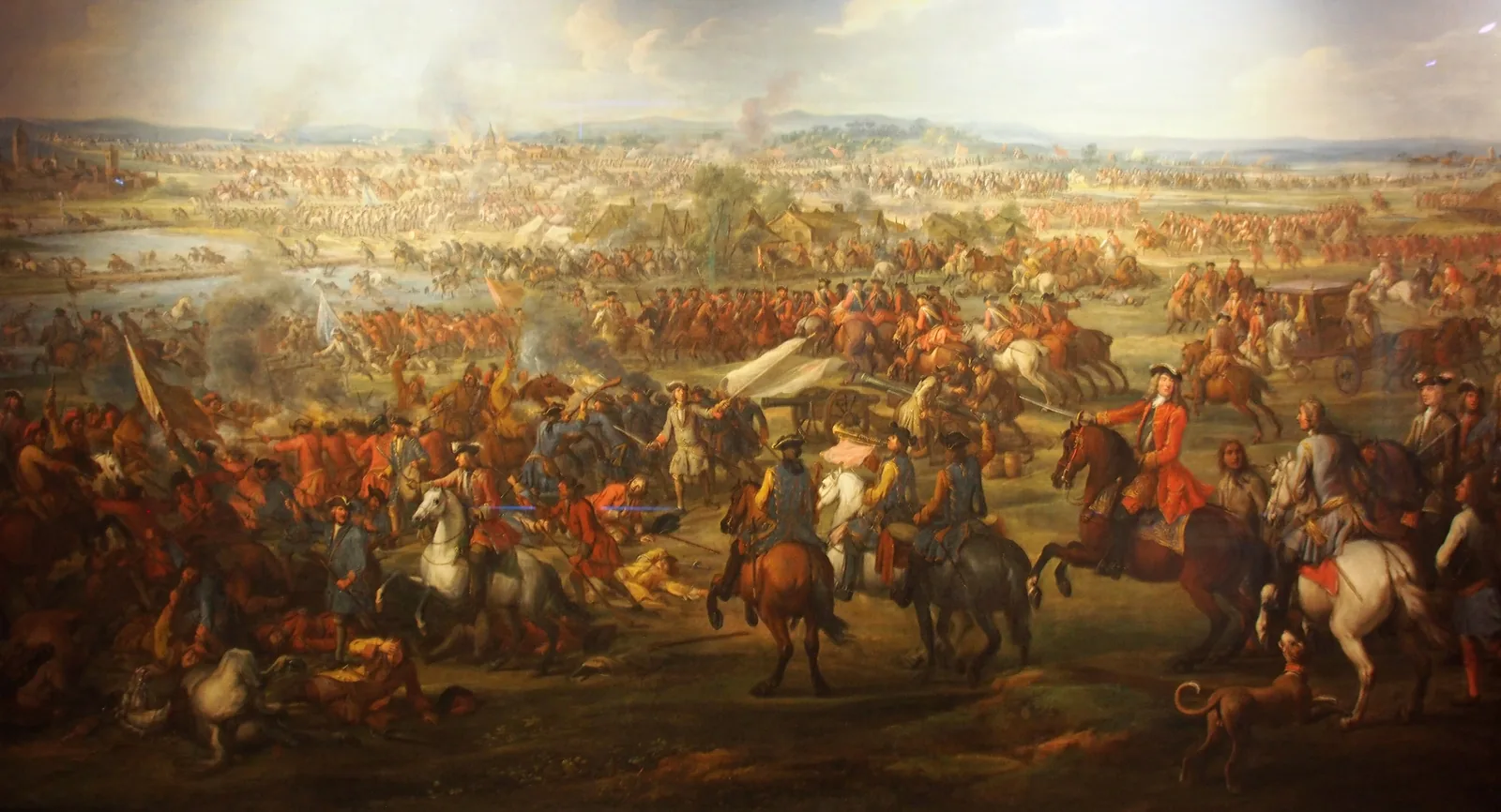
John Wootton, The Battle of Blenheim, c. 1742. National Army Museum, London · Public domain · Source page
A note on a tavern bill
Seventeen hours in the saddle
Evening, 13 August 1704, by the Danube in Bavaria. Smoke rises from a burning village called Blindheim. A general seventeen hours in the saddle tears a page from a notebook, probably a supply officer's, a tavern bill on its back, and writes to his wife: the queen's army has won a glorious victory.
In his coach sits a prisoner, Marshal Tallard, commander of one of Louis XIV's armies. In the village some 10,000 French soldiers are about to lay down their arms. In 61 years on the throne, Louis has never seen a French army destroyed like this.
How did an English general come to fight deep in southern Germany? It began four years earlier, at a king's deathbed in Madrid.
John Churchill, Duke of Marlborough
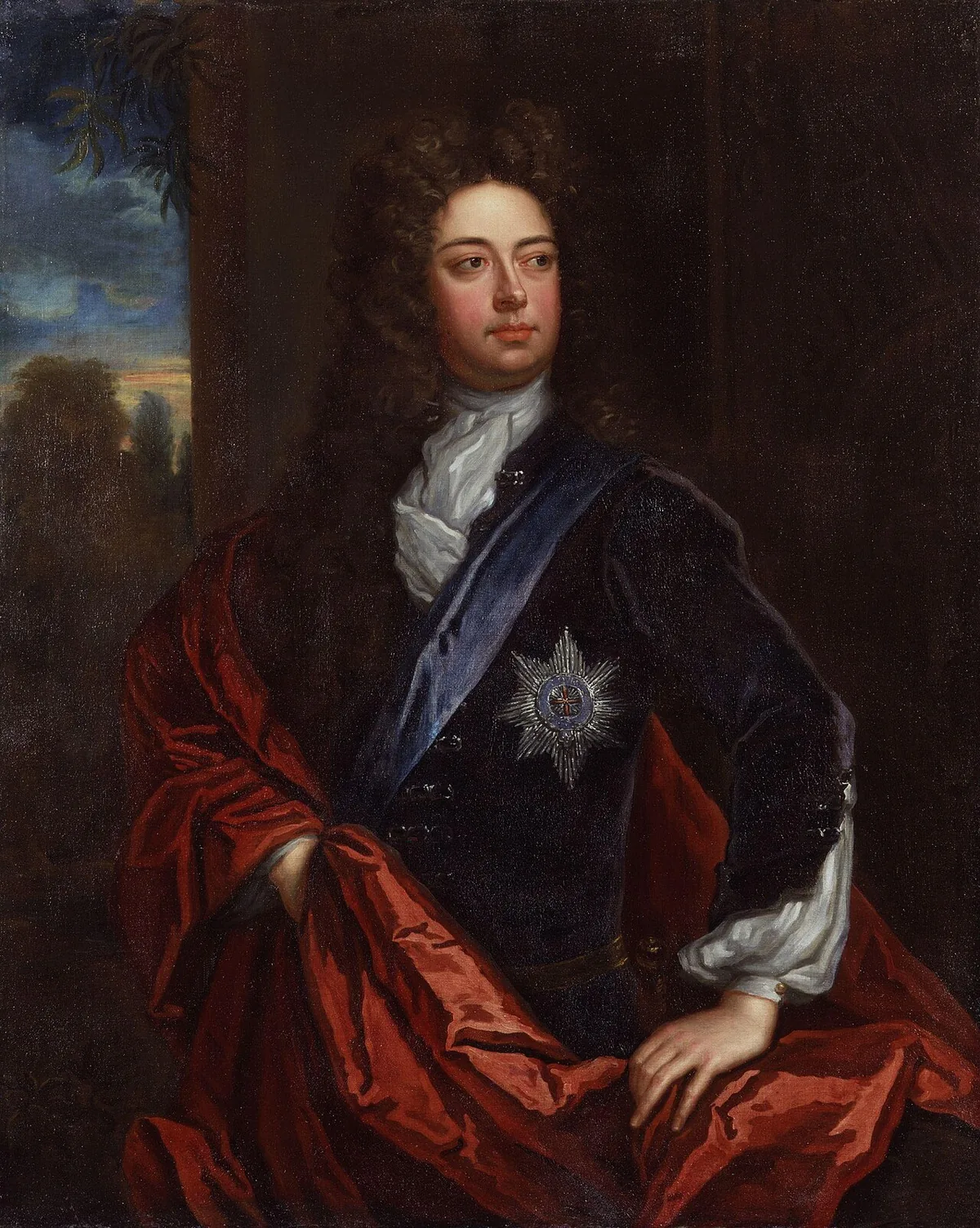
After Sir Godfrey Kneller, John Churchill, 1st Duke of Marlborough. National Portrait Gallery, London · Public domain · Source page
The son of a poor country squire, he rose by charm, nerve and his wife's friendship with a princess, and, it is often said, never lost a battle.
- Born: 26 May 1650 (English calendar), Ashe House, Devon, England
- Died: 16 June 1722 (English calendar), Windsor Lodge, England, after a series of strokes
- Won: Sedgemoor, 1685 (as second-in-command); The Schellenberg, 1704; Blenheim, 1704 (with Eugene); Ramillies, 1706; Oudenarde, 1708; Malplaquet, 1709, at a terrible cost
- Lost: Dismissed and briefly held in the Tower of London, 1692; Dismissed by Queen Anne, 1711
“I can't end my letter without being so vain as to tell my dearest soul, that within the memory of man there has been no victory so great as this.”
A will and a war
Background
The last Habsburg of Spain
Charles II of Spain, born in 1661, sickly and frail, was the last of the Spanish Habsburgs; Spaniards called him “the Bewitched”. He ruled the largest empire on earth: Spain, vast lands in the Americas, the Philippines, Naples, Sicily, Milan and the Spanish Netherlands, today's Belgium. He had no child.
Louis XIV and the Austrian emperor, Leopold I, were both sons and husbands of Spanish princesses, and both claimed the inheritance. To avoid war, Louis and William III, King of England and leader of the Dutch, signed two partition treaties to share it out. Nobody asked the Spaniards.
On 2 October 1700 the dying king signed his will: everything, undivided, to Louis's 16-year-old grandson, Philip, Duke of Anjou; if France refused, everything to Leopold's son, the Archduke Charles. A month later he was dead.
A decision point
You are Louis XIV, King of France.
November 1700, at the palace of Fontainebleau
A courier from Madrid has brought the will. Your small council, meeting in the rooms of Madame de Maintenon, your secret wife, is split two against two; your son, the Dauphin, speaks hard for the will.
This March you signed the second partition treaty with William III: Italian lands for France, Spain for the Archduke. But Emperor Leopold rejects it and wants everything. Refuse the will, and the offer goes to Vienna.
Accept, and your grandson is King of Spain, but France gains no land, and England and the Dutch may fear that France and Spain will one day be one.
What do you do?
- Keep to the partition treaty with England and the Dutch On paper France gains Italian lands. But the Emperor would fight for the whole inheritance, the Spaniards would resist being carved up, and you would have to conquer your share beside Protestant allies you do not trust. Probably war anyway, with the Spanish empire in Austrian hands.
- Accept the will: your grandson becomes King of Spain A Bourbon in Madrid, and no more Habsburg ring around France. Austria will surely fight for Italy. Whether England and the Dutch join it depends on what you do next.
- Accept the will, but go out of your way to calm London and The Hague Philip would give up his right to the French crown, the Dutch would keep their fortresses, and you would stay out of England's affairs. Probably the sea powers would grumble and stay out, and Austria would fight almost alone.
What really happened
Accept the will: your grandson becomes King of Spain
Louis accepted, and on 16 November 1700 presented his grandson at Versailles: “Gentlemen, behold the King of Spain,” in Saint-Simon's account. England and the Dutch at first recognised him as Philip V. But within ten months Louis kept Philip's place in the French succession, sent troops into the Dutch-held Barrier fortresses, won Spain's slave-trade contract for a French company, and recognised the exiled James II's son as King of England.
Louis reasoned that the Emperor would fight whatever he chose, and the will at least had the Spaniards on his side. Many historians, John Lynn among them, think accepting was defensible; it was the moves that followed that turned a war with Austria into a war with half of Europe.
1701–1702
From inheritance to war
In London and The Hague, Louis's moves looked like one plan: France and Spain run from Versailles. In September 1701 England, the Dutch Republic and the Emperor signed the Grand Alliance. Its aims were limited: Spain's Italian lands for the Emperor, a barrier for the Dutch, and a promise that France and Spain would never share one king.
William III died in March 1702 and his sister-in-law Anne became queen; in May the allies declared war. Louis's great generals were gone: Turenne killed in 1675, Condé dead in 1686. A new generation led his armies: Villars, Vendôme, Villeroi and Tallard.
1701–1702 · Italy
The prince Louis turned away
The first blows fell in northern Italy, where the Emperor's general was Prince Eugene of Savoy. Born in Paris, he had been refused a command by Louis in 1683, served the Habsburgs instead, and in 1697 destroyed an Ottoman army at Zenta.
In 1701 Eugene crossed the Alps by mountain tracks, beat the French at Carpi and threw back Marshal Villeroi's attack on his camp at Chiari. In February 1702 his men crept into Cremona through an old water channel and captured Villeroi himself. Irish regiments in French service held the gates, and Eugene withdrew with his prisoner. The French joked that the town was saved and the general lost.
Prince Eugene of Savoy
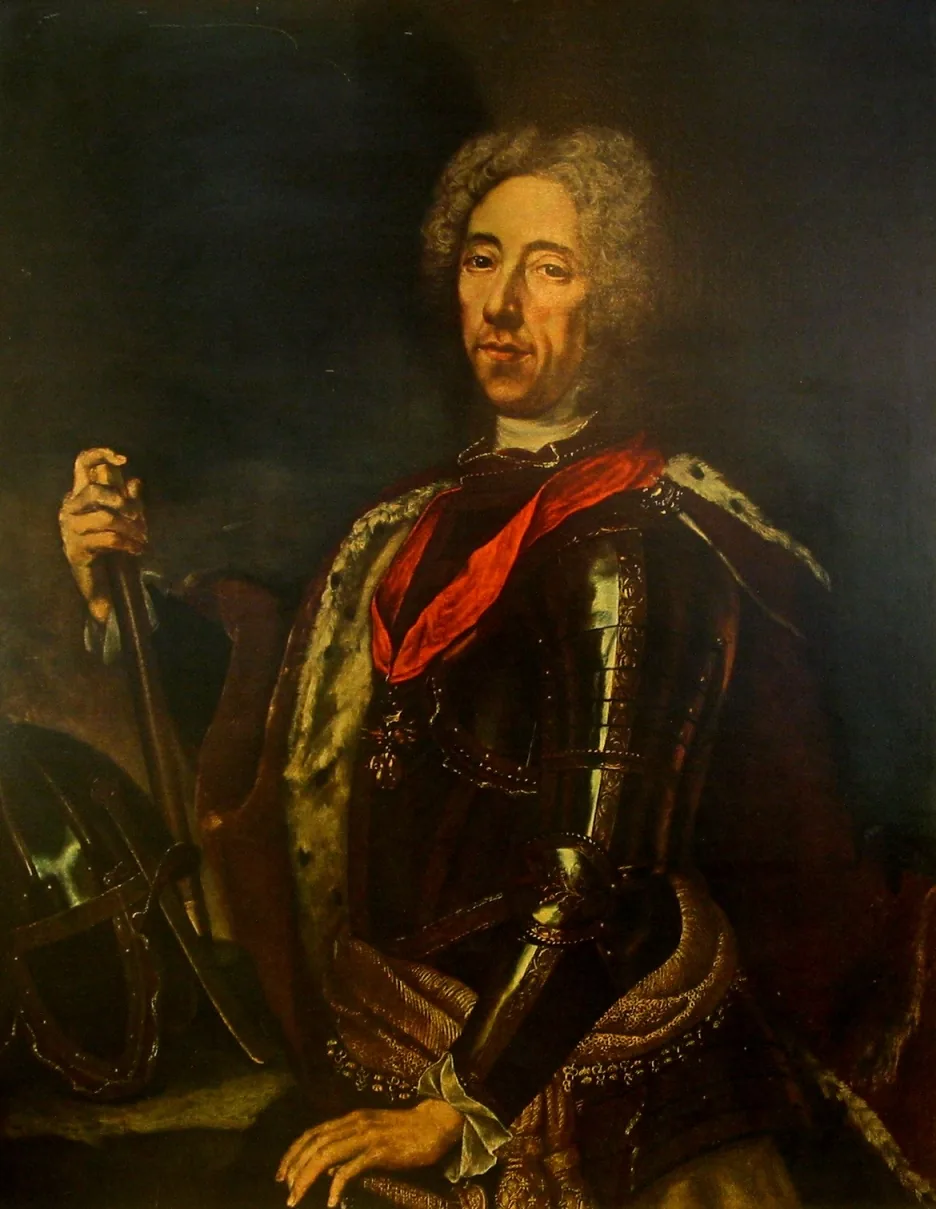
Jan Kupecký, Prince Eugene of Savoy, 1717. Heeresgeschichtliches Museum, Vienna · Public domain · Source page
A small, slight prince from Paris whom Louis XIV turned away, and who spent 53 years fighting France and the Ottomans for the Habsburgs.
- Born: 18 October 1663, Paris
- Died: 21 April 1736, Vienna, in his sleep, aged 72
- Won: Zenta, 1697; Chiari, 1701; Blenheim, 1704 (with Marlborough); Turin, 1706; Belgrade, 1717
- Lost: Luzzara, 1702 (a bloody draw); Denain, 1712
“I never saw better horses, better clothes, finer belts, and accoutrements; yet all these may be had for money; but there is a spirit in the looks of your men which I never yet saw in any in my life.”
The Duke and the Danube
The Englishman
A soldier at court
John Churchill learned his trade as a page to James, Duke of York, and as a young officer in Louis XIV's own army under Turenne. In 1685 he helped win Sedgemoor for James, by then king; in 1688 he deserted him for William of Orange, who made him Earl of Marlborough and later dismissed him.
His fortune rested on a friendship. His wife, Sarah Jennings, was Princess Anne's closest friend; in their letters they were plain “Mrs Morley” and “Mrs Freeman”. When Anne became queen in 1702 she made Marlborough Captain-General, then a duke. With his friend Godolphin at the Treasury, he had the queen's trust, the money and the army.
In Flanders, though, Dutch field deputies twice forbade him to fight. In 1702–03 he took fortresses but fought no great battle.
1702–1704
Vienna in danger
In 1702 Max Emanuel, the Elector of Bavaria, openly joined Louis. Bavaria sat on the Danube, the road to Vienna. In 1703 French and Bavarian troops under Marshal Villars beat an Imperial army at Höchstädt, while Hungarian rebels raided almost to the city's gates. By spring 1704, with Marshal Marsin's French army in Bavaria and Vendôme in Italy, the Emperor was threatened on three sides. If Vienna fell, the Grand Alliance would fall with it.
A decision point
You are John Churchill, Duke of Marlborough.
April 1704, The Hague
The Emperor's envoy, Count Wratislaw, begs for help: without it, Vienna may fall this summer. Eugene agrees. Prince Louis of Baden's Imperial army on the Rhine is too weak to save Bavaria alone.
Facing you is Marshal Villeroi's strong French army. The Dutch fear for their frontier the moment you leave, and have approved only a campaign on the Moselle. In London, Tory leaders threaten to bring you down if you fail. The Danube is some 400 kilometres away.
Where do you take the army?
- Stay in the Netherlands and take more fortresses on the Meuse Safe for the Dutch and for your career. But Vienna would be left to its fate, and if the Emperor made peace, England and the Dutch would face France almost alone.
- Campaign on the Moselle, into France, as the Dutch have approved A threat to France itself might draw French troops away from Bavaria. But it is slow country, full of fortresses, and might not draw them off in time to save Vienna.
- March to the Danube, join Baden and Eugene, and knock Bavaria out of the war If it works, Vienna is saved. But you leave the Dutch exposed, stretch your supplies across Germany, and stake your career on a single campaign.
What really happened
March to the Danube, join Baden and Eugene, and knock Bavaria out of the war
Marlborough marched for the Danube under cover of the Moselle plan. Villeroi followed him up the Rhine instead of attacking the Dutch, and by late June Marlborough was on the Danube.
He wrote to Godolphin that he knew he was taking a great deal upon himself, but that otherwise the Empire would be undone. David Chandler praises the planning; the Dutch historian Olaf van Nimwegen stresses that the march depended on Dutch consent, money and supplies.
May–June 1704
The march to the Danube
400 km
On 19 May 1704 the army left Bedburg, near Cologne: about 21,000 men, 16,000 of them British. At Koblenz, instead of turning up the Moselle, it crossed the Rhine and kept going south, gathering Prussians, Hanoverians, Hessians and Danes until some 40,000 men reached the Danube.
The key was supply. Commissaries rode ahead with cash, buying bread and fodder; at Heidelberg new shoes waited for the whole army. Captain Robert Parker of the Royal Irish Regiment remembered: “Surely never was such a march carried on with more order and regularity, and with less fatigue both to man and horse.”
On 10 June Marlborough met Eugene for the first time; they stayed friends for life. On 22 June the army joined Baden: some 400 kilometres in five weeks.
Myth
The march to the Danube was Marlborough's own secret, hidden from everyone; he tricked the Dutch into it.
The truth
Marlborough, Wratislaw, Eugene, Heinsius and Godolphin shaped the plan. The queen, Prince George and a handful of Dutch leaders (Heinsius, Fagel, Hop, Van Slingelandt) knew from the start; the States General had approved only a Moselle campaign. What was hidden was the destination, and not for long: after the Rhine crossing at Koblenz on 26 May the French knew it was not the Moselle, and by early June they guessed the Danube.
The evidence
Parker admits the secret was well kept: only at Heidelberg, “and not before, was it publickly known that the Duke's design was against the Elector of Bavaria”, and even Marlborough's brother Charles had not been told. But it was kept from the army, not from the few leaders who had to agree.
The Schellenberg and the burning of Bavaria
2 July 1704
A hill above the Danube
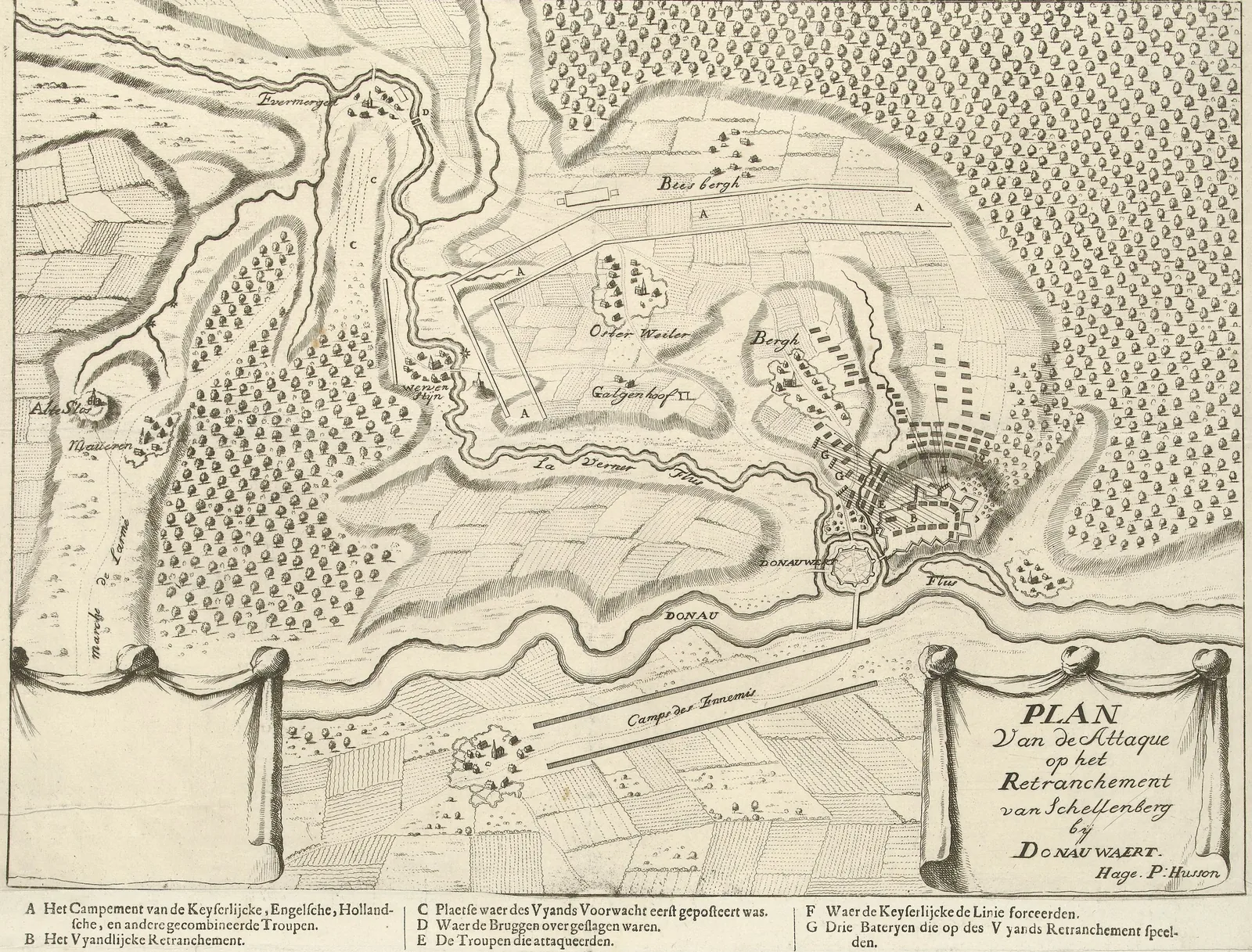
Plan of the attack on the entrenchments of the Schellenberg by Donauwörth, etching, The Hague: Pieter Husson and Paulus Scheltus, 1704. Rijksmuseum, Amsterdam · CC0 · Source page
To get into Bavaria the allies needed a crossing over the Danube. Donauwörth had a bridge, and above it rose the Schellenberg, a hill crowned by an old fort from the Thirty Years' War. Count d'Arco was digging in on the summit with some 12,000 Bavarian and French troops.
Marlborough and Baden had agreed to command on alternate days, and 2 July was Marlborough's. His men had marched since three in the morning, but a siege would take weeks and Tallard was on his way. Marlborough attacked that same evening, before the earthworks were finished.
The Schellenberg: who fought whom
2 July 1704, from about 6 to 9 p.m.
The Schellenberg hill above Donauwörth, on the Danube
The allies
- Commanders: Marlborough, Louis William, Margrave of Baden (the Imperials), Johan Wijnand van Goor (killed)
- Strength: about 22,000 engaged, the rest of the army behind (Modern estimate)
- Losses: about 6,000 killed and wounded (Parker (1747)); about 5,000 killed and wounded (Modern estimate)
Some 6,000 picked men, about 130 from each battalion, led the assault.
Bavarians and French
- Commanders: Count Jean-Baptiste d'Arco
- Strength: 16,000 (Parker); about 12,000, with 16 guns (Modern estimate)
- Losses: 7,000 killed, 2,000 drowned, 3,000 taken (Parker); about 5,000 killed, wounded or taken, and many more scattered (Modern estimate)
Parker's losses add up to 12,000, almost the whole defending force: a typical victor's inflation.
Outcome: An allied victory: d'Arco's force broken, the town abandoned, and the crossing into Bavaria won at a very heavy price.
Parker was there, but he gave the enemy's losses from hearsay. Modern historians (Falkner, Holmes, Van Nimwegen) give lower figures.
The storming of the Schellenberg
2 July 1704, evening
The allies must cross the Danube to get into Bavaria. Above the bridge at Donauwörth rises the Schellenberg, a hill crowned by an old fort, where Count d'Arco is digging in with some 12,000 Bavarian and French troops. The allies are preparing to attack in the evening, before the earthworks are finished.
A reconstruction after the Dutch plan printed in The Hague in 1704 (the picture above), the ground today, and the accounts of Parker, de la Colonie, G. M. Trevelyan (1930) and James Falkner (2004). North is up. The course of the lines, the edge of the woods and the 1704 bank of the Danube are uncertain; times are rounded to the half hour.
Phases of the battle
- Evening approach About 5 p.m., after a march of some 24 kilometres, the allies form up around Berg, west of the Kaibach brook, and their guns open fire. On the hill d'Arco's men are still digging; the northern line is only brushwood bundles under a little earth.
- Two assaults fail About 6 p.m. Goor's column climbs the steep slope towards the corner by the old fort. At the parapet it is thrown back, and Goor is killed. A second assault fails too. To hold the north side, d'Arco pulls men from the line between the fort and the town.
- Baden's breach About 7.30 p.m. Baden's Imperial grenadiers wade the Kaibach and walk into the almost empty line between the fort and the town walls. At the same time Marlborough launches a third assault on the northern line, dismounted dragoons among them.
- Down to the river Taken in flank and rear, the defenders run for the Danube; their bridge of boats breaks and many drown. The allies have their crossing, at a cost of some 5,000 killed and wounded. De la Colonie, a French officer on the hill, called both sides “perhaps the bravest soldiers in the world.”
The strategy
- Marlborough's army: Marlborough attacks that evening, on his day in command; a siege would take weeks, and Tallard is on his way. He sends Goor's column up the steep slope to the corner by the old fort, then a third assault on the northern line, with dragoons who have dismounted.
- Baden's Imperials: What Baden intended is not known. His Imperial grenadiers wade the Kaibach and walk into the thin line between the fort and the town walls, the line from which d'Arco had pulled men to hold the north.
- Bavarians and French: Count d'Arco holds the hill above the Donauwörth bridge to block the way into Bavaria, and is still working on the earthworks on the summit. The northern line is only brushwood bundles under a thin layer of earth. When the attack reaches the north, he pulls men from the line between the fort and the town.
What decided it: The line was stretched too thin: to hold the north, men had been drawn from the line between the fort and the town, and Baden's grenadiers waded the Kaibach into the gap. Attacked in flank and rear, the defenders fell back to the Danube, where their bridge of boats broke and many drowned.
Source: Burning Bavaria
“We sent this morning 3000 horse to his chief city of Munich, with orders to burn and destroy all the country about it. This is so contrary to my nature, that nothing but absolute necessity could have obliged me to consent to it, for these poor people suffer for their master's ambition.”
After the Schellenberg the Elector shut himself up in Augsburg and bargained, hoping for Tallard. To force his hand, allied cavalry burned villages across Bavaria: 372 towns, villages and farms, “it was said”, wrote Parker. Tallard told Louis XIV of “cruelties which the Turks would not be willing to commit.”
- Who gave the order, and who writes as if he regretted it? Marlborough agreed to it, yet in a private letter he presents himself as a gentle man forced by necessity. Both can be true; the letter also shows how he wanted his wife to see him.
- Why would Tallard compare the allies to the Turks? To a French Catholic king the Turks stood for the worst cruelty: Tallard chose the strongest word he had. Yet Louis's own armies had burned the Palatinate on the Rhine: under Turenne in 1674, and far more systematically in 1689.
August 1704
Two against three
In early August Tallard joined the Elector and Marsin, and Eugene reached the Danube with about 18,000 men, while Baden marched off with 15,000 to besiege Ingolstadt; some historians think Marlborough and Eugene were glad to see him go.
On 12 August the Franco-Bavarians camped behind a marshy brook, the Nebel. From a church tower at Tapfheim, Marlborough and Eugene studied their camp and, with fewer men and guns, decided to attack next morning.
Blenheim, 13 August 1704
13 August, dawn
Out of the mist
The allies marched at two or three in the morning, under cover of mist. Prisoners had told Tallard they were retreating to Nördlingen; some historians suspect the prisoners were sent to be caught. At about seven the French signal guns fired: the allies were forming for battle.
The field was nearly six kilometres wide. On the Franco-Bavarian right lay the Danube and Blindheim (to the English, Blenheim); in front ran the marshy Nebel; in the middle stood Oberglauheim, and on the left Lutzingen, under wooded hills. Tallard held the right, Marsin and the Elector the left; Marlborough faced Tallard, Eugene the other two.
Blenheim: who fought whom
13 August 1704, from about 7 a.m. to 9 p.m.
Between the Danube and the wooded hills, by the village of Blindheim (Blenheim), Bavaria
The allies
- Commanders: John Churchill, Duke of Marlborough, Prince Eugene of Savoy
- Strength: 64 battalions, 166 squadrons (Marlborough, report to the States General (Aug 1704)); 64,560 (Tallard, report written as a prisoner (Sept 1704)); “computed 52,000” (Millner, a sergeant who marched with the army (1733)); about 52,000, with 66 guns (Modern estimate (Chandler, Lynn))
- Losses: about 12,500: 4,542 killed and 7,942 wounded (Millner (1733), followed by most historians)
Marlborough's wing had about 36,000 men; Eugene's (blue on the map) about 16,000, Imperial, Prussian and Danish troops. Only about one soldier in five was British.
France and Bavaria
- Commanders: Marshal Tallard (captured), Marshal Marsin, Max Emanuel, Elector of Bavaria
- Strength: 60,000 (Millner (1733)); 56,000 (Coxe (1818), from Marlborough's papers); about 56,000, with 90 guns (Modern estimate)
- Losses: “at least 40,000 killed, drowned and taken” (Parker (1747)); “above 11,000 prisoners” (Marlborough, letter of 18 August); some 27,000 killed, wounded and taken, about 14,000 of them prisoners; thousands more deserted on the retreat (Modern estimate)
Tallard's army had about 33,000 men; Marsin and the Elector about 23,000.
Outcome: A crushing allied victory: Tallard's army destroyed and he himself captured, while Marsin and the Elector escaped west. Bavaria was out of the war, Vienna safe.
Everyone counted battalions and squadrons and guessed their size, but real units were weaker than on paper, and Tallard, explaining his defeat as a prisoner, had reason to inflate the enemy's numbers. Most historians now estimate about 52,000 against 56,000.
A decision point
You are Camille d'Hostun, Marshal Tallard.
Morning of 13 August 1704, behind the Nebel
You expected the enemy to retreat; instead they are forming up across the Nebel. Your position is strong, between the Danube and wooded hills, behind a marshy brook. But many of your horses are sick and many of your infantry are recruits.
The Elector urges you to line the brook with infantry and catch the enemy in the marsh. You see a bigger chance: not just to beat them back, but to destroy them.
How do you hold the line of the Nebel?
- Line the brook with infantry and catch them in the marsh The safest way to stop them: few men cross a marsh under close fire. But at best the enemy is beaten back, not destroyed, and may simply march away.
- Stand back, let them cross, then charge with the cavalry while the villages strike their flanks If it works, the enemy is caught with the marsh at his back and destroyed. But it needs the cavalry to strike at the right moment, and strong garrisons in Blindheim and Oberglauheim that do not swallow your reserves.
- Do not fight here: fall back and let the enemy go hungry Time is on your side: the allies are far from their bases and autumn is coming. But retreating in front of an attacking army is dangerous, and Bavaria would be left open to the torch.
What really happened
Stand back, let them cross, then charge with the cavalry while the villages strike their flanks
Tallard drew up his cavalry well back from the Nebel, “almost half an English mile”, says Parker. Into Blindheim he put 9 battalions and 12 squadrons of dragoons on foot, behind barricades of wagons. When the allies attacked, the village commander, the Marquis de Clérambault, pulled in the reserve on his own authority: by mid-afternoon some 27 battalions were packed inside, too crowded to fight well, while the centre was held mostly by cavalry.
On paper the plan was sound, but every part had to work at once. Parker tells of a quarrel in the church tower where Tallard, proud and conceited in his words, overruled the Elector, a story Parker only heard later. Tallard's report blamed Clérambault, who drowned that evening and could not answer.
A decision point
You are Marlborough.
About 1 p.m., 13 August 1704
Your attacks on Blindheim have been thrown back twice, and Eugene's first attack on Lutzingen has failed. Blindheim and Oberglauheim are crammed with French infantry; between them, on the slope beyond the brook, stand mostly cavalry.
Your engineers have repaired a stone bridge and laid causeways across the marsh. But troops that cross will have the marsh behind them and Oberglauheim on their flank.
What do you do now?
- Keep storming Blindheim Villages packed with infantry behind barricades are the hardest ground in war. You would lose thousands of men, and might still fail before dark.
- Pin the villages with small forces and push the mass of the army across in the centre If the crossing holds, your cavalry can strike the weak French centre. If the enemy hits you while you are half across, you could be driven into the marsh.
- Break off and wait for a better chance Your army is short of food and far from home, and the enemy is stronger. Waiting might turn into retreat, and Bavaria would be lost after all.
What really happened
Pin the villages with small forces and push the mass of the army across in the centre
Marlborough told Cutts just to keep Blindheim's garrison busy: some 5,000 allies pinned twice their number. In the centre his troops crossed in four lines, foot, horse, horse, foot, so the infantry could shelter the cavalry. At Oberglauheim the crossing nearly failed until Eugene sent cavalry.
The French had put their infantry in the villages and left the cavalry alone in the open between them. Chandler calls the attack a model of timing and of horse, foot and guns working together; John Lynn adds that French mistakes, and Eugene's costly attacks, made it possible.
The battle of Blenheim
13 August 1704, from about 7 a.m. to 9 p.m.
Before dawn on 13 August 1704 the allies set out in the mist to attack the French and Bavarian army drawn up behind the Nebel, a marshy brook between the Danube and wooded hills. Tallard had expected the enemy to retreat.
A reconstruction after the allied staff plan “drawn on the spot” by d'Ivoy, the Dutch quartermaster-general (The Hague, 1704), the modern villages and streams, and the deployments in James Falkner (2004) and Correlli Barnett (1974). North is up. The 1704 Danube, then closer to Blindheim, is reconstructed. Eugene's exact line, the upper course of the Nebel, the edge of the woods and the timings are uncertain.
Phases of the battle
- Surprise at dawn From about 7 a.m. the allied columns arrive from the east, and the French form up behind the Nebel. For hours the guns fire across the brook while Eugene struggles west through broken ground; he is ready only after midday.
- Blindheim and Lutzingen About 1 p.m. Cutts's British and Hessians attack Blindheim and are thrown back twice; Clérambault pulls the reserve into the village. In the west, Eugene's first attack on Lutzingen is beaten back.
- The centre crosses Marlborough's centre crosses the Nebel. At Oberglauheim the Irish Brigade in French service shatters Holstein-Beck's attack, and Marsin's horse threaten the crossing until Fugger's Imperial cuirassiers, sent by Eugene, drive them off.
- The breakthrough About 5.30 p.m. some 80 allied squadrons charge up the slope. Tallard's cavalry breaks, many riders are driven into the Danube, the nine battalions of the centre are cut down where they stand, and Tallard is taken. In the west Eugene takes Lutzingen; the Elector and Marsin withdraw in good order.
- An army taken Blindheim, surrounded and burning, has no way out but the river, and Clérambault drowns trying to cross it. About 9 p.m. the officers in the village agree to surrender, and some 10,000 men lay down their arms.
The strategy
- Marlborough's army: Marlborough pins the villages with small forces and pushes the main body of his army across in the centre, over a repaired stone bridge and causeways laid across the marsh. Between the villages, on the slope beyond the brook, stand mostly French horse, while Blindheim and Oberglauheim are crammed with infantry. His direct attacks on the villages were thrown back twice.
- Eugene's wing: Eugene struggles west through broken ground against Marsin and the Elector, and attacks Lutzingen; he is ready only after midday. He sends Fugger's Imperial cuirassiers to help in the centre. His exact route is uncertain.
- France and Bavaria: Tallard places infantry in Blindheim and Oberglauheim, and horse on the slope between them, with Marsin and the Elector on the left. He means to let the enemy cross the Nebel, then charge with the horse while the villages strike the enemy's flanks. He sees a chance to destroy them, not only to beat them back.
What decided it: The breakthrough came in the centre: when some 80 allied squadrons charged up the slope, the French horse broke, the nine battalions there were cut down where they stood, and Tallard was taken. Blindheim, surrounded and burning, had only the river as a way out.
13 August, night
The night after
About 9 p.m. the officers in Blindheim signed a capitulation. Tallard, taken by Hessian troopers as his cavalry broke, would spend seven years as a prisoner in England.
Louis heard only on 21 August, Saint-Simon says. According to a story that reached Parker, the king said he had often known armies beaten, but never one taken: hearsay, but it catches the shock.
Myth
Blenheim was an English victory.
The truth
Of some 52,000 allied soldiers only about one in five was British. Most were German and Danish troops in Dutch or other pay, and the Emperor's regiments. Eugene's wing held down 23,000 men all day, Imperial cuirassiers saved the crossing at Oberglauheim, and Hessian troopers captured Tallard. Marlborough himself wrote that had Eugene's success been equal to his merit, “we should in that day's action have made an end of the war.”
The evidence
Marlborough to Sarah, 14 August 1704 (Coxe); the orders of battle in Chandler and Falkner. Germans and French call the battle Höchstädt.
What the victors left behind
Source: A note on a tavern bill
“I have not time to say more, but to beg you will give my duty to the queen, and let her know her army has had a glorious victory. M. Tallard and two other generals are in my coach, and I am following the rest.”
Marlborough scribbled this on a slip torn from a notebook, perhaps a commissary's, which “contains on the back a bill of tavern expenses”, Coxe noted. Colonel Parke, his aide-de-camp, carried it to London. It probably stayed among the family papers that passed to the British Library in 1978.
- Whose army is it, according to the note? “Her army”: the queen's, not his or the allies'. It flatters Anne, on whom his career depended, and already turns a coalition victory into an English one.
- What is missing? Eugene, the Dutch, the Germans and Danes, and the dead. Notice what came first: the queen, the victory, and a marshal in his coach.
Source: The victor's own picture
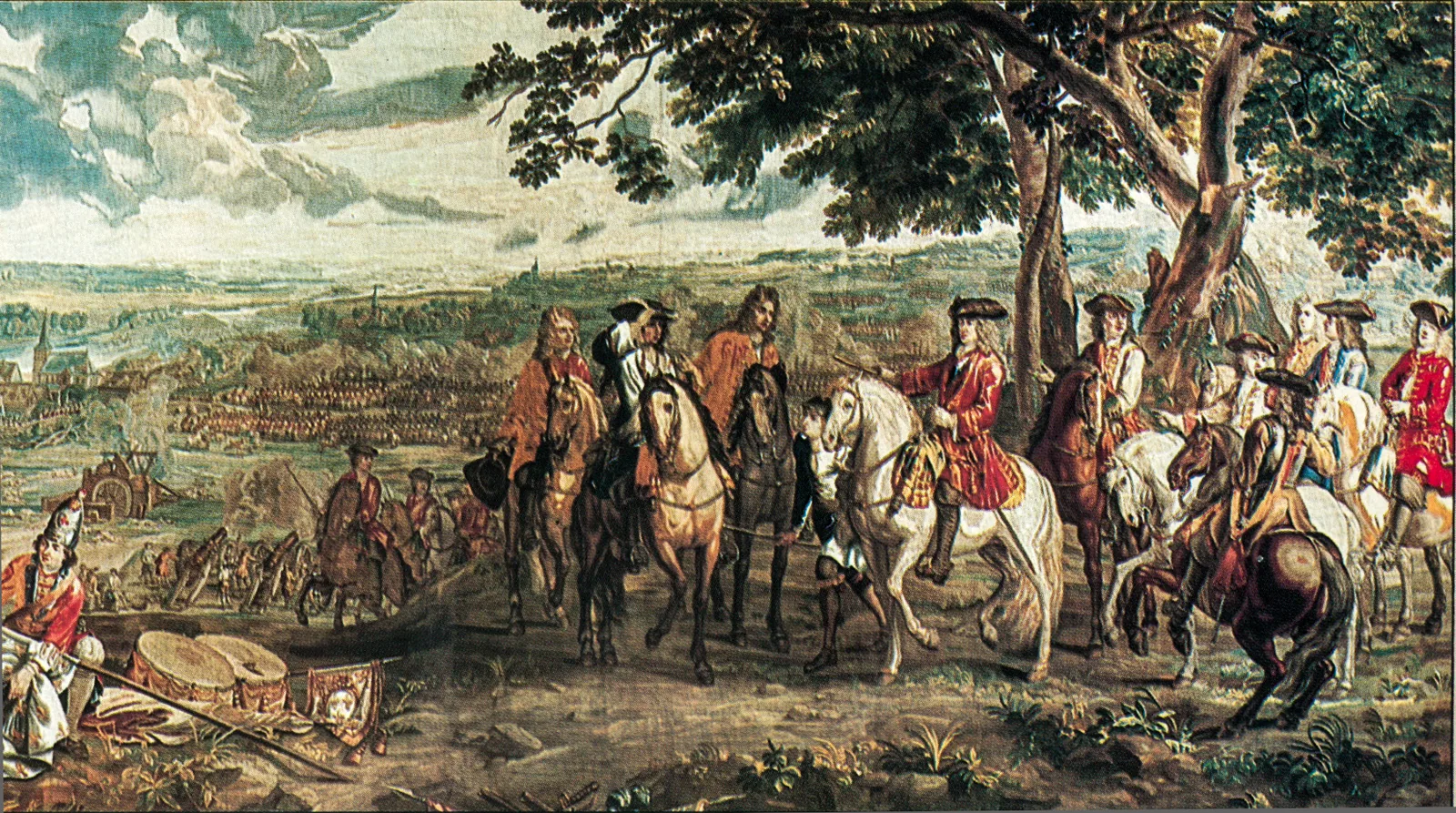
The Blenheim tapestry, designed by Lambert de Hondt II and woven by Judocus de Vos, Brussels. Blenheim Palace · Public domain · Source page
The Blenheim tapestry, one of the Victory Tapestries woven in Brussels for Marlborough in the 1710s, designed by Lambert de Hondt II. Blenheim Palace
Marlborough ordered tapestries of his campaigns for his new palace. Here Marshal Tallard, escorted by two British officers, surrenders to the Duke on his white horse.
- Who paid for this picture, and who is at its centre? Marlborough paid, and Marlborough is at the centre, high on a white horse, with the beaten marshal coming to him. A commissioned picture shows what its patron wanted remembered.
- Who is missing? Prince Eugene, who shared the command and the victory. The tapestry is evidence of how Marlborough saw his victory, not of how it was won.
1704–1705
A rock and a palace
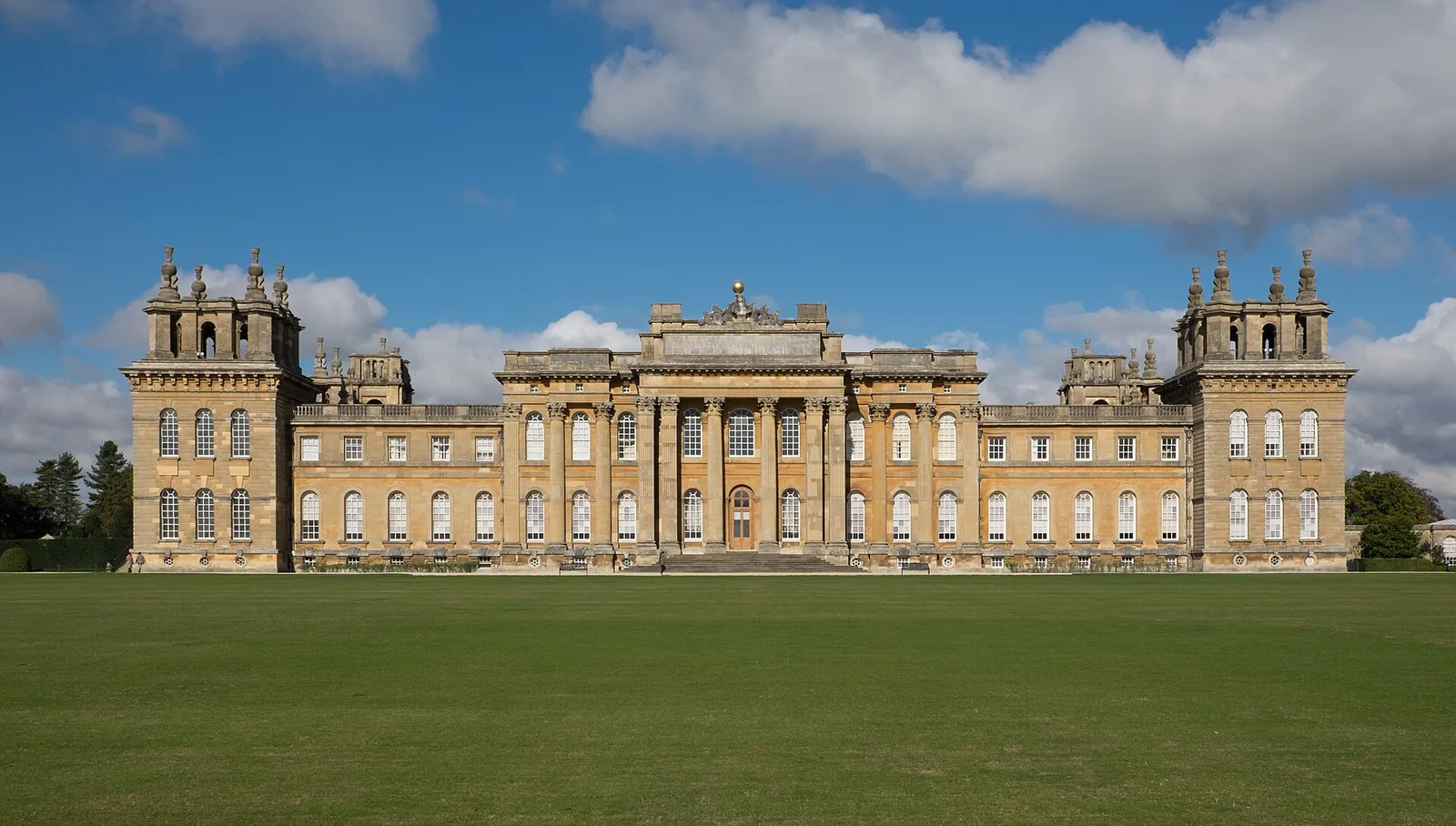
Blenheim Palace, south front, 2016. Photo: DeFacto · CC BY-SA 4.0 · Source page
While Marlborough marched on Bavaria, an English and Dutch fleet under Admiral Sir George Rooke landed troops at Gibraltar, which surrendered on 4 August 1704 and was taken in the name of the Archduke Charles. Britain holds it to this day.
Queen Anne gave Marlborough the royal estate of Woodstock, near Oxford, and the Crown promised to pay for building him a house. Vanbrugh designed a palace on the scale of a monument, named after a Bavarian village; begun in 1705, it was dogged by quarrels over money, and the Marlboroughs finished it largely at their own cost.
After Blenheim
- Aug–Nov 1704 The French fall back to the Rhine, losing thousands more to desertion. Ulm surrenders; Landau falls on 23 November.
- 7 Nov 1704 Treaty of Ilbersheim: Bavaria comes under Austrian military rule; Max Emanuel lives in exile until the peace of 1714 restores him.
- 1705 The new emperor, Joseph I, grants Marlborough the little principality of Mindelheim; Leopold I had made him a prince of the Empire in 1704. Work on Blenheim Palace begins.
- 1706–1714 Ten more years of war: Ramillies, Turin, Oudenarde, Malplaquet and at last the peace of Utrecht, the next lesson.
- 1874 Winston Churchill, Marlborough's descendant, is born at Blenheim Palace, a UNESCO World Heritage Site since 1987.
How decisive was Blenheim?
Did Blenheim change the course of the war and of Europe, or only of one year?
- Edward Creasy (1851), Winston Churchill (1933–38), G. M. Trevelyan (1930) A turning point of world history. It saved Vienna and the Grand Alliance, knocked Bavaria out, broke the myth of French invincibility, and opened the way to Britain's rise as a great power. In Creasy's words, “Had it not been for Blenheim, all Europe might at this day suffer under the effect of French conquests resembling those of Alexander in extent, and those of the Romans in durability.”
- John A. Lynn (1999), Russell F. Weigley (1991) Decisive for 1704, not for the war. It saved Vienna and the coalition, but Louis was fighting for a good peace, not to rule Europe, and the war ran on for ten more years, ending in exhaustion and compromise. Battles of this age rarely settled wars.
- Jamel Ostwald (2000) Decisiveness lies not in the battle itself but in what follows it. A victory mattered only where the winner could exploit it with sieges, supplies and politics. After Blenheim the allies could; after some of their later victories they could not.
No one disputes that Blenheim saved the Alliance in 1704. The open question is whether it changed the war's outcome: in the end, Philip V kept the throne of Spain. The next lesson follows the ten years that decided it.
What do you know now?
Check yourself
What did Charles II's will say?
Answer: The whole Spanish monarchy, undivided, would go to Philip of Anjou; if France refused, all of it would go to the Archduke Charles.. Right. The Spaniards' first concern was to keep the empire whole, and they wanted French strength to protect it.
Check yourself
Why was Marlborough's march to the Danube a gamble?
Answer: It left the Dutch Republic exposed to Villeroi, and Marlborough staked his career on saving Vienna, far from his bases.. Right. The Dutch had approved a Moselle campaign, the Tories at home wanted him near the sea, and failure would have ruined him.
Check yourself
At the Schellenberg, how did the allies finally break into the defences?
Answer: Baden's Imperial grenadiers got in through the weakly held stretch between the fort and the town, while a third assault went over the northern line.. Right. D'Arco had stripped that stretch to stop Marlborough's attacks on the north.
Check yourself
What went wrong for the French at Blindheim?
Answer: Some 27 battalions crowded into the village, held there by a much smaller force, while the centre was left mostly to cavalry.. Right. About 5,000 allied soldiers pinned twice their number, and when the centre broke the village was trapped.
Check yourself
Captain Parker tells of a quarrel between Tallard and the Elector in Blindheim's church tower. Why should a historian be careful with it?
Answer: Parker was on the other side of the brook and heard the story later; he also disliked Tallard.. Right. Hearsay plus hostility. Modern historians accept that the commanders disagreed, but the details and the words are Parker's.
Check yourself
Was Blenheim an English victory?
Answer: No: it was a coalition victory. Only about one allied soldier in five was British, and Eugene's Imperial, Prussian and Danish wing was essential.. Right. German troops, many of them in Dutch pay, made up most of Marlborough's own wing, and Eugene's wing pinned 23,000 men all day.
Terms
- partition treaty A plan agreed by Louis XIV and William III, in 1698 and again in 1700, to divide the Spanish inheritance between the claimants and so avoid a war.
- Grand Alliance The alliance against Louis XIV signed at The Hague in September 1701 by England (Britain from 1707), the Dutch Republic and the Holy Roman Emperor. Most German states joined it, and later Portugal and Savoy.
- Barrier fortresses A chain of fortresses in the Spanish Netherlands held by Dutch garrisons to shield the Dutch Republic from France. French troops took them over in February 1701.
- Elector One of the few German princes who chose the Holy Roman Emperor. Max Emanuel, Elector of Bavaria, sided with Louis XIV in this war.
- Captain-General The commander-in-chief of the English army. Queen Anne gave Marlborough the post in 1702, and he held it until 1711.
- field deputies Dutch politicians who rode with the army on behalf of the States General, the Dutch parliament. They could forbid the commander to risk Dutch troops in battle.
- commissary An official who bought and delivered food, fodder and other supplies for an army. On the march to the Danube, commissaries rode ahead and paid in cash.
- battalion The basic infantry unit of the time: on paper some 500 to 700 men, often fewer after months of campaigning.
- squadron The basic cavalry unit of the time: on paper some 120 to 160 riders.
- dragoons Soldiers who rode to battle but were trained to fight on foot with muskets. At Blindheim twelve squadrons of French dragoons fought dismounted, behind barricades.
- capitulation A surrender on agreed terms, signed by the officers in command. Blindheim's garrison capitulated at about 9 p.m. on 13 August 1704.
- Prince Eugene of Savoy A prince born in Paris who served the Habsburgs. He led the Emperor's troops in Italy and on the Danube, and stayed Marlborough's friend for life.
- Villeroi A French marshal in Louis XIV's army. In 1702 he was taken prisoner at Cremona, in Italy.
- Tallard A French marshal captured at Blindheim in 1704. He spent seven years as a prisoner in England.
- Vendôme A French commander of Louis XIV's new generation, who fought in Italy. He came after Turenne and Condé.
- Villars A French marshal of Louis XIV's new generation. In 1703 he beat an Imperial army at Höchstädt.
- Turenne A great French general under Louis XIV, killed in 1675.
- Condé One of Louis XIV's great generals, who died in 1686.
- Archduke A title of the Habsburg princes of Austria. The Archduke Charles was the allies' candidate for the Spanish throne.
- Dauphin The heir to the French throne. Here it means Louis XIV's son.
- Madame de Maintenon Louis XIV's secret wife. His small council met in her rooms.
- Saint-Simon A French duke who wrote memoirs of Louis XIV's court. He was not at Blindheim.
- Voltaire A French writer and thinker. He put a famous line in Louis XIV's mouth, which he may never have said.
- Mercure galant The French court newspaper. In November 1700 it credited the Spanish ambassador with the idea that the Pyrenees had vanished.
- Höchstädt A town in Bavaria. In 1703 the French and Bavarians beat an Imperial army there.
- Schellenberg A hill above Donauwörth, crowned by an old fort. Marlborough attacked it on 2 July 1704.
- Donauwörth A town on the Danube with a bridge, near the Schellenberg hill.
- Ingolstadt A fortified town in Bavaria. In August Prince Baden marched out to besiege it.
- Gibraltar A port and fortress at the southern tip of Spain. It was taken in 1704, and Britain still holds it.
- Parker A British captain of the Royal Irish Regiment who counted the miles of the march and wrote about it.
- Wratislaw The Emperor's envoy. He begged for help, because Vienna might fall that summer.
- Sobieska Daughter of the Polish king who saved Vienna. She urged her husband, the Elector of Bavaria, to change sides.
- Oberglauheim A village in the middle of the Blindheim battlefield. Marlborough's crossing there nearly failed until Eugene sent cavalry.
- Clérambault The Marquis who commanded the village of Blindheim. He pulled the reserve into it on his own authority.
- Cuirassiers Heavy cavalry wearing a breastplate. Imperial cuirassiers saved the crossing at Oberglauheim.
- Tories One of the two main English parties of the time. Its leaders threatened Marlborough if he failed.
Sources
- Marlborough's letters to Sarah and the Blenheim note, in William Coxe, Memoirs of John, Duke of Marlborough, rev. John Wade, vol. I (London: H. G. Bohn, 1847), chs. XXIV–XXVII; first edition 1818–19
- Robert Parker, Memoirs of the Most Remarkable Military Transactions from the Year 1683 to 1718 (London: S. Austen and W. Frederick, 1747), pp. 94–111
- Jean-Martin de la Colonie, The Chronicles of an Old Campaigner, 1692–1717, trans. Walter C. Horsley (London: John Murray, 1904), pp. 180–190 (the Schellenberg)
- Louis de Rouvroy, duc de Saint-Simon, Memoirs of Louis XIV and His Court and of the Regency, trans. Bayle St John (1857), vol. 3 ch. XVIII (the will) and vol. 4 ch. XXIX (Blenheim)
- Marshal Tallard's report and letters of August–September 1704, in F. E. de Vault and J. J. G. Pelet (eds), Mémoires militaires relatifs à la succession d'Espagne sous Louis XIV, vol. IV (Paris, 1841); quoted here in Frank Taylor's translation (1921)
- John Millner, A Compendious Journal of all the Marches, Famous Battles, Sieges … (London, 1733), quoted in C. T. Atkinson (1921)
- Military Memoirs: Robert Parker and Comte de Mérode-Westerloo, The Marlborough Wars, ed. David Chandler (London: Longmans, 1968); original: Mémoires du feld-maréchal comte de Mérode-Westerloo, 2 vols (Brussels, 1840)
- Plan van de Attaque op het Retranchement van Schellenberg by Donauwaert (The Hague: Pieter Husson and Paulus Scheltus, 1704), Rijksmuseum, Amsterdam, RP-P-OB-83.180
- David Chandler, Marlborough as Military Commander (London: Batsford, 1973; repr. Staplehurst: Spellmount, 2003)
- James Falkner, Blenheim 1704: Marlborough's Greatest Victory (Barnsley: Pen & Sword, 2004)
- Charles Spencer, Blenheim: Battle for Europe (London: Weidenfeld & Nicolson, 2004)
- John A. Lynn, The Wars of Louis XIV, 1667–1714 (London and New York: Longman, 1999)
- Richard Holmes, Marlborough: England's Fragile Genius (London: HarperPress, 2008)
- Derek McKay, Prince Eugene of Savoy (London: Thames and Hudson, 1977)
- Henry Kamen, Philip V of Spain: The King Who Reigned Twice (New Haven and London: Yale University Press, 2001)
- Ophelia Field, The Favourite: Sarah, Duchess of Marlborough (London: Hodder & Stoughton, 2002)
- Olaf van Nimwegen, De Veertigjarige Oorlog 1672–1712: De strijd van de Nederlandse Republiek tegen het Franse expansionisme (Amsterdam: Prometheus, 2020)
- Correlli Barnett, Marlborough (London: Eyre Methuen, 1974)
- Winston S. Churchill, Marlborough: His Life and Times, 4 vols (London: Harrap, 1933–38)
- G. M. Trevelyan, England under Queen Anne, vol. I: Blenheim (London: Longmans, Green, 1930)
- Russell F. Weigley, The Age of Battles: The Quest for Decisive Warfare from Breitenfeld to Waterloo (Bloomington: Indiana University Press, 1991)
- Jamel Ostwald, "The 'Decisive' Battle of Ramillies, 1706: Prerequisites for Decisiveness in Early Modern Warfare", Journal of Military History 64:3 (2000), 649–677
- C. T. Atkinson, Marlborough and the Rise of the British Army (New York and London: Putnam, 1921)
- Frank Taylor, The Wars of Marlborough, 1702–1709, 2 vols (Oxford: Blackwell, 1921)
- Edward Creasy, The Fifteen Decisive Battles of the World (London: Richard Bentley, 1851), ch. XI
Image credits
- John Wootton, The Battle of Blenheim, c. 1742. National Army Museum, London · Public domain · Source page
- After Sir Godfrey Kneller, John Churchill, 1st Duke of Marlborough. National Portrait Gallery, London · Public domain · Source page
- Jan Kupecký, Prince Eugene of Savoy, 1717. Heeresgeschichtliches Museum, Vienna · Public domain · Source page
- Plan of the attack on the entrenchments of the Schellenberg by Donauwörth, etching, The Hague: Pieter Husson and Paulus Scheltus, 1704. Rijksmuseum, Amsterdam · CC0 · Source page
- The Blenheim tapestry, designed by Lambert de Hondt II and woven by Judocus de Vos, Brussels. Blenheim Palace · Public domain · Source page
- Blenheim Palace, south front, 2016. Photo: DeFacto · CC BY-SA 4.0 · Source page


