The Black Death, 1347
Twelve ships sail into Messina. Within five years perhaps a third of Europe is dead, perhaps more.
Decisions, questions and your own progress, in the app
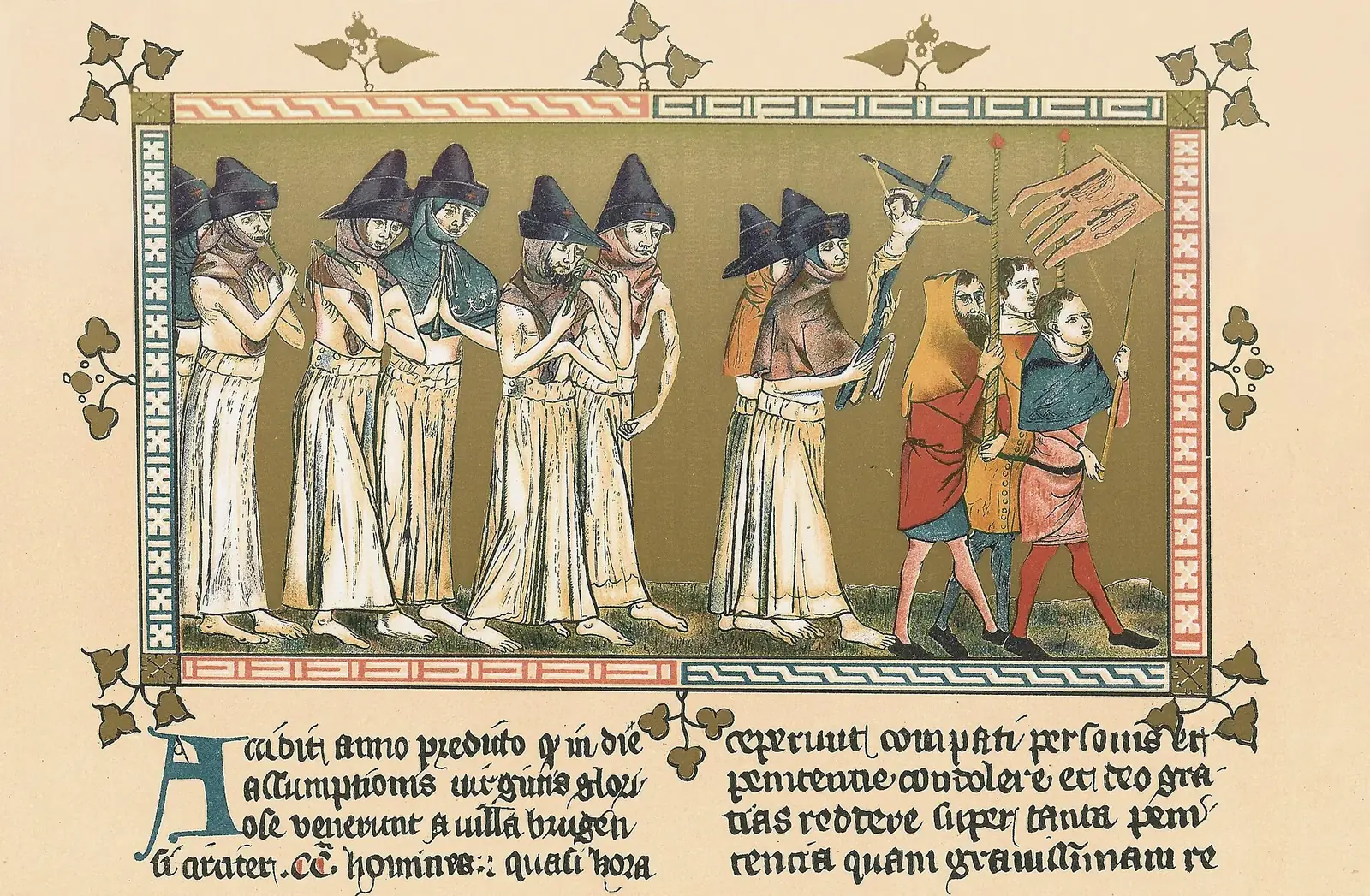
After a miniature attributed to Pierart dou Tielt in the chronicle of Gilles li Muisis, Tournai, early 1350s (Royal Library of Belgium, Brussels). Colour reproduction from H. F. Helmolt, History of the World, vol. 7, 1902 · Public domain · Source page
Twelve ships
October 1347. A line of galleys from Genoa rows into the harbour of Messina, in Sicily. Twelve, a Sicilian friar later wrote. Some of the sailors are burning with fever. Some are already dead.
Within five years, perhaps a third of Europe's people will be dead. Perhaps more.
Background
The road from the east
The sickness probably began in Central Asia and moved west along the trade routes of the Mongol world. In 1346 it struck a Mongol army besieging Caffa, a Genoese port in Crimea. By 1347 it was in Constantinople.
Today we know the killer: a bacterium, Yersinia pestis. It lives in wild rodents and reaches people through flea bites. Most victims got painful swellings called buboes; without modern medicine about half died, often within a week. In the lungs, as pneumonic plague, it spread through coughs and killed almost everyone.
In 1347 no one knew germs existed. Doctors blamed bad air, the stars or God's anger.
A decision point
You sit on Messina's city council.
October 1347, the harbour of Messina
Messina lives by the sea: grain, cloth, spices and news pass through its harbour. Sick sailors after a long voyage are nothing new.
But these sailors have painful swellings in the groin and armpits, and die within days. Now dockers who dealt with them are falling ill too. Merchants tell of a great death in the east.
What do you do?
- Let the galleys unload and trade as usual. The city needs its trade Probably even more contact between sailors, cargo and townspeople, and a faster spread. But the sickness was already in the city, so the end would most likely have been much the same.
- Drive the galleys out of the harbour at once The ships leave, and may carry the sickness to the next port. In Messina people keep falling ill: the sickness has already come ashore.
- Shut the city gates and call the people to processions, fasting and prayer Many cities did just this. Shutting the gates would probably lock the sickness in, since it is already inside, and cut the city off from the food that comes from the countryside. Big processions bring the sick and the healthy close together.
What really happened
Drive the galleys out of the harbour at once
According to Michele da Piazza, the people of Messina drove the Genoese out of the harbour. It was too late. The sickness stayed in the city, and people fleeing Messina carried it to Catania and across Sicily.
Michele says the people of Messina saw that the death came from the ships. Even without germs, people knew the sick could make the healthy sick. What they lacked was a method.
The first known rule came only in 1377: Ragusa (today's Dubrovnik) made arrivals from plague areas wait 30 days. Later the wait became 40 days, quaranta giorni in Italian: our word quarantine.
What really happened
Three continents, five years
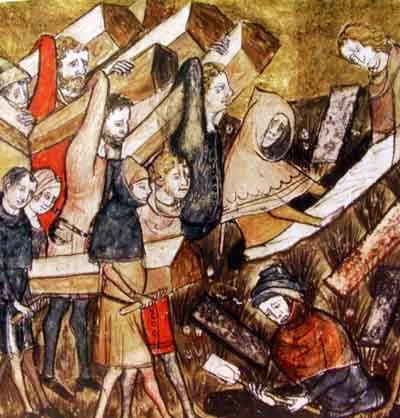
Burying plague victims in Tournai, miniature in the chronicle of Gilles li Muisis, Tournai, early 1350s. Royal Library of Belgium, Brussels, MS 13076–77, f. 24v · Public domain · Source page
30–60%
That is how much of Europe died in 1347–1351, by historians' estimates. No one counted then; the numbers are rebuilt from tax lists, land records and graves.
Ships carried the sickness around the Mediterranean. By the end of 1348 it was in Florence, Paris and London. Cairo, Damascus and Tunis were struck too; in Damascus, the traveller Ibn Battuta saw Muslims, Jews and Christians walk out together to pray. Elsewhere, bands of flagellants whipped themselves in public.
Survivors found workers scarce, and workers wanted more pay. England's king tried to freeze wages in 1349 and again in 1351. In the long run, wages rose anyway.
Source: Someone to blame
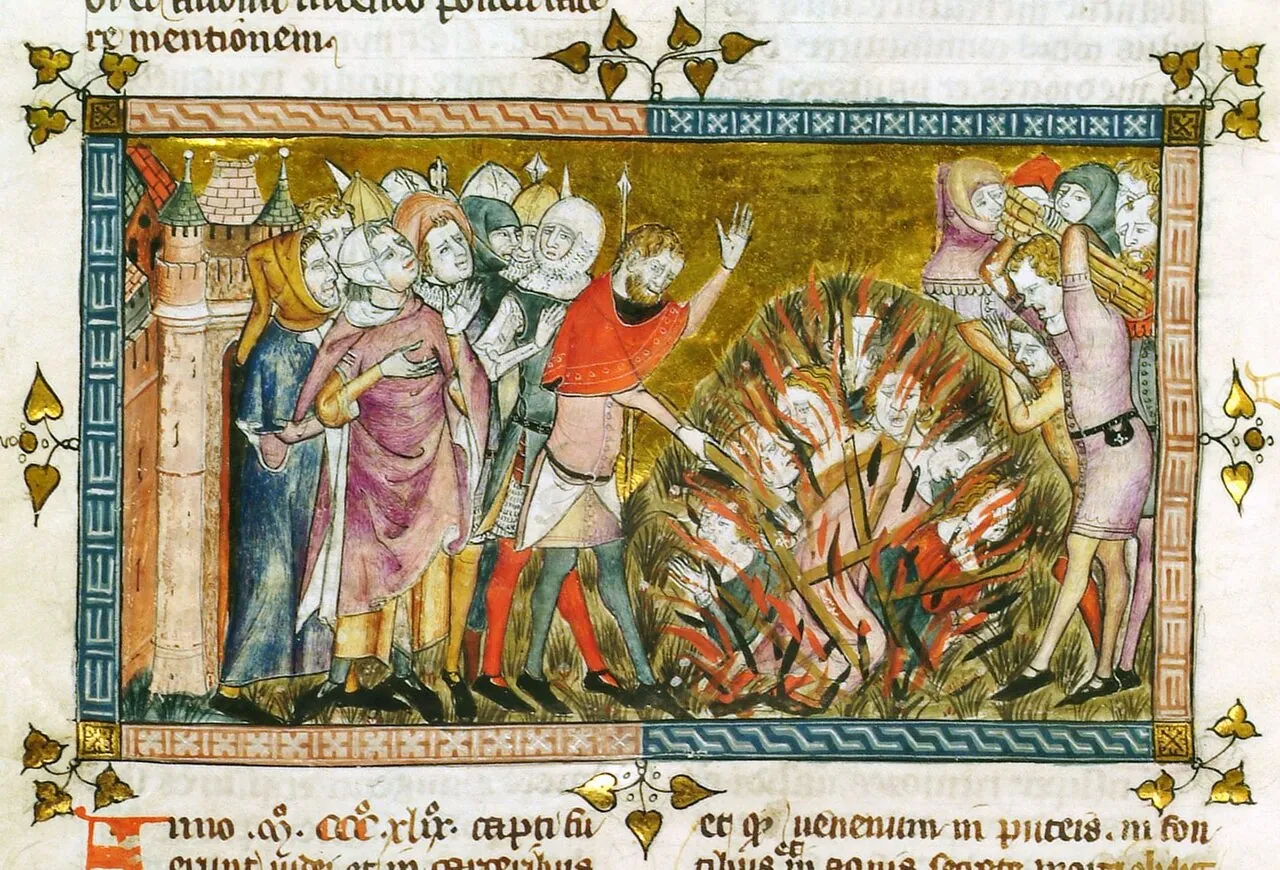
The burning of Jews, miniature attributed to Pierart dou Tielt in the chronicle of Gilles li Muisis, Tournai, early 1350s. Royal Library of Belgium, Brussels · Public domain · Source page
Miniature attributed to Pierart dou Tielt, in the chronicle of Gilles li Muisis, an abbot in Tournai (today in Belgium), early 1350s
In 1348 a rumour spread: the Jews were poisoning the wells. Prisoners were tortured until they “confessed”. In February 1349 the Jews of Strasbourg were burned, before the plague had even reached the city. Hundreds of Jewish communities, above all in the German lands, were attacked; no one can reliably count the dead. Pope Clement VI condemned the accusation in 1348: Jews were dying of plague too, he wrote, and it struck where no Jews lived.
- Who is watching, and how do they behave? Townspeople and armed men stand calmly by the gate while others bring wood. The painter shows an orderly public act, not a riot. To many Christians then, it looked like justice.
- What is missing from the picture? Any evidence: no poison, no well, no trial. The accusation is only in the Latin below: venenum in puteis, “poison in the wells”. The picture shows the punishment and takes the crime for granted.
Myth
Doctors of the Black Death wore long coats and beaked bird masks.
The truth
The beaked costume belongs to the 1600s, about 300 years later. This engraving dates from 1656, when plague struck Rome. Nothing from 1347–1351 shows such a mask.
The evidence
The German text below explains the beak: it held sweet-smelling spices against bad air. The verses beside it compare the doctor to a raven on a dung heap, greedy for gold. The print is partly satire.
Check yourself
Why did driving out the galleys not save Messina?
Answer: The sickness had already come ashore before the ships were sent away. Right. By the time the city acted, sailors, cargo, and probably rats and fleas, were already in the town. The expulsion came too late.
Check yourself
Why did Pope Clement VI say the well-poisoning accusation against Jews was false?
Answer: Jews were dying of the plague too, and it struck places where no Jews lived. Right. Clement used evidence anyone could check. His letters did not stop the killings in many places, but they show that the head of the Church rejected the accusation.
Check yourself
When does the famous beaked plague-doctor costume come from?
Answer: The 1600s, about three centuries after the Black Death. Right. The engraving in this lesson is from 1656. There is no evidence of such a mask in 1347–1351.
Terms
- galley A long ship driven by oars as well as sails. Genoa and Venice ran fleets of them to carry valuable cargo across the Mediterranean and the Black Sea.
- Yersinia pestis The bacterium that causes plague. Alexandre Yersin identified it in Hong Kong in 1894. DNA from Black Death graves shows it was the killer in 1347–1351 too.
- bubo A swollen, painful lymph node, usually in the groin, armpit or neck. It gave bubonic plague its name.
- pneumonic plague Plague in the lungs. It passes from person to person through coughing, and without treatment it is almost always fatal.
- miasma “Bad air”: the old belief that diseases come from foul, poisoned air, rising from rot and swamps or spoiled by the stars. Doctors held it for centuries, until germs were discovered in the 1800s.
- Michele da Piazza A Franciscan friar from Sicily who wrote a chronicle of the island in his own time. It is our main source for the plague's arrival in Messina, written some years after the events.
- quarantine Holding people, ships or goods apart for a fixed time to stop a disease spreading. The word comes from the Italian quaranta giorni, “forty days”.
- flagellants Penitents who marched from town to town in 1348–1349, whipping themselves in public to beg God to end the plague. Pope Clement VI condemned the movement in 1349.
- Caffa A Genoese port in Crimea. In 1346 a Mongol army besieged it, and the sickness struck that army.
- Crimea A peninsula on the northern shore of the Black Sea. The port of Caffa lay there.
- Constantinople A great city in the eastern Mediterranean, today Istanbul. By 1347 the plague had reached it.
- Mongols A people of horse riders from Asia who built a huge empire. The plague spread west along their trade routes.
- Sicily The largest island in the Mediterranean, off southern Italy. Messina, where the sick galleys arrived, lies on it.
- Messina A harbour city in Sicily. In 1347 sick sailors arrived there in ships from Genoa.
- Genoa A port city in northern Italy whose ships reached Messina and Caffa.
- Black Sea A sea between Europe and Asia Minor. Ships from its ports could have carried the plague to Italy.
- Issyk-Kul A lake in Central Asia, in today's Kyrgyzstan. Nearby graves dated 1338–1339 hold victims whose DNA carries a plague strain.
- Kyrgyzstan A country in Central Asia, where Lake Issyk-Kul lies.
- Tournai chronicle A medieval chronicle that gathers news of the plague from many places.
- Piacenza A city in northern Italy, home of the notary Gabriele de Mussis.
- notary An official who certifies documents and records legal facts. The notary Mussis probably was not at Caffa himself.
- Strasbourg A city on the Rhine, on the border of France and Germany. In February 1349 its Jews were burned.
- Clement VI The pope who in 1348 condemned the accusation that Jews poisoned the wells.
- Samuel Cohn A historian who shows that in many places town councils and nobles led the killings.
- Ibn Battuta A traveller who saw Muslims, Jews and Christians walk out together to pray in Damascus.
- Gabriele de Mussis A notary from Piacenza who wrote around 1348 that corpses were hurled over the walls of Caffa, and that fleeing Genoese brought the disease to Italy.
- Catania A city in Sicily. People fleeing Messina carried the sickness there.
- engraving A printed picture cut into a metal plate. The engraving in this lesson dates from 1656, when plague struck Rome.
- Cairo A great city in Egypt, struck by the plague by the end of 1348.
- Damascus A city in today's Syria. It was struck by the plague, and there Ibn Battuta saw Muslims, Jews and Christians walk out together to pray.
- Tunis A port city in North Africa, struck by the plague in 1348.
Sources
- Michele da Piazza, Historia Sicula (chronicle of Sicily), mid-14th century; English extracts in Rosemary Horrox (ed. and trans.), The Black Death (Manchester University Press, 1994)
- Gabriele de' Mussis, Historia de morbo (c. 1348); English extracts in Horrox, The Black Death (1994)
- Gilles li Muisis, chronicle and annals with miniatures, Tournai, c. 1349–1353. Brussels, Royal Library of Belgium, MS 13076–77
- Ibn Battuta, Travels in Asia and Africa 1325–1354, trans. H. A. R. Gibb (Routledge, 1929)
- Der Doctor Schnabel von Rom, engraving published by Paul Fürst, Nuremberg, 1656. British Museum 1876,0510.512
- Rosemary Horrox (ed. and trans.), The Black Death (Manchester University Press, 1994)
- Ole J. Benedictow, The Black Death 1346–1353: The Complete History (Boydell Press, 2004)
- Michael W. Dols, The Black Death in the Middle East (Princeton University Press, 1977)
- Samuel K. Cohn Jr, "The Black Death and the Burning of Jews", Past & Present 196 (2007), 3–36
- Mark Wheelis, "Biological Warfare at the 1346 Siege of Caffa", Emerging Infectious Diseases 8, no. 9 (2002), 971–975
- Katharine R. Dean et al., "Human ectoparasites and the spread of plague in Europe during the Second Pandemic", Proceedings of the National Academy of Sciences 115, no. 6 (2018), 1304–1309
- Maria A. Spyrou et al., "The source of the Black Death in fourteenth-century central Eurasia", Nature 606 (2022), 718–724
Image credits
- After a miniature attributed to Pierart dou Tielt in the chronicle of Gilles li Muisis, Tournai, early 1350s (Royal Library of Belgium, Brussels). Colour reproduction from H. F. Helmolt, History of the World, vol. 7, 1902 · Public domain · Source page
- Burying plague victims in Tournai, miniature in the chronicle of Gilles li Muisis, Tournai, early 1350s. Royal Library of Belgium, Brussels, MS 13076–77, f. 24v · Public domain · Source page
- The burning of Jews, miniature attributed to Pierart dou Tielt in the chronicle of Gilles li Muisis, Tournai, early 1350s. Royal Library of Belgium, Brussels · Public domain · Source page


