The Black Ships, 1853: a letter from an American president
In July 1853 four black steamships anchored near Tokyo without permission. A government that had kept the world at arm's length for about two centuries had months to decide. What did it choose, and what did it already know?
Decisions, questions and your own progress, in the app
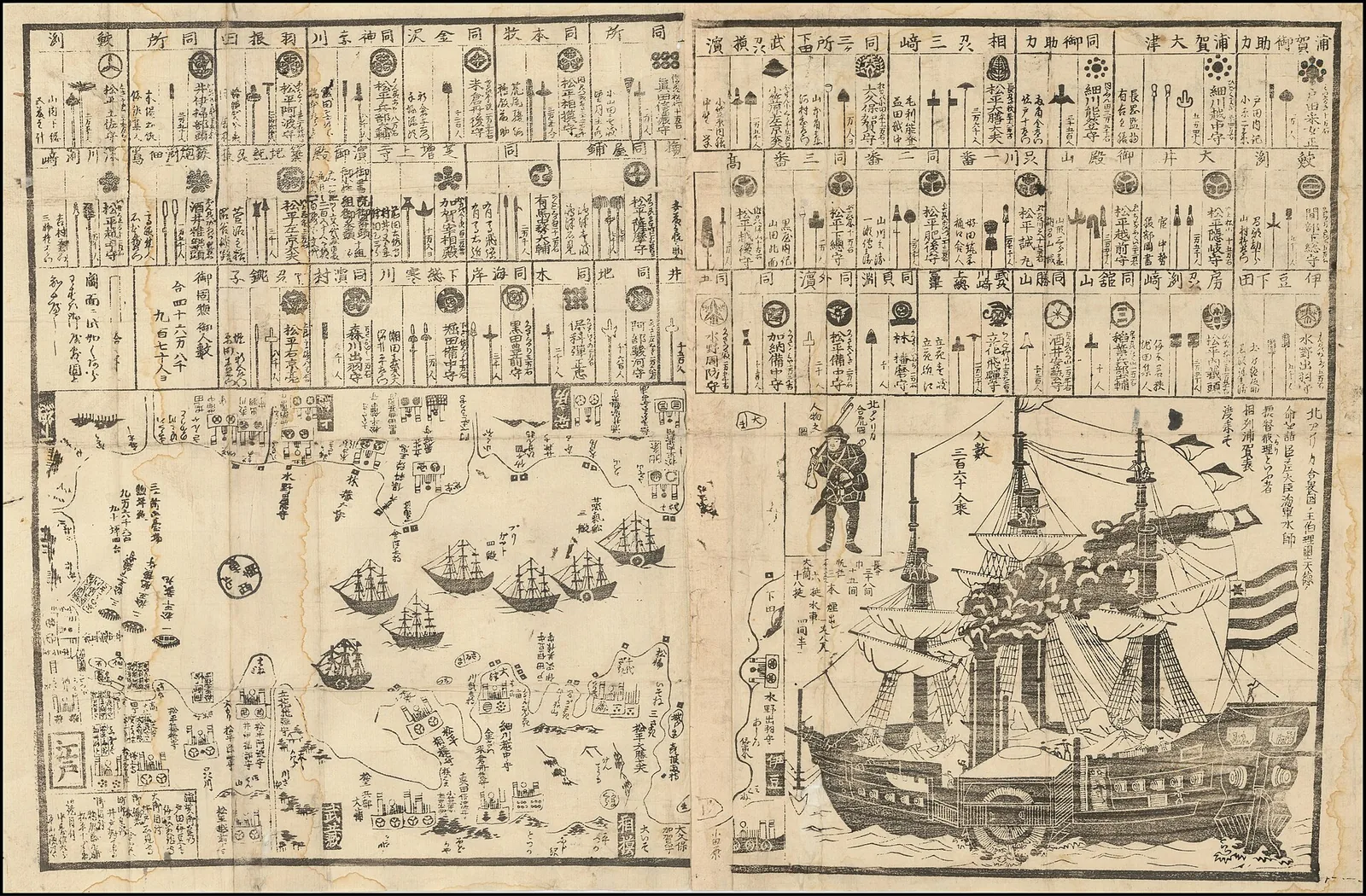
Anonymous kawaraban, about 1853. Public domain, via Wikimedia Commons. · Public domain · Source page
A bay without permission
Four ships, no permission
In July 1853 four American warships sailed into Edo Bay, near today’s Tokyo. Two were steamships, with black smoke rising from their funnels.
They carried a letter from the American president. For about two centuries, Japan had kept the world at arm’s length. Now the government had months to decide. What did it already know?
Background
A near-total ‘no’
Japan was never fully closed. Contact with foreigners was tightly limited. The Dutch lived on Dejima, a small artificial island in Nagasaki harbour. Chinese merchants also traded at Nagasaki. Korea kept contact through the island of Tsushima, and the Ryukyu islands, which the Satsuma domain controlled, also kept contact with Japan.
1852
A warning from Dejima
According to a Japanese account, in 1852 the Dutch chief on Dejima warned Nagasaki officials that American ships were coming. The wording is known only second-hand, and accounts differ on who sent the warning. All dates here are Gregorian. Japan then used a lunar calendar.
Check yourself
Before 1853, what was true of Japan’s contact with the outside world?
Answer: Limited, controlled contact: Dutch and Chinese at Nagasaki.. Right. Contact was small and tightly controlled, and mostly through one port.
The letter
8 July 1853
Four ships off Uraga
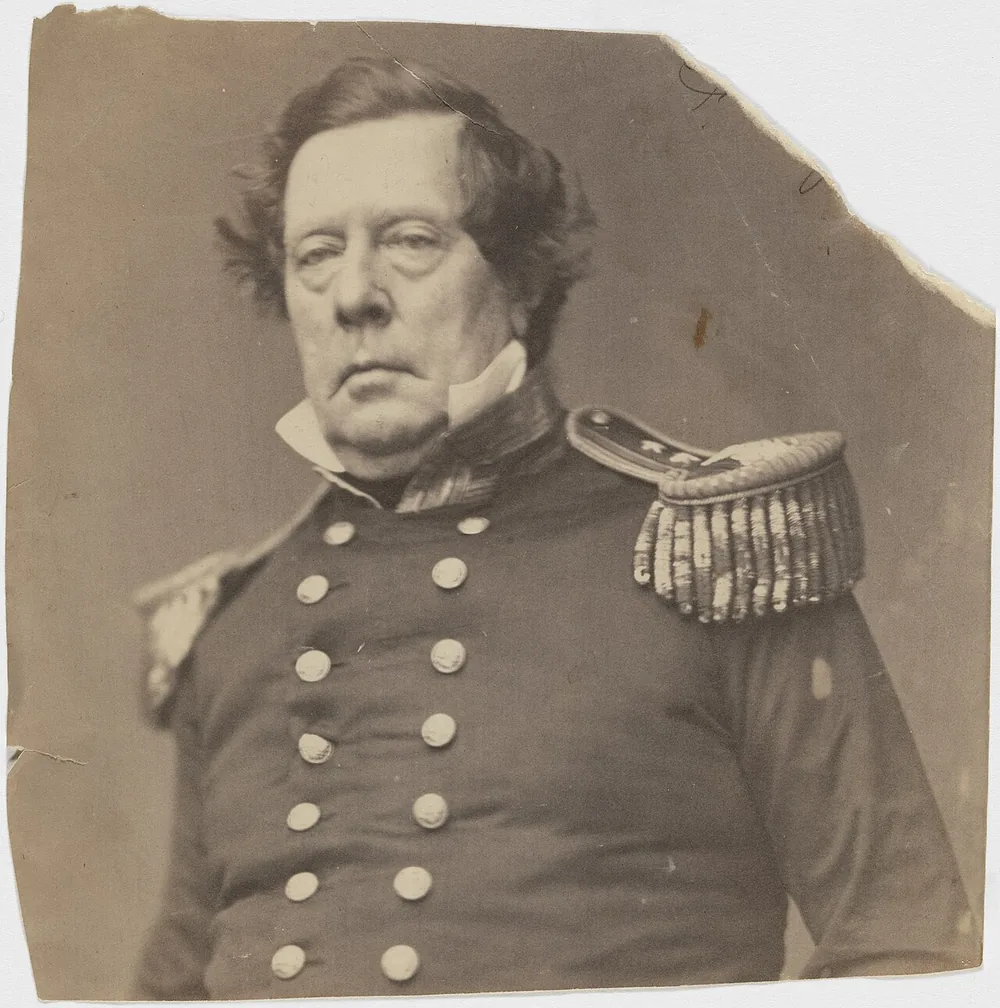
Matthew Calbraith Perry, photograph by Mathew B. Brady, about 1856. National Portrait Gallery (NPG). · CC0 · Source page
On 8 July 1853 four US Navy ships anchored off Uraga, at the mouth of the bay. Commodore Matthew Calbraith Perry led them.
The officials asked him to sail to Nagasaki. He ignored the request and threatened to attack Edo, seat of the shogunate, unless he was allowed ashore. His letter came from President Millard Fillmore.
A decision point
You are Abe Masahiro, one of the senior officials of the shogunate in Edo.
July 1853
Four American ships sit at the mouth of the bay, and their commander threatens Edo. Your shore guns are unlikely to match these ships, and the government has no ready answer.
What do you order?
- Order Perry to Nagasaki, and refuse the letter here. Probably Perry refuses to go. Having threatened Edo, he may test the threat. A fight that Japan would probably lose is likely.
- Order the shore guns to fire on the ships. Probably a short battle that Japan loses. The Americans would then have a clear reason to land in force.
- Receive the letter on the shore at Kurihama, and promise a later answer. Probably it buys time. Perry returns to his ships, and the government can consult. The risk is more demands.
What really happened
Receive the letter on the shore at Kurihama, and promise a later answer.
On 14 July 1853 Perry landed at Kurihama and handed the letter to Japanese officials. The government accepted it, and Perry sailed away. He did not go to Nagasaki.
Historians point to two facts: the threat was real, and the shore guns could not match the ships. A refusal or an attack risked a battle Japan could not win.
Check yourself
Why did the government accept the letter at Kurihama?
Answer: Perry threatened Edo, and the shore guns could not match the ships.. Right. This is the explanation historians point to: a real threat and weak defences.
Asking the lords
Summer 1853
Asking the lords
Abe had the letter translated. Then he did what several accounts call unusual: he showed it to the daimyo, the regional lords, and asked for their opinions.
Meanwhile Shogun Tokugawa Ieyoshi died on 27 July, shortly after Perry arrived. Some historians say the consultation weakened the shogunate, but the evidence is thin.
Source: The landing, as printed in New York
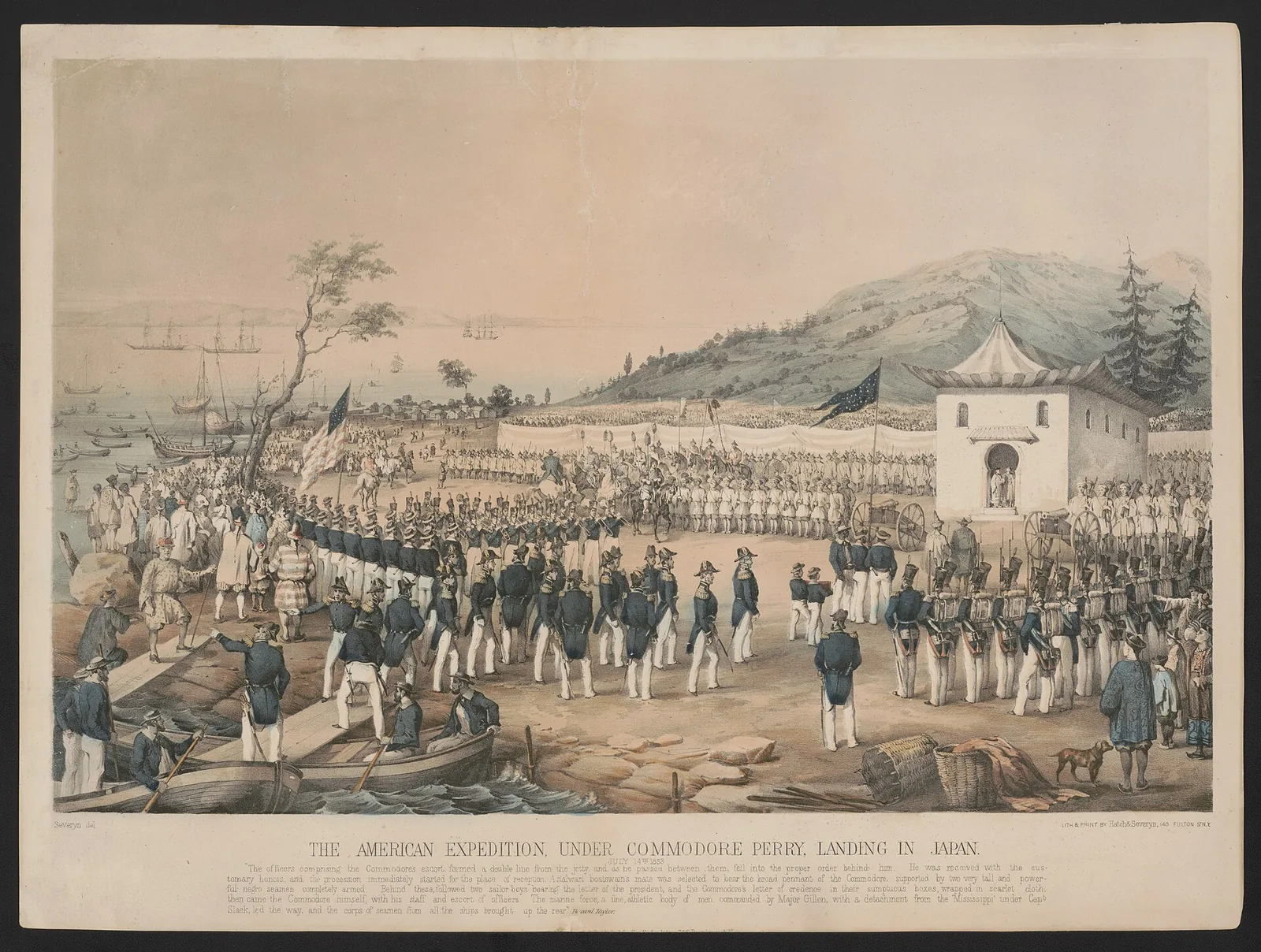
Hatch & Severyn, lithograph after Severyn, New York, 1853. Library of Congress. · Public domain · Source page
Coloured lithograph, New York, 1853 (Library of Congress record)
Made in the United States, for an American audience. It is not clear how much was drawn from what was really seen.
- Who made it, and for whom? Two New York printmakers, for American buyers. It is the landing seen from America.
- Where are the Japanese in the picture? At the edges and in the crowd behind. The centre belongs to American sailors in neat ranks.
- What is missing? A Japanese voice. Nothing shows what was said, so the print shows one side only.
Myth
The black ships were black because they were painted black.
The truth
The name is much older. It first described old Portuguese ships whose hulls were coated in black pitch, and later any Western ship. The steamships’ coal smoke was black. Sources disagree about the colour of Perry’s own hulls.
Check yourself
Where does the name ‘black ships’ come from?
Answer: From old Portuguese ships with pitch-black hulls.. Right. The name is much older than Perry, and only later covered his ships too.
The year after
1854
Perry comes back
Perry sailed away and said he would return. Officials were said to expect an answer in spring 1854.
The following year he came back with about eight ships. The sources disagree on the exact count and the month.
A decision point
You are again one of the senior officials of the shogunate, facing the American ships.
Early 1854, Edo
Perry is back with about eight ships and expects an answer. Your council has spent months on the letter, and you know your guns cannot match these ships.
What do you order?
- Refuse all contact, and prepare the coast for battle. Probably a battle Japan loses. The ships could move along the coast, and the shore guns would not be enough.
- Open two ports for supplies and shelter, treat shipwrecked sailors well, but allow no full trade. Probably it ends the standoff for now. The Americans would come back for more, but the government would gain time.
- Sign a full trade treaty at once, on American terms. Probably the fastest end, and the most one-sided. It would bypass the lords you have just consulted.
What really happened
Open two ports for supplies and shelter, treat shipwrecked sailors well, but allow no full trade.
On 31 March 1854 Japan signed the Convention of Kanagawa, also called the Treaty of Peace and Amity. Shimoda and Hakodate opened to American ships, which could get supplies there. Japan agreed largely because its guns could not match the American ships. It was not a trade treaty, but it had a most-favoured-nation clause clause, which paved the way for a later trade treaty.
Historians point to the fear of a battle Japan could not win. The treaty opened two ports and left trade for later.
Source: The Japanese side: defending the coast
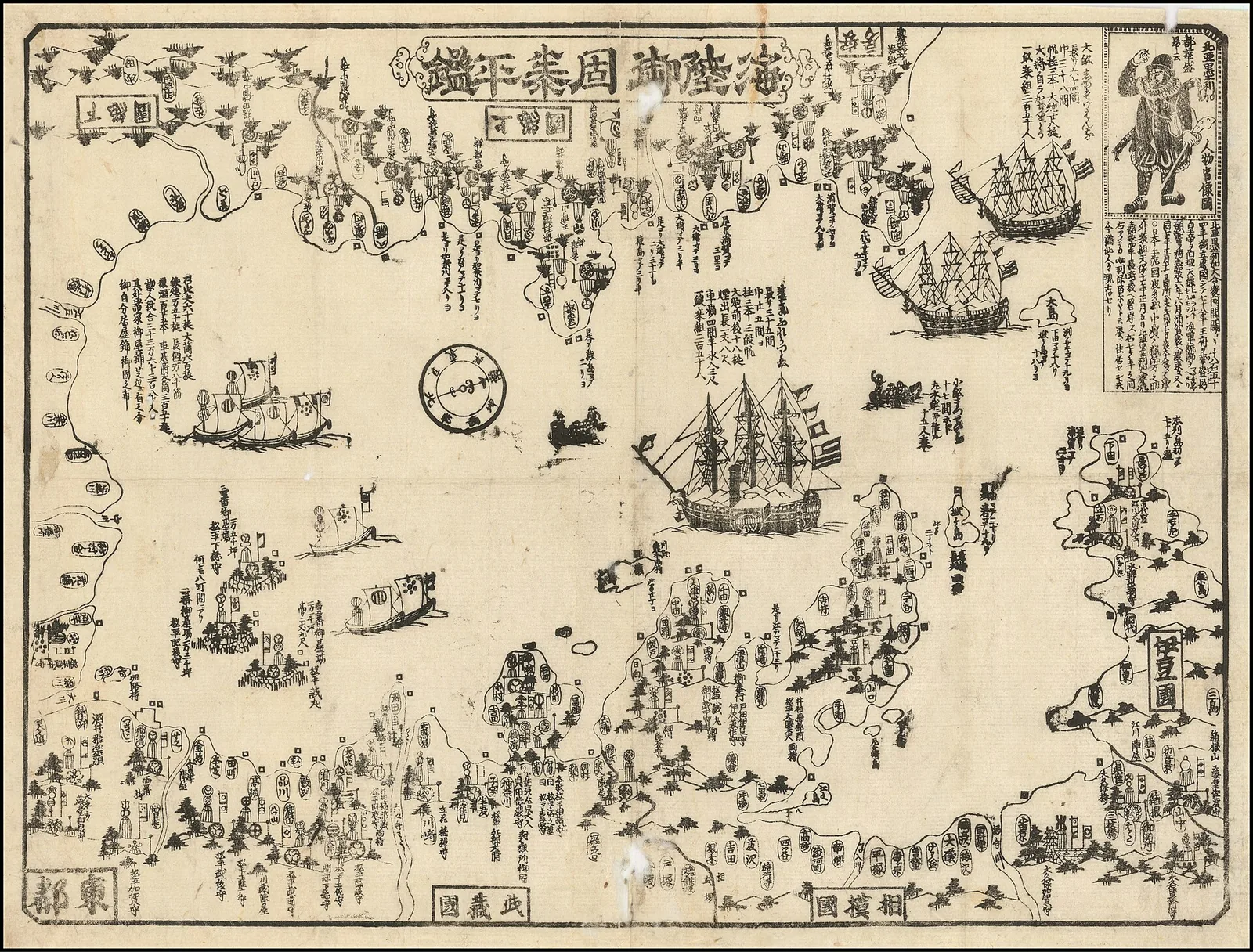
Woodblock news sheet, about 1853. Author unknown. Public domain, via Wikimedia Commons. · Public domain · Source page
Woodblock news sheet, about 1853. Author unknown.
A kawaraban like this sold cheaply and quickly in towns. Its title speaks of defence against a foreign navy, and it shows Perry’s fleet and his flagship.
- What does the sheet want its reader to feel? Perhaps reassurance: rows of names and crests suggest the defence is organised. That is interpretation, not fact.
- Why is the central ship a sailing ship, not a steamship? The two sheets show different ships for the same event. Neither is a photograph, so compare images before trusting one.
- What is missing? The people who lived on that coast. The sheet lists domains and names, not the fear of those who would face the ships.
Check yourself
What did the Convention of Kanagawa mainly give the Americans?
Answer: Two open ports for supplies, and care for shipwrecked sailors.. Right. Ships could get supplies, and shipwrecked sailors were to be treated well.
After the yes
1858
A new treaty, an old question
In 1858 the American envoy Townsend Harris pressed for a trade treaty. It became known by his name: the Harris Treaty.
The emperor in Kyoto had not approved it. The government had to decide whether to sign anyway.
A decision point
You are Ii Naosuke, the tairō, the most senior official of the shogunate.
July 1858, Edo
Harris wants the treaty now. The emperor has not approved it, and nobody knows when, or whether, he will. The decision is yours.
What do you do?
- Wait for the emperor’s approval, even if it takes months. Probably months of delay. The Americans might press harder, and approval might never come.
- Sign the treaty now, and explain it to the court afterwards. Probably a treaty in force quickly, and an angry court. The quarrel would become who has the right to decide for Japan.
- Refuse to sign, and keep the ports closed. Probably American pressure, and possibly force. We cannot know how far that pressure would have gone.
What really happened
Sign the treaty now, and explain it to the court afterwards.
On 29 July 1858 Ii signed the Harris Treaty without the emperor’s approval. It led to the Ansei Purge of 1858–59, in which more than 100 officials, courtiers and lords were purged. On 24 March 1860 rōnin from the domains of Mito and Satsuma killed Ii outside Edo Castle.
Historians disagree. Some see a deliberate decision by Ii. A Japanese government database blames a subordinate’s error. We do not know which is right.
What came next
- 31 March 1854 Convention of Kanagawa: Shimoda and Hakodate open to American ships.
- 29 July 1858 Ii Naosuke signs the Harris Treaty without the emperor’s approval.
- 1858–59 Ansei Purge: more than 100 officials, courtiers and lords are purged.
- 24 March 1860 Ii is killed by ronin outside Edo Castle.
- 1868 The Meiji Restoration: power returns to the emperor, and the shogunate is overthrown.
What decided it?
Did the ships decide it, or Japan’s own politics?
- Historians who stress force The threat of battle and weak guns decided it. Kanagawa followed from the military balance, not a free choice.
- Historians who stress Japan’s internal crisis The shogunate was already under strain. The consultation with the lords, which several accounts call unusual, opened decisions to new players. Some say it weakened the government, but the evidence is thin. Opponents rallied to the slogan sonnō jōi: revere the emperor, expel the barbarians.
Which pressure weighed more? Did the treaty end the argument, or only start the one inside Japan?
Check yourself
What followed Ii Naosuke’s signing of the Harris Treaty?
Answer: A purge of more than 100 officials and lords, then his murder in 1860.. Right. The purge came at once, and the killing some twenty months later.
Check yourself
What does the most-favoured-nation clause in the Convention of Kanagawa mean?
Answer: Any privilege given to another country also goes to the US.. Right. That is the clause’s purpose, and it helped pave the way for later trade treaties.
Terms
- shogunate The military government of the Tokugawa family, based in Edo (today’s Tokyo). The shogun led it, while the emperor in Kyoto remained the official head of state.
- daimyo A regional lord who held land, usually under the shogun, and kept his own troops and court.
- Dejima A small artificial island in Nagasaki harbour, where Dutch traders lived and worked under strict limits.
- kawaraban A woodblock news sheet, sold in Japanese towns. These sheets were quick and cheap, and not always accurate.
- most-favoured-nation clause A clause that gives one country any privilege later granted to another. The clause in the Convention of Kanagawa paved the way for later trade treaties.
- tairō The most senior official of the shogunate’s government, at the head of its council of advisers.
- rōnin A samurai without a lord or master.
- Matthew Perry A commodore of the United States Navy. He led the ships that reached the mouth of Edo Bay with a letter from the American president.
- Millard Fillmore President of the United States. The letter Perry brought to Japan was sent in his name.
- Uraga A coastal town at the mouth of Edo Bay, where the American ships anchored in 1853.
- Kurihama A shore site on the Miura peninsula, where Perry landed and handed over the letter to Japanese officials.
- Abe Masahiro A senior Japanese official who ordered the letter translated and asked the regional lords for their opinions.
- Tokugawa Ieyoshi A Japanese shogun who died shortly after Perry arrived.
- Townsend Harris The American envoy who pressed Japan for a trade treaty in 1858.
- Harris Treaty A trade treaty between Japan and the United States, signed without the emperor's approval. It is named after the envoy Townsend Harris.
- Ii Naosuke One of the highest officials in Japan. He signed the Harris Treaty without the emperor's approval and was later killed by ronin.
- Ansei Purge A wave of dismissals of officials, courtiers and lords in 1858–59, after the Harris Treaty.
- Mito A domain in Japan whose ronin helped kill Ii Naosuke.
- Satsuma A domain in southern Japan. It controlled the Ryukyu islands, and ronin from it took part in the killing of Ii Naosuke.
- Ryukyu Islands A chain of islands between Japan and Taiwan. They were under Satsuma's control and kept contact with Japan.
- Tsushima An island between Japan and Korea. Korea kept contact with Japan through it.
- Nagasaki A port in southern Japan. Dutch and Chinese merchants traded there, and its officials received a warning about American ships.
- Kyoto A city in Japan where the emperor lived. The emperor in Kyoto did not approve the Harris Treaty.
- Edo Castle The castle in Edo, seat of the shogun. Ii Naosuke was killed outside it.
- Convention of Kanagawa A peace and friendship treaty signed in 1854 between Japan and the United States. It opened ports to American ships.
- Shimoda A port in Japan that opened to American ships under the Convention of Kanagawa.
- Hakodate A port in northern Japan that opened to American ships under the Convention of Kanagawa.
- Gregorian calendar The calendar used in most of the world today. The dates in this lesson follow it; Japan then used a lunar calendar.
Sources
- Matthew C. Perry, Narrative of the Expedition of an American Squadron to the China Seas and Japan (1856), compiled by Francis L. Hawks
- Anonymous kawaraban, ‘Commodore Perry’s Arrival in Edo Bay’, about 1853. Wikimedia Commons
- Hatch & Severyn, after Severyn, ‘The American expedition, under Commodore Perry, landing in Japan’ (New York, 1853). Library of Congress
- Anonymous kawaraban, Japanese coastal defence against foreign navies, about 1853. Wikimedia Commons
- George Feifer, Breaking Open Japan: Commodore Perry, Lord Abe, and American Imperialism in 1853 (New York: Smithsonian Books, 2006)
- Susumu Yabuki, ‘S. Wells Williams’ Contribution to the Opening of Japan: With Special Reference to the Perry’s so-called White Flag Documents’, Social Sciences Series 68 (3), Yokohama City University (2017)
- National Diet Library, Japan: modern history exhibition, description of the 1853 letter and the consultation
- Nippon.com, ‘Foreign Relations in Early Modern Japan: Exploding the Myth of National Seclusion’

Image credits
- Anonymous kawaraban, about 1853. Public domain, via Wikimedia Commons. · Public domain · Source page
- Matthew Calbraith Perry, photograph by Mathew B. Brady, about 1856. National Portrait Gallery (NPG). · CC0 · Source page
- Hatch & Severyn, lithograph after Severyn, New York, 1853. Library of Congress. · Public domain · Source page
- Woodblock news sheet, about 1853. Author unknown. Public domain, via Wikimedia Commons. · Public domain · Source page


