Edward the Black Prince: Crécy, Poitiers, Nájera
At sixteen he fought at Crécy. At twenty-six he captured the king of France. He never became king.
Decisions, questions and your own progress, in the app
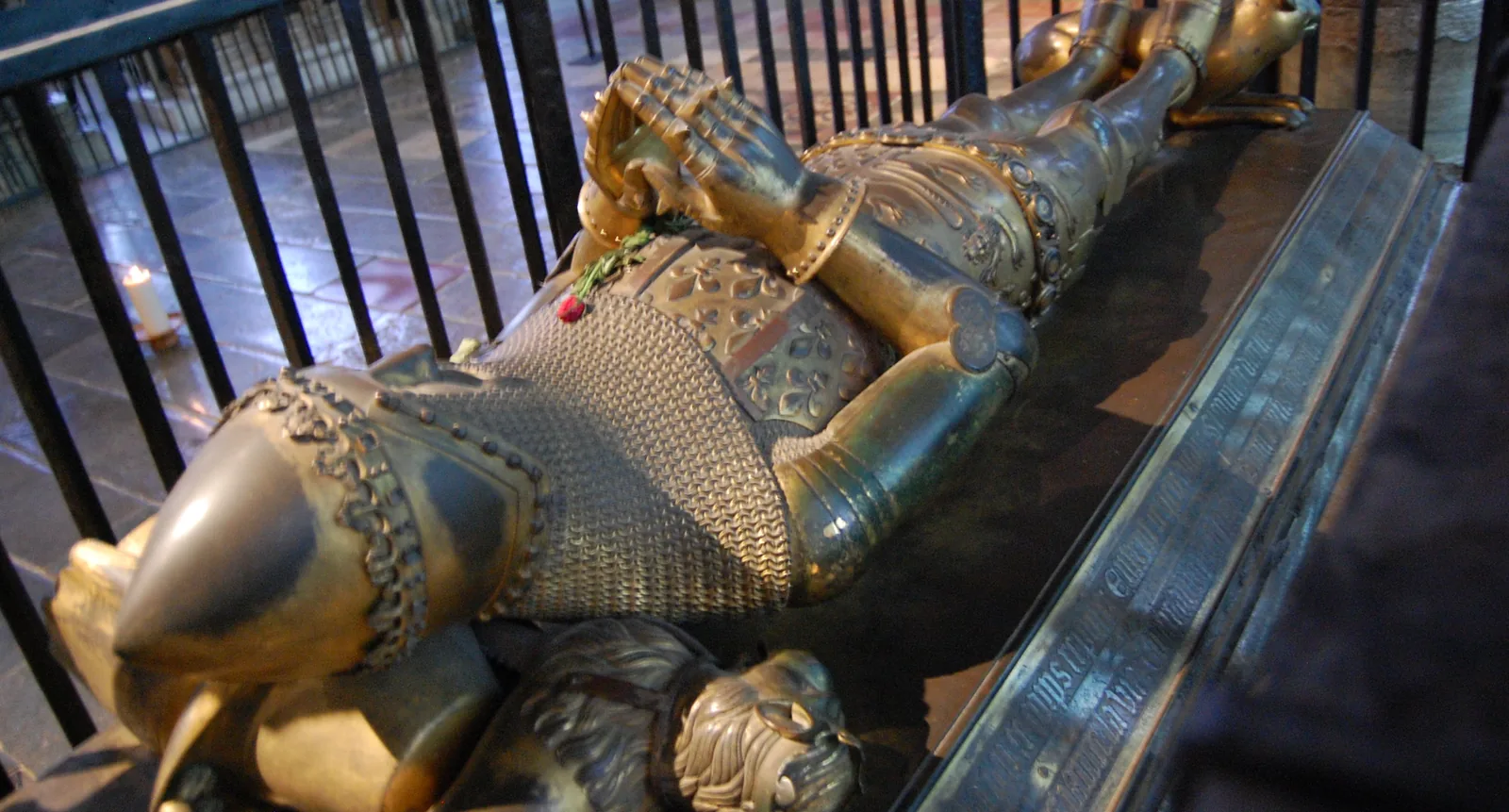
Tomb of the Black Prince, Canterbury Cathedral, after 1376. Photo: Julian P Guffogg, 2011 · CC BY-SA 2.0 · Source page
A knight of gilded bronze
‘Such as you are, so once was I’
Canterbury Cathedral. Behind iron railings, a knight of gilded bronze lies on a tomb, hands joined in prayer. Around him run French verses he chose himself, a warning to every passer-by: ‘Such as you are, so once was I; such as I am, so you shall be.’
In his day he was the most famous soldier in Europe. At 16 he fought at Crécy; at 26 he captured the king of France; at 36 he won a battle in Spain. He died at 45, before his father, and never became king. And nobody in his lifetime called him the Black Prince.
Edward of Woodstock, ‘the Black Prince’
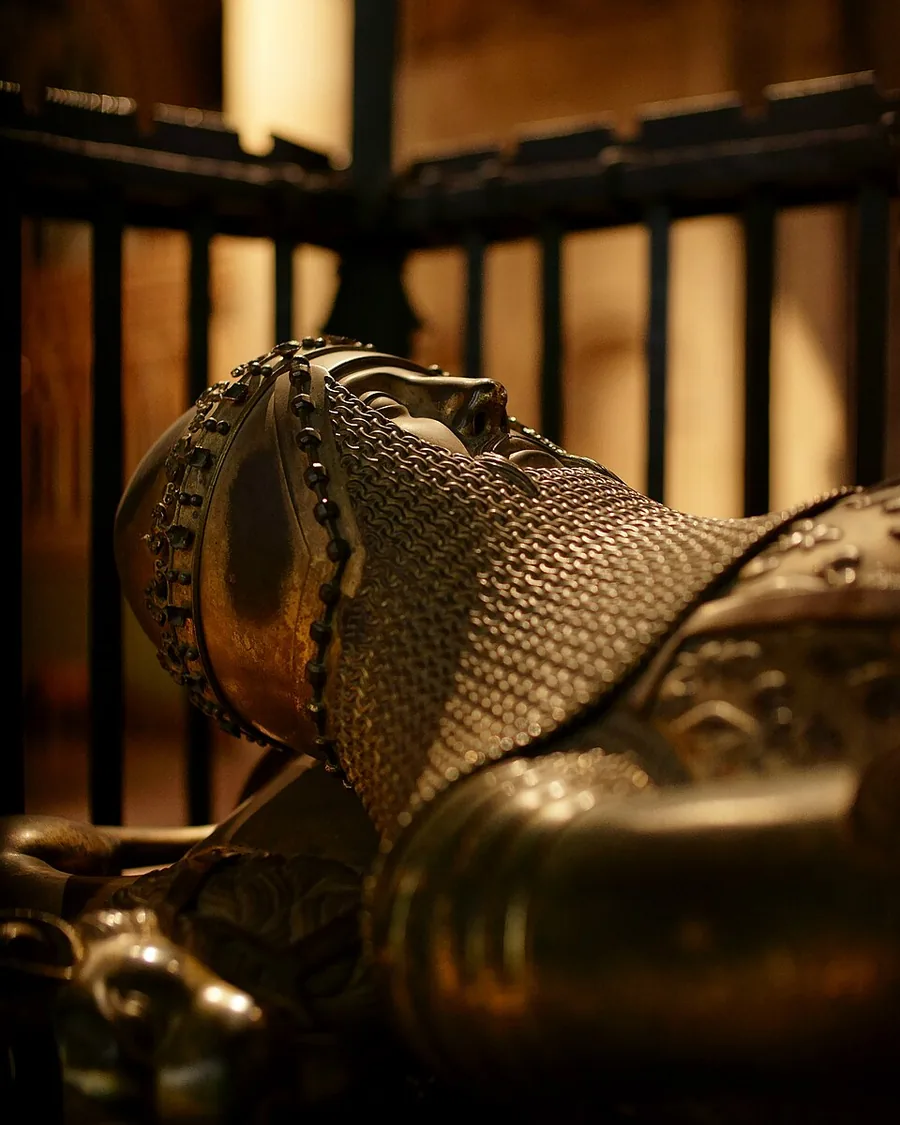
Effigy of the Black Prince, Canterbury Cathedral. Photo: Peter Trimming, 2014 · CC BY-SA 2.0 · Source page
The most admired knight of his age: he won every great battle he fought, and lost the principality he was given to rule.
- Born: 15 June 1330, Woodstock Palace, near Oxford; eldest son of Edward III and Philippa of Hainault
- Died: 8 June 1376, Westminster Palace, London, of a long illness, probably caught on the Spanish campaign of 1367
- Won: Crécy, 1346 (in the vanguard, aged 16); Poitiers, 1356; Nájera, 1367; The storming of Limoges, 1370
- Lost: No battle; but he lost Aquitaine to Charles V’s war of 1369–1372
“the victory lieth not in the multitude of people, but whereas God will send it.”
Myth
He was called the Black Prince because he fought in black armour.
The truth
Nobody called him that in his lifetime: he was Edward of Woodstock, or simply ‘the Prince’. The name first appears in writing in the 1530s and 1540s, more than 150 years after his death, and spread through Tudor chronicles and Shakespeare. No record from his lifetime mentions black armour.
The evidence
Perhaps the ‘black’ came from his ‘shield for peace’, black with three white ostrich feathers, set on the sides of his tomb; perhaps from the terror he spread in France. R. Barber, 1978; the Prince’s will, 1376.
Born for war
Background
A boy with titles
Edward was born on 15 June 1330 at Woodstock Palace, near Oxford. His father, Edward III, was only 17. At six the boy became Duke of Cornwall, England’s first duke; at 12, Prince of Wales.
In 1337 his father went to war with France, the Hundred Years’ War of the previous lesson: a quarrel over Gascony, which English kings held as vassals of the French king, and over Edward III’s claim to the French crown.
1346
Sixteen at Crécy
In July 1346 his father knighted him on the Normandy beach where the English army had landed. Six weeks later, at Crécy, the boy commanded the vanguard, in name at least, with veterans at his side. The previous lesson told that story; here one thing matters: the English way of fighting.
Their men-at-arms dismounted and stood in line, archers with the longbow on the flanks, and the enemy came to them. The Prince learned it at 16 and never forgot it. Two years later he was a founder knight of the Order of the Garter.
1355
The Prince in Gascony
Gascony, around Bordeaux, was the last of the English kings’ great lands in France, grown rich on the wine trade with England. In 1355 the truce ran out, and Edward III sent his son, now 25, there as his lieutenant.
With him rode the friends of a lifetime: Sir John Chandos, the Earls of Warwick and Salisbury, and Gascon lords such as Jean de Grailly, the Captal de Buch. Facing them was the Count of Armagnac, King John II’s lieutenant in the south.
A decision point
You are Edward, Prince of Wales, 25.
Bordeaux, early October 1355
You have some 5,000 to 6,000 men: English men-at-arms and archers, and Gascon lords hungry for plunder.
To the south-east lies Languedoc: Toulouse, Carcassonne, Narbonne. War has not touched it for generations, and it pays a large share of King John’s war taxes. Its cities have strong walls; you have no siege engines, and winter is coming.
What do you do?
- Besiege the French-held towns on Gascony’s border, one by one Slow and costly. Each siege could take weeks, and Armagnac would have time to gather an army to relieve it. You might win a few towns by Christmas, at the price of men lost to disease.
- Ride deep into Languedoc: burn and loot, but besiege nothing You strike where France is rich and unprotected. If Armagnac comes out to fight, you meet him in the field; if not, every burned village shows that King John cannot protect his people.
- Stay on the defensive and guard Gascony’s borders Safe and cheap. But your Gascon lords came for plunder, and some may drift back to the French side. And the war would be decided elsewhere, without you.
What really happened
Ride deep into Languedoc: burn and loot, but besiege nothing
The Prince rode. In eight weeks, from 5 October to 2 December 1355, his army covered about 1,000 kilometres. It passed Toulouse without attacking it and burned the lower towns of Carcassonne and of Narbonne, near the Mediterranean, though their walled cities held out. Hundreds of villages went up in flames. Armagnac never offered battle.
This was a chevauchée: war on the enemy’s wealth and on his people’s trust in their king. The Prince’s officer Sir John Wingfield wrote home that the lands they burned had paid the French king more for his wars than half his kingdom. That winter, frightened border lords changed sides. For the peasants of Languedoc it meant ruin.
Poitiers
Summer 1356
The king gives chase
In August 1356 the Prince rode north on a new raid, hoping to join the Duke of Lancaster on the Loire. The river’s bridges were broken or held, and he turned back.
This time the king of France came after him in person, with the largest army France had raised in ten years. John II crossed the Loire at Blois, moved faster than the English and got ahead of them. By 17 September he stood between the Prince and Bordeaux, near Poitiers.
John II of France
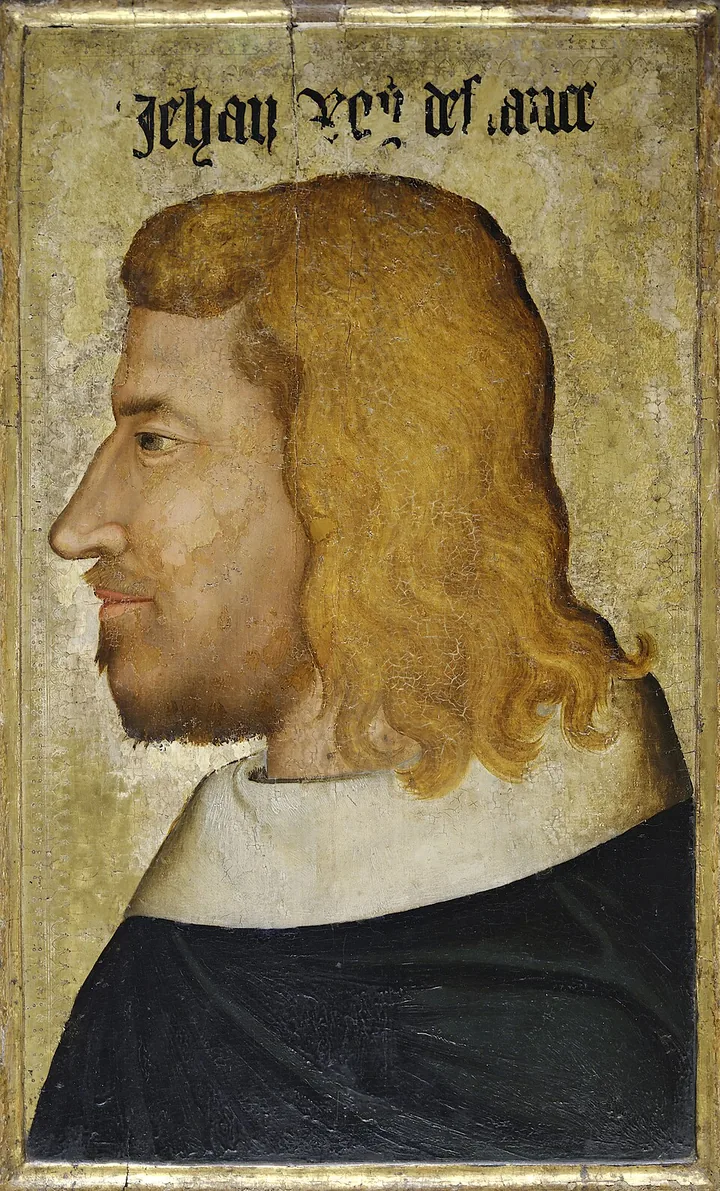
Anonymous Paris painter, John II, King of France, c. 1350–60. Musée du Louvre, Paris · Public domain · Source page
A brave king who fought on when his army fled, and spent years as a prisoner in England.
- Born: 16 April 1319, Near Le Mans; son of Philip VI
- Died: 8 April 1364, London, of illness, in captivity, having gone back to England of his own will after one of his sons, held as a hostage, escaped
- Won: The siege of Breteuil, 1356
- Lost: Poitiers, 1356: taken prisoner
“To whom shall I yield me? Where is my cousin the prince of Wales?”
A decision point
You are the Prince.
Sunday 18 September 1356, south-east of Poitiers
The French army is probably twice the size of yours. Your men are short of food and water, and your carts are heavy with loot. But you hold good ground: hedges, vineyards and woods in front, and a marshy stream, the Miosson, behind you and to your left.
It is Sunday. Cardinal Talleyrand, sent by the Pope, rides between the camps. You have offered to give back this summer’s conquests, free your prisoners and not fight the king of France for seven years. John’s answer: you and a hundred of your knights must surrender.
What do you do?
- Accept: surrender yourself and a hundred knights to save the army Your men probably live, but you become the most valuable prisoner in Europe. England would pay a crushing ransom, and the war would swing France’s way.
- Talk all day while your men dig in, and fight only on ground you choose You gain a day to deepen ditches and thicken hedges. If the French attack your position, the ground fights for you. If they wait, hunger will soon force you to move.
- Slip away across the Miosson by night, with the loot You might get away. But an army crossing a stream in the dark, strung out along its carts, is the easiest prey there is. If the French catch you half-way across, the day is lost.
What really happened
Talk all day while your men dig in, and fight only on ground you choose
The Prince talked and dug. The talks failed. On Monday morning, short of food, he began to move his army and its carts across the Miosson. Some of the French took it for flight, and attacked.
A month later the Prince wrote that he had moved off along the French front, ready to fight on ground that suited him. A real retreat, or bait? Historians still argue. Either way, the French attacked him where he had chosen to stand.
Poitiers: who fought whom
Monday 19 September 1356
Nouaillé-Maupertuis, about 8 to 10 km south-east of Poitiers
The Anglo-Gascon army
- Commanders: Edward, Prince of Wales, The Earls of Warwick, Salisbury, Oxford and Suffolk, Sir John Chandos, Jean de Grailly, Captal de Buch
- Strength: 2,000 men-at-arms, 4,000 archers and 1,500 others (Froissart, the French scouts’ report (Eustace de Ribemont)); fewer than 8,000 (Froissart, his own total a few lines later); about 6,000: some 3,000 men-at-arms, 2,000 archers and 1,000 Gascon foot (Modern estimate (Rogers; Green))
- Losses: light; no full count (All sources)
The army of the king of France
- Commanders: King John II, Charles the Dauphin, 18, The Duke of Orléans, the king’s brother, The marshals Clermont and Audrehem
- Strength: some 20,000 men-at-arms, besides others (Froissart, on the French army crossing the Loire); more than 60,000, with more than 3,000 knights (Froissart, his own total before the battle); 14,000–16,000 (Modern estimate)
- Losses: 3,000 dead; 60 lords and more than 1,000 others taken (The Chandos Herald); 5,000–6,000 dead of all sorts (Froissart); about 2,400–2,500 men-at-arms killed; 1,900 to 3,000 captured (Modern research (lists of the dead and prisoners))
Among the dead: the Duke of Bourbon; the Constable of France, the Duke of Athens; and Geoffroi de Charny, bearer of the Oriflamme.
Outcome: A crushing English victory. The king of France and his son Philip are taken prisoner.
Froissart’s figures disagree even with each other: within a few pages the French have 20,000 men-at-arms, then 60,000 fighting men. Historians rely on English pay records and French lists of the dead and captured; most accept a ratio of about one to two.
The battle of Poitiers
Monday 19 September 1356, from dawn into the afternoon
The Prince of Wales stands at Poitiers behind a long hedge and ditch, with the Miosson marsh on his left and the wood of Nouaillé on his right. The French army is probably twice his size. At dawn the English begin to move, and the French think they are slipping away.
One standard reconstruction, after Geoffrey le Baker, Froissart and the Prince’s letter as read by A. H. Burne (1955), D. Green (2002) and P. Hoskins (2011), with the ground checked against modern maps. The line of the hedge, the extent of the marsh and woods, whether the morning move was a retreat or a ruse, and the Captal’s route are all disputed, and the spot where the king was taken is not known exactly. Positions are approximate.
Phases of the battle
- Dawn: the English begin to move The English stand behind a long hedge and ditch, the Miosson marsh on their left and the wood of Nouaillé on their right. At dawn their baggage and Warwick’s division start across the ford. The French, in four divisions one behind the other, think the English are slipping away.
- The marshals charge The French marshals charge with a few hundred picked horsemen: Clermont at the gap where the road crosses the hedge, Audrehem against Warwick by the marsh. The English archers shoot the horses from the side. Clermont is killed and Audrehem taken.
- The Dauphin’s division Next comes the Dauphin’s division, on foot. For about two hours it fights at the hedge, the hardest fighting of the day, until it is thrown back and the Dauphin is led from the field. The Duke of Orléans’s division withdraws without fighting at all.
- The king’s attack, and a blow from the flank King John leads the last and largest division forward under the Oriflamme. The tired English mount and charge out of the hedge. At that moment the Captal de Buch, sent round behind the wood of Nouaillé with a small mounted force, falls on the French flank and rear.
- The king is taken Caught between the two attacks, the French division breaks. Many flee to Poitiers, which shuts its gates on them. King John is surrounded and surrenders with his son Philip.
The strategy
- The Prince’s army: The Prince talks with Cardinal Talleyrand, the Pope's envoy, while his men dig in behind the hedge, with the marsh on his left and the wood on his right. He wants the French to come to him and fight on ground he has chosen, and the Captal is sent round behind the wood. Whether the morning move was a retreat or a ruse, and the Captal's route, are disputed.
- French army: The French, in four divisions one behind another, think the English are slipping away, so they try to catch them. The marshals charge at the gap in the hedge and at Warwick by the marsh. The Dauphin's division follows, then the king, leading the largest division under the oriflamme.
What decided it: The French attacked division after division into the line the English held, and the archers brought down the horses. The Captal, coming from behind, struck the French flank and rear, and the last division was caught between the two attacks.
19 September 1356
‘Where is my cousin the Prince?’
King John fought on foot with an axe, his 14-year-old son Philip beside him, until the men around him had fallen. A later story has the boy crying, ‘Father, guard yourself on the right! Father, guard yourself on the left!’ The cry is not in Froissart or the Chandos Herald; it comes from later French tradition.
Knights jostled to take the king and his ransom. In Froissart, John asks: ‘To whom shall I yield me? Where is my cousin the prince of Wales?’ He gave his right gauntlet to Denis de Morbecque, a knight exiled from France who served the English. Some 2,000 to 3,000 French men-at-arms were taken that day; the greatest prize was the king.
Source: The Prince serves the king
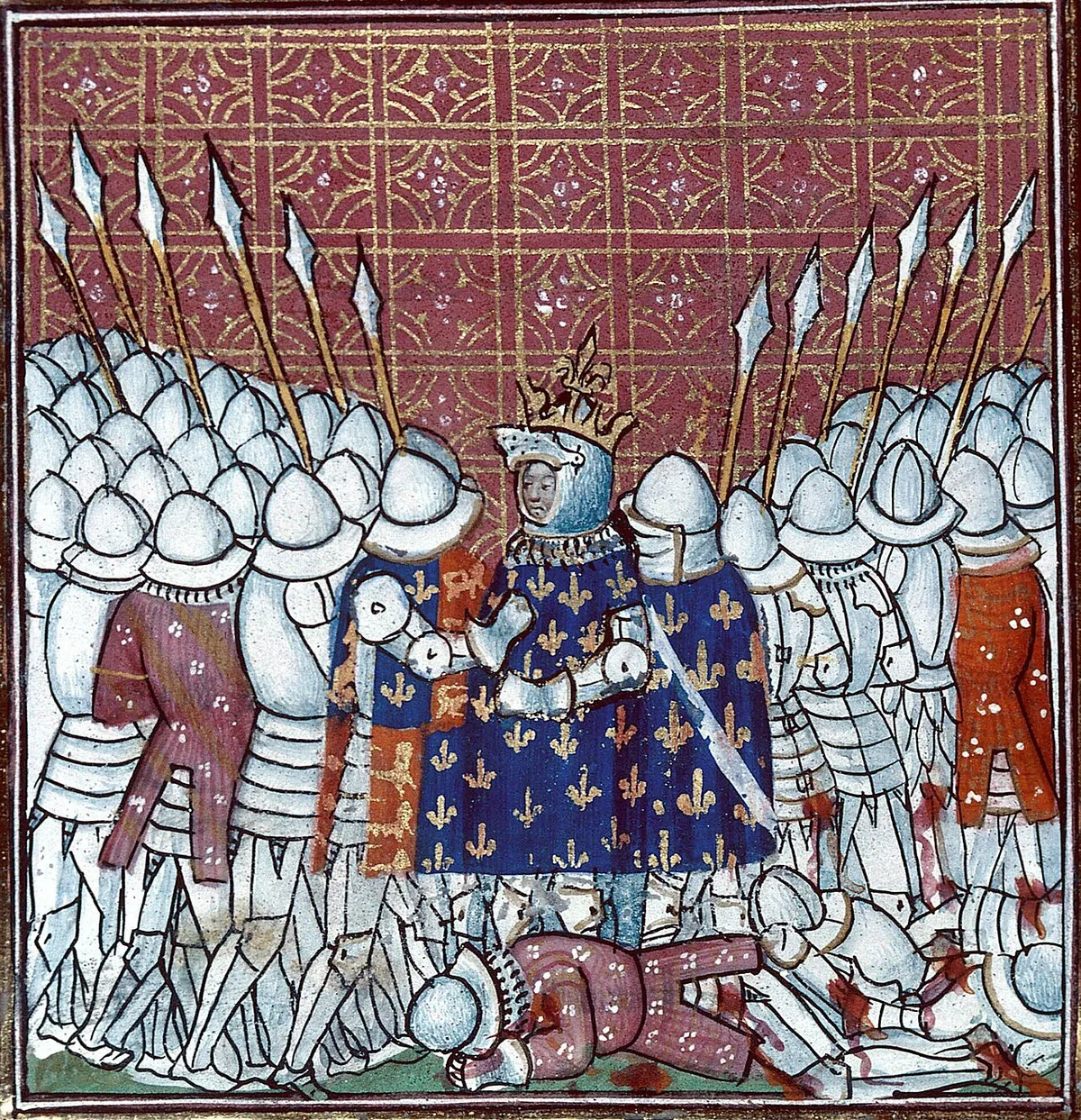
The Giac Master, Froissart’s Chronicles, c. 1412–1414. Bibliothèque municipale de Besançon, MS 864, f. 172 · Public domain · Source page
“always the prince served before the king as humbly as he could, and would not sit at the king’s board for any desire that the king could make, but he said he was not sufficient to sit at the table with so great a prince as the king was.”
That evening the Prince gave a supper for his royal prisoner. Froissart, then about 19 and at home in Hainault, wrote it up years later, largely from Jean le Bel’s chronicle. The picture, from a copy of his Chronicles painted about 1413, dresses everyone in the armour of that later day.
- Froissart was not there. Who told him, and who read him? Knights and heralds of both sides. He wrote for courts and nobles, and for years served the queen of England, the Prince’s mother. Noble courtesy was exactly what his readers wanted.
- Jean le Bel, an older chronicler, tells of the same supper. Does that make it true? Not by itself: Froissart copied le Bel, so this may be one story told twice. The Chandos Herald, writing separately, confirms only the courtesy: the Prince greeted the captive king warmly and offered to help him unarm. The words at table are Froissart’s.
- What did the Prince gain by serving his prisoner? Fame, and a calm king. Courtesy told Europe that the victor was the perfect knight, and kept the most valuable prisoner in Europe content. Chivalry and self-interest pointed the same way.
Prince of Aquitaine
1357–1360
A captive king, and a peace
In May 1357 the Prince rode into London beside his captive. France, without its king, fell into turmoil and a bloody peasant revolt.
In 1360, by the Treaty of Brétigny, Edward III agreed to give up his claim to the French crown in return for Calais and a greatly enlarged Aquitaine, free of any French overlord. John’s ransom was set at three million écus. But the clauses in which each king renounced his claims were left for a separate ceremony that never took place.
1361–1366
A love match and a splendid court
In October 1361 the Prince married for love, a rare thing for an heir. Joan of Kent was his father’s cousin, a widow of about 33 with children and a scandalous marital past; the wedding needed the Pope’s permission. In 1362 his father made him Prince of Aquitaine.
At Bordeaux and Angoulême the couple kept a splendid court: ‘for ever he had at his table more than fourscore knights and full four times as many squires,’ wrote the Chandos Herald. Their sons Edward and Richard were born there. Such a court cost money, and Aquitaine paid.
1366
Two brothers, one crown
Across the Pyrenees, Castile had two kings. Pedro I, the lawful king, was England’s ally; his enemies called him Pedro the Cruel, and he had put to death several half-brothers and many nobles. Another half-brother, Henry of Trastámara, wanted the crown.
In 1366 Henry invaded with Free Companies paid by France and Aragon and led by a Breton knight, Bertrand du Guesclin. Pedro fled to Bayonne, in English Gascony, to ask the Prince for help.
A decision point
You are the Prince of Aquitaine, 36.
Bordeaux, September 1366
Pedro, the lawful king of Castile and your father’s ally, has been thrown out by his half-brother, whom France backs. If Henry stays, Castile’s war galleys, the best on the Atlantic coast, will sail for France.
Pedro’s reputation is terrible, and he has no army and no money. But he promises to pay your troops and give you Biscay. Thousands of idle soldiers in Aquitaine are ready to be hired, and your father favours the war.
What do you do?
- Refuse: Pedro’s quarrel is not yours, and he cannot pay You keep your money and your health. But Castile becomes France’s ally, and its galleys join the French.
- Restore Pedro by force, under a treaty that makes him pay the army A short war could put an ally back on his throne and keep Castile’s fleet out of French hands. Everything depends on Pedro keeping his word.
- Offer to mediate between the brothers It costs almost nothing, but Henry is winning and has no reason to give up a crown. Talks would probably drag on while he settles in.
What really happened
Restore Pedro by force, under a treaty that makes him pay the army
By the Treaty of Libourne (September 1366) the Prince undertook to restore Pedro, who promised to pay the army. In February 1367 the army crossed the Pyrenees at Roncesvalles, in snow and a freezing wind.
Pedro was the lawful king, and Henry a usurper paid by England’s enemy: legitimacy, honour, his father’s policy and the war at sea all pointed one way. His reputation for cruelty reaches us mostly through Pero López de Ayala, who fought for Henry and later served his dynasty.
Nájera: who fought whom
Saturday 3 April 1367
The plain east of Nájera, on the road to Navarrete, in northern Castile (now La Rioja, Spain)
The Prince and Pedro
- Commanders: Edward, Prince of Wales and Aquitaine, Pedro I of Castile, John of Gaunt, Duke of Lancaster, and Sir John Chandos, The Captal de Buch
- Strength: more than 10,000 (Pero López de Ayala (fought on the other side)); about 8,000–10,000 (Modern estimate (Sumption))
- Losses: about 40 common soldiers and four knights (Froissart); light (Modern estimate)
The Prince led English, Gascons, Navarrese and hired companies, with Castilians loyal to Pedro.
Henry of Trastámara
- Commanders: Henry of Trastámara, Bertrand du Guesclin, Marshal Audrehem, Don Tello, Henry’s brother
- Strength: about 4,500 men-at-arms, besides light horse and foot (Pero López de Ayala (fought for Henry)); about 80,000 (Froissart (Henry’s own boast, as he tells it)); more than 30,000 in three divisions (The Chandos Herald, on the day); unknown; probably about equal to the Prince’s (Villalon and Kagay) (Modern estimate)
- Losses: about 7,700 dead in all, among them more than 2,000 drowned; more than 2,000 taken (The Chandos Herald); 560 men-at-arms and about 7,500 commoners, besides the drowned (Froissart); heavy; no reliable figure (Modern estimate)
Outcome: A crushing victory for the Prince. Du Guesclin and many Castilian nobles are taken; Henry escapes. Pedro is king again.
The Herald rode with the Prince and Ayala fought for Henry: both were eyewitnesses, and each leans towards his own side. Froissart was not in Spain.
The battle of Nájera
Saturday 3 April 1367, from first light
The Prince of Wales has set out to restore Pedro, the lawful king of Castile, to his throne. Henry of Trastámara has drawn up his army across the road on the plain, with the river and its bridge behind him. Before dawn the Prince leaves Navarrete.
A reconstruction after the Chandos Herald, who rode with the Prince’s army, and Pero López de Ayala, who fought for Henry, as read by J. Sumption (1999) and L. J. A. Villalon and D. J. Kagay (2017). The river, the town and the road to Navarrete follow modern maps. The exact spot on the plain between Nájera and Navarrete is not known, nor which way Henry first faced, nor the Prince’s exact route. Positions are approximate.
Phases of the battle
- The night march Henry has crossed the river onto the plain and drawn up across the road, facing east towards Navarrete, with the river and its bridge at his back. Before dawn the Prince leaves Navarrete, quits the road and swings north into the hills.
- Dawn: the turn and the clash At first light the Prince’s army appears from the north-east. Henry swings his line round to face it. Du Guesclin’s vanguard, on foot, meets Lancaster and Chandos hand to hand. ‘Forward banner!’ cries the Prince, in the Herald’s telling.
- The wings break Before contact, Don Tello’s light horse turn and ride away without striking a blow. The Captal wheels onto du Guesclin’s bare flank, and on the other wing the archers bring down Henry’s horsemen. Henry tries three times to rally his men.
- The collapse Du Guesclin, Marshal Audrehem and many Castilian nobles are surrounded and taken. Henry’s army breaks and runs for the only bridge, with the Prince’s rearguard in pursuit.
- The bridge At the bridge and in the streets of Nájera there is a terrible crush, and many drown in the swollen river. ‘It was said that the river was red with the blood,’ wrote the Herald. Henry escapes; the town is sacked.
The strategy
- The Prince and Pedro: The Prince leaves the road before dawn and swings north into the hills, to come at Henry from the side rather than along the road. His exact route is not known. Lancaster and Chandos, on foot, are with him, and the Captal leads the horse.
- Henry of Trastámara: Henry crosses the river onto the plain and draws his army up across the road, with the river and its bridge behind him. Which way he first faced is not known for certain. When the Prince appears from the north-east, Henry swings his line round to face the threat.
What decided it: The Prince came in from the side, and Henry had to swing his line round; the archers brought down the horsemen on one wing, and the Captal struck du Guesclin's bare flank. When the line broke, only one bridge was left for the fugitives, and many drowned.
1367–1369
The disastrous victory
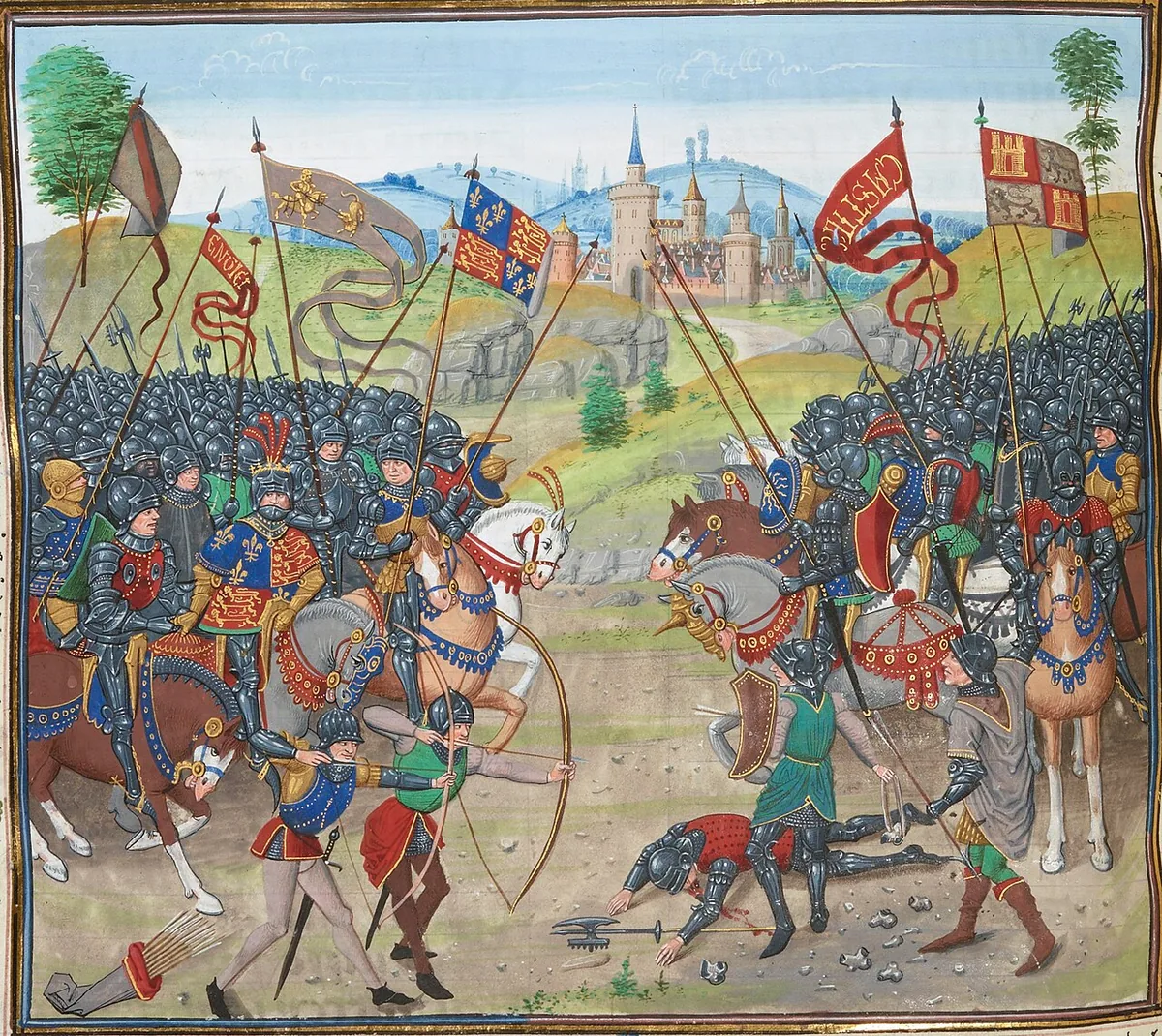
Loyset Liédet, Froissart’s Chronicles, 15th century. Bibliothèque nationale de France, MS Français 2643, f. 312v · Public domain · Source page
Pedro was king again, but he did not pay. All summer the army waited, unpaid and sick with dysentery. The Prince fell ill too, and never recovered. In August he led what was left back over the Pyrenees, deep in debt.
Among his prisoners was du Guesclin. In Froissart, du Guesclin teased the Prince that all France said he feared to free him; stung, the Prince set the ransom at 100,000 francs, and du Guesclin took him at his word. The king of France and the Duke of Anjou helped pay it.
Henry was back in Castile before the year was out, and in March 1369, at Montiel, he killed Pedro with his own hands. Castile’s galleys joined France, as the Prince had feared.
The tax and the fire
A decision point
You are the Prince of Aquitaine.
Angoulême, January 1368
The Spanish war has left you deep in debt. The soldiers must be paid, Pedro has paid nothing, your court is the most splendid in Europe, and you are ill.
The Estates of Aquitaine, its nobles, clergy and towns, have met at Angoulême; they have granted hearth taxes before. But the great southern lords, the Count of Armagnac and the Lord of Albret, are already discontented, and in Paris Charles V is waiting for an opening.
What do you do?
- Ask the Estates for a hearth tax for five years The money would clear your debts, and the tax would be lawful, voted by the Estates. But it falls on every household, including in the lands of lords who no longer love you.
- Ask your father to pay the debts from England England is short of money too, and Parliament would ask why Aquitaine cannot pay for itself. It would also show that you cannot rule your own principality.
- Cut the court’s spending and repay slowly Less splendour, fewer gifts to your knights, and creditors who must wait. It would cost you goodwill among your own men, but give your enemies no grievance.
What really happened
Ask the Estates for a hearth tax for five years
The Estates granted ten sous a household for five years. Froissart says Sir John Chandos argued against it. Armagnac and Albret refused to let it be collected on their lands and took an appeal to Charles V in Paris, as their sovereign. Charles accepted it.
Historians divide over the blame. Richard Barber and David Green stress that the tax was legal and normal, and that Charles V had prepared the ground with care; Jonathan Sumption sees a heavy-handed, English-run government that lost the southern nobility. Either way, the tax gave Charles his legal case.
1369–1370
‘With our helmet on our head’
In January 1369 Charles V summoned the Prince to Paris to answer the appeals, as a vassal answers to his lord. Froissart gives his reply: ‘We shall willingly attend on the appointed day at Paris, since the king of France sends for us; but it will be with our helmet on our head, and accompanied by sixty thousand men.’
It was war again, but the Prince was too ill to ride. French armies took town after town, and many lords changed sides. On the last day of 1369 Sir John Chandos was mortally wounded in a skirmish.
19 September 1370
Limoges
In August 1370 the bishop of Limoges, a friend of the Prince, opened the city to Charles V’s brother. The Prince took it as personal treason. Carried in a litter, too ill to ride, he besieged the city; his miners brought down part of the wall, and on 19 September 1370, fourteen years to the day after Poitiers, it was stormed and sacked.
Myth
When the Prince took Limoges in 1370, he had 3,000 men, women and children massacred.
The truth
The number comes from Froissart, writing years later for patrons on the French side. The rest of the evidence points to a smaller event: a chronicle kept in Limoges itself counts about 300 dead, and a letter the Prince wrote a few days later, published only in 2023, mentions some 200 knights and men-at-arms taken prisoner. Most historians now put the civilian dead at around 300. It was still a real sack of a city taken by storm, which the laws of war then allowed, and the Prince’s fury was real.
The evidence
Froissart, Chronicles I, ch. 290; R. Barber (1978); J. Sumption, Divided Houses (2009); M. Jones (2017); G. Pépin (2023), who published the Prince’s letter to Gaston Fébus.
Source: Two accounts of one morning
Froissart: “You would then have seen pillagers, active to do mischief, running through the town, slaying men, women and children, according to their orders… upwards of three thousand men, women and children were put to death that day.”
The Chandos Herald: “there were… good 300 men-at-arms, without the burgesses therein. But all were slain or taken by the noble and renowned Prince.”
Neither writer is known to have been at Limoges. Froissart wrote years later; the Herald, about fifteen years later, in a poem praising the Prince.
- Each writer had a reason to tell it his way. What was each one’s reason? The Herald wrote in the Prince’s honour, for his son’s court; a massacre had no place in his poem. Froissart, writing for lords on the French side, loved a scene of horror and pity. Neither is neutral.
- What does each one leave out? The Herald counts only soldiers, ‘without the burgesses’, whose fate he never mentions. Froissart gives no source for his 3,000, a round number of the kind he liked.
- How can a historian decide between them? Find a third witness, and weigh its bias too. A chronicle of the abbey of Saint-Martial counts about 300 dead, but the abbey stood in the half of Limoges loyal to the Prince. Then compare documents like the Prince’s letter about his prisoners.
1370–1376
The last years
In late 1370 the Prince’s elder son, Edward, died aged five. In January 1371 the Prince sailed for England with Joan and their son Richard; in 1372 he gave the principality back to his father.
In 1376 the Commons of the ‘Good Parliament’ attacked the corrupt circle around the old king. Many believed the dying Prince stood behind them; the evidence is indirect. On 7 June he made his will, and the next day, 8 June 1376, he died at Westminster, a week before his 46th birthday. His son Richard was nine.
What he left behind
Source: A tomb designed by its owner
“Such as you are, so once was I; such as I am, so you shall be… My great beauty is all gone; my flesh is all wasted.”
His will set it all out: burial at Canterbury, an effigy in full armour, his shields for war and peace round the tomb, and these verses, written clearly for all to read. Copies of his helm, gauntlets, surcoat and shield hang above.
- Did the Prince write these verses? No. He chose them, but they are an older French poem, the warning of the dead from the Disciplina Clericalis of Petrus Alphonsi, a Spanish Jew who became a Christian in 1106. The same lines were on an English earl’s tomb in 1304.
- Look at the effigy, then read the verses. What two messages does the tomb send? Glory and humility at once. The gilded knight says: remember the warrior. The verses say: my flesh is rotting, and so will yours. A Christian prince was expected to show both.
- His will asked for burial in a chapel in the crypt. Where does he lie? Beside the shrine of St Thomas Becket, the holiest place in the cathedral, not in the crypt. Those who buried him decided he deserved more: tombs, too, are made by the living.
What came after
- 1369 Henry kills Pedro; Castile becomes France’s ally, and the war with France resumes.
- 1369–1375 Charles V and du Guesclin, avoiding pitched battles, retake most of Aquitaine.
- 1372 Castilian galleys beat an English fleet off La Rochelle.
- 1376 The Prince dies, a year before his father.
- 1377 His son becomes king as Richard II, aged ten.
- 1399 Richard II is deposed by his cousin Henry IV, John of Gaunt’s son. Henry’s son, Henry V, will renew the war: the next lesson.
Flower of chivalry, or a soldier who failed as a ruler?
Was the Prince a great commander beaten by illness and debt, or a brilliant soldier who could not govern?
- Richard Barber, Edward, Prince of Wales and Aquitaine (1978) A brilliant commander, generous and devout, who lived by the ideals of chivalry. Aquitaine was undone by the Spanish debts, his illness and Charles V’s skilful legal war, not by tyranny. Limoges was a much smaller affair than Froissart claimed.
- Jonathan Sumption, Trial by Fire (1999) and Divided Houses (2009) An outstanding field commander and a poor politician. Nájera was a disastrous victory, and the English-run government he set up in Aquitaine drove away the southern lords who mattered most.
- David Green, Edward the Black Prince: Power in Medieval Europe (2007) Study the Prince as a political figure, through his household, his money and his networks. He leaned too heavily on English officials, but the crisis of 1368–69 was largely made in Paris.
All three agree he was a superb soldier. The open question is how far a ruler can be blamed for a crisis prepared by his enemy and worsened by his own illness.
What do you know now?
Check yourself
When did people start calling Edward ‘the Black Prince’?
Answer: In the 16th century, more than 150 years after his death. Right. In his lifetime he was ‘the Prince’ or Edward of Woodstock. The name appears in writing only in the 1530s and 1540s, and Shakespeare made it famous.
Check yourself
What was the 1355 raid into Languedoc meant to do?
Answer: Ruin the French king’s revenue and show that he could not protect his people. Right. It was a chevauchée: war on the enemy’s wealth. Wingfield boasted that the lands they burned had paid the French king more for his wars than half his kingdom.
Check yourself
What finally decided the battle of Poitiers?
Answer: A small mounted force under the Captal de Buch struck the French flank and rear while the Prince charged from the front. Right. The king’s division was caught between the two attacks and broke.
Check yourself
Froissart describes the Prince serving King John at supper. What is true of the story?
Answer: The Chandos Herald confirms the Prince’s courtesy to the captive king, but the scene at table and the speeches are Froissart’s craft. Right. A separate witness, the Herald, confirms the courtesy. The supper itself comes from Jean le Bel and Froissart, who copied him; the words are Froissart’s.
Check yourself
Why is Nájera called a ‘Pyrrhic’ victory?
Answer: Pedro never paid, the army fell sick, and within two years Henry was king again. Right. The Prince won the battle and lost his health, his money and his ally.
Check yourself
How many people died at Limoges in 1370?
Answer: We cannot be sure; the best evidence suggests about 300, not Froissart’s 3,000. Right. A local chronicle and the Prince’s own letter point to a much smaller event, though it was a real sack.
Terms
- chevauchée French for ‘a ride’: a fast mounted raid through enemy land, burning, looting and taking ransoms, without stopping for long sieges. The English used it again and again in the Hundred Years’ War.
- man-at-arms A fully armoured soldier, knight or squire, who could fight on horseback or on foot. English men-at-arms usually dismounted to fight beside the archers.
- longbow A bow of yew almost as tall as a man. A trained archer could shoot ten or more arrows a minute. England’s archers were mostly commoners, paid wages, and on campaign many of them rode.
- Order of the Garter A brotherhood of 26 knights founded by Edward III around 1348, with the Prince among its first members. It still exists.
- Dauphin The title of the eldest son and heir of the king of France, from the province of Dauphiné. At Poitiers the Dauphin was Charles, 18, the future Charles V.
- Oriflamme The red war banner of the kings of France, kept at the abbey of Saint-Denis. When it was unfurled, no prisoners were to be taken.
- ransom Money paid to free a prisoner of war. A captured knight was worth more alive than dead, and a captured king was worth a fortune.
- Free Companies Bands of soldiers left without pay by the truces in France, who lived by plunder and sold their swords to whoever would pay. In 1366 Bertrand du Guesclin led many of them to Spain.
- hearth tax A tax on every household (in French fouage, from feu, ‘fire’). In 1368 the Estates of Aquitaine granted the Prince ten sous a hearth for five years.
- appeal A complaint against a lord, taken to the court of his own overlord. Under the Treaty of Brétigny, Aquitaine was meant to be free of French sovereignty, but the formal renunciations were never exchanged, so Gascon lords could appeal to the king of France in Paris.
- Froissart Jean Froissart (c. 1337–c. 1405), a writer from Hainault who wrote the most famous chronicle of the Hundred Years’ War. He loved chivalry, invented speeches, and rewrote his work for each new patron.
- Chandos Herald The herald of Sir John Chandos, the Prince’s closest companion. About ten years after the Prince’s death he wrote a long French poem in his praise. In 1367 he rode with the army to Spain.
- Canterbury A city in England with a famous cathedral. The Prince lies in a gilded bronze tomb there.
- Woodstock A palace near Oxford, where Edward was born in 1330.
- Duke of Cornwall A title in the English nobility, which Edward received at six. He was England's first duke.
- Hundred Years’ War A long war between England and France, over Gascony and the French crown. It began in 1337.
- Gascony A region in south-west France, around Bordeaux. English kings held it as vassals of the French king.
- Crécy A battle in northern France in 1346, which the English army won against the French.
- Languedoc A region in southern France, with Toulouse and Carcassonne. War had not touched it for generations.
- Carcassonne A walled city in Languedoc. In 1355 the Prince burned its lower town, though the walled city held out.
- Armagnac A county in southern France. Its count was King John's lieutenant in the south and never offered battle.
- John Chandos An English knight and the Prince's old friend. He was mortally wounded in 1369.
- Talleyrand A cardinal sent by the Pope, who tried to make peace between the Prince and the French king. The talks failed.
- Miosson A marshy stream near Poitiers, which the English army crossed before the battle.
- Limoges A French city. In 1370 the Prince stormed and sacked it, after its bishop opened the gates to Charles V's brother.
- Estates An assembly of nobles, clergy and towns that granted taxes. The Estates of Aquitaine approved the hearth tax.
- Charles V The king of France, who waited for his chance against the Prince. His armies took town after town.
- Pedro I The lawful king of Castile and England's ally. His enemies called him Pedro the Cruel.
- Bertrand du Guesclin A Breton knight who led Henry's companies. He was taken prisoner by the Prince and later became Constable of France.
- Nájera A battle in Spain where the Prince defeated Henry. Historians see it as a costly victory that cost him his health and money.
- Treaty of Libourne A 1366 agreement in which the Prince undertook to restore Pedro to the Castilian throne, and Pedro promised to pay the army.
- Treaty of Brétigny A 1360 treaty in which Edward III gave up his claim to the French crown for Calais and a greater Aquitaine.
- Pyrenees A mountain range between France and Spain. The English army crossed it in snow in February 1367.
- Edward III King of England, the Prince's father. In 1337 he went to war with France.
- Shakespeare An English playwright. The name 'the Black Prince' spread partly through his plays.
- Tudor The royal dynasty that ruled England after the Prince's death. Its chronicles spread the name 'the Black Prince'.
- Calais A port in northern France on the Channel, given to England by the Treaty of Brétigny.
Sources
- Jean Froissart, Chronicles, Book I (Poitiers, the supper), trans. John Bourchier, Lord Berners (1523–25), ed. G. C. Macaulay, in Chronicle and Romance (Harvard Classics 35, New York: P. F. Collier, 1910)
- Jean Froissart, Chronicles of England, France, Spain and the Adjoining Countries, trans. Thomas Johnes (1803–05; London, 1848 ed.), Book I (Nájera, the summons of 1369, Limoges, ch. 290)
- The Chandos Herald, La Vie du Prince Noir (c. 1385), trans. M. K. Pope and E. C. Lodge, Life of the Black Prince by the Herald of Sir John Chandos (Oxford: Clarendon Press, 1910)
- Edward, Prince of Wales, letter to the Mayor, Aldermen and Commonalty of London, Bordeaux, 22 October 1356, in N. H. Nicolas and E. Tyrrell (eds), A Chronicle of London from 1089 to 1483 (London, 1827)
- The will of Edward, Prince of Wales (7 June 1376) and the tomb inscription, printed with notes by F. Madden in A. P. Stanley, Historical Memorials of Canterbury (London: John Murray, 1855; later eds.)
- Geoffrey le Baker, Chronicon (c. 1357–60), trans. D. Preest, ed. R. Barber, The Chronicle of Geoffrey le Baker of Swinbrook (Woodbridge: Boydell, 2012)
- Pero López de Ayala, Crónica del rey don Pedro (late 14th century)
- Richard Barber, Edward, Prince of Wales and Aquitaine: A Biography of the Black Prince (London: Allen Lane, 1978; repr. Woodbridge: Boydell, 1996)
- Richard Barber (ed. and trans.), The Life and Campaigns of the Black Prince (London: Folio Society, 1979; Woodbridge: Boydell, 1986)
- David Green, The Battle of Poitiers 1356 (Stroud: Tempus, 2002)
- David Green, Edward the Black Prince: Power in Medieval Europe (Harlow: Pearson Longman, 2007)
- Marilyn Livingstone and Morgen Witzel, The Black Prince and the Capture of a King: Poitiers 1356 (Oxford and Philadelphia: Casemate, 2018)
- Peter Hoskins, In the Steps of the Black Prince: The Road to Poitiers, 1355–1356 (Woodbridge: Boydell, 2011)
- Clifford J. Rogers, War Cruel and Sharp: English Strategy under Edward III, 1327–1360 (Woodbridge: Boydell, 2000)
- Jonathan Sumption, The Hundred Years War II: Trial by Fire (London: Faber and Faber, 1999)
- Jonathan Sumption, The Hundred Years War III: Divided Houses (London: Faber and Faber, 2009)
- Michael Jones, The Black Prince (London: Head of Zeus, 2017)
- L. J. Andrew Villalon and Donald J. Kagay, To Win and Lose a Medieval Battle: Nájera (April 3, 1367), a Pyrrhic Victory for the Black Prince (Leiden: Brill, 2017)
- H. J. Hewitt, The Black Prince's Expedition of 1355–1357 (Manchester: Manchester University Press, 1958)
- Françoise Bériac-Lainé and Chris Given-Wilson, Les prisonniers de la bataille de Poitiers (Paris: Honoré Champion, 2002)
- A. H. Burne, The Crecy War (London: Eyre & Spottiswoode, 1955)
- Françoise Autrand, Charles V le Sage (Paris: Fayard, 1994)
- Guilhem Pépin, ‘The Sack of the “City” of Limoges (1370) Reconsidered in the Light of an Unknown Letter of the Black Prince’, Journal of Medieval Military History XXI (Woodbridge: Boydell, 2023), 161–180
Image credits
- Tomb of the Black Prince, Canterbury Cathedral, after 1376. Photo: Julian P Guffogg, 2011 · CC BY-SA 2.0 · Source page
- Effigy of the Black Prince, Canterbury Cathedral. Photo: Peter Trimming, 2014 · CC BY-SA 2.0 · Source page
- Anonymous Paris painter, John II, King of France, c. 1350–60. Musée du Louvre, Paris · Public domain · Source page
- The Giac Master, Froissart’s Chronicles, c. 1412–1414. Bibliothèque municipale de Besançon, MS 864, f. 172 · Public domain · Source page
- Loyset Liédet, Froissart’s Chronicles, 15th century. Bibliothèque nationale de France, MS Français 2643, f. 312v · Public domain · Source page


