The fall of the Berlin Wall, 1989
On 9 November 1989 a party spokesman read out a notice at a press conference and was asked when it took effect. Within hours, thousands of people stood at the crossings. How did a wall that had stood for 28 years open?
Decisions, questions and your own progress, in the app
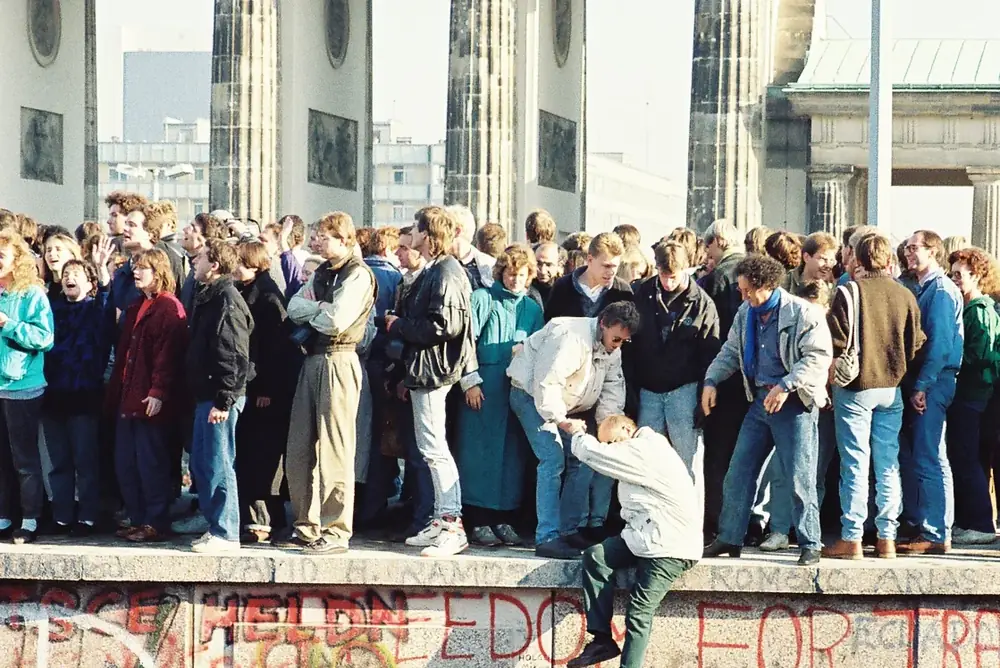
Photo: Sue Ream, Wikimedia Commons · Sue Ream, photographer (San Francisco, California) · CC BY 3.0 · Source page
A wall, a speech and a question
9 November 1989, East Berlin
A press conference in East Berlin, on the evening of 9 November 1989. At the end, party spokesman Günter Schabowski reads out a note about new travel rules. He had not helped to draft them. Then a reporter asks the question everyone wants answered: when do these rules take effect?
Schabowski answers: “As far as I know, this is immediate, without delay.” Within hours, thousands of people will be standing by the Wall, asking to cross. How did a wall that had stood for 28 years open?
Background
A wall for 28 years
28 years
On 13 August 1961 the East German government began to build a wall through the middle of Berlin. It cut the city in two and stood for 28 years. Behind it ran a death strip: open ground with anti-vehicle trenches and beds of nails, which nobody was allowed to enter.
1985–1987
A new Soviet leader
In the Soviet Union, Mikhail Gorbachev spoke of perestroika, which means restructuring, and of glasnost, which means openness. In 1985 Ronald Reagan and Gorbachev met in Geneva. By 1987 the West had heard these two words again and again.
Source: Reagan at the Brandenburg Gate
“Mr. Gorbachev, tear down this wall.”
Peter Robinson, a White House speechwriter, wrote the speech. Beside Reagan stood the West German president, Richard von Weizsäcker, Chancellor Helmut Kohl and Berlin's mayor, Eberhard Diepgen. In his own later account, several drafts had left this line out, and he kept it. At the time the press received the speech coolly.
- Who was the speech for? Three audiences at once: Berliners facing the Wall, the Soviet leader on the far side of it, and the American public at home. The line is aimed at Moscow, but it is spoken in Berlin.
- What does the line ask Gorbachev to do? To prove that his reforms are real, with a visible act: open the gate and pull the Wall down. It is a demand for action, not an analysis of the situation.
- What is missing from the text? Any reply from Gorbachev. The Wall stood for more than two years after the speech.
Myth
Reagan's words in 1987 brought the Wall down.
The truth
The line did not bring the Wall down. At the time the press was unimpressed, and the line became famous only after November 1989. The Wall fell because of many forces, among them the crowds on the streets and decisions taken in Moscow and in East Berlin.
The evidence
Deutsche Welle, 2007: John Kornblum, a former US ambassador, said the speech did not reach its present status until after the Wall fell.
The fence and the picnic
1989
Poland first
The movement that shook the region did not start in Berlin. In April 1989 the communist government and the Solidarity movement sat together at a Round Table and agreed on elections. On 4 June Solidarity won the vote, and a second round followed on 18 June. For anyone living in the Eastern bloc, change had become possible.
Spring and summer
The fence comes down
Hungary begins to take down the fence on its border with Austria. One account dates the start to 2 May 1989; another says June. Either way, a fence that had marked the Iron Curtain for decades was coming down.
27 June
A symbolic cut
On 27 June the Austrian foreign minister, Alois Mock, and the Hungarian foreign minister, Gyula Horn, cut through the fence together in a symbolic ceremony.
19 August
The picnic
Near the Hungarian town of Sopron, a “Pan-European Picnic” brought people from both sides of the border together. For three hours the border gate stood open. Hundreds of East Germans took their chance and walked across into Austria. Estimates of how many crossed range from about 600 to about 700.
A decision point
You are Miklós Németh, prime minister of Hungary.
Budapest, August 1989.
Since the picnic, East Germans have been reaching Hungary without much trouble, and many want to go on through Austria to the West. Much of the fence on the Austrian border is already down. What remains is an automated border system. It costs money, and its spare parts must be paid for in hard currency.
East Berlin wants its citizens back. In Moscow it is unclear how much disorder on Hungary's border would be tolerated. If chaos grows here, hard-liners in Moscow could blame Gorbachev. You do not know how much change Moscow will accept.
What do you decide about the people waiting at the border?
- Send them back to East Germany, as East Berlin asks. The border would close again for a while, and East Berlin would be pleased. But in the West, forced return would look like betrayal, and reformers in Budapest would protest. Those left outside would try other routes, so the pressure would probably grow, not fall.
- Keep them in Hungary, and ask the West to take them in. Hungary would carry the cost of holding them, and talks with Bonn and East Berlin could drag on for months. Meanwhile the pressure on the border would stay, and it would be unclear who was responsible for them.
- Let them travel west through Austria, and open the border. Probably many more people would come. East Berlin would lose control over its citizens leaving, Bonn would be drawn in, and Moscow would have to respond. Hungary would face East Berlin's anger, but would probably avoid a violent clash on the border.
What really happened
Let them travel west through Austria, and open the border.
Németh chose the third road. On 22 August, in Bonn, he told Chancellor Helmut Kohl that the refugees would not be sent back. Kohl later recalled Németh's words: “Returning the refugees to East Germany is out of the question.” The border opened on the night of 10–11 September, and about 30,000 East Germans fled to the West after that.
Several reasons have been given, and the sources do not say how much each one weighed. Money: the automated border with Austria cost money to keep running, and its spare parts had to be paid for in hard currency. The crowds: people waiting at the border were a daily problem, and forcing them back would have been hard to defend. Fear of Moscow: some historians argue that Németh feared hard-liners would turn on Gorbachev if Hungary let things slide. Others see a humanitarian choice. Historians still argue about this.
After Bonn
A call to Moscow
Helmut Kohl telephoned Mikhail Gorbachev to tell him about Németh's decision.
Embassy steps and a Monday in Leipzig
Late summer and autumn
The embassy in Prague
In the late summer and autumn of 1989, thousands of East Germans gathered in the grounds of the West German embassy in Prague. They had come from East Germany, and they wanted to leave for the West. Day after day they waited in the grounds.
30 September
The balcony
Hans-Dietrich Genscher, the West German foreign minister, stepped out onto the embassy balcony. He told the people below that they could travel on to West Germany. According to German accounts, the cheers drowned out most of his speech.
7 October
The fortieth anniversary
On 7 October East Germany celebrated its fortieth anniversary, with Mikhail Gorbachev as a guest. A crowd of two to three thousand people chanted: “Gorbi, help us!”
A decision point
You are a worker in Leipzig.
Leipzig, Monday 9 October 1989, in the morning.
For weeks the Monday peace prayers in Leipzig's churches have ended in marches through the city centre. Tonight a very large demonstration is expected, and the state is preparing itself.
The state holds the power of force. Many remember what happened in Beijing's Tiananmen Square in June 1989, and fear it could happen here. Others say only the street will make the people heard. At home, your family is worried about you.
What do you do this evening?
- Stay at home and watch the news on television. You stay safe, and the march goes on without you. If many make the same choice, the protest stays small, and the state can claim the city is calm.
- Join the march through the city centre and shout: “We are the people!” You take a real risk, because the security forces could move against you. But if enough people join, the state may not dare to use force, and the march becomes a force of its own.
- Go to the prayer service in the church and stay inside. You stay safe and join the prayer. The march goes on without you, and the church remains a place for a quieter voice.
What really happened
Join the march through the city centre and shout: “We are the people!”
About 70,000 people marched through the city centre. The police did not stop them; the Chronik der Wende says they pulled back in the face of the crowd, and no shots were fired. That afternoon, local radio read an appeal signed by six Leipzig men, among them the conductor Kurt Masur and three local officials of the ruling party. The march was the largest East German protest since 17 June 1953.
Their chant, “We are the people!”, claimed the street for ordinary citizens. The fear was real, and the security forces were ready, but they did not act on it that night. The chronicle says the police pulled back in the face of the crowd. People who stayed home made their own choice too, and no source can count them.
Source: The appeal read on the radio
“We urge you to remain calm so that a peaceful dialogue will be possible.”
The appeal was read on local radio that afternoon, before the evening march. What is shown here is a translation, not the German text.
- Who is speaking here, and who did not sign? Six men from Leipzig, among them the conductor Kurt Masur and three local officials of the ruling party. Ordinary marchers did not sign. The appeal speaks for the city, from above.
- What does the appeal ask people to do? To stay calm and to talk. It does not ask people to give up on the state, and it does not tell them to stay home. It speaks of dialogue.
- A call for calm can serve two sides. Who gains from it? The marchers, who are protected from violence, and the authorities, who prefer an orderly protest. The appeal can be read both ways.
Pressure in the streets
18 October
A new leader for the party
On 18 October the Politburo voted to remove Erich Honecker, who had led the party since 1971. Egon Krenz was chosen to succeed him. The official reason given was Honecker's health.
Late October
The marches grow
In Leipzig the Monday demonstrations keep growing from week to week.
4 November
Half a million in the square
On 4 November the Alexanderplatz in East Berlin filled with people. The official estimate was more than half a million. According to Chronik der Wende, it was the largest protest demonstration in East German history. It ended with a rally on the square.
In those same weeks
New rules for travel
In those same weeks the government was drafting new rules for travel abroad.
The gate at Bornholmer
Evening, 9 November
The press conference
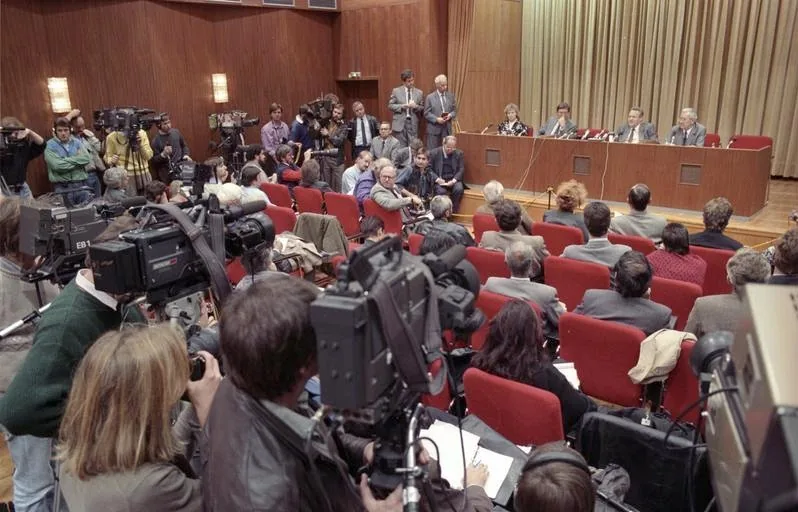
Photo: Thomas Lehmann (ADN-ZB), Bundesarchiv, image 183-1989-1109-030 · CC BY-SA 3.0 · Source page
On the evening of 9 November 1989, Günter Schabowski, a member of the Politburo and secretary of the party's Central Committee, held a press conference at the International Press Centre in East Berlin. He reported on the Central Committee's session, and towards the end he read out a note about new rules for travel abroad. He had not written the rules.
The note
Notes in pen
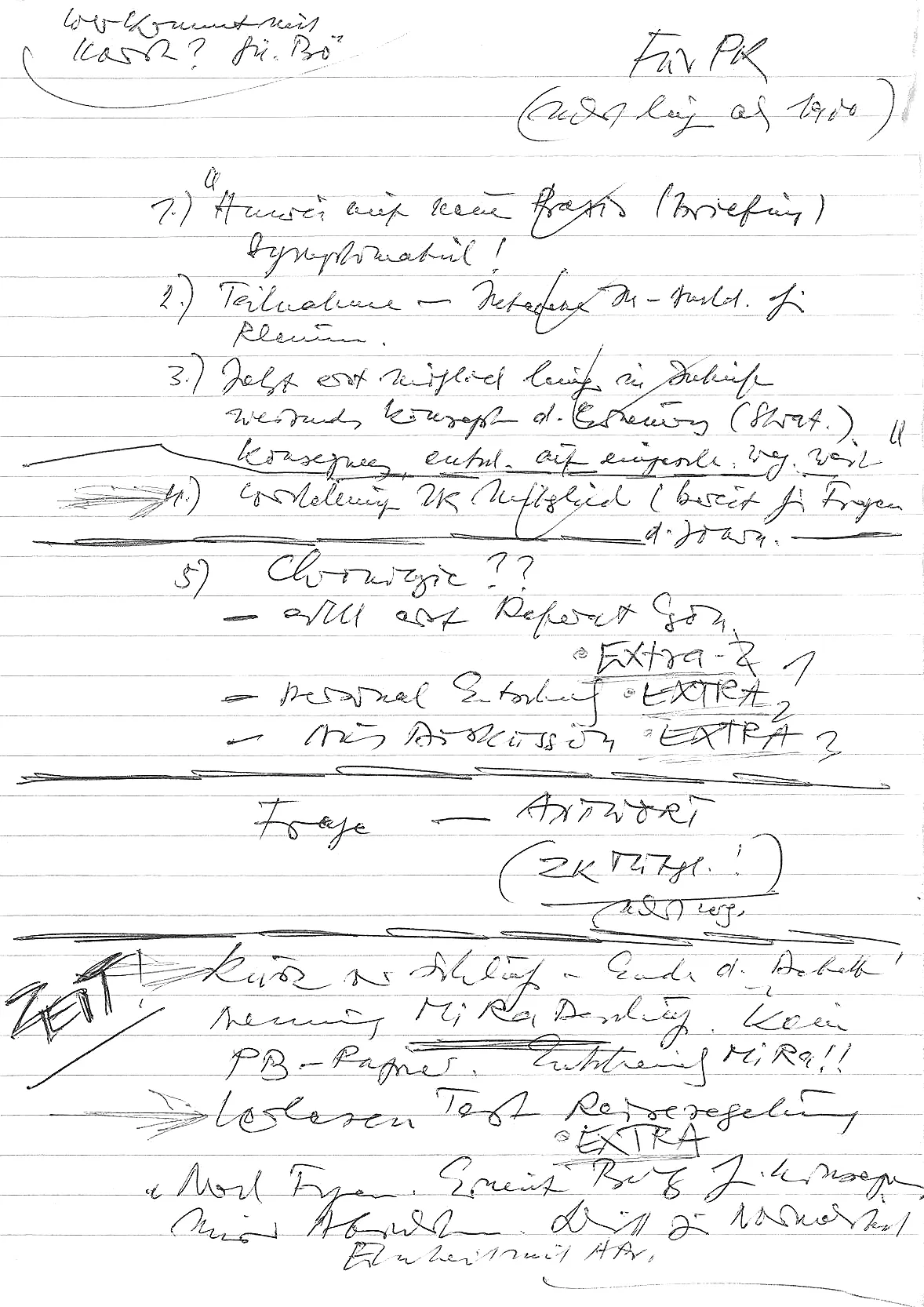
Handwritten notes by Günter Schabowski, 1989. Source: Haus der Geschichte, via Wikimedia Commons · CC BY-SA 3.0 · Source page
Schabowski's notes for the press conference are handwritten, in pen, with numbered points and arrows. In the top right corner is written Für PK, meaning “for the press conference”. It is a working page, not a legal text.
Source: The question and the answer
“As far as I know, this is immediate, without delay.”
This is a later summary, not a transcript. The chronicle does not name the reporter who asked the question, and the wording differs between translations.
- Who asked the question? Two reporters each claim to have asked it: Riccardo Ehrman of the Italian agency ANSA, and Peter Brinkmann of the German paper Bild. The authorship is disputed, so it is not safe to state it as certain.
- Why does the wording change between translations? The words were spoken in German, live, and then translated. Translations add and drop words, and other English versions say the rule takes effect immediately. Do not treat one translated sentence as the transcript.
- What is missing from the answer? A start date and time. Schabowski had not been told when the rules would begin, and he answered from what he knew.
That evening
West German television
That evening West German news programmes showed excerpts of the press conference: ZDF's heute, and ARD's Tagesschau. Many East Berliners watched West German television at home, and heard the news there.
A decision point
You are Harald Jäger, a Stasi officer on duty at the passport-control post at Bornholmer Strasse.
Berlin, Bornholmer Strasse, 9 November 1989, about 23:00.
A large crowd of thousands has gathered at the gate, and more come all the time. Many have seen the news and believe the new rules already apply. According to one account your orders are to turn people back, and when you ask your superiors for new orders, none come.
The people in front of you are not going home. You are in charge at this post, and you have to decide what happens at the gate.
What do you do at the gate?
- Keep the gate shut and wait for orders. The crowd would stay at the barrier and grow, and the pressure would move to other crossings. Waiting would look like stubbornness, not a decision.
- Open the gate for a small group and keep the rest out. A few people would cross, and the rest would keep pushing against the barrier. Each crossing would become an arbitrary choice about who passes. The pressure would probably grow.
- Open the gate for everyone. The crowd would cross, and the border would stop working as a barrier that night. Other crossings would probably open too, and the rule meant for the next day would be overtaken by events.
What really happened
Open the gate for everyone.
Jäger ordered the gate opened at about 23:30. Wikipedia gives that time; in an interview with The Local, Jäger gave about 23:20. People crossed into West Berlin. Other crossings opened that night too, and crowds climbed onto the Wall in many places.
Jäger described the night in interviews, so this is his own account. According to one account, he had orders to turn people back, and he got no new orders when he asked. The sources do not say what he thought in those minutes. Sarotte names him as the man who, in practical terms, opened the Wall that night. Jäger and Schabowski were both state officials doing a job, not heroes or villains.
The night
Through the gate
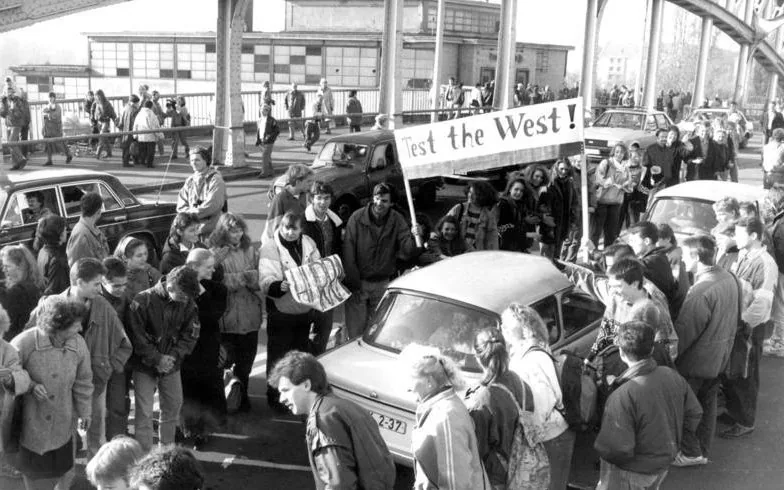
Photo: Hans Peter Lochmann (ADN-ZB), Bundesarchiv, image 183-1989-1118-028 · Lochmann, Hans Peter · CC BY-SA 3.0 · Source page
The gate at Bornholmer Strasse was one of several crossings that opened that night. People streamed over the bridge into West Berlin. On 10 November, schoolchildren from the Wedding district of West Berlin lined the bridge and welcomed the first visitors from the East.
Myth
The East German government decided to open the Wall.
The truth
No. The new travel rules were meant to take effect the next day, and the start time was not passed on to Schabowski. When he said “immediately”, he answered from what he knew. The crossings opened that night because officers at the gates decided, under pressure from the crowds, to open them.
The evidence
Wikipedia, “Berlin Wall”: the rules were meant for the next day, and Schabowski was not told the time. Sarotte, The Collapse (2014), argues that the opening was accidental rather than planned.
A choice in Bonn
October 1989
Moscow lets go
In October 1989 the Soviet spokesman Gennadi Gerasimov said that each country in the Eastern bloc could choose its own path. The line later became known as the Sinatra doctrine. Historians disagree whether this was deliberate policy or a reaction to events.
A decision point
You are Helmut Kohl, chancellor of West Germany.
Bonn, November 1989.
In East Germany the regime's authority is collapsing. The protests grow, and some voices speak not only of reform but of unity. Germany is still divided into two, and the Western Allies still hold rights over Berlin and over Germany as a whole.
Your coalition partner, the liberal FDP, has its own view of the pace, and so do the Western Allies and Moscow. The question is which plan you put forward, and when.
Which plan do you put forward?
- Fast unity: East Germany joins the Federal Republic at once. This would satisfy the crowds in the East quickly. But Moscow and the Western Allies might be alarmed, and their rights over Germany were still in force.
- A plan in stages: close cooperation, then a confederation, then a federation. The first condition: a government in East Germany with democratic legitimacy. This would calm the Allies and Moscow, and give East Germany time to renew itself. But it might be too slow for people already on the streets, and it depends on an East German government willing to talk.
- Keep two German states, and help East Germany reform itself. A reformed East Germany might calm the crowds for a while, but Germany would stay divided, with no way to end the split that people were already asking about.
What really happened
A plan in stages: close cooperation, then a confederation, then a federation. The first condition: a government in East Germany with democratic legitimacy.
Kohl chose the staged path. On 28 November 1989 he presented his Ten-Point Plan to the Bundestag. He had not first consulted his coalition partner, the liberal FDP, or the Western Allies. The plan set out stages: closer cooperation, then a confederation, then a federation, with a democratically legitimate government in the GDR as the condition for all of them. Unity came on 3 October 1990, about ten months later.
Why stages? One reading is that the stages gave East Germany a route to change, and gave Moscow and the Western Allies time to adjust, so they had less reason to block the process. The opposition SPD opposed the plan. Historians still debate whether Kohl wanted a long road to unity, or a plan that would move as fast as events allowed. The texts examined here show a staged plan, not a timetable.
Source: Point five of the Ten-Point Plan
“…that absolutely presupposes a democratically legitimized government in the GDR.”
Point five speaks of “confederative structures” between the two states, with the aim of creating a federation. The quoted line is the small print at the end, and it contains the condition.
- What is the aim of point five, and what is only a step towards it? The aim is a federation. Confederative structures are the step before it. The text describes a plan of stages, not a single act of unity.
- What condition does the sentence set? A government in the GDR with democratic legitimacy. The word “absolutely” makes it a precondition: without it, there is no next stage. This is the part that decides things, not the pleasant tone of the plan.
- Who was the speech for? To the Bundestag and the West German public. To people in the East, above all those on the streets. And in effect to Moscow and the Western Allies, who had not been consulted in advance.
November–December
The Velvet Revolution
In Czechoslovakia the Velvet Revolution ran from 17 November to 29 December 1989. A student march in Prague began it. Mass demonstrations and strikes brought down the communist government within weeks.
After the Wall: a myth, a debate and the quiz
22 December 1989
The gate reopens
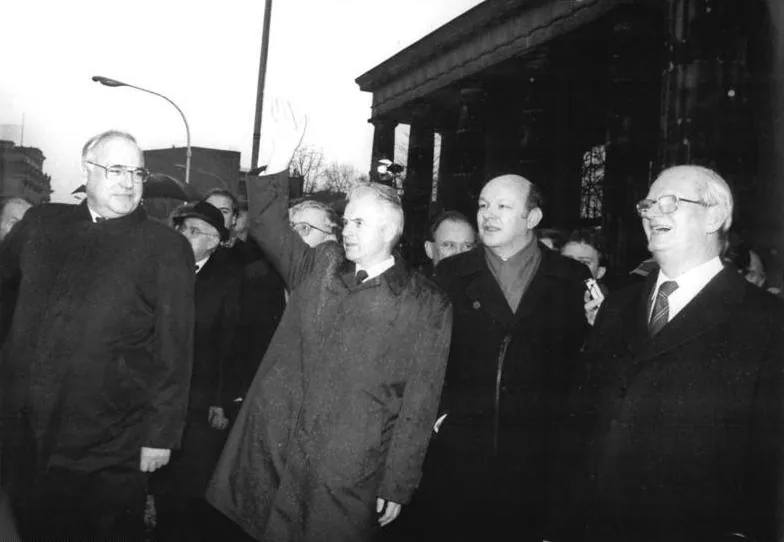
Photo: Rainer Mittelstädt (ADN-ZB), Bundesarchiv, image 183-1989-1222-032 · CC BY-SA 3.0 · Source page
On 22 December 1989 the Brandenburg Gate opened again; the crossing there had been closed since 1961. The same day, the rule of Nicolae Ceaușescu in Romania came to an end.
From 1990
Taking the Wall down
Demolition of the Wall began on 13 June 1990, and the last sections came down only in 1994.
1990–1991
One country, and a state that fell
On 3 October 1990 Germany was formally reunited, less than a year after the night at Bornholmer Strasse. On 26 December 1991 the Soviet Union was formally dissolved.
Helmut Kohl
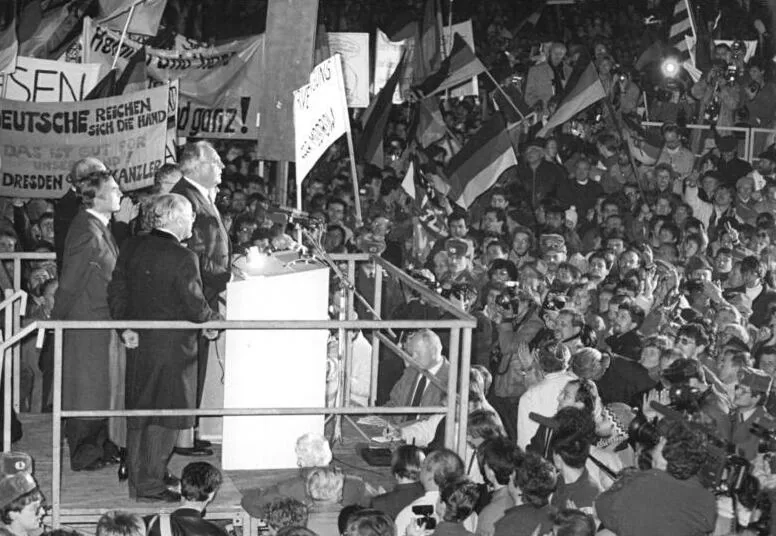
Photo: Rainer Mittelstädt (ADN-ZB), Bundesarchiv, image 183-1989-1219-034 · CC BY-SA 3.0 · Source page
The West German chancellor who presented the Ten-Point Plan and led Germany into reunification.
- Born: 3 April 1930, Ludwigshafen, Germany
- Died: 16 June 2017, Ludwigshafen
- Won: German reunification, 1990
- Lost: The federal election of 1998
“…that absolutely presupposes a democratically legitimized government in the GDR.”
Myth
The Wall fell in one night.
The truth
The crossings did open that night, and that was the most dramatic moment. But the Brandenburg Gate did not open until 22 December, and demolition began on 13 June 1990 and lasted until 1994. The fall was a process of months and years.
The evidence
Wikipedia, “Berlin Wall”: the dates of the Brandenburg Gate's reopening, and the start and end of the demolition.
The sequence, in order
- 13 August 1961 The Wall is built.
- 19 August 1989 The Pan-European Picnic near Sopron. The border gate opens for three hours.
- 10–11 September 1989 Hungary opens its border to East Germans.
- 30 September 1989 Genscher on the embassy balcony in Prague.
- 9 October 1989 About 70,000 march in Leipzig. No shots are fired.
- 18 October 1989 The Politburo removes Honecker, and Egon Krenz takes his place.
- 4 November 1989 More than half a million people gather at Alexanderplatz, by official estimates.
- 9 November 1989 The press conference. At Bornholmer Strasse the gate opens at about 23:30.
- 28 November 1989 Kohl presents the Ten-Point Plan to the Bundestag.
- 22 December 1989 The Brandenburg Gate reopens. In Romania Ceaușescu's rule ends.
- 3 October 1990 Germany is formally reunited.
Why did the Wall fall?
Was it a mistake on one night, or a state that had already come apart from within?
- Mary Elise Sarotte, The Collapse (2014) Sarotte argues that the opening was accidental rather than planned: her book's subtitle is The Accidental Opening of the Berlin Wall. According to the publisher's summary, she names Jäger as the man who, in practical terms, opened the Wall that night.
- Stephen Kotkin, with a contribution by Jan Gross, Uncivil Society (2009) Going by its title and the publisher's summary, the book argues that the communist establishment imploded from within: the collapse came from inside the system itself. This summarises the title and the publisher's blurb, not the full argument.
The question stays open: how much weight to give Moscow's restraint, the crowds, the economy and the Western leaders, and which of them decided the outcome. Historians weigh these differently.
Check yourself
Who presented the Ten-Point Plan to the Bundestag on 28 November 1989?
Answer: Helmut Kohl, the West German chancellor. Yes. Kohl presented the plan on 28 November 1989, without first consulting his coalition partner or the Western Allies.
Check yourself
Which country began taking down its fence on the border with Austria in 1989?
Answer: Hungary, in the spring and summer of 1989. Yes. Hungary began taking down its fence on the Austrian border in 1989. The sources give 2 May or June as the start.
Check yourself
Which Soviet leader did Reagan address at the Brandenburg Gate in 1987?
Answer: Mikhail Gorbachev, who led the Soviet Union. Yes. The speech addressed him by name, on 12 June 1987.
Check yourself
On what date was the Soviet Union formally dissolved?
Answer: On 26 December 1991. Yes. The Soviet Union was formally dissolved on this date, more than two years after the Wall came down.
Check yourself
From which balcony did Genscher speak to East German refugees in Prague, and on which day in 1989?
Answer: The West German embassy balcony, 30 September. Yes. On 30 September 1989 Genscher told the refugees that they could travel on to West Germany.
Check yourself
Roughly how many people marched in Leipzig on 9 October 1989?
Answer: About 70,000. Yes. According to Chronik der Wende about 70,000 people marched, the largest East German protest since 17 June 1953.
Terms
- perestroika “Restructuring”: Mikhail Gorbachev's programme of economic and administrative reform in the Soviet Union, from about 1985.
- glasnost “Openness”: Gorbachev's policy of more open information and public debate in the Soviet Union.
- death strip The strip of ground along the Berlin Wall, with anti-vehicle trenches and beds of nails. Entering it was forbidden.
- Politburo The small committee at the top of a communist party, which took the main decisions between congresses.
- Stasi The East German secret police. It spied on citizens, made arrests, and controlled borders and travel.
- Round Table The April 1989 talks in Poland between the communist government and the opposition led by Solidarity. They led to elections that were partly free.
- hard currency Money that other countries accept in payment, such as the US dollar or the West German mark. Eastern bloc states needed it for imports.
- Sinatra doctrine The nickname for the Soviet policy of 1989: allies could choose their own path, without Moscow stepping in.
- confederation A loose union of independent states with limited shared institutions. Unlike a federation, it has no strong central government.
- Velvet Revolution The name for Czechoslovakia's peaceful change from communist rule to democracy, in November and December 1989.
- Bundestag The German federal parliament. In 1989 it met in Bonn.
Sources
- Ronald Reagan, speech at the Brandenburg Gate, Berlin, 12 June 1987; the words as Deutsche Welle printed them in 2007
- Günter Schabowski, press conference, East Berlin, 9 November 1989; English text in Chronik der Wende (translator not named)
- Helmut Kohl, Ten-Point Plan for German Unity, speech to the Bundestag, 28 November 1989; English translation by German History in Documents and Images (GHDI)
- Chronik der Wende, entries for 9 October 1989 (Leipzig) and 4 November 1989 (Alexanderplatz), English texts
- Deutsche Welle, “Reagan's famous ‘tear down this wall’ speech turns 20”, 12 June 2007 (includes an interview with John Kornblum)
- Mary Elise Sarotte, The Collapse: The Accidental Opening of the Berlin Wall (Basic Books, 2014)
- Stephen Kotkin, with a contribution by Jan Gross, Uncivil Society: 1989 and the Implosion of the Communist Establishment (Modern Library, 2009)
- Wikipedia (English): “Berlin Wall”, “Pan-European Picnic”, “Günter Schabowski”, “Sinatra Doctrine”. Used for several dates and details the sources above do not give; a starting point, not a final authority
Image credits
- Photo: Sue Ream, Wikimedia Commons · Sue Ream, photographer (San Francisco, California) · CC BY 3.0 · Source page
- Photo: Thomas Lehmann (ADN-ZB), Bundesarchiv, image 183-1989-1109-030 · CC BY-SA 3.0 · Source page
- Handwritten notes by Günter Schabowski, 1989. Source: Haus der Geschichte, via Wikimedia Commons · CC BY-SA 3.0 · Source page
- Photo: Hans Peter Lochmann (ADN-ZB), Bundesarchiv, image 183-1989-1118-028 · Lochmann, Hans Peter · CC BY-SA 3.0 · Source page
- Photo: Rainer Mittelstädt (ADN-ZB), Bundesarchiv, image 183-1989-1222-032 · CC BY-SA 3.0 · Source page
- Photo: Rainer Mittelstädt (ADN-ZB), Bundesarchiv, image 183-1989-1219-034 · CC BY-SA 3.0 · Source page


