Ben-Gurion: four decisions that made a state
The United States proposed a truce days before the British Mandate ended. How is such a decision made, and what other choices by David Ben-Gurion shaped the state?
Decisions, questions and your own progress, in the app
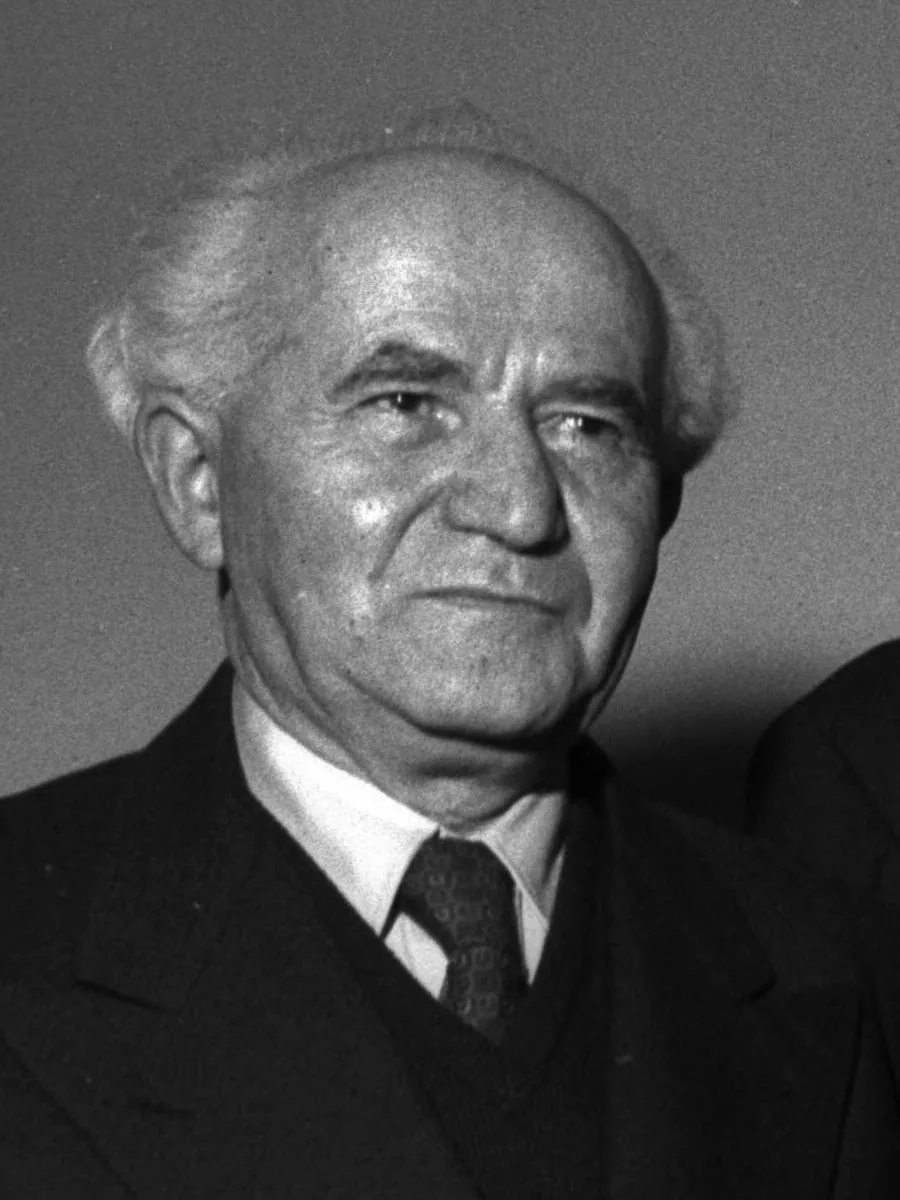
David Ben-Gurion, 10 January 1952. Government Press Office, Israel (National Photo Collection, D508-115) · Hans Pinn · Public domain · Source page
A boy from Plonsk
Jaffa, September 1906
In September 1906 a nineteen-year-old came ashore at Jaffa. He came from Płońsk, a small town in the Russian Empire that is now in Poland. His name was David Grün. He had not come to rule anything. He had come to work the land and to help build a Jewish society that could stand on its own feet.
Forty years later he would stand in a room and put a question to his colleagues that would decide the future of a country. How does someone make a choice like that? And what other choices shaped him on the way? This lesson follows four of his decisions.
Plonsk, 1905
A worker before a politician
David Grün grew up in Płońsk, where Jews, Poles and Russians lived side by side. He joined the Poalei Zion, a socialist Zionist movement that held that Jews should build their country with their own labour. In a group photograph from 1905 he sits in the front row, third from the right, among young men in dark coats.
In 1906 he went to Palestine. At first he worked as a hired labourer. In October 1907 he moved to Sejera in the Galilee, on the suggestion of Shlomo Zemach. Life in the the Yishuv, the Jewish community of Palestine, was hard. Work was scarce, and the young pioneers argued about labour, socialism and the society they wanted to build.
1910–1915
A new name and an exile
In 1910 he took the name Ben-Gurion, after Yosef ben-Gurion, a figure from the Jewish past. A new name marked a new start: he was no longer just one labourer among many.
In October 1912 he went to Constantinople, the Ottoman capital, to study law at the university there. In March 1915 the Ottoman authorities deported him to Egypt, and he never finished the degree. In 1935 he became chairman of the executive of the the Jewish Agency, the body that spoke for the the Yishuv to the British.
Between the White Paper and the vote
May 1939
The White Paper
In May 1939, with war coming to Europe, the British government published the the White Paper. It capped Jewish immigration to Palestine at 75,000 over five years. After that, immigration would depend on the consent of the Arabs of Palestine, and within ten years the country was to become independent.
The the Yishuv saw a betrayal of the Balfour Declaration. Some Jews answered by smuggling immigrants in on old, crowded ships, the ha’apala. For the leaders the question was harder: what do you do when Britain is also fighting the Nazis?
A decision point
You are David Ben-Gurion, chairman of the executive of the Jewish Agency.
Jerusalem, September 1939
The war broke out a few days ago. Britain is at war with Germany, and young people in the Yishuv want to fight the Nazis. The White Paper is still in force, and the ships are still trying to bring immigrants in.
Some in your movement want to stop the protests until the war is over. Others want to act now, while the British are busy in Europe. You must decide what the Yishuv does next.
What do you propose the Yishuv does?
- Stop the illegal immigration and the protests, and wait until the war is over. Britain would probably be grateful for the calm, and the White Paper would stay in force for the length of the war. But the Yishuv would give up its pressure on London, and its voice in the settlement after the war would be weaker.
- Help Britain’s war effort, and fight the White Paper politically and through illegal immigration. Britain would take the help and keep the White Paper. The fight would go on in London and at sea. The Yishuv would probably earn some goodwill in London and lose little, but the paper would remain British policy until the war ended.
- Start an armed revolt against Britain now, while its army is fighting Germany. Britain would have both the means and the will to crush such a revolt. The Yishuv would be cut off from the war effort it wanted to join. Probably the revolt would fail quickly, and the price would be paid by the Yishuv’s young men.
What really happened
Help Britain’s war effort, and fight the White Paper politically and through illegal immigration.
He chose the second course. The Jewish Agency offered the Yishuv’s help to Britain’s war effort, and volunteers joined British units. Meanwhile the illegal immigration and the political fight against the White Paper went on.
One English-language account gives his words as: “we must help the [British] army as if there were no White Paper, and we must fight the White Paper as if there were no war.” Other accounts give the line in different words, so the exact wording is not known.
According to the sources, Ben-Gurion believed the Jews needed Britain to win, and that the White Paper could be fought without giving up the fight against Germany. Opponents, among them the Irgun, wanted to fight Britain directly. It was a political choice, made by a leadership with little power to act alone.
May 1942
Biltmore, and what people knew
In May 1942 about 600 delegates from 18 countries met at the the Biltmore programme Hotel in New York. Their programme called for Palestine to become a Jewish Commonwealth, with open immigration. Ben-Gurion was one of the leading figures at the conference.
By then, news of the mass murder of Jews in Europe had begun to reach Palestine. The leaders had to decide how far the rescue of European Jews should come before the demand for a state, and how to press a country at war to open its gates. Historians still argue about what the leaders knew, and what they could have done with it.
1945–1947
One underground, then the UN
In 1945 the Haganah, the Irgun and Lehi joined in the the Hebrew Resistance Movement, a joint campaign against the British. They sabotaged railways and bridges. In July 1946 the Irgun bombed the King David Hotel in Jerusalem, where the British administration had its offices. 91 people were killed.
Afterwards Chaim Weizmann asked the movement to stop. The Jewish Agency, which Ben-Gurion chaired, backed him. The Haganah accepted the decision reluctantly, while the Irgun and Lehi did not. The movement ended in August 1946.
In February 1947 Britain handed the question of Palestine to the United Nations. In May the UN set up a committee to study it. On 29 November 1947 the General Assembly voted, 33 for, 13 against and 10 abstentions, to recommend dividing the country into a Jewish and an Arab state, with an economic union and a special regime for Jerusalem. The Jewish Agency accepted the plan. The Arab Higher Committee rejected it. The next day fighting broke out across the country.
Declare, or wait
April–May 1948
The end of the Mandate
By spring 1948 the British were preparing to leave. The the Mandate was due to end at midnight on 14 May. The Yishuv had been fighting for months, and its leaders had set up a provisional body, the People’s Administration, to govern on the day the British left.
The United States had proposed a truce in the fighting.
A decision point
You are David Ben-Gurion, head of the People’s Administration.
Tel Aviv, 12 May 1948, two days before the Mandate ends
Arab armies are expected to enter the country when the Mandate ends. The members of the People’s Administration are divided. Some want to accept the American truce proposal and put off the declaration of a state. Others argue that without a declaration the Yishuv would have no government to speak for it, and no legal standing to ask the world for help.
The vote is in your hands. You must decide what goes to the vote.
What do you put to the vote?
- Accept the American truce proposal and put off the declaration. The Mandate would end with no Jewish government in place. Probably the fighting would pause, on terms the other side might not keep, and the state would be postponed for weeks or months. Historians debate whether such a delay was realistic.
- Declare the state on 14 May, when the Mandate ends. Probably the war would begin at once, against armies that were already expected. But the new state would have a government able to act, raise an army and speak for itself to the world.
- Declare a state, but keep the announcement back until a truce is agreed. The declaration would lose its force. Probably the neighbouring states would not treat an undeclared state as a state, and the Americans would have more time to press for delay. A state that is not announced has little legal weight.
What really happened
Declare the state on 14 May, when the Mandate ends.
On 12 May the People’s Administration voted. Ten of its thirteen members were present. Six voted to declare the state when the Mandate ended, and four voted against. Chaim Weizmann, the Zionist elder statesman, is reported to have said of the delay: “What are they waiting for, the idiots?” The reported words rest on a single account.
On 14 May, in the hall of the Tel Aviv museum, the state was declared.
Supporters argued that the end of the Mandate would leave a vacuum: without a declaration, the Yishuv would have no government to speak for it. The four who voted against preferred the truce. Historians still debate whether a delay was realistic at all, and the sources read for this lesson do not settle the question.
14 May 1948
Four o’clock in Tel Aviv
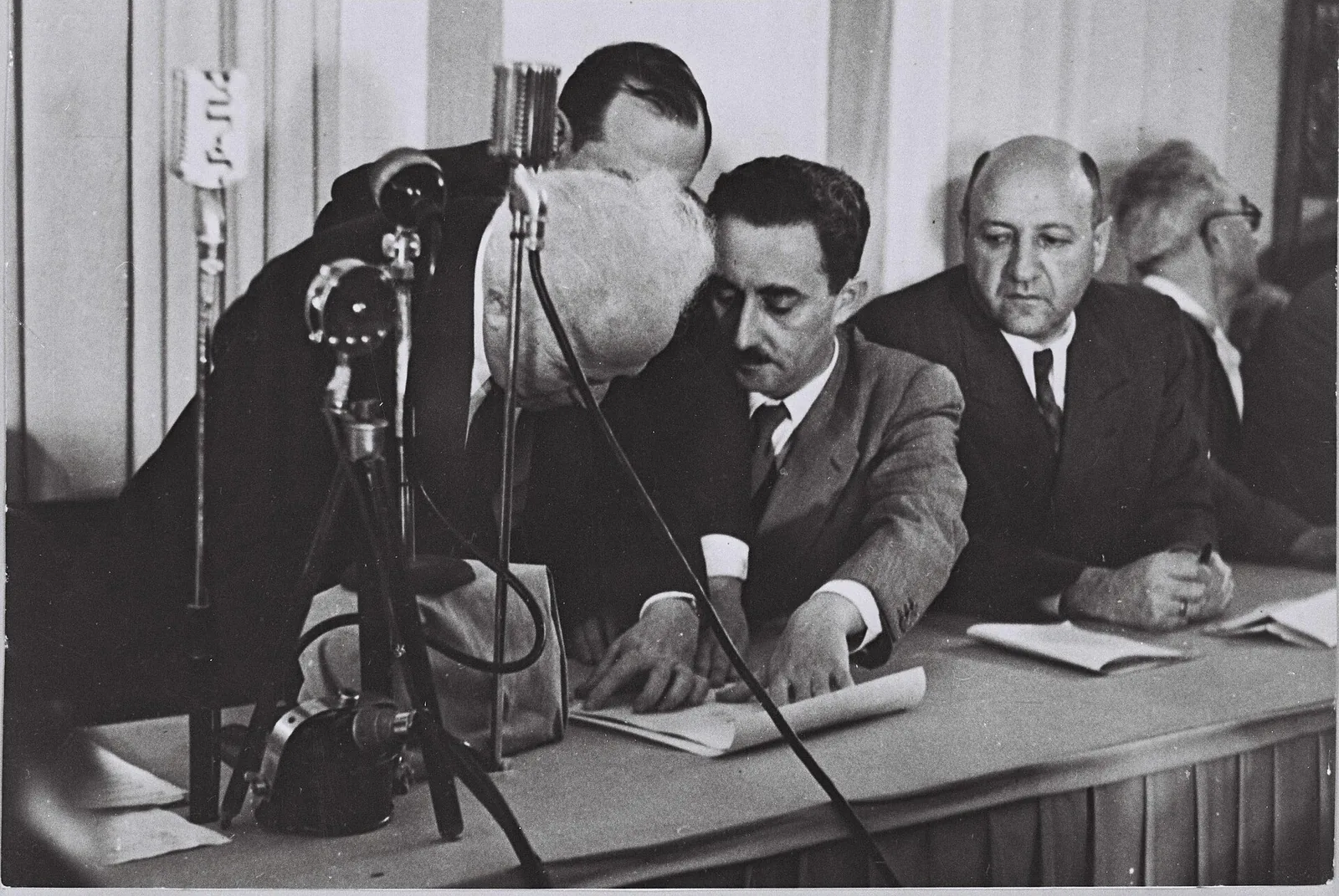
Ben-Gurion signs the Declaration of Independence, Tel Aviv museum, 14 May 1948. Government Press Office, Israel (National Photo Collection, D662-049) · Government Press Office (GPO), Israel · CC BY-SA 3.0 · Source page
16 minutes
It was Friday, 5 Iyar 5708. At four in the afternoon Ben-Gurion stood up in the hall of a small art museum on Rothschild Boulevard. He read the Declaration of Independence aloud for about sixteen minutes, and Kol Yisrael broadcast the reading live.
The photograph shows the signing. Ben-Gurion bends over the scroll, Moshe Sharett holds it, and Eliezer Kaplan looks on. The name of the state was also put to a vote. In one account, “Israel” was chosen by six votes to three.
Source: The Declaration: the opening lines
“The Land of Israel was the birthplace of the Jewish people.”
“…complete equality of social and political rights to all its inhabitants irrespective of religion, race or sex.”
The Declaration was written and read in Hebrew. The English versions are translations, and they differ from one another, so compare them before you rely on one.
- Who is speaking, and on what grounds? The text speaks in the name of the Jewish people. It rests on the historic claim of the Jewish people and on the UN resolution of 1947. Ask whether those two grounds carry the same kind of authority.
- What does it promise the people who live in the country? Equality of social and political rights to all inhabitants, without distinction of religion, race or sex. Historians later asked how far that promise was kept, in the war and after it.
- What does it leave out? Borders. The text does not say where the state’s frontiers run. Where they would run was the question the war was about.
Source: Ben-Gurion on the ‘Rock of Israel’
“Each of us, in his own way, believes in the ‘Rock of Israel’ as he conceives it.”
“Don’t let me put this phrase to a vote.”
The Declaration’s closing line, in Hebrew, says that the signatories sign “in trust in the Rock of Israel”. The phrase is biblical and can be read in more than one way. Ben-Gurion’s remark suggests he did not want its meaning fixed by a vote.
- Why might a leader refuse to put a phrase to a vote? A vote would force each member to say what the phrase means. Probably he wanted wording that people with very different beliefs could all sign. That is an interpretation, not something the quote states.
- The 1948 JTA translation of the closing line reads “with trust in Almighty God”. What has changed? The image of a rock has become a God, and an English reader hears a religious formula. A translator decides what the reader hears, so compare two translations before you trust either.
Myth
Ben-Gurion declared the state alone, and everyone agreed.
The truth
He read the Declaration and proclaimed the state on behalf of the provisional leadership. But the decision was not his alone, and it was not unanimous. On 12 May the People’s Administration voted six to four in favour of declaring the state, with ten of its thirteen members present.
The evidence
The count comes from one detailed published account of the vote. The names of the individual voters rest on that same account, so this lesson does not print them. The reading was Ben-Gurion’s, which is why the myth lasts: the vote is far less visible than the man at the table.
A ship and two towns
June 1948
The ship from France
The Altalena, an Irgun ship carrying arms and volunteers, sailed from France on 11 June 1948. It reached the coast on 20 June and anchored off Kfar Vitkin, north of Tel Aviv.
According to Begin’s men, the arms were meant for their own units. On the evening of 21 June the ship sailed south toward Tel Aviv, and around midnight it ran aground near the beach.
A decision point
You are David Ben-Gurion, prime minister and minister of defence.
Tel Aviv, the afternoon of 22 June 1948
The Altalena is aground off the shore, in sight of the promenade. Its arms and fighters are on board, and your army has moved troops along the beach. Begin’s men say the arms are for their own units. You say the state will have one army and one authority over weapons. The government had already authorised the use of force on 20 June, if it proved necessary.
What order do you give?
- Negotiate: let the ship unload its arms under army supervision, into one army. Probably the arms would reach the army without bloodshed. But the Irgun men would stay in a separate force for some time, and the question of who commands the armed groups would remain open.
- Hold the ship at sea, and wait until its men give in. Probably a long standoff, with the arms still on board while the front needs them, and a chance that the ship would land its cargo somewhere else.
- Order the army to fire on the ship. Probably a bloody clash on the beach, and the end of the separate force. It would prove that the state held the only authority over arms. The cost would be lives on both sides and a deeper split in the country.
What really happened
Order the army to fire on the ship.
At about four in the afternoon on 22 June the army fired on the ship. It was hit, caught fire and was abandoned. The shelling order was Ben-Gurion’s. Begin ordered his men not to return fire, but firing continued. Irgun men and a few soldiers were killed. The totals differ between accounts, so this lesson gives no single figure.
Ben-Gurion’s case was that a state could not allow an armed group to land weapons beyond its control. Opponents said the bloodshed was unnecessary and that a negotiated handover was possible. Some books make stronger claims, including that the aim was to destroy Begin’s men. Those claims are contested, and this lesson does not adopt them.
Source: The burning ship, 22 June 1948
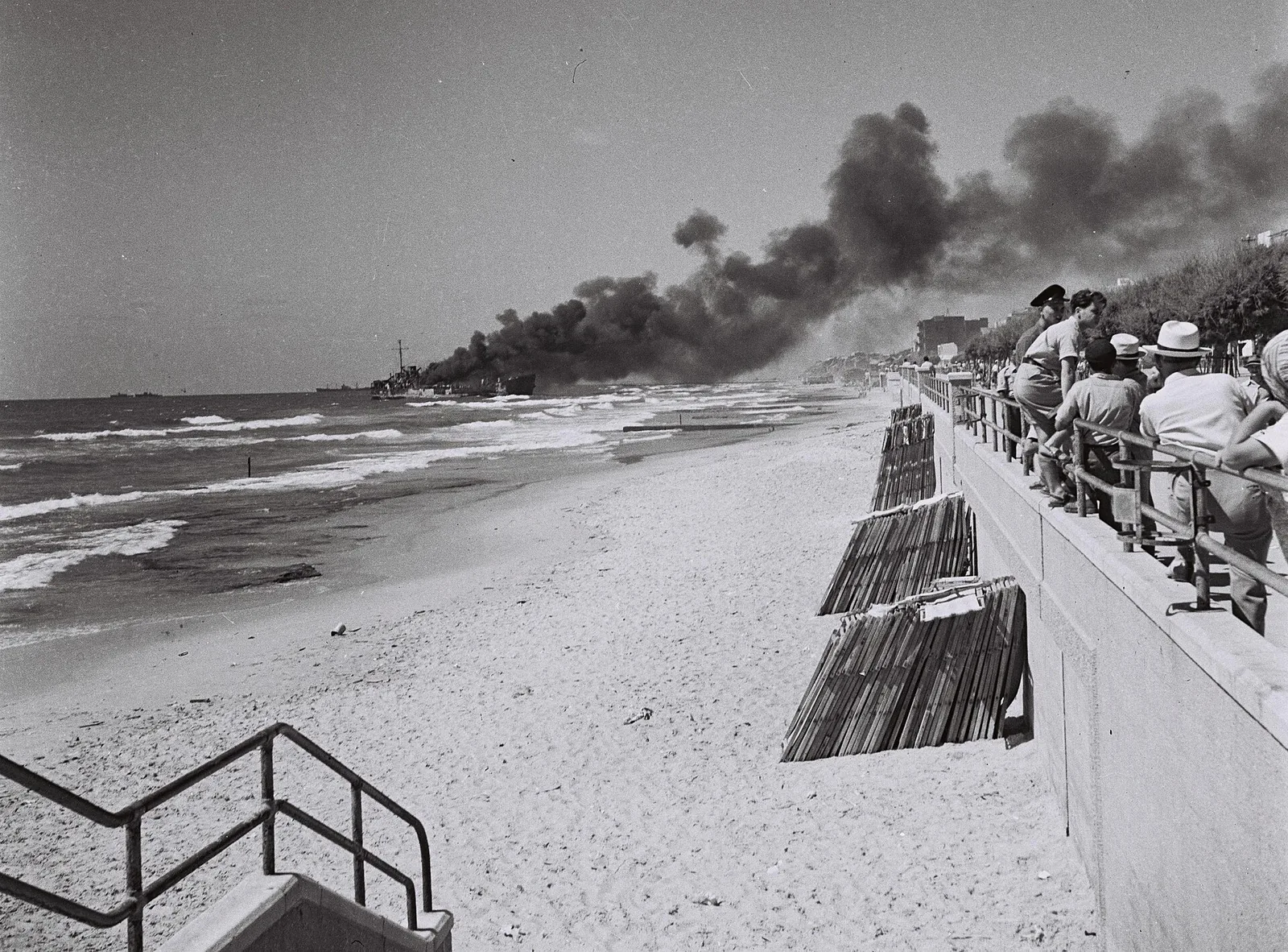
The burning Altalena, 22 June 1948. Government Press Office, Israel (National Photo Collection, D836-019) · Government Press Office (GPO), Israel · CC BY-SA 3.0 · Source page
Government Press Office photograph, 22 June 1948 (National Photo Collection of Israel, D836-019)
The photograph was taken on the day of the shelling, from the Tel Aviv promenade. The archive caption reads: “The shelling and burning of the Etzel’s ‘Altalena’ ship.”
- Who took this photograph, and for whom? A photographer of the Government Press Office, an arm of the state. A state photograph is a record, and also a choice about what the state wants seen.
- The caption calls the ship the Etzel’s. What do the words tell you? Etzel is the Hebrew name of the Irgun. The caption names the group and the act, the shelling, but not who gave the order. Captions are part of the argument.
- What is missing from the frame? The men on board and the fighting on the beach. The people on the promenade are shown watching, but the picture cannot show why they are there or what they think.
After the fire
One question settled
The ship burned off the beach and was later towed out and sunk. The affair settled one question for the new state: no armed group would keep its own weapons outside the army. Whether this was the wisest way to settle it is still argued.
10–14 July 1948
Lydda and Ramle
About 50,000–70,000
In the weeks after the Altalena affair, the army was advancing through the centre of the country. In July 1948 it took Lydda and Ramle, two towns with large Arab populations. Residents of Ramle left between 10 and 12 July. On 12 July an order was issued for Lydda. In the English version usually quoted, its key line reads: “The inhabitants of Lydda must be expelled quickly without attention to age.”
The people of Lydda left on the morning of 13 July, and many walked for about three days. The order was signed by Yitzhak Rabin, the operations chief of the attack. Estimates of how many people were driven out of Lydda and Ramle range from about 50,000 to 70,000. Whether Ben-Gurion approved the expulsion, and how, is one of the most disputed questions of 1948.
Planned, or haphazard?
Were the expulsions of 1948 planned, and who was responsible for the expulsions from Lydda and Ramle?
- Benny Morris In The Birth of the Palestinian Refugee Problem Revisited (2004) he finds no central expulsion policy. The treatment of the Arab population was haphazard, and soldiers understood it as deportation. He argues that Ben-Gurion personally directed the expulsions from Lydda and Ramle.
- Efraim Karsh In Fabricating Israeli History (1997) he argues that more of the flight was voluntary than Morris and others concede. Expulsions did happen, above all at Lydda. He criticises the ‘New Historians’ for casting the Arabs as victims.
- Ilan Pappé In The Ethnic Cleansing of Palestine (2006) he argues that the expulsions were widespread and part of a planned operation, Plan Dalet, and calls them ethnic cleansing.
- Yoav Gelber In his study of the 1948 war and the refugee problem he argues that Ben-Gurion’s agreement with two ministers, Bechor-Shalom Shitrit and Moshe Sharett, shows he did not intend expulsions, and that a wave of the hand is not a clear order. He attributes the expulsions to Allon’s forces, citing Allon’s reputation for scorched-earth tactics.
What would count as proof of a decision to expel: a written order, a spoken order, a wave of the hand, or a policy every commander understood? Each side answers differently, and each answer leads to a different verdict on the man at the top. This lesson does not decide between them.
Immigrants and German money
5 July 1950
Every Jew may come
On 5 July 1950 the Knesset passed the Law of Return, which gives every Jew the right to settle in Israel. The vote was unanimous, and the date was chosen as the anniversary of Herzl’s death. Since 1948 hundreds of thousands of immigrants had arrived, many of them survivors of the Holocaust with nothing left. The state had to house them, feed them and find them work, and it had very little money.
January 1952
German money
David Ben-Gurion, 10 January 1952. Government Press Office, Israel (National Photo Collection, D508-115) · Hans Pinn · Public domain · Source page
Germany’s Nazi government had murdered six million Jews. In the early 1950s the West German government said it was ready to pay compensation, and Israel had to decide whether to talk. Many Israelis could not bring themselves to take German money. Others said the survivors and the young state were owed it.
A decision point
You are David Ben-Gurion, prime minister.
Jerusalem, January 1952
West Germany is ready to negotiate payments. The money would help the state absorb its immigrants, and it would reach survivors. Many people in the country regard any deal with Germany as shameful. Menachem Begin, leader of the Herut opposition movement, is preparing to speak against it, and the Knesset is debating whether to approve the talks.
What do you propose to the Knesset?
- Approve talks with West Germany on reparations, for the state and for the survivors. Probably the state would receive money and goods for rebuilding and for the survivors, at the price of a bitter public quarrel. Germany would become a constant subject of Israeli politics.
- Refuse any money and any talks with Germany. Probably the survivors would get nothing from Germany, the state’s finances would stay tight, and the question of responsibility would stay open. The principle would be kept, but the cost would fall on many people who needed help.
- Accept payments only for individual survivors, paid directly, and not for the state. Probably the talks would be harder, because Germany would not want to pay in that form. The state would not get the money it needed for absorbing immigrants, and fewer survivors would be reached.
What really happened
Approve talks with West Germany on reparations, for the state and for the survivors.
He chose the first course. In January 1952 the Knesset debated the talks. A large rally in Zion Square in Jerusalem turned into a riot, with stones thrown and windows of the Knesset broken. The government went on. The reparations agreement was signed in Luxembourg on 10 September 1952 by Moshe Sharett for Israel and Konrad Adenauer for West Germany, and it came into force in March 1953.
Ben-Gurion argued that the state needed the money to absorb its immigrants, and that the survivors were owed it. Begin argued that the money was blood money, and that accepting it made the state a party to the crime. Both arguments were made in public, and both are still quoted. The sources read for this lesson do not show how the public or the Knesset divided, so this lesson gives no figure.
Source: Begin on ‘blood money’
“It is blood money, and the majority in both the Knesset and the General public are against it.”
Begin’s statement against the German talks, from the archive of the Begin Heritage Center. The sentence is a claim about public opinion, not a measurement of it.
- Who is speaking, to whom, and in what role? Begin, leader of the Herut opposition, speaking against the government’s policy in public. The statement addresses the Knesset and the public as its audience.
- What does ‘blood money’ assume? That the money is the price of the murder, so that accepting it makes the state a party to the crime. The government’s side answered that the money was owed to the survivors and to a state that had to absorb them.
- He says the majority is against the talks. How could you check that? Look for evidence from the time, such as polls, votes or letters, rather than the speaker’s word alone. A claim about ‘the majority’ is a claim about the public, and only evidence can test it.
Retreat and return
End of 1953
Sde Boker
At the end of 1953 Ben-Gurion resigned as prime minister and moved to Sde Boker, a kibbutz in the Negev desert. He stayed away from government for more than a year.
1954–1955
The Lavon affair
In July 1954 Israeli agents planted bombs in Egypt. The targets included the post office in Alexandria and the American information libraries in Alexandria and Cairo. According to the accounts, the aim was to damage Egypt’s relations with the West. Eleven people were arrested, and two of them died by suicide in prison.
The defence minister, Pinhas Lavon, resigned in February 1955. Ben-Gurion returned to the Ministry of Defence on 21 February 1955, and in November he was prime minister again. Lavon denied that he had ordered the operation. An inquiry later found that he had not authorised it. Who did order it is still argued over.
October 1956
Sinai and Suez
In the autumn of 1956 Israel invaded the Sinai Peninsula, alongside Britain and France, who attacked Egypt over the Suez Canal. Ben-Gurion backed the campaign, which history knows as the Suez Crisis.
1960–1962
Eichmann
On 11 May 1960 Israeli agents captured Adolf Eichmann in Buenos Aires. Eichmann had been an SS officer who organised the deportation of Jews to the death camps. In May 1960 Ben-Gurion told the Knesset that Eichmann was in Israel and would be put on trial. The trial in Jerusalem ended in a death sentence in December 1961. Eichmann was hanged at Ramla in the night of 31 May to 1 June 1962.
The end, and the reckoning
1963–1973
After it all
In June 1963 Ben-Gurion resigned as prime minister and minister of defence. He left active politics in 1970, but his name stayed in every argument about the state. He died in Ramat Gan on 1 December 1973, aged 87. He was buried near Sde Boker, at what is now Midreshet Ben-Gurion, not in the kibbutz itself.
What followed, in order
- 1939 The White Paper stays British policy until the war ends. The Yishuv helps the war effort and fights the Paper politically and through illegal immigration.
- 29 November 1947 The UN recommends dividing the country. The Jewish Agency accepts the recommendation, the Arab Higher Committee rejects it, and fighting breaks out the next day.
- 12 May 1948 The People’s Administration votes six to four to declare the state when the Mandate ends.
- 14 May 1948 The Declaration is read in Tel Aviv. The state exists, and the armies of its neighbours enter the country.
- 22 June 1948 The Altalena is shelled off Tel Aviv. The army establishes sole authority over arms, and Irgun men are killed.
- July 1948 Tens of thousands of Arab residents leave Lydda and Ramle. Who gave the order remains disputed.
- 5 July 1950 The Law of Return opens immigration to every Jew.
- 10 September 1952 The Luxembourg agreement is signed with West Germany. It comes into force in March 1953.
- 1962 Eichmann is hanged at Ramla, after a trial in Jerusalem that ended in December 1961.
- June 1963 Ben-Gurion resigns as prime minister and minister of defence.
Check yourself
According to the account quoted in this lesson, what did Ben-Gurion say the Yishuv should do in September 1939?
Answer: Help the British army, and fight the Paper as if there were no war.. Right. This is the line as one account gives it: help the army as if there were no White Paper, and fight the Paper as if there were no war.
Check yourself
How did the People’s Administration vote on 12 May 1948?
Answer: Six for declaring the state when the Mandate ends, four against.. Right. Ten of thirteen members were present: six voted to declare and four voted against.
Check yourself
Which statement about the Altalena fits the sources in this lesson?
Answer: Government allowed force on 20 June; Ben-Gurion ordered the fire.. Right. The 20 June decision allowed force ‘if necessary’, and the shelling order was Ben-Gurion’s.
Check yourself
Which statement about the Declaration of Independence is correct?
Answer: It promises equal social and political rights to all inhabitants.. Right. The text promises complete equality of social and political rights, irrespective of religion, race or sex.
Check yourself
Why do historians disagree about Lydda and Ramle?
Answer: The sources differ on whether Ben-Gurion ordered the expulsions.. Right. Rabin’s accounts differ, and historians split over the role of the top leadership.
Check yourself
What followed the Knesset’s decision to negotiate with West Germany?
Answer: The Luxembourg agreement was signed in September 1952.. Right. The agreement was signed on 10 September 1952 and came into force in March 1953.
Terms
- the Yishuv The Jewish community of Palestine before the state existed. In 1947 it numbered about 600,000 people.
- the Jewish Agency The body that represented the Yishuv and the Zionist movement to the British, and later to the UN. Ben-Gurion chaired its executive from 1935.
- the White Paper A British policy paper of May 1939. It limited Jewish immigration to 75,000 over five years, then made it depend on Arab consent, and promised an independent Palestine within ten years. Not to be confused with Churchill’s White Paper of 1922.
- ha’apala Illegal immigration to Palestine in defiance of the British quotas, mostly on small, old ships. Those who came this way were called ma’pilim.
- the Biltmore programme The programme adopted at the Biltmore conference in New York in May 1942. It called for Palestine to become a Jewish Commonwealth, with open immigration.
- the Mandate British rule over Palestine, granted to Britain by the League of Nations. It ended at midnight on 14 May 1948.
- the Hebrew Resistance Movement A joint underground of the Haganah, the Irgun and Lehi against the British, from 1945 until August 1946.
- the Irgun The National Military Organisation (Etzel), an underground that broke away from the Haganah in 1931. Its leader in 1948 was Menachem Begin.
- the Altalena An Irgun ship that reached the coast in June 1948 carrying arms and volunteers.
- the People’s Administration The Yishuv’s provisional executive for the end of the Mandate, headed by Ben-Gurion.
- the Declaration of Independence The proclamation of the State of Israel, read in Tel Aviv on 14 May 1948.
- the reparations agreement The agreement between Israel and West Germany on reparations, signed in Luxembourg on 10 September 1952 and in force from March 1953.
- Poalei Zion A socialist Zionist movement that held that Jews should build their country with their own labour.
- Płońsk A small town in the Russian Empire, now in Poland, where David Grün grew up.
- Sejera A place in the Galilee to which David Grün moved to work.
- Shlomo Zemach The man who suggested that David Grün move to Sejera.
- Constantinople The capital of the Ottoman Empire. Today it is called Istanbul.
- Ottoman Empire A large empire with its capital at Constantinople. Its authorities deported David Grün to Egypt in 1915.
- Balfour Declaration A British statement that backed a Jewish national home in the Land of Israel. The Yishuv saw the White Paper as a betrayal of it.
- Haganah The defence organisation of the Yishuv. In 1945 it joined the Irgun and Lehi in a joint campaign against the British.
- Lehi A Jewish underground group that fought the British. In 1945 it joined the Haganah and the Irgun against them.
- Chaim Weizmann A veteran Zionist statesman. After the King David Hotel bombing he asked the movement to stop.
- King David Hotel A hotel in Jerusalem where the British administration had its offices. The Irgun bombed it in July 1946.
- Moshe Sharett An Israeli leader who held the Declaration scroll at the signing and signed the reparations agreement with West Germany.
- Menachem Begin The leader of the Irgun, and of the Herut opposition that fought the deal with West Germany.
- Yigal Allon A senior army commander who later argued that the first shots at the ship were warning shots that hit it by accident.
- Kfar Vitkin A village on the coast, north of Tel Aviv, off which the Irgun ship Altalena anchored in June 1948.
- Yitzhak Rabin The operations chief of the attack. He signed the order concerning Lydda.
- Lydda A town with a large Arab population, taken in July 1948 together with Ramle. Many of its residents were driven out.
- Ramle A town with a large Arab population, taken together with Lydda. Its residents left in July 1948.
- Law of Return A law that gives every Jew the right to settle in Israel. The Knesset passed it in 1950.
- Konrad Adenauer The leader of West Germany, who signed the reparations agreement with Israel in 1952.
- Adolf Eichmann An SS officer who organised the deportation of Jews to the death camps. Israeli agents captured him in Buenos Aires, and he was hanged in 1962.
- Suez Crisis The 1956 campaign in which Israel invaded Sinai and Britain and France attacked Egypt over the Suez Canal.
- Pinhas Lavon The defence minister who resigned in 1955. An inquiry later found that he had not authorised the operation in Egypt.
- Sde Boker A kibbutz in the Negev desert, where Ben-Gurion moved after he resigned as prime minister.
- Kol Yisrael The state's broadcaster. On 14 May it broadcast the reading of the Declaration of Independence live.
Sources
- Declaration of the Establishment of the State of Israel, 14 May 1948. English texts as printed by The Times of Israel, and by the Jewish Telegraphic Agency (reprint of 16 May 1948)
- Menachem Begin, statement on the negotiations with Germany, January 1952 (Begin Heritage Center archive, English translation by the Center)
- David Ben-Gurion, remark on the ‘Rock of Israel’, as quoted by the Israeli Ministry of Foreign Affairs (the Ministry’s English translation)
- Government Press Office photographs, National Photo Collection of Israel: D662-049 (14 May 1948), D836-019 (22 June 1948), D508-115 (10 January 1952), D684-001 (1905); via Wikimedia Commons
- Benny Morris, The Birth of the Palestinian Refugee Problem Revisited (Cambridge: Cambridge University Press, 2004)
- Efraim Karsh, Fabricating Israeli History: The ‘New Historians’ (London: Frank Cass, 1997)
- Ilan Pappé, The Ethnic Cleansing of Palestine (Oxford: Oneworld, 2006)
- Yoav Gelber, a study of the 1948 war and the Palestinian refugee problem (exact title, publisher and year not verified)
- Tom Segev, The Seventh Million: The Israelis and the Holocaust (Hebrew original 1991; English translation New York: Hill and Wang, 1993)
- Dina Porat, An Entangled Leadership: The Yishuv and the Holocaust, 1939–1945 (Hebrew original, 1986)
- Tuvia Friling, Arrows in the Dark (2 vols., Madison: University of Wisconsin Press, 2005)
- Shabtai Teveth, Ben-Gurion and the Holocaust (New York: Harcourt Brace, 1996)
- English Wikipedia articles ‘David Ben-Gurion’, ‘Israeli Declaration of Independence’, ‘Altalena Affair’, ‘Palestinian expulsion from Lydda and Ramle’, ‘Lavon affair’ and ‘Capture of Adolf Eichmann’. Used to check dates and counts; the books they cite should be read before the figures are quoted elsewhere
Image credits
- David Ben-Gurion, 10 January 1952. Government Press Office, Israel (National Photo Collection, D508-115) · Hans Pinn · Public domain · Source page
- Ben-Gurion signs the Declaration of Independence, Tel Aviv museum, 14 May 1948. Government Press Office, Israel (National Photo Collection, D662-049) · Government Press Office (GPO), Israel · CC BY-SA 3.0 · Source page
- The burning Altalena, 22 June 1948. Government Press Office, Israel (National Photo Collection, D836-019) · Government Press Office (GPO), Israel · CC BY-SA 3.0 · Source page
- David Ben-Gurion, 10 January 1952. Government Press Office, Israel (National Photo Collection, D508-115) · Hans Pinn · Public domain · Source page


