Barbarossa and the Lombard cities, 1176
29 May 1176: a red-bearded emperor loses a battle to Italian cities that have decided to be free. This is what a crisis looks like at the height of an empire.
Decisions, questions and your own progress, in the app
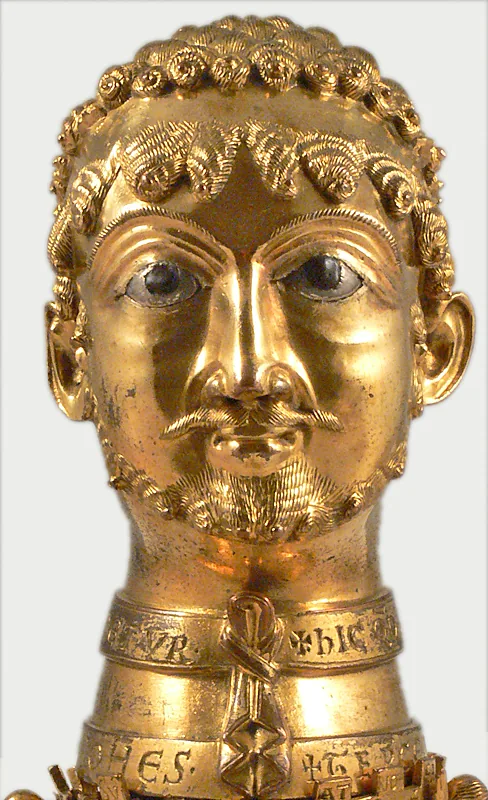
Head of Frederick I, ‘Barbarossa’, gilded bronze, c. 1160. Photo: Montecappio · Public domain · Source page
The emperor with the red beard
Legnano, 29 May 1176
Northern Italy, late May 1176. An emperor in his fifties rides at the head of heavy cavalry that has come from Germany. In front of him stand cities that refuse to bow, and several of them are prosperous.
Italians called him Barbarossa, “red beard”. You will see how that beard became a legend, and how the legend hides what really happened.
Frederick I, Barbarossa
A German emperor of the Hohenstaufen dynasty who tried to recover the rights of the empire over the rich cities of northern Italy, and failed in a way that made him a legend.
- Born: c. 1122, Probably Haguenau, in Alsace
- Died: 10 June 1190, The river Saleph (today Göksu), Cilicia, He drowned in the river on the way to Jerusalem. The accounts of exactly how it happened differ, and they are not all of one kind.
- Won: Settling the feud with the Welf family by giving Bavaria to Henry the Lion, 1154–1156; The fall of Milan, 1162
- Lost: Legnano, 1176
“the regalia and other rights within and without the cities, as you have been accustomed to hold them”
Background
Two families and an old feud
Frederick was born around 1122 into the Hohenstaufen family, which held Swabia and much land in southern Germany. The family were loyal to the imperial line and hoped one day to wear the crown themselves. Their rivals were the Welf family, lords of the great duchies of Saxony and Bavaria.
The two houses fought for decades. Their names survive as party labels in Italian and German: Ghibellines and Guelphs. The first comes from Waiblingen, a Hohenstaufen estate, the second from the name Welf. Over the centuries the labels changed their meaning, so remember the families, not the words.
The crown
King at Frankfurt, emperor in Rome
1155
On 4 March 1152 the German princes chose Frederick as king at Frankfurt. He became “King of the Romans”, a title that marked him as the heir to the empire. The imperial crown had to come from the pope in Rome, so he went south. He was crowned king of Italy at Pavia in April 1155 (some historians place the ceremony at Monza instead).
On 18 June 1155 Pope Adrian IV crowned him emperor in St Peter’s, Rome. The pope wanted help against the Roman commune and the Normans of Sicily, so the crown came with a price. This was the height of Frederick’s public honour, and within two years the pope and the emperor were quarrelling.
One word
A “holy empire”
1157
In 1157 the phrase “sacrum imperium”, holy empire, appears in a document from the emperor’s chancery, the office that wrote his letters and charters. It was new language, and it gave the emperor’s rule a sacred dignity.
The full name “Holy Roman Empire” comes much later: its form is usually dated from 1254, and it became standard only after that. Historians still argue over who coined the earlier phrase. In Frederick’s time that name was not in standard use, so it is a later summary, not his title.
Roncaglia and Milan
Roncaglia, November 1158
Four lawyers from Bologna
In November 1158 Frederick held a diet on the plain of Roncaglia, near Piacenza in northern Italy. He summoned representatives of the Lombard cities, and four jurists from the University of Bologna, a city where Roman law had been taught as a serious discipline since about 1088.
The question sounded simple: which rights over the cities belonged to the emperor? Those rights were called regalia, royal rights: tolls, taxes, justice, roads and rivers. In the rich cities of the north many of these rights were held by the cities themselves, or by whoever had grabbed them. The emperor said they were his.
Source: The list of royal rights, Roncaglia 1158
public roads, navigable rivers and those which unite to form navigable rivers, harbors, and the banks of rivers
This is a legal list, written to decide who collects what. It is not a story, a personal letter or an eyewitness report. The list goes on to name other royal dues, such as those on mines, fisheries and salt-works.
- Who wrote this list, and for whom? Four jurists working for the emperor. It was meant for judges and tax collectors, not for an ordinary reader.
- What is missing? The cities themselves. The list describes the king’s claim, not what the cities had built for themselves over decades without any written charter.
- Why would roads and rivers matter to an emperor? Because tolls and taxes came from them. Whoever controls a road, a river or a harbour collects money from every merchant who passes. These rights were the wealth of northern Italy.
What followed
The cities say no
At Roncaglia the rights were awarded to the emperor, and the cities did not accept the ruling. Enforcing it meant war. Milan, one of the richest cities of the north, went on resisting.
The emperor besieged Milan for months. In the end the city gave in, in March 1162. The war was won, but the question of what to do with the city remained open.
March 1162
The city that surrendered
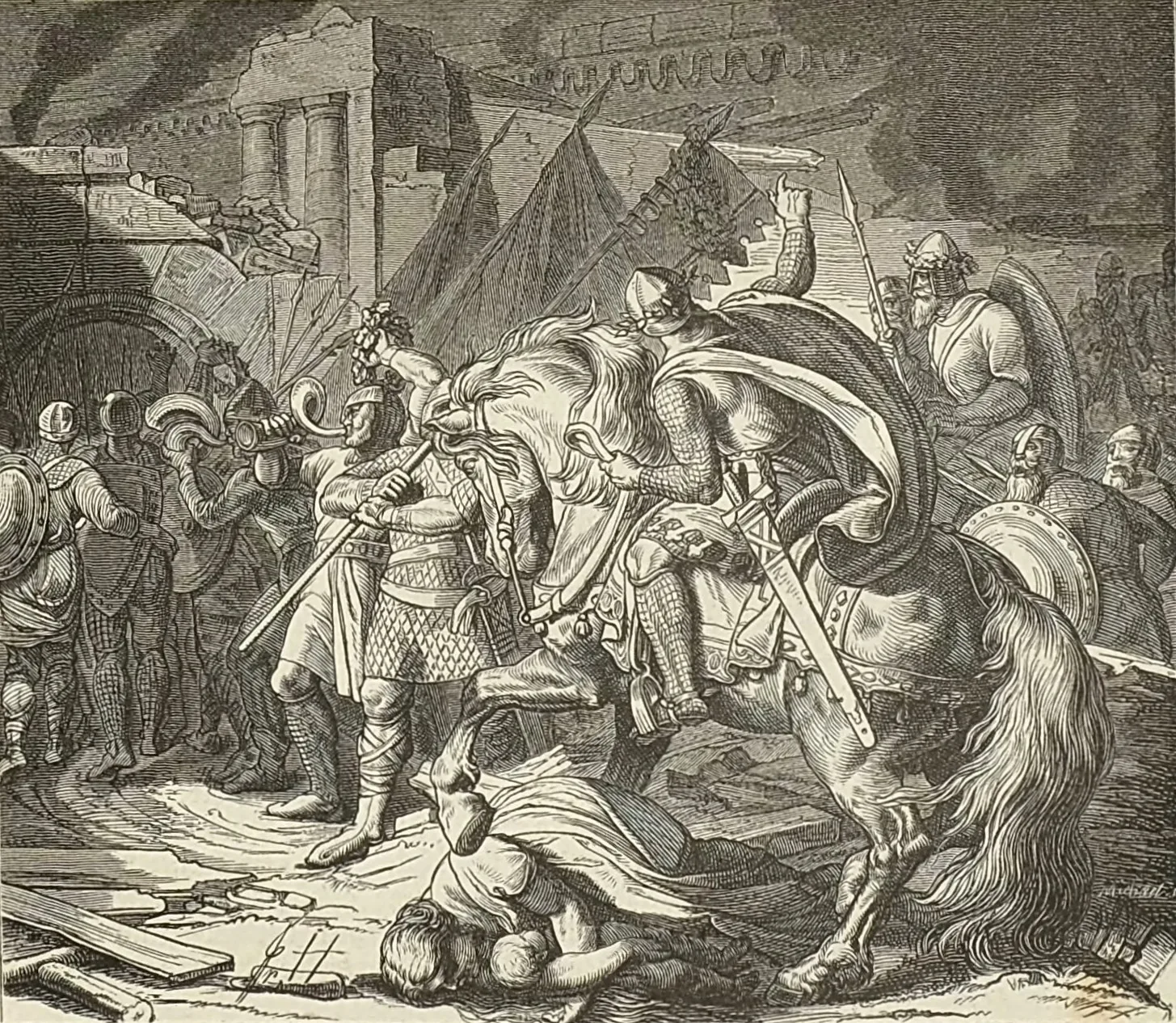
Friedrich Hottenroth, Barbarossa at Milan (1162), about 1875 · Public domain · Source page
1162
About three weeks after the surrender, on the emperor’s orders, much of the city was pulled down. Walls and towers came down, and its people were dispersed. The city itself was nearly erased.
To the emperor, Milan had broken its oath, so it was a rebel. To the other cities the message was plain: even the greatest city of the north could not stand against him. The message did not bring peace.
A decision point
You are Frederick Barbarossa.
March 1162, before the walls of Milan, which has surrendered
Milan has surrendered. Its consuls have sworn to you, the walls are in your hands, and the wealth of its markets could fill your treasury, which has been running low since the long campaign.
Your army is tired, and the cities of Lombardy are watching you. German princes have spoken to you about the outcome, and some want a hard lesson. Others warn that a rich city will remember every humiliation.
What do you do with the city?
- Pull the city down: walls, towers and houses, and move its people to villages around it. Probably fear and quiet for a time. But the cities will learn that submission brings no mercy, and a city that fears you may rebel the moment you turn your back.
- Accept the oath, impose a heavy fine, and send imperial officials to run the city’s taxes. Probably money and order for a few years. But a city that paid its fine and kept its walls and its memories may wait for the next chance.
- Make a treaty: the cities accept your lordship, and you recognise the rights they already hold. Probably a settlement close to what was finally agreed at Constance in 1183, twenty years later. Fewer soldiers and less money, but the cities may stay loyal for a while.
What really happened
Pull the city down: walls, towers and houses, and move its people to villages around it.
The emperor ordered much of the city pulled down, and its people moved out. The sources that describe it, above all the Deeds of Frederick by Otto of Freising and continued by Rahewin, were written at the emperor’s own request, so their account has to be read with that in mind.
Frederick believed Milan had broken its oath, and that the other cities would not respect a settlement unless they saw what happened to a rebel. Historians disagree about his motives. The result was the opposite of what he wanted: the cities drew closer together, and by 1167 they had formed the Lombard League.
The League and the pope
April 1167
An oath at Pontida
1167
The Lombard cities learned from the past. After Milan, they knew that the emperor would not spare any city that stood alone. In 1167 they agreed to join in an alliance called the Lombard League. According to tradition the oath was sworn at Pontida, near Bergamo, on 7 April 1167.
The League was not a state. Each city kept its own councils, its own quarrels and neighbours it did not trust. Among its members were Verona, Padua, Bologna, Piacenza, Brescia, Bergamo, and of course Milan itself.
The Church
A pope in exile, and rival popes
The fight with the cities had a second front: who was pope? In 1159 Roland Bandinelli was elected pope and took the name Alexander III, but part of the cardinals chose a rival, Victor IV. The emperor backed Victor and his successors, who are called antipopes.
The two sides fought over the Church for years. Alexander spent long periods in exile, the first from 1162 to 1165 and again from 1167, and returned to Rome only in 1178. Frederick refused to recognise him. The split in the Church is called the schism, and the League took Alexander’s side.
A decision point
You are a consul of a Lombard city, in 1167.
Spring 1167, in a city within earshot of Milan’s bells
Milan was pulled down five years ago. The emperor’s officers come and go through your city and collect the tolls exactly as they want. Some neighbouring towns have already made their peace with the emperor, and they seem to be doing well.
Messengers have come from Verona and Piacenza with a shared oath: stand together against the emperor and support Alexander. It will cost money, men and perhaps war. If you stand alone, the emperor will return to you whenever he chooses.
Will you swear with the other cities?
- Swear the oath, send men and money, and join the alliance. Probably war with the emperor, heavy costs, and an alliance full of rivalries. The League may fall apart at the first quarrel over taxes or leadership.
- Stay out and make your own deal with the emperor. Probably protection of your tolls for a time. But when the emperor wins somewhere else, he will come back to you alone, with no one to share the cost.
- Wait and see, and join only when a neighbour does. Probably the worst of both: you join late on worse terms, or you are attacked alone if your neighbour decides otherwise.
What really happened
Swear the oath, send men and money, and join the alliance.
The cities met at Pontida and swore, on 7 April 1167 according to tradition. The alliance grew over the following years. Each city made its own choice, one at a time.
After Milan, many cities understood that the emperor could defeat any one of them alone. The pope needed allies, and the cities had money and men. Their rivalries were real, so the choice was hard. The details of the oath are known mainly from later tradition, so the date is not fully proven.
1168
A city named for the pope
The League did more than fight. It also built. In 1168 a new fortified town was founded in Piedmont and later named Alessandria after Pope Alexander III. The name was a political message: this town belonged to the pope and to the alliance. Later it became a stronghold against the emperor.
Chiavenna and Legnano
Early 1176
The cousin who did not come
Frederick needed more men. In early 1176 he met his cousin, the Welf duke Henry the Lion of Saxony and Bavaria, at Chiavenna, a small town near Lake Como, according to the usual account. He asked for an army to bring to Italy. Henry refused to send it.
The reasons are not clear. Some sources point to a quarrel over the city of Goslar. Other explanations have been offered. A story that Frederick knelt before his cousin is disputed, and the sources do not agree on that either.
A decision point
You are Frederick Barbarossa, in May 1176.
May 1176, north-west of Milan
Your cousin Henry has not come. The cities that once gave you oaths are now preparing for battle. You have brought heavy horsemen with you, and reinforcements from Germany have reached you on the road. The full army you counted on has not arrived.
The League is taking itself seriously. Scouts report large numbers of foot soldiers in Milan and a city army moving out to meet you. You know this will be a fight between your horse and their infantry, and infantry is your weakness. Pavia, which has stayed loyal, invites you to come and wait there.
What do you do?
- Fall back to Pavia and wait for more men to arrive. Probably more men will come, but the League will gather its own strength too. The longer you wait, the more closely the cities will unite, as they did in 1167.
- Advance now with the horsemen you have, and attack before the infantry is organised. Probably a strong charge that breaks the League’s horse. But if the foot soldiers hold, your horsemen may be trapped among them, and the whole army could collapse.
- Withdraw over the Alps to Germany and try again the following year. Probably the cities keep their rights in practice, and their loyalty to the emperor fades. The pope stays safe, and your authority in Italy is lost for a long time.
- Offer the cities talks, and avoid battle. Probably long talks, in which the cities demand that everything settled at Roncaglia is given up. You may win a truce, but not authority.
What really happened
Advance now with the horsemen you have, and attack before the infantry is organised.
The emperor marched on toward Pavia, and near Legnano met the League’s army, which had come out from Milan to intercept him. He fought. His horsemen won the first charge, but the Milanese foot around the carroccio held, and by the end the field was full of scattered men.
Frederick did not want to wait while the cities united, and he believed his heavy horse would decide the battle. Historians still argue whether waiting in Pavia was a realistic option.
Legnano: who fought whom
29 May 1176
Legnano, between Milan and Como
The imperial army
- Commanders: Frederick Barbarossa, Philip of Cologne
- Strength: About 3,000 heavy cavalry, almost no infantry (Modern estimate (Grillo; Freed 2016))
- Losses: Heavy losses; no reliable total survives (Modern estimate (Grillo; Freed 2016))
On the modern estimates about 2,000 newly arrived horsemen joined about 1,000 men already in Italy. These are estimates, not totals from the period.
The Lombard League
- Commanders: No overall commander is named in the contemporary sources. Guido da Landriano is a plausible candidate only
- Strength: 12,000–15,000: about 2,000–3,000 horse and 10,000–12,000 foot (Modern estimate (Grillo))
- Losses: A few hundred killed or wounded (Modern estimate (Grillo))
Outcome: A victory for the League. The imperial army broke up, and the emperor himself vanished from view for a time and was believed dead, but he survived.
The sources differ widely, and the modern numbers rest on reconstruction. Many early writers were far from the battlefield or reported second-hand, so every figure here stays disputed.
The battle of Legnano
29 May 1176, one day of fighting
On 29 May 1176 the Emperor Frederick Barbarossa comes down from the north toward Pavia with heavy horse and almost no foot, and his cousin Henry has not sent the army he asked for. The Lombard League has marched out of Milan to meet him, and its foot, with the carroccio, stands near Legnano. Neither army knows exactly where the other is.
A schematic reconstruction after Grillo and Freed (2016). The exact site is not known, so the map has no scale. Positions and directions are approximate, and the order of attacks is disputed.
Phases of the battle
- The armies close The emperor comes down from the north toward Pavia. The League marches out of Milan to meet him, and the foot with the carroccio stands near Legnano. Neither army knows exactly where the other is.
- The first clash About 700 Lombard horsemen meet an imperial vanguard of about 300 near Borsano. The vanguard pulls back to the emperor, and the pursuing Lombard horse runs into the emperor’s heavy cavalry.
- The imperial charge The emperor’s heavy horse charges and drives most of the Lombard horsemen from the field. But the charge runs on into the Milanese foot around the carroccio, and it stalls there.
- The line holds The foot stands in lines, and repeated attacks do not break it. The League’s horsemen regroup and return from several directions. The imperial standard falls, and the emperor enters the fighting and for a moment is lost from sight.
- The flight The imperial army breaks up. Many are killed, drowned in the river or taken prisoner. The emperor survives and rides off the field.
The strategy
- The emperor: Frederick does not wait for his full army, which has not arrived. He means to attack with the horsemen he has, before the League’s foot is organised. Knowing that infantry is his weakness, he hopes to break the League with a heavy charge.
- The League: The sources do not say what the League intended, and name no overall commander. Its foot stands with the carroccio near Legnano, and its horse rides out to meet the emperor.
What decided it: The Milanese foot held in lines around the carroccio, and the emperor’s heavy charge stalled against it. After the imperial standard fell, the imperial army broke up.
After the battle
The emperor who vanished
29 May
The emperor rode into the fighting, and his horse was killed or disabled. For a time the report was that he was dead. He survived, but his army was left without its commander and without its standard. Many of his men were killed or fled, some drowned in the Ticino, and a large number were captured.
The details survive in several versions. The fullest accounts were written away from the battlefield, so no one can say for certain what happened to him inside the fighting.
The legend
The chronicle written late
In the national memory of Italy Legnano became the battle where the cities defeated the emperor. The heroes of the story are Alberto da Giussano and his ‘Company of Death’, some 900 knights sworn to die. But that story first appears in writings from the fourteenth century, not in the record of the time.
Even without the legend, the victory at Legnano was enough to change the course of the war.
Myth
At Legnano, Milan won because Alberto da Giussano and his Company of Death, knights sworn to die for the city, held the field.
The truth
The story of Alberto and the Company of Death is not in the record of the time. No chronicle written then mentions Alberto or the company. They first appear in Galvano Fiamma, who wrote some 150 years after the battle, and in the nineteenth century they became part of Italian national myth.
The evidence
What the record does show is the carroccio, the wagon with Milan’s standard, around which the city’s foot fought. The fighting around the wagon is attested. The unit of 300 men sworn to the carroccio appears in later sources, so that number too belongs to tradition.
Venice and Constance
After Legnano
An emperor without an army
After Legnano the emperor’s army was scattered, and the cities were in no hurry to take him back. His cousin Henry did not come to help, and the rift between them grew. Frederick tried to repair the defeat by diplomacy, but his quarrel with the pope was far from over.
In 1177 it was agreed that the emperor and the pope would meet at Venice. Envoys settled the details first at Anagni, then came to Venice. The League, the king of Sicily and the Venetians all had a stake in the outcome.
A decision point
You are Frederick Barbarossa, in 1177.
Summer 1177, before the meeting at Venice
Your army is weakened. The Lombard cities still hold their fields, and their alliance has not broken. The pope stands on the other side, backed by the League and by the kingdom of Sicily, your enemy.
You still have an antipope, Callixtus III, but his position has been weakening for years. The German princes are tired of the war and want peace at home. A meeting at Venice would require you to admit that you were wrong.
What do you do?
- Recognise Alexander III as pope, lift the ban, give up your antipope, and agree a truce with the cities. Probably an end to the schism and a long truce with the cities. The price is a public admission of error.
- Keep your antipope and hope that the princes and cities split later. Probably the schism continues, the German bishops divide, and the war in Italy drags on at heavy cost.
- Make a separate peace with the cities and leave the pope out of it. Probably the cities gain what they want, but the pope’s standing suffers, and you stay in a bitter quarrel with the Church.
What really happened
Recognise Alexander III as pope, lift the ban, give up your antipope, and agree a truce with the cities.
At Venice, in July 1177, the emperor recognised Alexander as pope, and the cardinals lifted the ban. He gave up his antipope, Callixtus III. The cities received a six-year truce, and the king of Sicily a peace.
Frederick needed peace to rebuild his power in Germany. The princes were tired, and the schism had lasted about eighteen years. Historians still debate whether he was forced into this, or chose peace to turn his strength elsewhere.
Venice, 1177
The entry into Venice
1177
The doge of Venice escorted the emperor into the city, with the patriarch of Aquileia beside him. There were ceremonies and meetings, and the settlement was announced publicly. The emperor recognised Alexander, and the cardinals lifted the ban.
But the public account of the settlement rests on different sources, and they do not describe the moment in the same way. Some speak of a kiss, others of a prostration.
Myth
At Venice the pope set his foot on the emperor’s neck and so humiliated him before the world.
The truth
The story of the foot and the neck is not in the earliest sources. It is usually treated as a later legend. Some accounts speak of a prostration, others of a kiss of peace.
The evidence
The eyewitness usually cited is Romuald II, archbishop of Salerno, who was present and wrote an account of the scene. The foot story does not appear in the direct reports of the ceremony that we know of. Historians therefore treat it as a later legend.
A long fall
Henry the Lion falls
1180
Henry the Lion’s fall belongs to the story of Legnano. He had not come to his cousin’s aid, and the emperor did not forget it. In 1180 a court of princes and bishops tried Henry in his absence, and he lost the duchies of Saxony and Bavaria.
He submitted only in 1181, at an imperial diet at Erfurt. Afterwards he went into exile for about three years, at the court of his father-in-law, Henry II of England. The emperor had beaten his cousin, but may have lost a strong ally in the north.
1183
The peace of Constance
25 June
On 25 June 1183 the emperor, with his son Henry VI, issued a privilege: an imperial grant, not a treaty between equals. The cities were not equals, since formally the emperor could not sign a treaty with his own subjects. He recognised the League and the rights the cities had long held. In return they swore an oath of fealty and paid a yearly sum.
The conflict in northern Italy was closed this way for a long time. What the emperor had claimed at Roncaglia became a bargain: he kept his sovereignty, and the cities kept much of their own lives.
Source: The Peace of Constance, clause 1
the regalia and other rights within and without the cities, as you have been accustomed to hold them
This document closed the conflict. It is written as a grant from a ruler to his subjects, and it recognises rights ‘as you have been accustomed to hold them’: custom, not the legal claim of Roncaglia.
- Which phrase marks the difference from Roncaglia? ‘As you have been accustomed to hold them’. What Roncaglia had declared the emperor’s right is here recognised as what the cities already held in practice.
- Why is the document a grant and not a treaty? Because formally the emperor could not sign a treaty with his own subjects. The content is a compromise, but the form keeps his sovereignty.
- What is missing from the document? It does not say what happens in a future dispute, or exactly which cities are covered. Historians argue over how to read it, which is one reason the matter was never fully closed.
Mainz, the cross and the Saleph
Mainz, Pentecost
The festival of knights on the island
1184
At Pentecost 1184 Frederick held a great festival on an island in the Main near Mainz. His two sons, Henry and Frederick, were knighted by him. Many knights and guests took part. Accounts give very large numbers of participants, which are hard to check.
After Venice, the festival was a show of power and a message to the princes: the emperor was back, and the Hohenstaufen had a future. Mainz is remembered as the moment the emperor was seen in full glory.
Source: Frederick and his sons, from the Chronicle of the Welfs
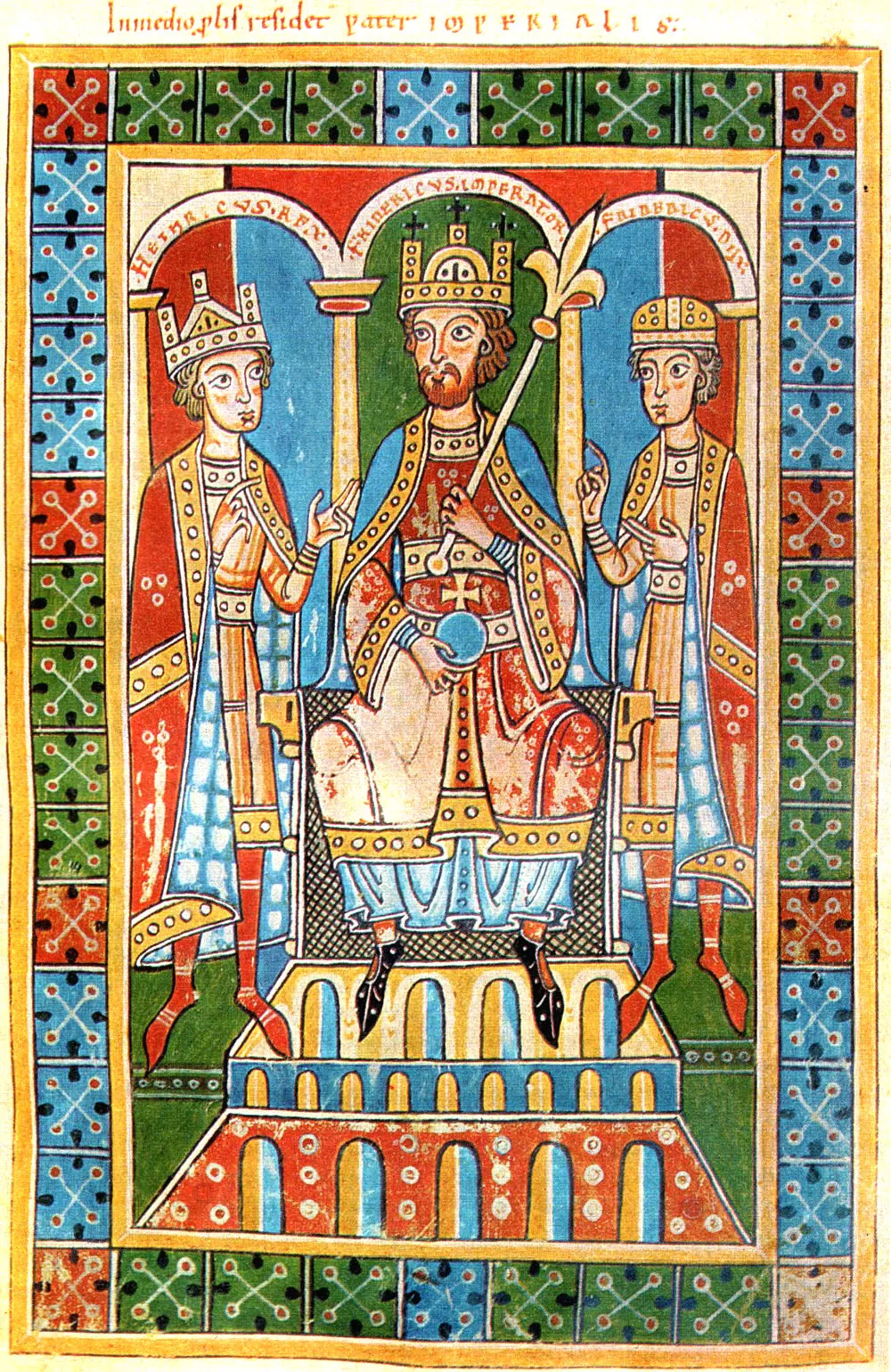
Frederick I and his sons King Henry VI and Duke Frederick of Swabia. From the Chronicle of the Welfs (Historia Welforum), Weingarten Abbey, 1179–1191 · Public domain · Source page
Miniature from the Chronicle of the Welfs (Historia Welforum), Weingarten Abbey, 1179–1191
The chronicle was written for the Welf family, probably at the request of Welf VI, and its copies were made at Weingarten Abbey. Henry the Lion’s family had lost heavily in those years. The picture shows Frederick with his sons, Henry VI and Frederick of Swabia.
- Who commissioned the book, and for whom? The Welf family, or those speaking for it at their abbey. The book tells the history of their own house, and it does not need to present the emperor as an enemy.
- What does the picture want you to believe? That the emperor’s dynasty is secure and that the sons carry on their father’s line. He is shown as a father of kings, not as a rebel or an outlaw.
- What does the picture leave out? Legnano, Venice and the way Henry the Lion fell. The book is a history of their own house, yet the picture says nothing of these events.
1186
A bride from Sicily
1186
In 1186 Henry VI married Constance, heiress of the Norman kingdom of Sicily. The marriage tied the Hohenstaufen to southern Italy and turned Sicily into part of the dynasty’s ambitions. It was arranged against the wishes of Pope Urban III.
The marriage had a long echo: the son born to the couple in 1194 was Frederick II, who would fight the popes himself.
1187–1188
Jerusalem falls
In the summer of 1187 Saladin destroyed the army of the kingdom of Jerusalem at the Horns of Hattin, and that autumn Jerusalem surrendered to him. The loss echoed across Europe, and the pope called kings and princes to a new crusade.
For German princes this was a test of both Christian honour and the emperor’s authority. Frederick, by then an old man, was asked to lead them.
A decision point
You are Frederick Barbarossa, in 1188.
March 1188, at Mainz
You are in your sixties. Jerusalem is in Saladin’s hands, and pressure to march is growing across Europe. The princes are waiting to see what you will do.
The eastern road is long. It runs through Hungary and Byzantine lands, whose rulers do not trust you. Such a march costs a great deal of money, and it would leave Germany without its king for years. Your son Henry would stay behind.
Will you take the cross and lead the army yourself?
- Take the cross and lead the army yourself, by land. Probably the largest army of the crusade, but at the cost of years without government in Germany and a grave risk to your life.
- Take the cross and send your army under one of your sons. Probably a less experienced command and a weaker campaign. But you keep your hold on government, and the princes see that you have not given up leadership.
- Send money and ships, and stay in Germany. Probably a cheaper and slower campaign with fewer knights. The money may help, but without your army you have no say over the other kings.
What really happened
Take the cross and lead the army yourself, by land.
Frederick took the cross at Mainz on 27 March 1188, and left Regensburg on 11 May 1189, sailing down the Danube toward Hungary and Byzantine lands.
Frederick was old, and wanted to keep his honour and his soul. The Church pressed him, and the fall of Jerusalem wounded the prestige of the emperor. Historians debate whether this was genuine piety or political calculation: a victorious crusade could bring honour and allies. Both may be true.
East
The road to Asia Minor
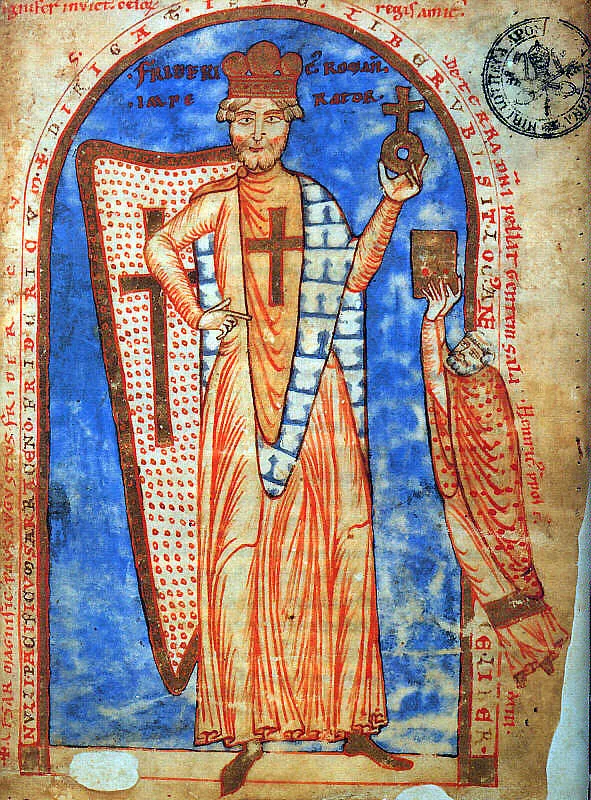
Frederick I as a crusader, dedicatory image. Manuscript Vat. Lat. 2001, about 1188 · Public domain · Source page
18 May 1190
The army passed through Hungary and the Balkans, and entered Byzantine lands. Relations with the Byzantine emperor were poor throughout. Then it crossed into Asia Minor, where the Seljuk sultanate of Rum opposed it.
On 7 May the crusaders won a battle at Philomelion. On 18 May they took Iconium, the Seljuk capital, which is today Konya. The city fell with little resistance, and the crusaders looted it.
10 June 1190
The river in Cilicia
On 10 June 1190, as the army crossed the Saleph, today the Göksu, near Silifke, Frederick drowned. Accounts differ on how it happened: some say the horse slipped in the current, others that he was bathing.
After his death the army broke up, and many went home. His son Frederick of Swabia led the rest on towards the Holy Land. His body was buried in parts: flesh at Antioch, bones at Tyre, heart and organs at Tarsus.
Source: A memorial by the river
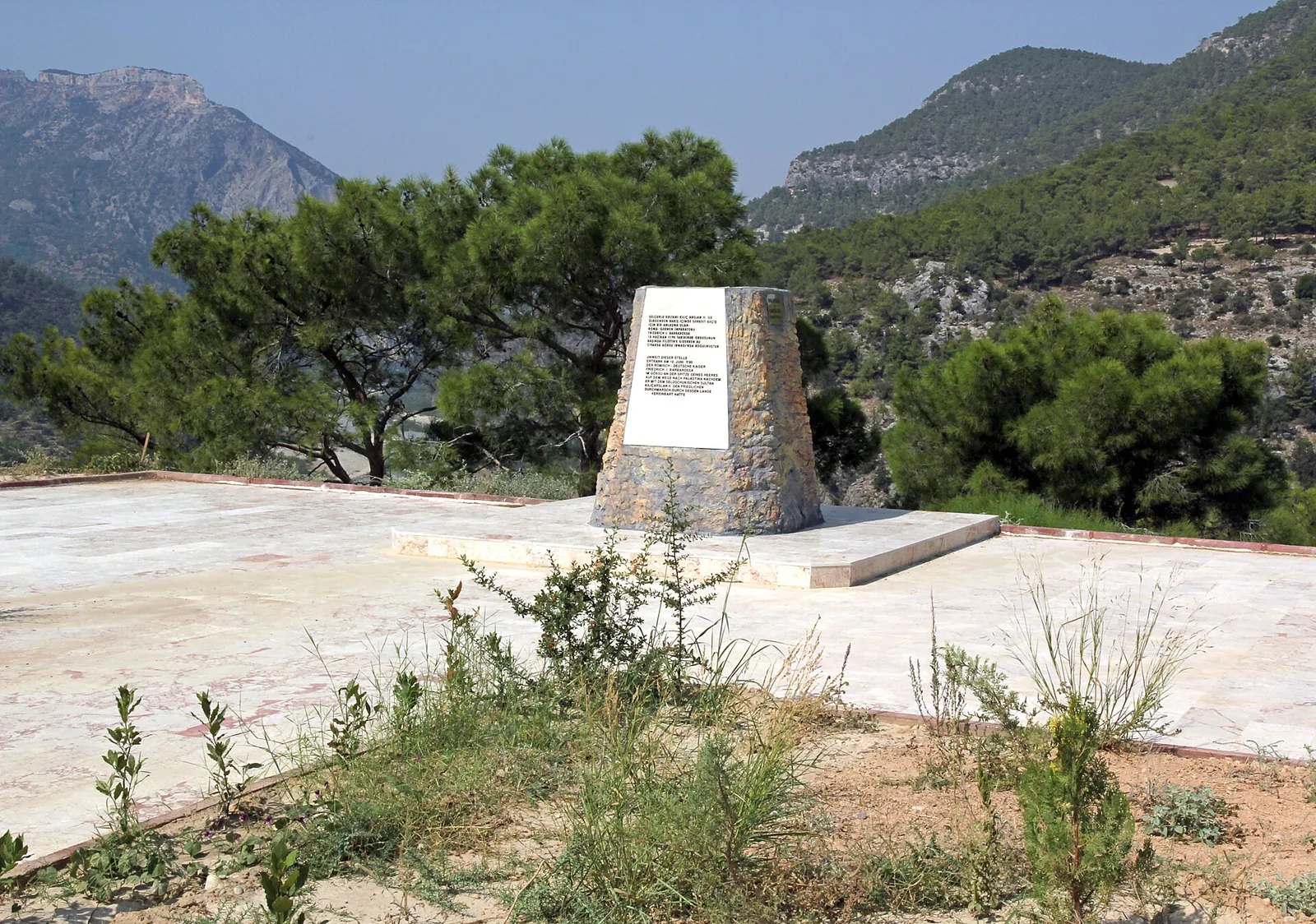
The Barbarossa memorial on the Göksu (Saleph), photograph of 2012 by Ingeborg Simon · CC BY-SA 3.0 · Source page
Memorial to Emperor Frederick Barbarossa on the Saleph (today Göksu) near Silifke, photographed in 2012
This is a modern memorial. Its inscription says he drowned in the river near this spot, but it does not describe how it happened. The place is remembered through names and legends.
- What survives of the moment itself? Almost nothing. The accounts are written later, and it is the river that remains. Anyone who wants to know what happened must ask the writers, not the stone.
- Who put up the memorial, and why? The memorial is meant to remember the emperor and the place. Every memorial has a purpose, and here it is to make the story part of the landscape.
Afterwards: the timeline, the legend and the argument
What the struggle left behind
- 1158 Roncaglia: the royal rights are awarded to the emperor, and the cities reject the ruling.
- 1162 Milan surrenders in March, and is then partly destroyed.
- 1167 The Lombard League is formed. The following year Alessandria is founded, and later named for the pope.
- 1176 Legnano: the emperor is defeated in the field, and survives.
- 1177 Venice: the emperor recognises Alexander III as pope, and the cities receive a six-year truce.
- 1180 A court of princes and bishops strips Henry the Lion of his duchies and declares him an outlaw.
- 1183 The Peace of Constance: the cities keep their rights, and swear fealty to the emperor.
- 1190 Iconium is taken on 18 May. Frederick drowns on 10 June. The army breaks up.
- 1197 After the death of Henry VI, the cities stop meeting their obligations, according to the sources. The conflict flares again in the time of his grandson Frederick II, in 1226–1250.
Myth
The emperor Barbarossa sleeps in the Kyffhäuser mountain, waiting to return and save Germany.
The truth
The legend first concerned Frederick II, Barbarossa’s grandson, who was believed not to be dead after 1250. Only later, in the late Middle Ages or early modern period, was it attached to Barbarossa, and sources differ on when. In the nineteenth century, in the age of German nationalism, the poet Friedrich Rückert published a poem in 1817, and the Brothers Grimm added the story to their collection. The emperor became a national emblem.
The evidence
Sources give different dates for the move from one emperor to the other. What is clear is that the nineteenth century did not invent the story but chose it. The legend rests on uncertainty about how Frederick died on the road to Jerusalem.
Was Italy a trap or a strategy?
Was Frederick’s Italian policy a failure that drained Germany, or a realistic attempt to rebuild imperial power?
- Heinrich von Sybel, 1859 He argued that the Italian campaigns diverted princes and money from Germany itself, and called the medieval empire’s politics unnational. The debate was tied to the rivalry between Prussia and Austria.
- Julius Ficker, 1861 He answered in lectures at Innsbruck that the emperors’ policy was both national and universal.
The question that remains: what counted as success for a medieval emperor? Money, peace, honour or the crown?
Test yourselves
Check yourself
What did the four jurists decide at Roncaglia?
Answer: That the royal rights, including roads, rivers and harbours, belong to the emperor under Roman law.. Right. The list names roads, rivers and harbours, and the tolls on them went to the emperor.
Check yourself
Which statement about Alberto da Giussano and the Company of Death is correct?
Answer: They first appear in Galvano Fiamma, about 150 years after the battle, and leave no trace in the record of the time.. Right. That is why the story is doubted, and why it became national only in the nineteenth century.
Check yourself
Why was the Peace of Constance written as a privilege, a grant, and not as a treaty?
Answer: Because the emperor could not, formally, sign a treaty with his own subjects.. Right. The form protected his sovereignty, even though the content was a compromise.
Check yourself
What is true of the story that the pope set his foot on the emperor’s neck at Venice?
Answer: It appears in later sources, and not in the earlier accounts.. Right. Historians therefore treat it as a later legend.
Check yourself
Which statement about the names of the empire is correct?
Answer: The phrase ‘sacrum imperium’ appears in 1157, and the name ‘Holy Roman Empire’ is usually dated from 1254.. Right. That is the gap between the early phrase and the later summary name.
Check yourself
What happened to Frederick’s army after his death in the Saleph?
Answer: Many went home, and the rest continued under his son Frederick of Swabia.. Right. The army broke up, and his son Frederick of Swabia led what was left.
Terms
- regalia Rights held to belong to the ruler alone: tolls, taxes, justice, roads and harbours. In many cities of northern Italy they were in the hands of the cities, or of whoever held them in practice.
- Hohenstaufen The dukes of Swabia who gave the empire Frederick I and Frederick II in the twelfth and thirteenth centuries.
- Welf A family of dukes of Saxony and Bavaria, rivals of the Hohenstaufen. Henry the Lion was one of them.
- diet An assembly of princes, bishops and envoys of cities, called by the emperor to judge, decide and display authority.
- chancery The office that wrote the emperor’s letters, charters and decrees.
- Lombard League An alliance of northern Italian cities, formed in 1167 against the emperor and on the side of the pope.
- carroccio An ox-drawn wagon with a mast and the city’s standard. It went to battle as the symbol of the city, and defending it was a great honour.
- antipope A rival pope, chosen by one faction against the pope that most of the Church recognised.
- schism A split in the Church, when two rival claimants to the papacy each have their supporters.
- Henry the Lion Duke of Saxony and Bavaria, and the emperor's cousin. He refused to send him an army for Italy, and in the end both duchies were taken from him.
- Alberto da Giussano A legendary hero of the battle of Legnano. The story about him appears only in later sources, not in the record of the time.
- Company of Death A company of knights sworn to die, according to the legend of Legnano. It is not in the record of the time.
- Ghibellines A party label in the wars of Italy and Germany. It comes from a Hohenstaufen estate.
- Guelphs A party label in the wars of Italy and Germany. It comes from the name of the Welf family, rivals of the Hohenstaufen.
- Pavia A city in northern Italy where Frederick was crowned king of Italy. It stayed loyal to him.
- Piacenza A city in northern Italy, near the plain of Roncaglia. It was one of the cities of the Lombard League.
- Roncaglia A plain in northern Italy near Piacenza. There the rights over the cities were awarded to the emperor.
- Bologna A city in Italy whose university taught Roman law in a new and serious way.
- Lombardy The region of northern Italy where the Lombard cities lay, among them Milan.
- Roman commune A self-governing city council in Rome. The pope wanted help against it.
- Cardinal A senior churchman who elects the pope.
- Alexander III A pope whom the Lombard League backed. Frederick refused to recognise him.
- Victor IV An antipope chosen by some cardinals and backed by the emperor.
- Callixtus III An antipope backed by the emperor, whom he gave up at Venice.
- Normans A people who conquered southern Italy and Sicily. Their kingdom on Sicily was the emperor's enemy.
- Constance Heiress of the Norman kingdom of Sicily. She married Henry VI, which tied the Hohenstaufen to southern Italy.
- Henry VI Son of Frederick Barbarossa. He married Constance in 1186, and their son was Frederick II.
- Frederick II Barbarossa's grandson, born in 1194 to Henry VI and Constance. He fought the popes.
- Saladin A Muslim leader who destroyed the army of the kingdom of Jerusalem at the Horns of Hattin, and took Jerusalem.
- Horns of Hattin The place where Saladin destroyed the army of the kingdom of Jerusalem.
- Seljuks A Muslim dynasty that ruled the sultanate of Rum in Asia Minor. It fought Frederick's army on his march.
- Byzantine Of the Byzantine Empire, the Eastern Roman Empire. Its rulers did not trust Frederick.
- Pentecost A Christian festival held after Easter. At Pentecost 1184 Frederick held a great festival near Mainz.
- Deeds of Frederick A book about the deeds of Emperor Frederick, written by Otto of Freising and continued by Rahewin at the emperor's own request.
Sources
- J. H. Thatcher and E. McNeal, A Source Book for Medieval History (New York: Scribner, 1905), nos. 103 and 109 (pp. 188 and 199): the Roncaglia decrees and the Peace of Constance (text on the Internet Medieval Sourcebook)
- Otto of Freising and Rahewin, Gesta Friderici I. imperatoris, ed. G. Waitz and B. von Simson, MGH SS rer. Germ. 46 (Hanover, 1912)
- Ansbert, Historia de expeditione Friderici imperatoris, trans. Graham A. Loud, in The Crusade of Frederick Barbarossa: The History of the Expedition of the Emperor Frederick and Related Texts (Crusade Texts in Translation 19; Farnham and Burlington: Ashgate, 2010)
- Historia Welforum, Chronicle of the Welfs: text written around 1170; the miniature's manuscript made at Weingarten Abbey, 1179–1191 (Wikimedia Commons file record; the miniature in the lesson)
- John B. Freed, Frederick Barbarossa: The Prince and the Myth (New Haven: Yale University Press, 2016)
- Paolo Grillo, Legnano 1176: Una battaglia per la libertà (Rome–Bari: Laterza)
- Knut Görich, Friedrich Barbarossa: Der erste Stauferkaiser (Munich: C. H. Beck, 2022)
- Peter Munz, Frederick Barbarossa: A Study in Medieval Politics (London: Eyre & Spottiswoode, 1969)
- Peter H. Wilson, The Holy Roman Empire: A Thousand Years of Europe’s History (London: Allen Lane, 2016)
- Vedran Sulovsky, Making the Holy Roman Empire Holy: Frederick Barbarossa, Saint Charlemagne and the Sacrum Imperium (Cambridge: Cambridge University Press, 2024)
Image credits
- Head of Frederick I, ‘Barbarossa’, gilded bronze, c. 1160. Photo: Montecappio · Public domain · Source page
- Friedrich Hottenroth, Barbarossa at Milan (1162), about 1875 · Public domain · Source page
- Frederick I and his sons King Henry VI and Duke Frederick of Swabia. From the Chronicle of the Welfs (Historia Welforum), Weingarten Abbey, 1179–1191 · Public domain · Source page
- Frederick I as a crusader, dedicatory image. Manuscript Vat. Lat. 2001, about 1188 · Public domain · Source page
- The Barbarossa memorial on the Göksu (Saleph), photograph of 2012 by Ingeborg Simon · CC BY-SA 3.0 · Source page


