The Bar Kokhba revolt, 132–136: the star and the failure
Rabbi Akiva saw in him the "star" of the Book of Numbers; others wrote "Bar Koziba", a name some read as "son of the lie". He led the last great Jewish revolt against Rome. What do we really know about him?
Decisions, questions and your own progress, in the app
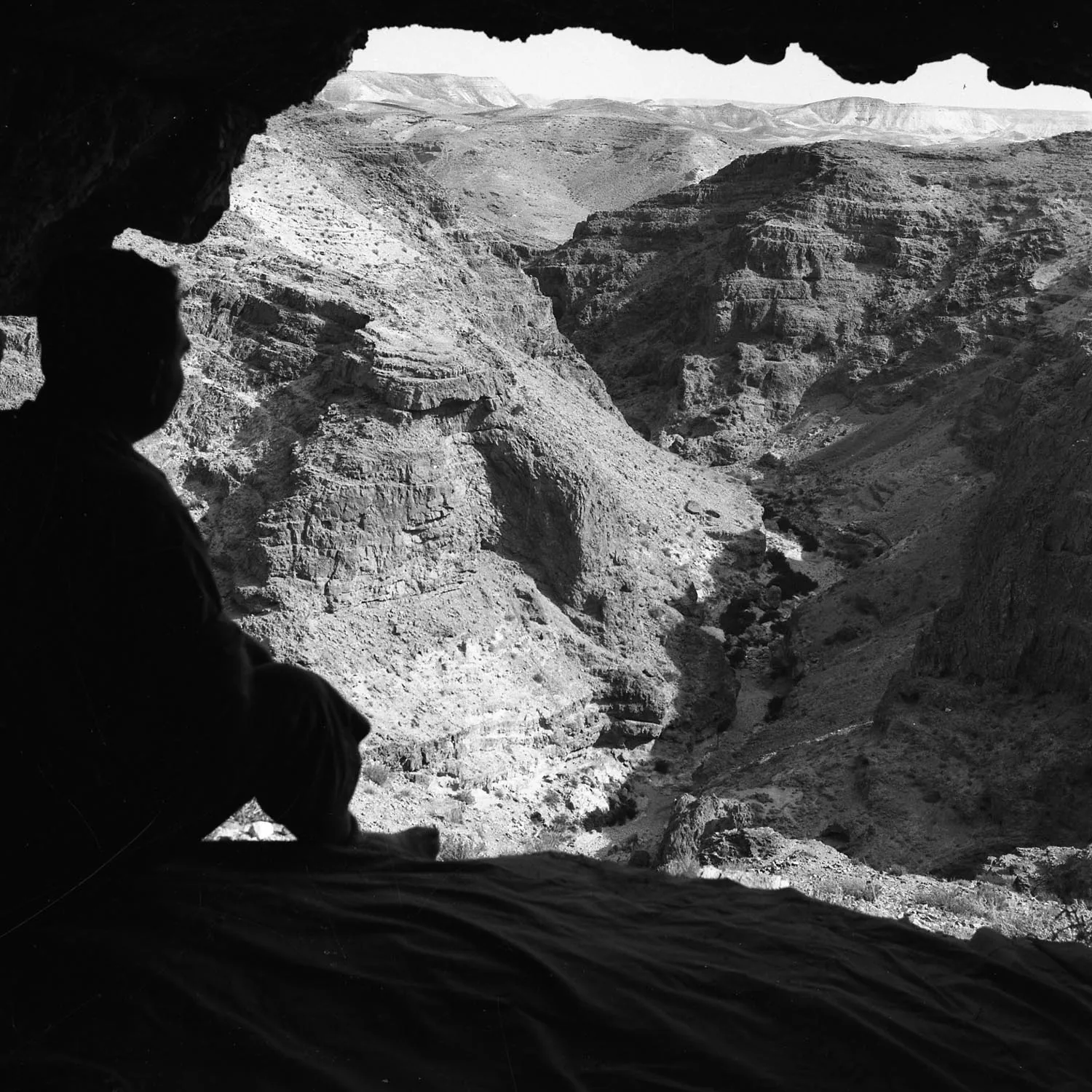
Cave of Letters, Nahal Hever. Photo: Israel Antiquities Authority · רשות העתיקות של ישראל Israel Antiquities Authority · CC BY-SA 4.0 · Source page
A star over the ruins
A star over the ruins
Jerusalem, about 132 CE. The Temple has lain in ruins since the Romans burned it in 70.
Rabbi Akiva, one of the great teachers of his generation, sees in the leader of the revolt the “star” promised in the Book of Numbers, and calls him the messiah. Other texts call the same man Bar Koziba, and some readers have heard in that name “son of the lie”. What do we really know about him?
Background
After the Temple
In 70 Roman legions took Jerusalem and burned the Temple. The city was wrecked, but the Jews did not vanish. At Yavne, a town on the coast, a circle of teachers gathered around Rabban Yohanan ben Zakkai. From that circle grew the rabbinic Judaism that later shaped the Mishnah, and the study houses that kept it alive for centuries.
In 66 a great revolt broke out in Judaea against Rome. The Romans crushed it, and Masada, the last stronghold, fell in 73 or 74 CE. Judaea became a Roman province, ruled by a Roman governor.
Hadrian's city
The emperor
Hadrian on the road
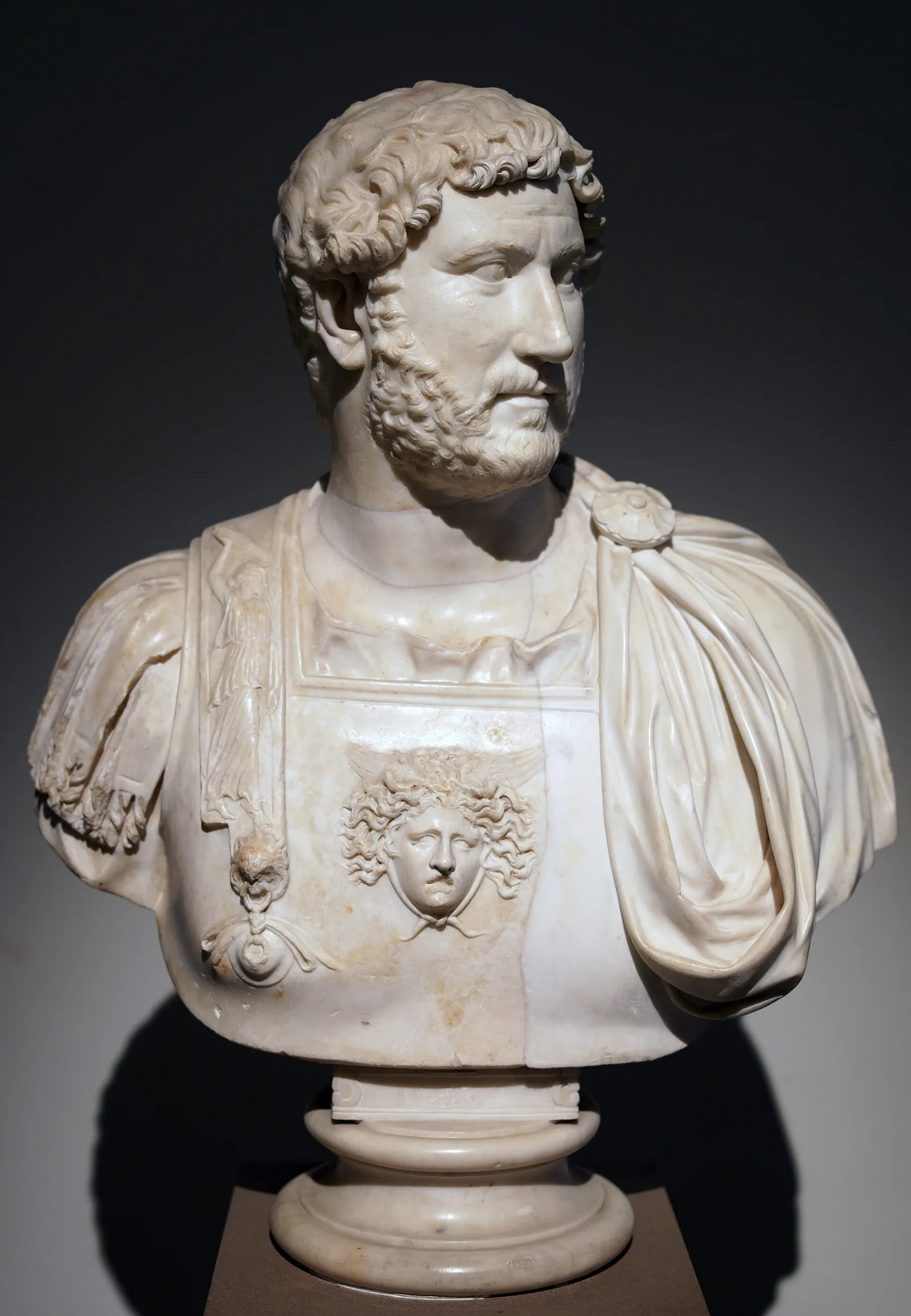
Hadrian, marble bust. National Archaeological Museum, Naples. Photo: Commonists, 2021 · CC BY-SA 4.0 · Source page
Hadrian became emperor in Rome in 117. He loved to travel, and much of his reign was spent in the provinces. He ordered a wall built across northern Britain, and founded new cities in the east and the west.
In 129 and 130 he toured the eastern provinces and visited Judaea. There he faced a question: what to do with Jerusalem, which had lain in ruins for six decades.
A decision point
You are the emperor Hadrian.
Jerusalem, about 130 CE.
Jerusalem has been a ruin since 70. The Temple is gone, and what is left is mostly broken stone. Your advisers propose a new Roman city on the site, with a temple to Jupiter where the old Temple stood, and settlers brought from outside Judaea.
Judaea has many Jews, and some of their teachers speak of a Temple restored. Every step you take in this city will be heard across the land.
What do you do?
- Found a Roman city on the ruins, with a temple to Jupiter. The city would become a visible Roman centre. Jews would probably not accept a foreign temple on the Temple's site in silence, so tension would follow. If anger grew, the result could be a revolt.
- Leave the ruins as they are, with no new city. There would be no new cause for anger. Judaea stays a province with a Roman governor, and its tensions go on. But Rome gives the place no new symbol, and religious life may revive around the ruins.
- Found a Roman city without a temple to a foreign god, so as not to insult the site. This is a reasonable compromise. The name and Roman character would still change the city, but no foreign temple would stand on the Temple's site. Some Jews might object anyway, so tension would remain.
What really happened
Found a Roman city on the ruins, with a temple to Jupiter.
Hadrian founded the city, called Aelia Capitolina, on the ruins of Jerusalem. Dio says he raised a new temple to Jupiter on the site of the old one. The earliest known coin of the city dates to about 130 to 132.
No source records the emperor's own reasons, and historians disagree. Peter Schäfer (2003) sees a pragmatist who would avoid needless provocation. Menahem Mor (2016) argues that Aelia was not an intentional measure against the Jews, and that the charisma of the revolt's leader was the spark. Smallwood (1976) reads the city as a reply to a rising Jewish nationalism.
The next source, Cassius Dio, puts the blame on the city itself.
The new city
A coin of the city
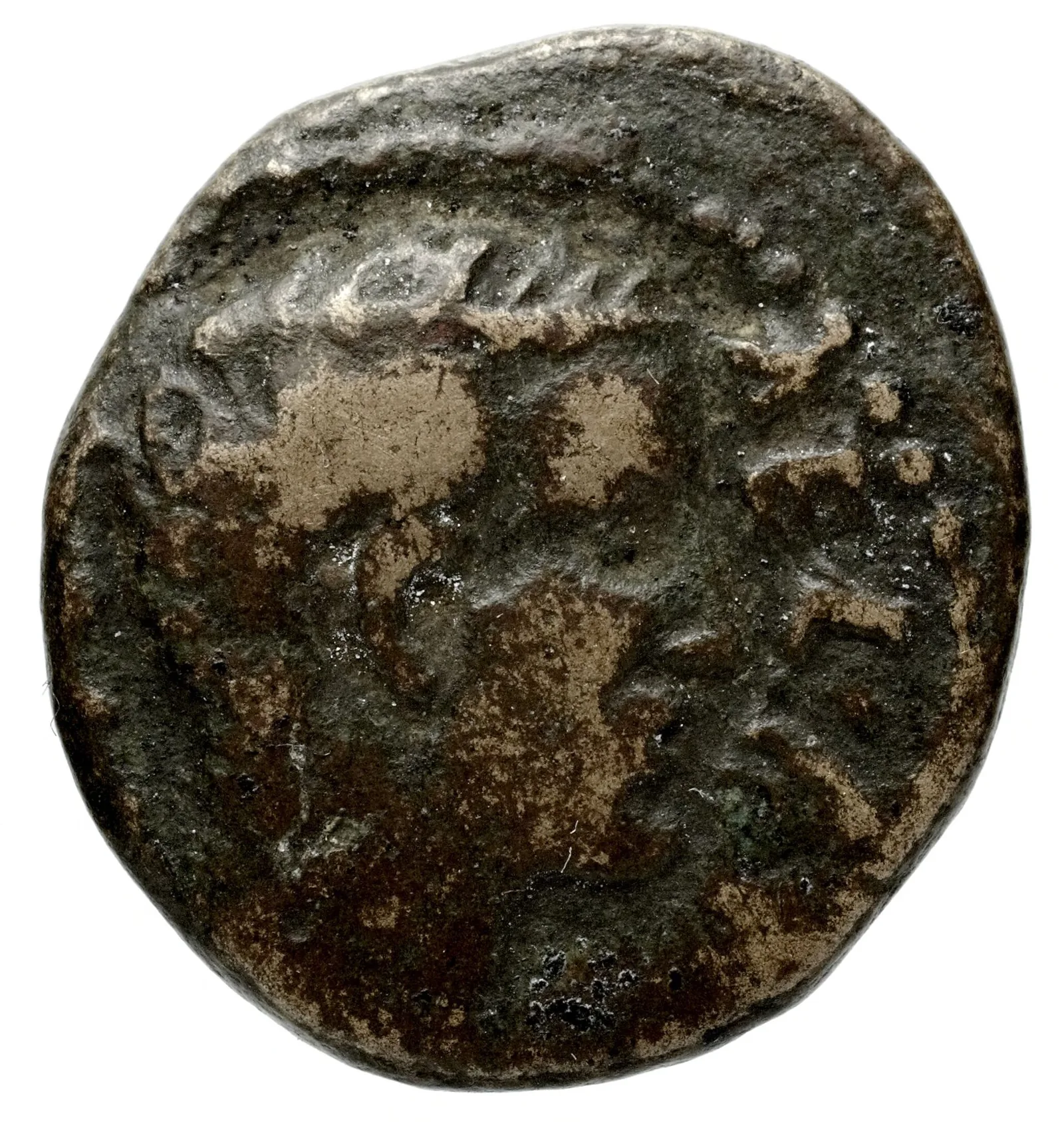
Bronze coin of Jerusalem (Aelia Capitolina). Bibliothèque nationale de France · Public domain · Source page
Aelia Capitolina struck its own bronze coins. The coin in the picture is so worn that its lettering and design cannot be read. Even so, it shows that the city had a name and a mint of its own.
Coins like this one are among the few direct witnesses to the new city's name.
Source: Cassius Dio on the new city
“At Jerusalem he founded a city in place of the one which had been razed to the ground, naming it Aelia Capitolina.”
Dio was a Roman senator from Bithynia, in Asia Minor, who wrote about a century after these events. His book survives for this period only in a summary made by a Byzantine monk, so every sentence is the report of a writer working from a distance.
- Who wrote this, when, and from where? A Roman senator from the east, about a century after the events. The text we read is a summary by a Byzantine monk, not Dio's own manuscript.
- What does Dio blame for the war? The city and its temple. In Dio's telling, the foundation brought on a war of real importance and long duration. He does not explain why the emperor wanted it.
- What is missing from this passage? The emperor's own reasons. Dio's summary says that foreign peoples were to settle the city and that foreign cults were to be set up there. That is his summary, not Hadrian's words.
Myth
Hadrian banned circumcision, and that is why the revolt broke out.
The truth
The claim comes from the Historia Augusta, a late collection of imperial biographies, written more than two centuries after Hadrian's death. Most modern historians doubt that a ban of this kind existed, and some read the passage as satire. A ban is not a proven cause of the revolt.
The evidence
The collection was written around the late fourth century. Benjamin Isaac (2017) calls the passage “satirical”; Oppenheimer (2023) finds no reliable evidence of a ban before the revolt.
The star and the sage
The promise
A star out of Jacob
The Book of Numbers tells how Balaam, a seer hired to curse Israel, blesses them instead. His blessing has a line: a star will come out of Jacob, and a sceptre will rise out of Israel. Many people knew that promise long before the revolt.
The verse was never about one man. It was handed down from mouth to mouth, and it became one of the ways Jews thought about redemption.
A decision point
You are Rabbi Akiva, a teacher in the land of Israel.
The land of Israel, 132 or 133 CE.
The revolt has begun, and its leader, Shimon ben Kosiba, is the man leading the fighters. People gather to him, and some ask you to support him, because they believe he will bring redemption.
You have studied Scripture all your life. You know that Rome is strong, and that many of your colleagues fear the revolt. What do you say?
What do you say?
- Declare him publicly the King Messiah and give him religious authority. Your word would give the revolt religious legitimacy, and many would follow him. If the revolt failed, your name would be tied to the failure.
- Stay silent on the question, keep teaching, and leave the decision to later. Your students and your study house would probably be safer. Some would call your silence wisdom, others cowardice. The revolt would go on without your blessing.
- Publicly denounce him as a pretender and warn the people. His followers might turn their anger on you, and Rome would not thank you. Many would see you as a traitor to the national cause, though others might agree that the danger was real.
What really happened
Declare him publicly the King Messiah and give him religious authority.
Rabbi Akiva did support him. The Jerusalem Talmud says he called him the King Messiah. Another sage, Rabbi Yohanan ben Torta, rebuked him: grass would grow on his cheeks before the Son of David came.
We cannot see into his mind. The text gives his reason as a verse of the Bible: he read the leader's name as the star of Numbers. Historians disagree about how far the sages as a group backed the revolt. Goodblatt (1984) argues that they did not, and that priests led it. The sources give no reason to doubt Akiva's own support.
Source: The Jerusalem Talmud on Akiva
“When Rabbi Akiva would see Bar Koziba, he would say, ‘This is the King Messiah!’”
The text says that Akiva read the star of Numbers as a hint at this man's name, Koziba. It passes on the words of Rabbi Simeon bar Yohai, which reached the text by oral transmission before they were written down.
- Who reports Akiva's words, and when were they written down? Rabbi Simeon bar Yohai is named as the one who reported it. The text was written in the land of Israel around 400 CE, more than two centuries after the revolt. What it holds is a memory, not a transcript.
- What does Akiva's line add to the story? A respected teacher gives the leader religious authority. The same passage also gives a sceptic, Yohanan ben Torta. The text itself shows that there was disagreement.
- Does the passage prove that the leader was the Messiah? No. It records one teacher's belief and another teacher's doubt. It cannot tell us what the leader himself claimed.
Myth
Bar Kokhba was a false messiah whom the rabbis rejected, and his name means “son of the lie”.
The truth
Akiva's support is in the text. The name Bar Koziba appears in rabbinic sources. The reading “son of the lie” is not attested in the sources checked here. The name the leader himself signed was Shimon ben Kosiba.
The evidence
The letters found in the Cave of Letters are signed Shimon ben Kosiba, the name he used himself.
Letters, coins and a leather pouch
Evidence
The Cave of Letters
The Cave of Letters lies in Nahal Hever, in the Judaean Desert. Bedouin knew it first. Archaeologists explored it in 1953 and 1955. In March 1960 Yigael Yadin, the Israeli archaeologist who later wrote a major book on the revolt, sent four search teams into the cave for about two weeks. Who deserves credit for the find is disputed. What was found is not.
The finds included about fifteen letters from the revolt's years, two of them in Greek. They were addressed to men at En-Gedi and elsewhere, and they contain orders and requests for supplies. One letter orders that a man named Eleazar bar Hitta be arrested.
The archive
Babatha's papers
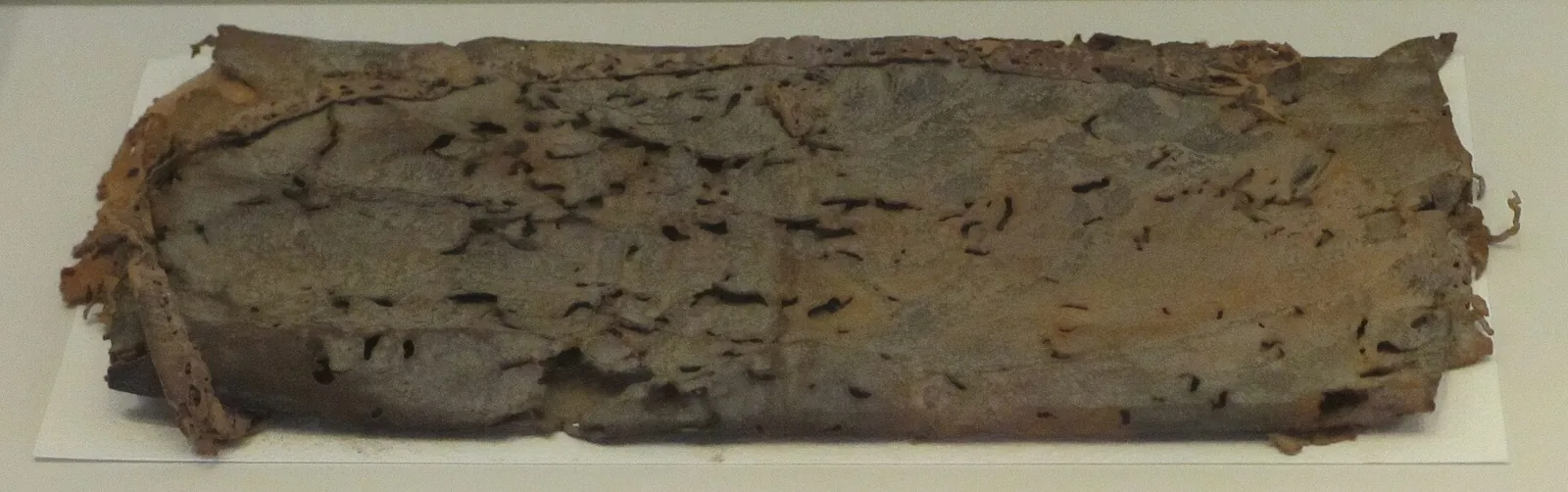
Babatha's pouch, Israel Museum, Jerusalem. Photo: Chamberi, 2013 · CC BY-SA 3.0 · Source page
Among the finds in Nahal Hever was the archive of one woman, Babatha. Thirty-five documents dated 94 to 132 CE were kept together in a leather pouch and hidden in a crevice. They include a deed for a palm grove, a marriage contract, a loan of 300 denarii, a petition for a guardian for her son, a summons from July 131 to her husband's other wife, and a receipt from August 132 for her son's upkeep.
Her papers survived because someone hid them in the cave. We do not know what became of her.
Coins
The revolt's coins
The revolt struck its own coins, and they are the nearest thing we have to an official document of the revolt's leadership. Its large silver coins are the sela, a Greek tetradrachm. Small bronze coins carry the words “Year one of the redemption of Israel”.
Not every coin was struck from scratch. Some were made over older Roman coins: an overstrike leaves part of the earlier image still visible beneath the new design. A silver sela in the Ashmolean Museum in Oxford is one such coin, and traces of the emperor Trajan's portrait remain on it.
Source: A letter from Shimon
“Shimon to Yehudah, son of Menasheh, at Qiryat Arabayyah.”
The address line looks dry, but it tells us who sends, to whom, and from where. The body of the letter, as published, asks for palm branches and citrons, and for myrtle and willow, the plants of Sukkot, for a large camp. We quote only the address here.
- Who is writing, to whom, and what is the tone? A man with authority gives an order to another man, by name, in a named place. The tone is practical, not a speech. The letter reads like a quartermaster's note.
- What does a request for festival plants tell us? That the festival mattered to the leaders even in the middle of the war, and that they wanted its requirements met in a large camp.
- What can one letter not tell us? Whether the order was obeyed, what the men ate, or how many camps there were. One letter is one voice, from one man.
Source: A silver coin with a Temple
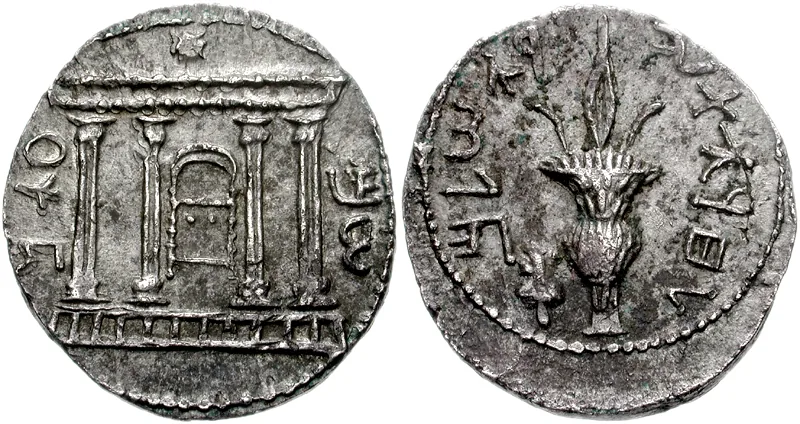
Silver tetradrachm (sela) of the Bar Kokhba revolt. Photo: CNG, auction house · CC BY-SA 3.0 · Source page
Silver tetradrachm (sela) of the Bar Kokhba revolt, from its last years (about 134–135 CE). Photograph by the auction house CNG, on Wikimedia Commons.
One side: a Temple facade with a star above. The other: a lulav and an etrog, the Four Species of Sukkot. The legend around the lulav is read as “For the freedom of Jerusalem”. The sources link silver coins of this kind to the last year and a half of the revolt.
- What does the front show, and why would the leaders choose it? The Temple, the place burned in 70. Perhaps the coin presents the Temple as the goal of the revolt, at a time when no worship took place in it.
- Which plants are on the back, and where else do they appear in this chapter? A lulav and an etrog: the same plants the letter asks for. The letter and the coin point to the same festival.
- Does the coin show that the rebels took Jerusalem? No. It shows what the rebels wanted to say. Four revolt coins have been found in Jerusalem, against more than 22,000 across the region (Israel Antiquities Authority figures as of 2020). A coin shows who used it, not always who ruled the place.
Rome answers
The war
A governor who fell short
When the revolt broke out, the Roman governor of Judaea, Tineius Rufus, tried to crush it. He appears to have suffered a humiliating defeat at the start. The sources that tell us this are short and indirect, so historians write “appears”.
The army
A general from Britain
Rome sent for Sextus Julius Severus, a senior general brought to Judaea from Britannia in 133 CE. The move was unusual: a senior commander was pulled from the far edge of the empire. Werner Eck (1999) reads it as a sign of emergency.
A decision point
You are Shimon ben Kosiba, the leader of the revolt.
Judaea, 133 or 134 CE.
You command many fighters, but most of them are not trained like the Roman legions. Rome is sending a new commander, Severus. The Romans know how to besiege, to attack, and to keep discipline.
You know the hills and the caves of Judaea. In some places rock has been cut into passages, and there are pits and tunnels beneath the ground where people can hide, store food and come out when they must. Scholars call these hiding complexes.
What do you do now?
What do you decide?
- Gather your forces on open ground and try to win one great battle. The battle could end in a quick defeat, since the legions are stronger in open ground. A victory might decide the war, but the risk is very high.
- Rely on the hills, the strongholds and the caves, and strike at small Roman groups. The war would last longer and cost Rome dearly. But families in the caves would suffer from siege and hunger, and there is no promise that the enemy would give up.
- Approach the Romans at once, while your army is whole, and try to reach an agreement. Rome would probably demand that you give up the revolt and its leaders. Some of your men would refuse and call you a traitor. The sources record no such talks.
What really happened
Rely on the hills, the strongholds and the caves, and strike at small Roman groups.
The rebels relied on fortified strongholds, caves and underground passages. Dio says that they did not dare to meet the Romans in the open field, and that they strengthened their positions with underground passages and walls. The letters, and the flight of families into the caves, fit this picture.
The rebels were not the legions, and open battle was dangerous for them. The hills gave them an advantage, and hiding bought time and pressure on Rome. But it brought great suffering to families. Historians disagree about how far Shimon controlled the many groups in the field. His letters show orders, but not one plan.
The long war
A decision point
You are Sextus Julius Severus, the Roman commander in Judaea.
Judaea, 134 CE.
Open attacks have not brought a quick victory. The rebels pull back into the hills and caves, and their fighters slip out in small groups, strike, and vanish. Villages and strongholds lie in your path, and each one must be taken.
The war is becoming long and grinding, and the emperor wants results. If you do not finish the work, the war will drag on.
What do you order your men to do?
- Attack the strongholds head-on, with the legions, in set battles. You would win some fights and lose men. The rebels would retreat into the caves, and the sieges would take years.
- Cut off the rebels' food, seal the caves, hunt the small groups, and take the villages one by one. It would be slow and costly, and it would bring hunger to many people in the area. But it would probably work, and the revolt would weaken.
- Offer the rebels terms that let them leave the caves in safety. It would spare much bloodshed, but Rome would read it as a defeat. The rebels might not trust you, and the causes of the revolt would remain.
What really happened
Cut off the rebels' food, seal the caves, hunt the small groups, and take the villages one by one.
This is the war of attrition that Dio describes. Severus did not attack in the open. He caught small groups, cut off their food and shut them up in isolated places. Dio says very few of them survived. Dio is the only source that describes this method in detail, and he wrote about a century after the events.
Severus left no words of his own. According to Dio, he avoided open attack because of the rebels' numbers and their desperation. The account is Dio's, and historians ask how closely it follows what actually happened. The moral question and the human cost have no simple answer.
A letter
What the letter leaves out
According to Dio, Hadrian's letter to the Senate about the war was written without the usual opening that emperors used. The formula normally ran: “If you and your children are in health, it is well; I and the legions are in health.” This letter leaves it out. Some readers take the gap as a sign of heavy Roman losses, but the text gives no figure for those losses.
The end
Betar
The last stronghold was Betar, in the hills south-west of Jerusalem. Rome besieged it from the start of summer 135, and Betar fell that year. Bar Kokhba was killed, and the sources are not certain how he died.
Later tradition says the town was breached and destroyed on the Ninth of Av, the day of mourning for the Temple. The Mishnah and the Babylonian Talmud both record this tradition. It is a tradition, not a dated record, but the day has kept the memory of the fall alive ever since.
After the war
Afterwards
The line around Jerusalem
After the war Jews were barred from Jerusalem and its district. Jerome, a Christian scholar who wrote several centuries later, describes a slave market at Terebinthus, near Hebron, where countless people of every age and both sexes were sold. Modern summaries quote him; the Latin has not been checked here.
Harris (1980) estimated that more than 100,000 Jews were enslaved. That is an estimate, not a count.
The name
Syria Palaestina
The province of Judaea was renamed Syria Palaestina. Historians do not agree when, or why, that happened. The earliest surviving use of the name is in a military diploma of 139 (Millar, 2001).
One reading sees a deliberate punishment, meant to erase the Jewish link to the land. Another reads the name as an administrative label that existed before the revolt. The answer changes what we think Hadrian intended.
Witnesses
Every source has a viewpoint
Justin Martyr, a Christian writer of the 150s CE, says that the leader “gave orders that Christians alone should be led to cruel punishments” unless they would deny Jesus. It is one side's account, and it says nothing about Jewish victims.
The Babylonian Talmud, compiled centuries after the revolt, tells how Akiva was arrested for teaching Torah and tortured to death while reciting the Shema. Historians read this as a story of martyrdom, not a record of the day. Every source comes with a viewpoint: Roman, rabbinic or Christian.
What followed
- 70 CE Jerusalem falls and the Temple burns.
- 117 CE Hadrian becomes emperor in Rome.
- 129–130 CE Hadrian visits Judaea.
- About 130 CE Aelia Capitolina is founded on Jerusalem's ruins. The earliest known coin of the city dates to about 130–132.
- 132 CE The revolt breaks out, probably in summer. Its main phase begins in autumn.
- 133 CE Severus is brought from Britannia to command the fighting.
- 134–135 CE Silver sela are struck in year 3 of the revolt, with the Temple facade and the legend “For the freedom of Jerusalem”.
- 135 CE Betar falls after a siege that began in summer. Bar Kokhba is killed, and how he died is uncertain.
- About 135 CE or later The province of Judaea takes the name Syria Palaestina. The date is debated.
- 139 CE The earliest surviving use of the name: a military diploma.
- About 200 CE Judah ha-Nasi edits the Mishnah, in the Galilee.
Myth
After 135, Jews were banished from the land of Israel for ever.
The truth
Jews were barred from Jerusalem and its district, and the centre of Jewish life moved to the Galilee. But Jewish communities stayed, especially in the Galilee and in the southern Hebron hills.
The evidence
Schwartz (2016) describes an expulsion from Jerusalem and its district. Meyers and Chancey (2012) call the Galilee the new demographic and religious centre. Scholars report Jewish settlement in the southern Hebron hills (Eshel, Eshel and Yardeni, 2011; Levine, 2017). The Mishnah was edited around 200 CE under Judah ha-Nasi.
What set off the revolt?
What was the decisive cause of the revolt?
- The city Dio ties the war to the founding of Aelia and its temple to Jupiter. Smallwood (1976) sees the city as a reply to a rising Jewish nationalism. Berthelot (2021) notes that Aelia is often regarded as the main cause.
- The leader Mor (2016) argues that Aelia was not an intentional measure against the Jews, and that Bar Kokhba's charisma was the spark. Schäfer (2003) sees a pragmatic emperor who would have avoided provocation.
- Expectation and a dispossessed class Mendels (1992) and Cohen (2014) stress expectations of redemption that had run for some seventy years, and a dispossessed class that had lost its land. On their reading, the revolt grew from social and religious forces, not from one event.
The big question stays open: will one cause do? Which of these views fit together, and which contradict each other?
Check yourself
According to Dio, what brought on the war?
Answer: Founding Aelia Capitolina on Jerusalem. Right. Dio ties the war to the founding of the city and to its temple to Jupiter on the Temple site.
Check yourself
What does the front of the year 3 silver coin show?
Answer: The facade of the Temple. Right. This is the Temple facade. The coin probably presents the Temple as a symbol of the revolt.
Check yourself
From which province was Severus brought to command the war?
Answer: Britannia, on the northern frontier. Right. The move from Britannia was unusual, and Eck (1999) reads it as a sign of emergency.
Check yourself
According to the Jerusalem Talmud, what did Rabbi Akiva call Bar Koziba?
Answer: The King Messiah. Right. This is Rabbi Akiva's declaration, in the Jerusalem Talmud.
Check yourself
Where does the story of the slave market near Hebron come from?
Answer: Jerome, a Christian scholar. Right. Jerome describes the market at Terebinthus, near Hebron, as modern summaries quote him.
Check yourself
Which claim about Jews after 135 do the sources support best?
Answer: Jews were barred from Jerusalem; life moved to the Galilee. Right. This is what the sources and scholarship support: a ban on Jerusalem and its district, and a new centre of life in the Galilee.
Terms
- messiah The anointed king whom Jewish tradition expected to bring redemption to the people and the land, and to restore the house of David. Jews did not always agree on what he would do.
- Aelia Capitolina The Roman city founded on Jerusalem's ruins around 130 CE. Its name combined the emperor's family name, Aelius, with Jupiter Capitolinus.
- hiding complex Caves, passages and tunnels underground, where the rebels hid, stored food and slipped away from Roman troops.
- sela A large silver coin, a Greek tetradrachm. Some of the revolt's silver coins were struck in this form, with the Temple facade and a legend.
- overstrike A coin struck with a new design over an older coin, so that part of the earlier image still shows.
- Syria Palaestina The name given to the province of Judaea after the revolt, around 135 CE or later. The date and motive are debated.
- Mishnah The collection of Jewish law edited in the land of Israel around 200 CE, under Judah ha-Nasi.
- Jerusalem Talmud A collection of discussions on the Mishnah, compiled in the land of Israel around 400 CE.
- Ninth of Av The Jewish day of fasting and mourning for the destruction of both Temples. Tradition links Betar's fall to this day.
- attrition A war won slowly, by wearing down food, resources and manpower, rather than in one decisive battle.
- Sukkot The autumn festival of booths. Its Four Species are the lulav, the etrog, the myrtle and the willow.
- Rabbi Akiva One of the great teachers of his generation. He backed the revolt and its leader, and called him the messiah.
- Rabban Yohanan ben Zakkai The teacher around whom sages gathered at Yavne after the Temple was destroyed. From that circle grew rabbinic Judaism.
- Yavne A town on the coast where sages gathered after the Temple was destroyed.
- Masada A fortress in the Judaean desert, the last stronghold of the great revolt against Rome. It fell to the Romans.
- Judaea The province where Jerusalem lies. After the great revolt it became a Roman province, ruled by a Roman governor.
- Hadrian A Roman emperor who loved to travel and founded new cities. He founded Aelia Capitolina on the ruins of Jerusalem.
- Jupiter The chief god of the Romans. According to Dio, Hadrian built him a temple on the site of the old Temple.
- Dio A Roman senator from Bithynia, in Asia Minor. He wrote about a century after the revolt, and his book survives only in a summary.
- Babatha A woman whose archive of documents was found in the Cave of Letters. We do not know what became of her.
- Nahal Hever A wadi in the Judaean Desert, where the Cave of Letters lies.
- Cave of Letters A cave in Nahal Hever, in the Judaean Desert. Letters from the years of the revolt were found in it.
- Yigael Yadin An Israeli archaeologist who sent search teams into the Cave of Letters, and later wrote a major book on the revolt.
- En-Gedi A spring and settlement on the shore of the Dead Sea. Letters from the revolt's years were sent to men there.
- Eleazar bar Hitta A man named in one of the revolt's letters found in the cave, which orders his arrest.
- Roman legion A large unit of the Roman army, trained to besiege, to attack and to keep discipline.
- Tineius Rufus The Roman governor of Judaea at the start of the revolt. He tried to crush it, but appears to have suffered a humiliating defeat at first.
- Sextus Julius Severus A senior Roman general brought from Britannia to Judaea to crush the revolt. Werner Eck reads his summons as a sign of emergency.
- Jerome A Christian scholar who wrote several centuries after the revolt. He describes a slave market at Terebinthus, near Hebron.
- Terebinthus A place near Hebron where, according to Jerome, many people were sold as slaves.
- Betar The last stronghold of the rebels, in the hills of Judaea. It fell to Rome after a siege.
- Denarius A Roman silver coin. Documents found in the Cave of Letters mention a loan of 300 denarii.
- Tetradrachm A large Greek silver coin. The sela of the revolt is a coin of this kind.
- Lulav A palm branch, one of the Four Species of Sukkot. It is held together with the etrog, myrtle and willow.
- Trajan A Roman emperor. Traces of his portrait remain on a silver sela that was struck over an older Roman coin.
Sources
- Cassius Dio, Roman History 69.12–14, trans. E. Cary (Loeb, 1925)
- Jerusalem Talmud, Ta'anit 4:5 (68d; COJS numbers it 4:6), trans. S. Berrin (COJS)
- Letter of Shimon bar Kosiba to Yehudah son of Menasheh, from the Cave of Letters (COJS translation; translator not named)
- Justin Martyr, First Apology 31, trans. Roberts and Donaldson (Ante-Nicene Fathers)
- Historia Augusta, Life of Hadrian (late fourth century; cited, not quoted)
- Jerome, Commentary on Jeremiah 6.18 (cited through modern summaries; Latin not checked here)
- Peter Schäfer, ed., The Bar Kokhba War Reconsidered: New Perspectives on the Second Jewish Revolt against Rome (Tübingen: Mohr Siebeck, 2003)
- Werner Eck, “The Bar Kokhba Revolt: The Roman Point of View”, Journal of Roman Studies 89 (1999), pp. 76–89
- Yigael Yadin, Bar-Kokhba (London: Weidenfeld and Nicolson, 1971)
- Raviv and Ben David, “Cassius Dio's figures for the demographic consequences of the Bar Kokhba war: exaggeration or reliable account?”, Journal of Roman Archaeology (2021)
- Goodblatt, Katedra 29 (1984), pp. 6–12
Image credits
- Cave of Letters, Nahal Hever. Photo: Israel Antiquities Authority · רשות העתיקות של ישראל Israel Antiquities Authority · CC BY-SA 4.0 · Source page
- Hadrian, marble bust. National Archaeological Museum, Naples. Photo: Commonists, 2021 · CC BY-SA 4.0 · Source page
- Bronze coin of Jerusalem (Aelia Capitolina). Bibliothèque nationale de France · Public domain · Source page
- Babatha's pouch, Israel Museum, Jerusalem. Photo: Chamberi, 2013 · CC BY-SA 3.0 · Source page
- Silver tetradrachm (sela) of the Bar Kokhba revolt. Photo: CNG, auction house · CC BY-SA 3.0 · Source page


