The fall of Baghdad, 1258: the end of the caliphate
In February 1258 a Mongol army took Baghdad, the city of the Abbasid caliphs. Few events have been described with so many numbers, and few of those numbers can be checked. What really happened, and what was added to the story later?
Decisions, questions and your own progress, in the app
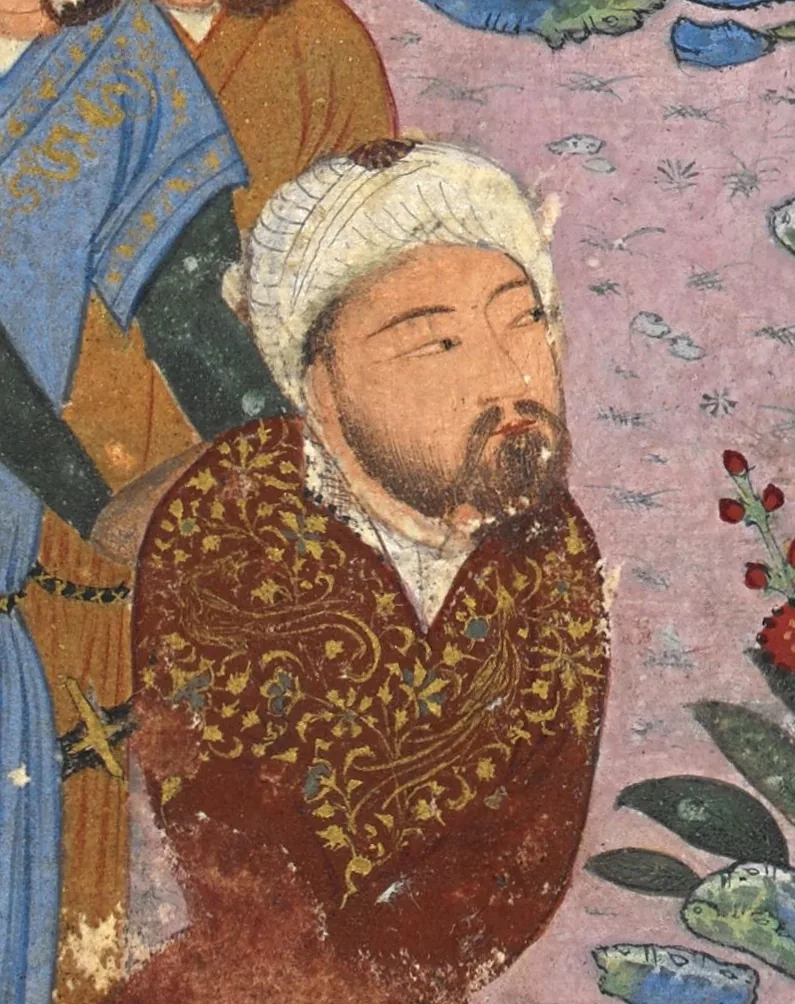
Painter unknown, folio 89v, British Library, Or. 2780, 1398. Detail. · Public domain · Source page
The scene
A ruler before the conqueror
This painting of a caliph was made about 140 years after the end of the Abbasid caliphate in Baghdad. It imagines how that end came.
The real story is harder to pin down. The city surrendered in February 1258. The death toll is disputed, and so is what happened to the caliph next. The writers who tell it either came later or served the Mongol court.
The place
The city on the Tigris
Baghdad stands on the Tigris, in what is today Iraq. The Abbasid caliphs made it their capital, and in 1258 the caliph still ruled from there, with his court and his officials.
The city had libraries and scholars who copied and read books. Keep that in mind. The story of what happened to those books is one of the legends we will test later.
Who
The man at the top
The caliph in 1258 was al-Musta'sim, the last Abbasid caliph to rule in Baghdad. The city, its walls, its officials and its crowded streets all depended on him.
A caliph was both ruler and religious leader. Titles do not stop armies. Before he chose anything, al-Musta'sim had to decide what his title was worth.
Who is coming
The army at the gates
The army heading for Baghdad was led by Hulagu, a grandson of Chinggis Khan. He was a Mongol prince, born in Mongolia about 1217, and he had been sent west with a great army.
His task was clear: take Baghdad.
The road to it
January 1258
Across the river
By January 1258 the Mongol army had surrounded the city. According to one account, its commanders crossed the Tigris on 16 January, and Hulagu ordered bridges built above and below the city.
The caliph had little time to decide. Hulagu wanted his submission. This was a demand, not a request.
The demand
The demand for submission
Hulagu demanded that the caliph submit on the terms the Great Khan had set. Those terms are not given in full in the surviving accounts, so we know the demand but not all its details.
In practice, submitting meant opening the gates to Mongol rule. The caliph had to weigh that against the risk of a long fight.
A decision point
You are al-Musta'sim, caliph in Baghdad.
Winter 1257–58, in Baghdad.
A Mongol army is closing in on your city. Its commander, Hulagu, demands your submission. Your walls are strong, and you have heard that the Mongols have taken strong places in the north.
Your advisers disagree. Some say pay, send hostages and wait. Others say that a caliph who bows once will be asked again.
No one can say how long the city could hold, or whether help from other Muslim rulers will come in time.
What do you do?
- Submit now: open the gates, pay what is asked and send hostages. Probably the walls and the city's wealth are spared for now. But a caliph who has submitted once can be asked again, and the next demand will be harder to refuse.
- Refuse, and hold the walls with the city's own men. Probably a long siege. The walls may hold for a time, but how long depends on the Mongols' engines, and on help that may never come.
- Send an envoy to negotiate, and wait for his answer. Probably talks begin, and they may buy time. But an envoy can be turned away or held, and the city would lose its strongest bargaining position.
What really happened
Refuse, and hold the walls with the city's own men.
The caliph refused the demand. The city held out for about two weeks while the Mongols pressed hard on its walls, and he did not submit at the start.
No source gives the caliph's reasons in his own words. Historians can see what he did, not what he expected. We know that Hulagu asked for submission, and that the caliph refused.
The event
The siege
Catapults at the walls
The siege began in late January 1258. The Mongols brought catapults, machines that hurled stones at the walls. According to one account, on 1 February the catapults broke through one of the towers.
Inside, the city's people kept watch on the walls. According to one account, some men went out to talk, and the fighting went on.
Inside
The vizier and the walls
The caliph's chief minister was the vizier Ibn al-Alqami. What the vizier advised is not clear from the sources, and his part in the story has been argued over ever since.
By 4 February, according to one account, the Mongols controlled much of the eastern wall. The city was losing ground, and its people knew it.
A decision point
You are still al-Musta'sim, inside the walls.
10 February 1258, in Baghdad.
The Mongols hold much of the eastern wall. Envoys have gone out before, and the fighting has not stopped.
Some of your people urge you to go out and end the fighting. Others urge you to stay behind the walls and fight on.
You cannot know whether the Mongols will keep their word, or what they will do to a caliph who comes to them.
What do you do?
- Stay behind the walls and send envoys in your place. Probably the talks go on without you and the fighting continues. The envoys may lack the power to end it.
- Go out to the Mongol camp in person and surrender the city. Probably the fighting stops soon. But you become a prisoner, and the Mongols alone decide your fate.
- Refuse all talk and fight in the streets to the end. Probably the Mongols take the city by force, with heavier losses on both sides. Your fate would then be decided in the fighting, not at a table.
What really happened
Go out to the Mongol camp in person and surrender the city.
On 10 February the caliph went out to the Mongol camp in person, and the city surrendered.
No source records what the caliph was thinking. Historians agree on what he did, but not on why he chose it.
After the surrender
The city falls
Days
The Mongols entered the city about 13 February, according to one account, though the sources differ on the exact day. For days the killing went on, and no one can give its size with confidence.
The figures
How many died?
A figure of about 200,000 is attributed to Hulagu himself. Later Muslim writers give figures from 800,000 up to two million. The sources disagree, and no one figure is accepted as fact.
Such numbers cannot be checked. They are best read as claims about the sack, not as measurements.
What we really know
Source: A court man saves books
Paraphrase: according to Juvayni's own account, he was with the Mongol army at the mountain fortress of Alamut in 1256 and saved copies of the Qur'an and other valuable books from its library.
Juvayni was a Persian official in Mongol service. He was with the army at Alamut, and in 1259 he was made governor of Baghdad. He wrote for the court that employed him.
- Who wrote this, and for whom? A Persian official in Mongol service, writing close to the events for the court that paid him.
- What might he leave out? Anything that made his masters look bad, or his own part look compromised.
- Does a book saved at Alamut tell us what happened to books in Baghdad? Not directly. It describes another fortress. It shows only that some books were saved, by a man who worked for the conquerors.
Myth
The Tigris ran black with the ink of Baghdad's books.
The truth
No source written at the time says this. The best-known version is attributed to an unnamed 16th-century historian. It is best read as a legend or a literary image, not as a record of what happened.
The evidence
The ink story first appears in writing long after 1258. The image is vivid, which helps explain why it lasted.
Source: A siege drawn fifty years later
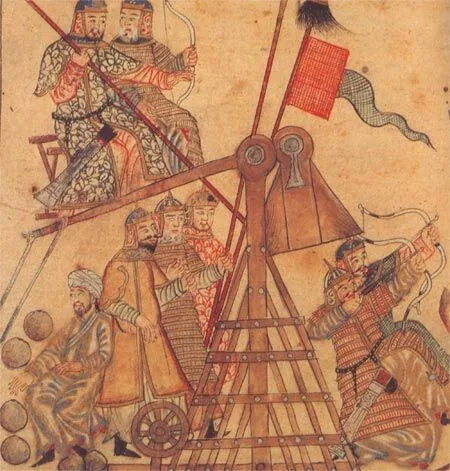
Unknown artist, miniature from Rashid al-Din's Jami al-tawarikh, about 1307. · Public domain · Source page
A miniature from Rashid al-Din's Jami al-tawarikh (Compendium of Chronicles), made about 1307.
Rashid al-Din was a minister to the Mongol rulers of Iran. He wrote about half a century after Baghdad fell, from earlier reports, not from his own eyes. This picture shows Mongol troops beside a siege engine. It is a siege in general, not a view of Baghdad.
- When and for whom was this made? About 1307, in a book written for the Mongol court, about fifty years after the siege.
- Is this a picture of Baghdad? No. It shows a siege in general. The artist drew the machines and soldiers of his own day.
- What is the picture trying to show? The Mongols' skill with siege engines. Ask what its makers wanted readers to believe.
A decision point
You are Hulagu Khan, the Mongol commander before Baghdad.
About 10 to 20 February 1258, in Baghdad.
The city has surrendered, and the caliph is in your hands. You were sent to take Baghdad, and you have taken it.
Your advisers disagree. Some want the caliph kept alive, as a figurehead who rules in your name. Others want him put to death, so that no caliph is left for the city to rally around.
What do you do?
- Keep the caliph alive and rule the city through him. Probably the city stays calm for a time, and a caliph who owes you his life is useful. But a living caliph still carries a title that people look to.
- Order him put to death. Probably the caliphate ends in this city, with no living caliph for its people to rally around. The city would be yours without a rival figurehead.
- Spare the city, and keep the caliph under guard, away from its people. Probably the people settle down. But a guarded caliph can be freed, and the question of who rules Baghdad would stay open.
What really happened
Order him put to death.
Hulagu ordered the caliph put to death, about 18 to 20 February 1258. The sources differ on the day and on how he died.
No source gives Hulagu's reasons in his own words. Historians have offered views, but the evidence does not settle which one is right.
Source: A story about the caliph, retold
Paraphrase: an account of what happened to the caliph after he came out to the Mongol camp. Le Strange, who published the chronicle, gives the date as on or about 18 February 1258, and notes that the accounts differ on how it happened.
The chronicler wrote about 150 years after the events, and he was not an eyewitness. We know of no eyewitness account of what happened to him.
- How far after the events was this written? About 150 years. The writer relied on older reports, not on his own eyes.
- Why do the accounts differ? Each writer passed on a version, and versions shift when they are copied and retold.
- What would make the date trustworthy? A second, independent account from close to the time. We know of none.
What followed, and the quiz
After
Under new rulers
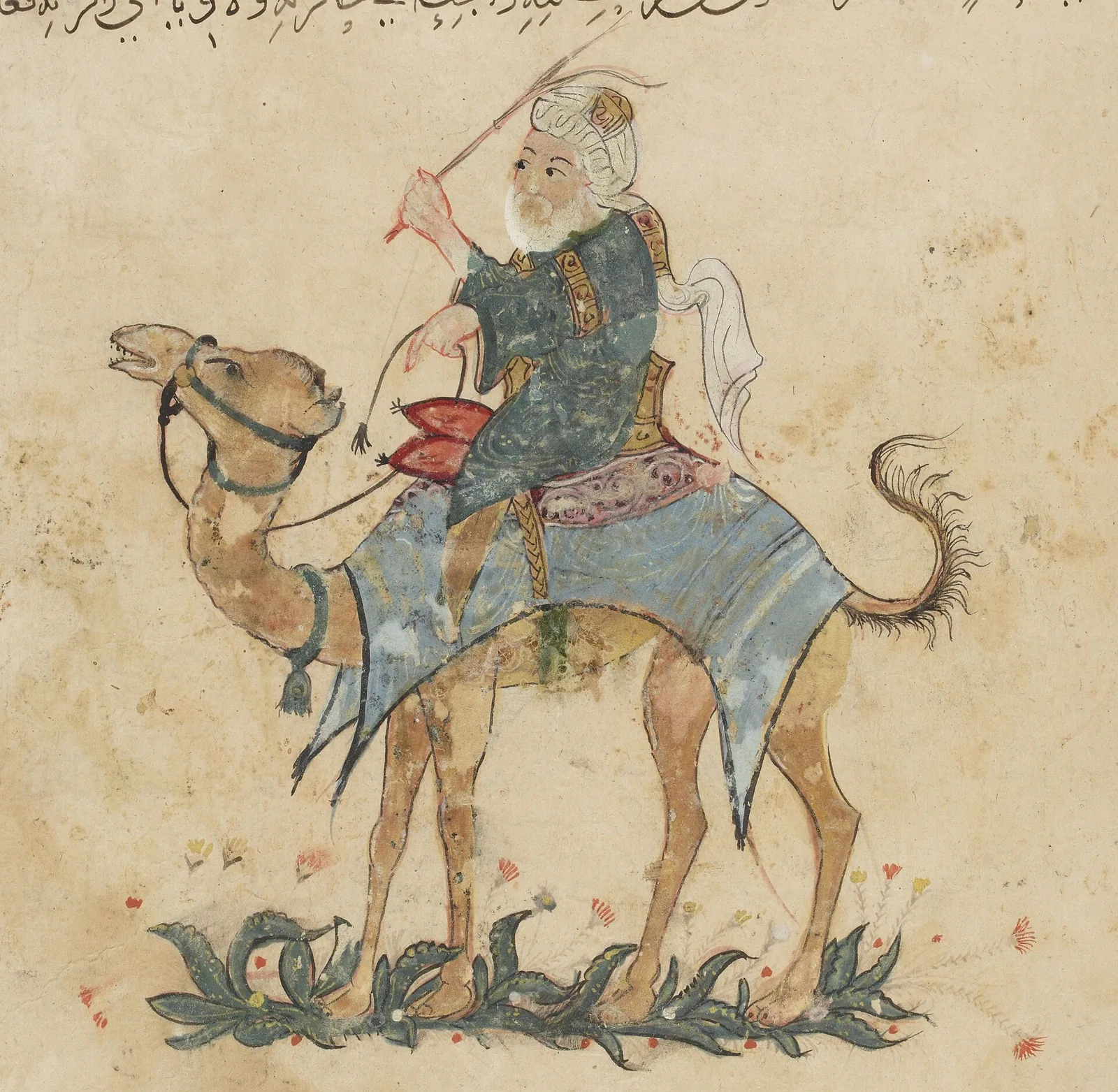
Yahya ibn Mahmud al-Wasiti, folio from the Maqamat of al-Hariri, 1237. Bibliothèque nationale de France, Arabe 5847. · Public domain · Source page
Baghdad stayed under Mongol rule. In 1259 Juvayni, who had already served Hulagu, was made governor of the city. Its libraries and scholars suffered, and the sources disagree on how much was lost.
Historians still argue about how much the sack destroyed. Michal Biran argues that intellectual life in Baghdad carried on under the Mongols, and that the city was not in decline.
The years after
- 1258, about 18 to 20 February The caliph is put to death on Hulagu's orders. The sources differ on how.
- 1258, within about three months of the siege The vizier Ibn al-Alqami dies. The sources agree on the year, but not on the day.
- 1259 Juvayni, who had already served Hulagu, is made governor of Baghdad.
- April 1262 Hulagu writes to King Louis IX of France, offering an alliance.
- about 1265 Hulagu dies in north-west Iran.
Did disease follow the conquest?
Did plague strike Baghdad after the Mongol conquest?
- Fancy and Green (2021) They argue that plague struck besieged cities after their sieges, and that Baghdad was among them.
- Brack, Biran and Amitai (2024) They argue that the main Persian source is misread, and that there is no evidence of plague during or after the conquest.
Fancy and Green published a reply in 2025. Historians still disagree. What kind of evidence would settle the question?
Check yourself
What did the caliph do first, when Hulagu demanded that he submit?
Answer: He refused the demand, and the city held out.. Right: he refused, and the city held out for about two weeks while the Mongols pressed its walls.
Check yourself
What happened on 10 February 1258?
Answer: The caliph went out in person, and the city surrendered.. Right: on 10 February he went out to the Mongol camp himself, and the city gave itself up.
Check yourself
Why should a reader be careful with Juvayni's account of the Mongol campaigns?
Answer: He worked for the Mongol court, so he had reason to favour it.. Right: his career depended on the Mongols, so his account has to be checked against other sources.
Check yourself
Which statement about the death toll of the sack is best supported by the lesson?
Answer: Figures range from about 80,000 to 2 million, and none is accepted as fact.. Right: the figures differ widely, and historians do not treat any one of them as established.
Check yourself
What is the best correction to the story that the Tigris ran black with the ink of Baghdad's books?
Answer: No source from 1258 says so. It is a later legend.. Right: the best-known version appears in 16th-century writing, long after the events.
Check yourself
Which of these best describes the plague debate in the lesson?
Answer: Fancy and Green say plague struck Baghdad; Brack, Biran and Amitai find no evidence.. Right: the two sides read the sources differently, and the question is still open.
Terms
- caliph The title of the ruler who led the Muslim community after the Prophet Muhammad. The Abbasid caliphs ruled from Baghdad.
- Abbasid The dynasty of caliphs who ruled from Baghdad until the Mongols took the city in 1258.
- khan A title of a Mongol ruler or commander. Chinggis Khan and his grandsons bore it.
- siege The surrounding of a walled city, to force it to surrender by cutting it off or battering its walls.
- vizier The chief minister of a ruler, who ran the government in his name.
- envoy A person sent to negotiate on behalf of a ruler.
- hostage A person held as a guarantee that another side will keep an agreement.
- figurehead A ruler who keeps the title while someone else holds the real power.
- chronicle A year-by-year written history, often kept at a royal court or a monastery.
- plague An infectious disease that could kill large numbers of people quickly.
- Hulagu A Mongol prince, grandson of Chinggis Khan. He led the army that took Baghdad in 1258.
- Ibn al-Alqami The caliph's vizier in Baghdad. Later writers accused him of treason, but the sources do not settle it.
- al-Musta'sim The last Abbasid caliph to rule in Baghdad. In 1258 the Mongols took the city.
- Tigris A river that runs past Baghdad, in what is today Iraq.
- Mongolia A country in central Asia, the homeland of the Mongols.
- Juvayni A Persian official in Mongol service. In 1259 he was made governor of Baghdad. He wrote for the court that employed him.
- Alamut A mountain fortress in Iran. Juvayni was there with the Mongol army.
- Rashid al-Din A minister to the Mongol rulers of Iran. He wrote about half a century after Baghdad fell, from earlier reports.
- Dimitri Gutas A historian who argued that the name House of Wisdom may be a mistranslation of another Arabic term.
- Michal Biran A historian who argues that intellectual life in Baghdad carried on under Mongol rule.
- House of Wisdom A name for an institution or building in Baghdad, linked to libraries and scholars. Whether it was one building is disputed.
- catapult A war machine that hurled stones at walls. The Mongols brought catapults to the siege of Baghdad.
- siege engine A large machine built for a siege of a city or fortress.
- sack The plunder and destruction of a captured city. The killing in Baghdad went on for days.
- eyewitness A person who saw an event with their own eyes, so their account is a direct source.
- Great Khan The title of the supreme ruler of the Mongols. The terms he set for surrender are not given in full in the sources.
- Mongols A nomadic people of the steppe of Central Asia. In 1258 they took Baghdad.
Sources
- Ata-Malik Juvayni, The History of the World-Conqueror (Tarikh-i Jahangushay), trans. J. A. Boyle, 1958
- Rashid al-Din, Jami al-tawarikh (Compendium of Chronicles), early 14th century
- G. Le Strange, 'The Story of the Death of the last Abbasid Caliph, from the Vatican MS. of Ibn-al-Furat', Journal of the Royal Asiatic Society 32 (1900), 293–300
- Jonathan Brack, Michal Biran and Reuven Amitai, 'Plague and the Mongol conquest of Baghdad (1258)? A reevaluation of the sources', Medical History 68(4) (2024), 392–410
- Michal Biran, 'Libraries, Books, and Transmission of Knowledge in Ilkhanid Baghdad', Journal of the Economic and Social History of the Orient 62 (2019), 464–502
- Dimitri Gutas, Greek Thought, Arabic Culture, 1998
Image credits
- Painter unknown, folio 89v, British Library, Or. 2780, 1398. Detail. · Public domain · Source page
- Unknown artist, miniature from Rashid al-Din's Jami al-tawarikh, about 1307. · Public domain · Source page
- Yahya ibn Mahmud al-Wasiti, folio from the Maqamat of al-Hariri, 1237. Bibliothèque nationale de France, Arabe 5847. · Public domain · Source page


