Attila: the king of the Huns as the Romans saw him
Almost everything we know about Attila was written by his enemies. What really happened at the Catalaunian Plains and at the meeting with the Pope, and what is legend?
Decisions, questions and your own progress, in the app
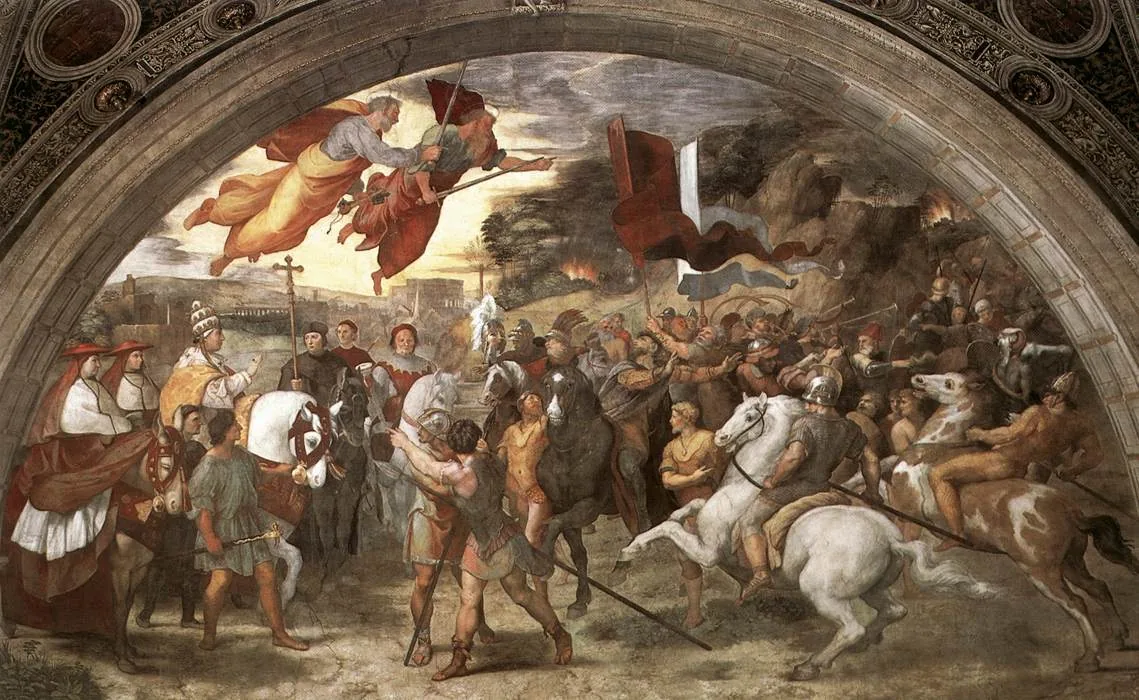
Raphael, The Meeting of Leo the Great and Attila, fresco, 1514. Vatican (Stanza di Eliodoro). · Public domain · Source page
A court at the end of the road
The king his enemies wrote about
The year is 448. In Constantinople the emperor’s advisers must decide what to do about Attila, king of the Huns, whose court lies beyond the Danube, in Pannonia. Going to war is one choice. Sending a diplomat to talk, and to watch, is another.
Attila ruled the Huns from 434 until he died in 453. Few names from the late Roman world are as famous, yet almost everything written about him comes from the Roman world, mostly from people who feared him. In this lesson we ask what really happened at the Catalaunian Plains and at the meeting with the pope, and what is only a story.
Background
The Huns beyond the Danube
The Huns were not one people with one name and one language. They were a confederation: a ruling group, with many peoples under it, some with leaders of their own. In the years of this story, a vast area north of the Danube was in their hands.
From 434 Attila ruled jointly with his brother Bleda. Jordanes, a historian who wrote in the sixth century, long after, says that Attila killed Bleda around 445 to become sole king. Whether that is true, the story shows how Roman writers pictured the Huns: a force that took what it wanted from its neighbours.
The gold
Gold for peace
Rome had paid the Huns before. In 443, after a campaign, the yearly payment rose to 2,100 Roman pounds of gold, under the Treaty of Anatolius. This was tribute: a regular payment from a weaker power to a stronger one, to buy peace.
The peace did not hold. In 447 Attila beat the Romans at the river Utus and raided as far as Thermopylae. The gold went on flowing out of the treasury until 450, when a new emperor in the East refused to pay.
Sources
Who saw Attila
Almost everything we know about the court of Attila comes from writers who were not Huns, and most of them wrote long after the events. One of the writers closest to the events is Priscus of Panium, a Greek-speaking Roman diplomat and historian. His history of 430 to 476 survives only in fragments, known mostly through later quotations.
Keep in mind which side he writes from. It will matter at the next decision.
A decision point
You are one of the advisers to the emperor Theodosius II in Constantinople.
Constantinople, 448. The court must decide before the next demand comes.
Attila beat the Roman army at the Utus and raided as far as Thermopylae. Since the treaty of 443 the yearly payment has been 2,100 Roman pounds of gold, and you must decide whether to keep paying.
The walls protect the capital, but your field army lost in the open. If you stop paying, Attila may turn on the Balkan provinces again. If you pay more, he will learn that Rome pays.
What do you advise?
- Keep paying, and send an embassy to negotiate with Attila. Probably the peace holds for a while, and you buy time. But the gold keeps leaving the treasury, and Attila learns that Constantinople pays.
- Stop paying, and rely on the capital’s walls and the army you have left. Probably Attila turns on the Balkans again. The walls may hold the capital, but the provinces suffer, and the Utus has shown that your field army is weak.
- Offer a larger payment, on condition that Attila leaves your lands. Probably Attila accepts, at least for a time, and the price rises. What you have shown is that Rome will pay, and the next demand will come.
What really happened
Keep paying, and send an embassy to negotiate with Attila.
In the history, the government chose the first option. Maximinus went to the Hun court with Priscus, in 448–449 (the sources differ on the year), and the payments went on.
There was also a secret plan. Chrysaphius, the powerful minister at court, had bribed Edeco, a Hun envoy, to kill Attila. Edeco told Attila about the plan. Maximinus knew nothing of it, according to Priscus.
We did not put the plot among your choices. Nobody should be asked to decide on a murder. It is part of the record all the same, and it did not stop the payments: the gold kept flowing until Marcian stopped it in 450.
The first option is the closest to what the government did, and a sensible minister could argue for it: the walls were strong, but the field army had lost, and buying time made sense.
Almost all we know about this embassy, the plot included, comes from Priscus, who was there. He wrote from the Roman side, and later writers relied on him. That does not make him wrong, but it does mean we should ask what he left out.
Scourge of all lands
The picture
How the enemy was described
The picture of Attila was built in writing, and most of the writers wrote after his death. Jordanes, a historian of Gothic origin writing in Latin in the sixth century, describes him in grand and frightening terms, and calls him the scourge of all lands. That is the picture that stayed: a fearsome enemy from the steppe.
Notice whom the picture serves. A feared enemy makes everyone who survived him look brave, and it makes the writer who tells of the victory look great.
The peoples
Not one people
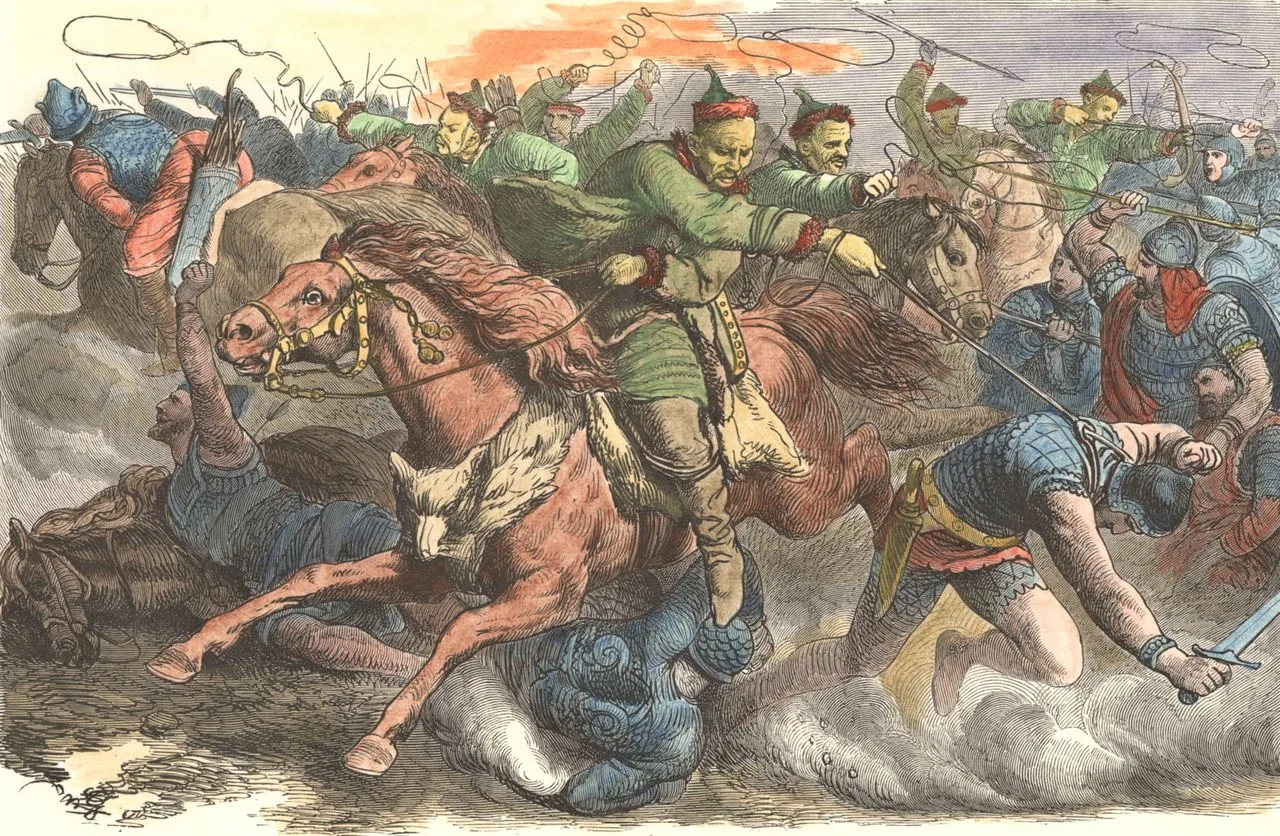
Johann Nepomuk Geiger, The Huns in Battle with the Alans, engraving after his drawing, c. 1873. · Public domain · Source page
The Huns were not one people with one name. The army that followed Attila included many groups, and his empire held peoples with leaders of their own. Historians describe it as a vast empire of many peoples.
His court was not only a camp of warriors. Priscus describes Roman embassies that came to it and bargained there, not only raids. The picture here is a nineteenth-century painting of Huns fighting Alans: an artist’s invention, not a likeness of Attila. Jordanes, reporting Priscus, also describes the king himself: short, with a broad chest, a large head, small eyes and a thin, greying beard. That is the only description of his looks that we have, and it comes from a Roman-side diplomat.
A legend
The sword of Mars
Jordanes also repeats a story, which he attributes to Priscus, about how Attila came to power. A shepherd found a sword that a limping heifer had trodden on. He brought it to the king, and Attila believed he had been appointed ruler of the whole world.
Whether any shepherd found anything, we cannot know. The story shows what kind of king the sources wanted to describe: one who believed the world was his.
Myth
Attila was called the Scourge of God in his own lifetime, by his own people and by the Romans.
The truth
We know of no contemporary source that gives him that title. Jordanes calls him the scourge of all lands, and that is the earliest version of the picture that we have.
The phrase ‘Scourge of God’ comes later. The anonymous Life of Leo calls him the scourge of God, and Gibbon, writing in the 1770s and 1780s, says that either a Tartar or a Hun might deserve the title.
The evidence
Gibbon (1776–1788) writes that “either the Tartar or the Hun might deserve the epithet of the Scourge of God.” He offers the title as a description, not as a name that Attila is known to have used.
Source: Jordanes on the man who would shake the nations
He was a man born into the world to shake the nations, the scourge of all lands, who in some way terrified all mankind by the dreadful rumors noised abroad concerning him.
Jordanes was of Gothic origin, and he wrote in Latin in the sixth century, long after Attila’s death. He says he condensed a lost history of the Goths by Cassiodorus, and he also quotes Priscus. How much of the book rests on Cassiodorus is debated.
- Who wrote this, and when? Jordanes, writing in Latin in the sixth century, about a king who had died long before. He was a historian telling the story of his own people.
- Is the line a description, or rhetoric? Mostly rhetoric. ‘Born into the world to shake the nations’ and ‘terrified all mankind’ tell us how the author wanted his readers to feel. The line gives a reputation, not an act.
- What is missing? Any date, battle, treaty or place. The line rests on ‘dreadful rumours’, and the author does not say whose rumours they were.
A ring and half an empire
Spring 450
A ring arrives
In the spring of 450 a message reached Attila’s camp from the West. Honoria, the sister of the Western emperor Valentinian III, sent a plea and her ring. The eunuch Hyacinthus carried both, and the ring was the proof that she meant what she wrote.
A message like this is a proposal, and a proposal can be answered in many ways.
A decision point
You are Attila, king of the Huns, in spring 450.
Attila’s camp, spring 450. Honoria’s ring has just arrived.
In the East the gold still comes, under the treaty, but the treaty is not a guarantee, and any dealing with the eastern court may take time.
From the West comes an offer. Honoria, the sister of Valentinian III, has sent her ring as proof of her wish. Any such marriage brings a dowry, and you can name a large one.
What do you do?
- March east at once, and force Constantinople to keep the payments coming. Probably the eastern court pays on, at least for a while. But it learns that threats work, and you will have to march again whenever the gold runs late.
- Claim Honoria, and the half of the Western Empire you name as her dowry. Probably Valentinian III must choose between his sister, a dowry he cannot pay, and a war in the West. Refusal gives you a reason to march west, with a claim the Roman world must take seriously.
- Negotiate with Valentinian III: gold and land, in return for leaving the West in peace. Probably Valentinian pays, and the West stays quiet for a time. But you will have set the price yourself, and the Western court will learn that a payment buys you off.
What really happened
Claim Honoria, and the half of the Western Empire you name as her dowry.
In the history, the second option was chosen. Attila claimed Honoria as his bride, and with her the half of the Western Empire that he asked for as her dowry.
The sources say that Valentinian rejected the demand, and Attila used the refusal as a reason for war. A second pretext came from the Franks, where two sons of a king were fighting over the succession. The sources disagree on which son asked Attila for help, but the Honoria affair is the better-attested reason.
Attila’s motives are debated. Did he want a bride, land, gold, or a pretext for war? The ring is the best-attested part of the affair, and the sources agree that Attila made the claim. They do not agree on why.
Summer 450
The emperor dies, and the gold stops
Theodosius II died on 28 July 450. His successor, Marcian, became emperor of the East on 25 August. Almost at once he cancelled the treaties with Attila and ended the subsidy payments.
The gold no longer came from the East. The question now was what Attila would do next.
The claim
Half an empire
Attila asked for half of the Western Empire as Honoria’s dowry. Valentinian III did not hand her over, according to the sources, and Attila’s next move was west, into Gaul, in 451.
That move was not only about a marriage. In the Frankish lands a dispute over the succession gave Attila another pretext. The sources disagree on which of two sons turned to him, and which turned to the Roman general Aetius. So the Frankish quarrel is the less certain of the two reasons.
The Catalaunian Plains, 451
Gaul, 451
Through the cities of Gaul
In 451 Attila’s army marched west across Gaul. Gregory of Tours, a bishop writing in the sixth century, says that Metz was sacked on 7 April 451. Some historians think the Metz story may be a literary invention. We cannot test it.
Later accounts name Orléans as the next target, and one source claims the Huns besieged it. The Roman general Aetius had to decide where, and with whom, to fight.
The allies
Who stood on which side
Flavius Aetius was the Roman general who commanded in Gaul. Gaul was home to peoples bound to Rome by treaty, as allies rather than subjects. Such peoples were called foederati, allies under treaty.
Among them were the Visigoths, whose king was Theodoric I. Aetius had Roman troops of his own, and these peoples were the others he could call on.
A decision point
You are Flavius Aetius, the Roman general in Gaul, in spring 451.
Gaul, spring 451. Attila’s army is in the country, and it is on the move.
Attila’s army is large, though few modern historians accept the figure of 500,000 that Jordanes gives. You have Roman troops, and allied peoples under treaty who can fight for you. Theodoric I, king of the Visigoths, is near you, with his own army and his own interests.
Your choice matters for Rome as well as for Gaul. A defeat could hand the whole province to the Huns, and a victory could give the Visigoths a share in whatever follows.
What do you do?
- Face Attila with the Roman troops under your command, and no allies. Probably you lose the battle, and Gaul falls before the Hun advance. Your army is too thin to fight alone at full strength.
- Make an alliance with Theodoric I, and fight together. Probably the combined army can meet Attila in the open. But the Visigoths will expect a share in whatever follows, and their king will not be easy to satisfy.
- Let Attila pass, and avoid a battle that could lose all of Gaul. Probably Attila takes his plunder through the cities, and each town pays a heavy price. But your army stays whole, and you keep your options for the next fight.
What really happened
Make an alliance with Theodoric I, and fight together.
Aetius chose the alliance. In June 451 the combined army met Attila’s on the Catalaunian Plains, a battle that is famous but not clear.
Theodoric I was killed in the fighting. What followed the battle is the next part of the story.
An alliance was the most sensible way to fight Attila in the open with an army big enough to win. Aetius needed Theodoric, and the Visigoths had a price of their own.
We do not know what Aetius thought. The sources record what he did. Gibbon thought he missed a chance to finish Attila, and others think the battle decided very little. Both readings appear in the ‘go deeper’ panel on the battle.
June 451
The battle on the plains
The army that met Attila was a mixed force: Roman troops, and peoples bound to Rome by treaty. That mix shapes everything that followed.
The armies met in June 451. The exact place is not settled. The field is called the Catalaunian Plains, and historians place it near Chalons-en-Champagne or near Troyes. The sources do not decide between them.
Theodoric I, king of the Visigoths, fell in the fighting. Jordanes says that his men found his body among the dead. He gives the dead on both sides as “one hundred and sixty five thousand are said to have been slain”, a figure that many historians think is far too high. One source, the chronicler Hydatius, is said to give 300,000. We do not know the true number.
Myth
Grass never grew again where Attila’s horse had trodden.
The truth
Nobody can confirm it. The saying appears in Gibbon, as a saying, with no source. It is not in Jordanes or in the other texts we checked. The earliest version we have is Gibbon’s, written in the 1770s and 1780s, centuries after Attila died.
The story is about a king’s pride, not about what his horse did. It tells us what later writers wanted him to be.
The evidence
Gibbon: “It is a saying worthy of the ferocious pride of Attila, that the grass never grew on the spot where his horse had trod.” He gives no source for the saying.
After the battle
The night after
Why the Romans let them go
The fighting ended with the armies broken, but not destroyed. Jordanes says that Theodoric’s son Thorismund wanted to press on and attack the Hun camp. Aetius feared what would happen if the Huns were destroyed: the Visigoths would break away from Rome.
Aetius persuaded Thorismund to go home. The Hun army was not destroyed, and the Roman general kept the balance he wanted. Historians still argue over whether this was wise, or whether Aetius missed a chance to end the Hun threat.
Italy, 452
The raid south
The next year Attila turned south, into Italy. In 452 he sacked Aquileia, a major city at the head of the Adriatic. Its people fled to the islands of the lagoon, where the settlements that would later become Venice began.
Italy was already short of food after a famine in 451.
The meeting at the Mincio
Spring 452
A bishop rides out
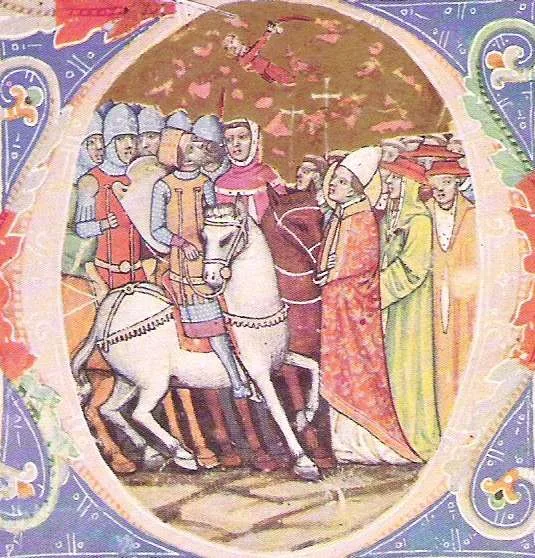
Chronicon Pictum, miniature, c. 1360. Facsimile at the University of Maryland Library. · Public domain · Source page
Rome sent a delegation north to meet Attila. Its leader was Pope Leo I, and the meeting took place at the river Mincio, near Mantua.
The source that matters most is Prosper of Aquitaine, a Christian chronicler who wrote about three years after the meeting. A later, anonymous life of the pope tells a stranger story. We will read both.
A decision point
You are Attila, king of the Huns, on the river Mincio, in spring 452.
The Mincio, near Mantua, spring 452. The Roman embassy has come to your camp.
You have sacked Aquileia, and other cities of northern Italy lie open to you. But Italy has been short of food since a famine in 451, and your camp is hungry and sick.
Rome lies to the south, and the Roman embassy is in front of you with an offer of peace. The Eastern emperor has stopped the gold, and you have no bride yet.
What do you do?
- March on Rome, while the army is still strong enough to try. Probably you win a great prize and shake the whole West. But your army is hungry and sick, and the country around you cannot feed it for long.
- Accept the offer of peace, and go back beyond the Danube. Probably the Western court keeps its city, and you keep the plunder you have taken and your fame. But you go home without the bride and the dowry, and without a clear victory to show your people.
- Demand Honoria and the dowry as the price of peace. Probably Rome refuses, and the standoff goes on while your army goes hungry. You may lose the chance to leave on terms of your own choosing.
What really happened
Accept the offer of peace, and go back beyond the Danube.
In the history Attila accepted the offer of peace and went back across the Danube. Prosper says the pope’s presence is what made him do it.
The sources do not explain the retreat in the same way. The next steps read the two main texts, and the debate asks what else may have played a part.
Each option was known to commanders of the time. Marching on Rome meant following Alaric, the Gothic king who sacked the city in 410 and died soon afterwards. One reading of Priscus gives a different reason: a superstitious fear of Alaric’s fate.
The third option, to keep pushing for Honoria, was the hardest to justify: it asked an army that was already starving to wait.
Source: Prosper: the presence of the pope
...when the king had received the embassy, he was so impressed by the presence of the high priest that he ordered his army to give up warfare and, after he had promised peace, he departed beyond the Danube.
Prosper was a Christian writer in Gaul, writing about three years after the meeting. He credits Leo alone, and says nothing about divine help. Who had reason to praise the pope?
- Who wrote this, and when? Prosper of Aquitaine, a Christian chronicler, writing about 455 about the events of 452. He was writing about a Roman bishop’s success, which is a reason to read him with care.
- What does the author say made Attila turn back? The presence of the pope. The passage names no famine, no disease and no money. It gives one reason, and the reason is Leo.
- Whose interest does the story serve? The Church’s, and the pope’s. This does not prove the story is false. It does mean the author had a reason to praise the bishop of Rome, and that the reason shapes the telling.
Source: The Life of Leo: the apostles appear
And lo, suddenly there were seen the apostles Peter and Paul, clad like bishops, standing by Leo, the one on the right hand, the other on the left.
The Life of Leo is an anonymous, undated biography of the pope. It was written after the events, and it adds a miracle that Prosper does not mention. Robinson, the editor of this translation, calls it a miraculous tale written to suit the taste of its time.
- What is new in this text, compared with Prosper? Peter and Paul, standing beside the pope. Prosper gives no supernatural help. The Life adds the miracle later, by a writer whose name we do not know.
- Why would a writer add a miracle to a meeting that really happened? To make the pope’s victory greater, and to show that God and the apostles of Rome were on the side of the bishop. We cannot be sure of the motive, but the addition is clear.
- What should a historian do with a later detail like this? Treat it as evidence of what the later writer believed, not as proof of what happened in 452. Check which text is earlier, and who wrote it.
Myth
The Huns were Mongols, a wild people who only destroyed.
The truth
Nobody has proved that the Huns were Mongols. In the eighteenth century Joseph de Guignes proposed a link with the Xiongnu of Central Asia. That link is still controversial, and it is a claim about origins, not a proof of who the Huns were.
The Huns did sack cities, and the sources are full of destruction. But Attila ruled an empire of many peoples, with a court that received Roman envoys and bargained with them. Destruction was part of his reign, but not all of it.
The evidence
Priscus, who was sent to Attila’s court as a diplomat, describes a court where Roman embassies came and went. We have no Hun account of the same events, because the Huns left no written history of their own that survives.
Why did Attila go home?
Did the pope persuade Attila to leave Italy, or did hunger, disease or an army at his back make the decision?
- Prosper and the Leo tradition The presence of the pope persuaded Attila. The later Life adds the apostles, which shows how the story grew.
- E. A. Thompson (1948) Supply decided it: an army that could not be fed in Italy could not stay.
- J. B. Bury (1923) Disease in the camp, and Marcian’s army, which was campaigning across the Danube against the Hun lands in 452, made the decision for him.
What would settle it? A Hun account, or a letter from Attila’s side, would help. None survives. Our witnesses wrote from the Roman side, or from within the Roman world.
A feast and a nosebleed
453
A wedding feast
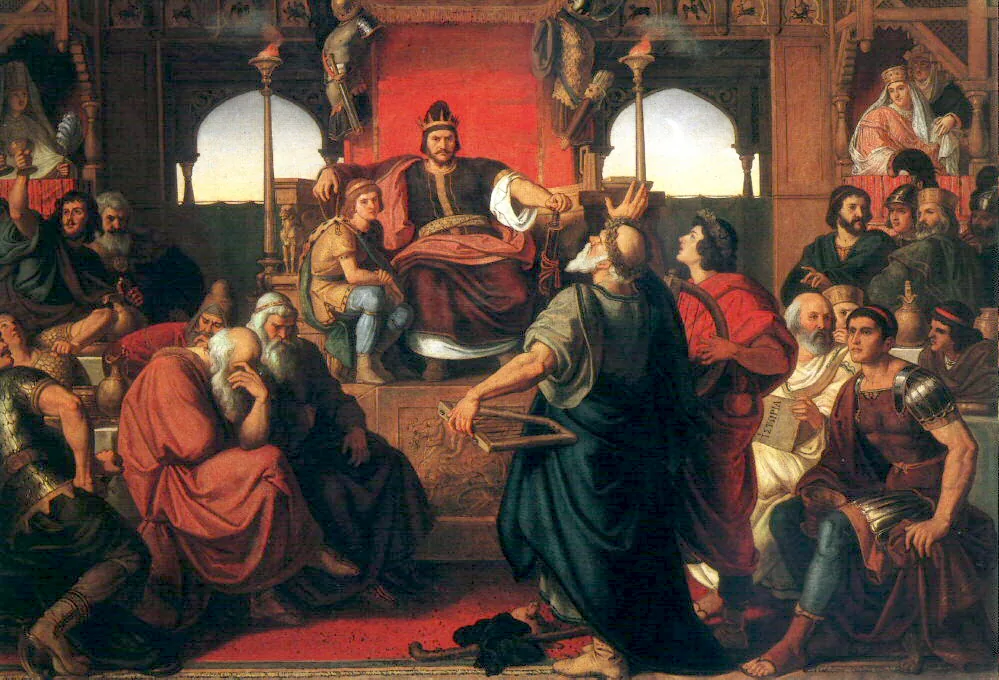
Mór Than, Feast of Attila, 1870. Painting, reproduced from Fine Arts in Hungary. · Public domain · Source page
In 453 Attila married Ildico, a young woman. He already had other wives, and the wedding was a great feast. The next morning he was found dead.
The sources say he died in the early months of 453. Our main account of the death comes from Jordanes, who passes on what Priscus wrote.
Source: Jordanes: the nosebleed
as he lay on his back, heavy with wine and sleep, a rush of superfluous blood, which would ordinarily have flowed from his nose, streamed in deadly course down his throat and killed him
Jordanes writes in the sixth century, long after Attila’s death, and says he takes the story from Priscus. The passage ends with the author’s verdict: ‘Thus did drunkenness put a disgraceful end to a king renowned in war.’
- Who is reporting this death, and how far from it? Jordanes, writing long after the event, passing on what Priscus wrote. Two writers stand between us and the death, and both had their own reasons to shape it.
- What is the author’s verdict, and is it medical or moral? Moral. ‘Drunkenness’ is a judgement on the king’s conduct. The passage describes a medical event, a nosebleed, and then explains it as the king’s punishment for excess. Notice where the moral sits.
- What would you need to know to trust the cause of death? A witness at the feast, a physician’s report, or a Hun account. The sources we have offer none of these.
Other accounts
Other explanations
The nosebleed is not the only account. The Chronicon Paschale, a Byzantine chronicle, suspects that a concubine was involved. Marcellinus Comes, writing about eighty years after the events, says that his wife killed him with a blade. A modern medical explanation proposes that swollen veins in the gullet burst and bled heavily.
A 2005 book, The Night Attila Died, argues for an assassination. Most historians reject the murder stories as rumour, written long after the death.
A dream
A bow broken in the night
Jordanes also tells that the eastern emperor Marcian dreamed, on the night Attila died, that a god showed him Attila’s bow broken. A dream cannot be tested. The story is more useful as a sign of how people felt: it treats Attila’s death as the end of a threat.
The funeral
Riders and mourners
Jordanes describes the funeral. The body was laid in a silken tent on the plain. Horsemen rode round it, singing of his deeds, and mourners cut their faces, a custom of grief that Jordanes describes without judging.
After Attila
The empire breaks
Attila’s sons quarrelled over the inheritance. The peoples who had lived under his rule saw their chance. Ardaric, king of the Gepids, led a revolt, and at the battle of Nedao, a few years later, the Hun empire broke apart.
The Huns did not vanish from history, but the empire Attila had built did not outlive him.
From the treaty to the breakup
- 443 After a campaign, the treaty of Anatolius sets the yearly tribute at 2,100 Roman pounds of gold.
- 447 Attila beats the Romans at the Utus and raids as far as Thermopylae.
- 448–449 A Roman embassy goes to Attila’s court, with Priscus in it. A plot to kill Attila comes to light: Edeco warns him.
- 450 Honoria sends her ring to Attila in spring. On 28 July Theodosius II dies. On 25 August Marcian becomes emperor, and soon cancels the payments.
- 451 June: the Catalaunian Plains. Theodoric I is killed. Attila’s army is not destroyed.
- 452 Aquileia is sacked. Attila meets Leo at the Mincio, and goes back beyond the Danube.
- 453 Attila dies after his wedding feast, and is found dead the next morning.
- after 453 The battle of Nedao: Ardaric and the Gepids lead a revolt, and the Hun empire breaks apart.
Afterwards
What can we know?
Most of what we know about Attila comes from writers who were not Huns. Priscus was on the embassy, Jordanes wrote in the sixth century, Prosper and the Life of Leo told the story from the side of the pope, and Gibbon wrote in the eighteenth century. As far as we know, none of them was a Hun. Keep that in mind as you answer the questions.
Check yourself
Honoria sent her ring in the spring of 450. To whom did it go?
Answer: To Attila, king of the Huns. Correct. The eunuch Hyacinthus carried the ring to Attila as proof of her offer.
Check yourself
Which king was killed fighting for the allied side at the Catalaunian Plains in June 451?
Answer: Theodoric I, Visigoth king. Correct. Theodoric I fell in the fighting, according to Jordanes and later writers.
Check yourself
Who met Attila at the river Mincio in 452?
Answer: Pope Leo I. Correct. Leo, bishop of Rome, went to Attila’s camp to talk about peace.
Check yourself
Which account says that the apostles Peter and Paul stood beside Leo when he met Attila?
Answer: The later Life of Leo. Correct. The Life of Leo is an anonymous, undated text, and it adds the apostles to the meeting.
Check yourself
According to Priscus, as Jordanes reports him, where and how did Attila die?
Answer: At his wedding feast, of a nosebleed. Correct. Jordanes, reporting Priscus, says he died after drinking at his wedding feast, from a nosebleed that ran down his throat.
Check yourself
When did Marcian become emperor of the East, and what did he stop?
Answer: 25 August 450; the gold to Attila. Correct. Marcian took power on 25 August 450, and cancelled the treaties and the payments to Attila.
Terms
- tribute A regular payment that a weaker power makes to a stronger one, usually to buy peace. The Eastern Roman government paid the Huns a yearly tribute.
- foederati Peoples who fought for Rome under a treaty, from the Latin foedus, ‘treaty’. They served as allies rather than as Roman soldiers.
- Visigoths A Gothic people who settled in Gaul and Spain under treaties with Rome. Their king in 451 was Theodoric I.
- Priscus of Panium A Greek-speaking Roman diplomat and historian, who was on the embassy to Attila’s court in 448–449. He wrote a history of 430 to 476 in eight books, which survives in fragments.
- Jordanes A historian of Gothic origin who wrote the Getica, a history of the Goths in Latin, in the sixth century.
- chronicle A history recorded year by year or event by event, often by monks or officials, and often long after the events.
- Eastern Roman Empire The half of the Roman Empire ruled from Constantinople, which later historians call the Byzantine Empire. In the 440s its emperor was Theodosius II.
- Life of Leo An anonymous biography of Pope Leo I, written later, of unknown date. It adds the apostles Peter and Paul to the meeting at the Mincio.
- Scourge of God A later title for Attila. We know of no contemporary source that uses it, and it spread through later writing.
- dowry The property a bride brings to her husband, or a sum given with her. Attila’s claim to Honoria’s dowry was a claim to half the Western Empire.
- Catalaunian Plains The battlefield in Gaul, near Chalons or Troyes, where Aetius and Theodoric I fought Attila in June 451. The exact site is not known.
- Honoria The sister of the Western emperor Valentinian III. She sent Attila a plea and her ring, and he claimed her as his bride.
- Valentinian III The Western emperor, brother of Honoria. According to the sources, he rejected Attila's demand.
- Maximinus A Roman envoy who went with Priscus to Attila's court in 448–449.
- Chrysaphius The powerful minister at the Eastern court. According to Priscus, he bribed a Hun envoy to kill Attila.
- Edeco A Hun envoy whom Chrysaphius bribed. According to Priscus, he told Attila about the plot against him.
- Thermopylae A narrow pass in Greece, famous for a battle in which the Greeks fought the Persians. Attila raided as far as there.
- Utus A river where Attila beat the Romans in 447.
- Constantinople The capital of the Eastern Roman Empire. The emperor's advisers there decided how to deal with Attila.
- Aetius The Roman general who commanded in Gaul. He chose an alliance with the Visigoths and other allied peoples against Attila.
- Theodoric I King of the Visigoths. He was killed in the battle of the Catalaunian Plains in 451.
- Leo I The pope who led a Roman delegation to meet Attila at the river Mincio.
- Prosper of Aquitaine A Christian chronicler from Gaul, who wrote about three years after the meeting. He credits Leo alone with the retreat.
- Gibbon A British historian who wrote in the eighteenth century. He said a Tartar or a Hun might deserve the title Scourge of God.
- Ildico The young woman Attila married in 453. He was found dead the next morning.
- Ardaric King of the Gepids. He led a revolt, and at the battle of Nedao the Hun empire broke apart.
- Gepids A people who lived under Attila's rule. Their king, Ardaric, led a revolt after his death.
- Marathon A battle in ancient Greece, where the Athenians beat the Persians. Hyun Jin Kim reads the Catalaunian battle as a deliberate echo of it.
- Raphael An Italian Renaissance painter. In 1514 he painted the meeting of Leo and Attila in the Vatican.
- Hyacinthus A eunuch who carried Honoria's plea and ring to Attila.
- Xiongnu A nomadic people of Central Asia. Joseph de Guignes proposed a link between them and the Huns, a link still controversial.
- eunuch A castrated man, often employed in royal courts.
- Aquileia A large city at the head of the Adriatic. Attila sacked it in 452, and its people fled to the islands of the lagoon.
Sources
- Jordanes, The Origin and Deeds of the Goths (Getica), trans. Charles Christopher Mierow (Princeton: Princeton University Press, 1915), chs. XXXV, XL and XLIX
- Prosper of Aquitaine, Chronicle, for the year 452 (written about 455), in James Harvey Robinson, ed., Readings in European History (Boston: Ginn, 1905), pp. 49–51
- Anonymous, Life of Leo (date unknown), in Robinson, Readings in European History (1905), via the Fordham Medieval Sourcebook
- Edward Gibbon, The History of the Decline and Fall of the Roman Empire, vol. 3, chs. XXXIV–XXXV (London, 1776–1788), Project Gutenberg eBook 733
- Priscus of Panium, History of 430–476 (fragments), known through the quotations of Jordanes and later writers
- E. A. Thompson, A History of Attila and the Huns (Oxford: Clarendon Press, 1948)
- Christopher Kelly, Attila the Hun: Barbarian Terror and the Fall of the Roman Empire (London: The Bodley Head, 2008)
- Hyun Jin Kim, The Huns (London: Routledge, 2015)
- Peter Heather, The Fall of the Roman Empire: A New History of Rome and the Barbarians (London: Macmillan, 2005)
- J. B. Bury, History of the Later Roman Empire from the Death of Theodosius I to the Death of Justinian (London: Macmillan, 1923)
- Edward S. Creasy, The Fifteen Decisive Battles of the World (London: Richard Bentley, 1851)
Image credits
- Raphael, The Meeting of Leo the Great and Attila, fresco, 1514. Vatican (Stanza di Eliodoro). · Public domain · Source page
- Johann Nepomuk Geiger, The Huns in Battle with the Alans, engraving after his drawing, c. 1873. · Public domain · Source page
- Chronicon Pictum, miniature, c. 1360. Facsimile at the University of Maryland Library. · Public domain · Source page
- Mór Than, Feast of Attila, 1870. Painting, reproduced from Fine Arts in Hungary. · Public domain · Source page


