Alexander the Great
King at 20, ruler from Greece to India by 30. Then his own army said no.
Decisions, questions and your own progress, in the app
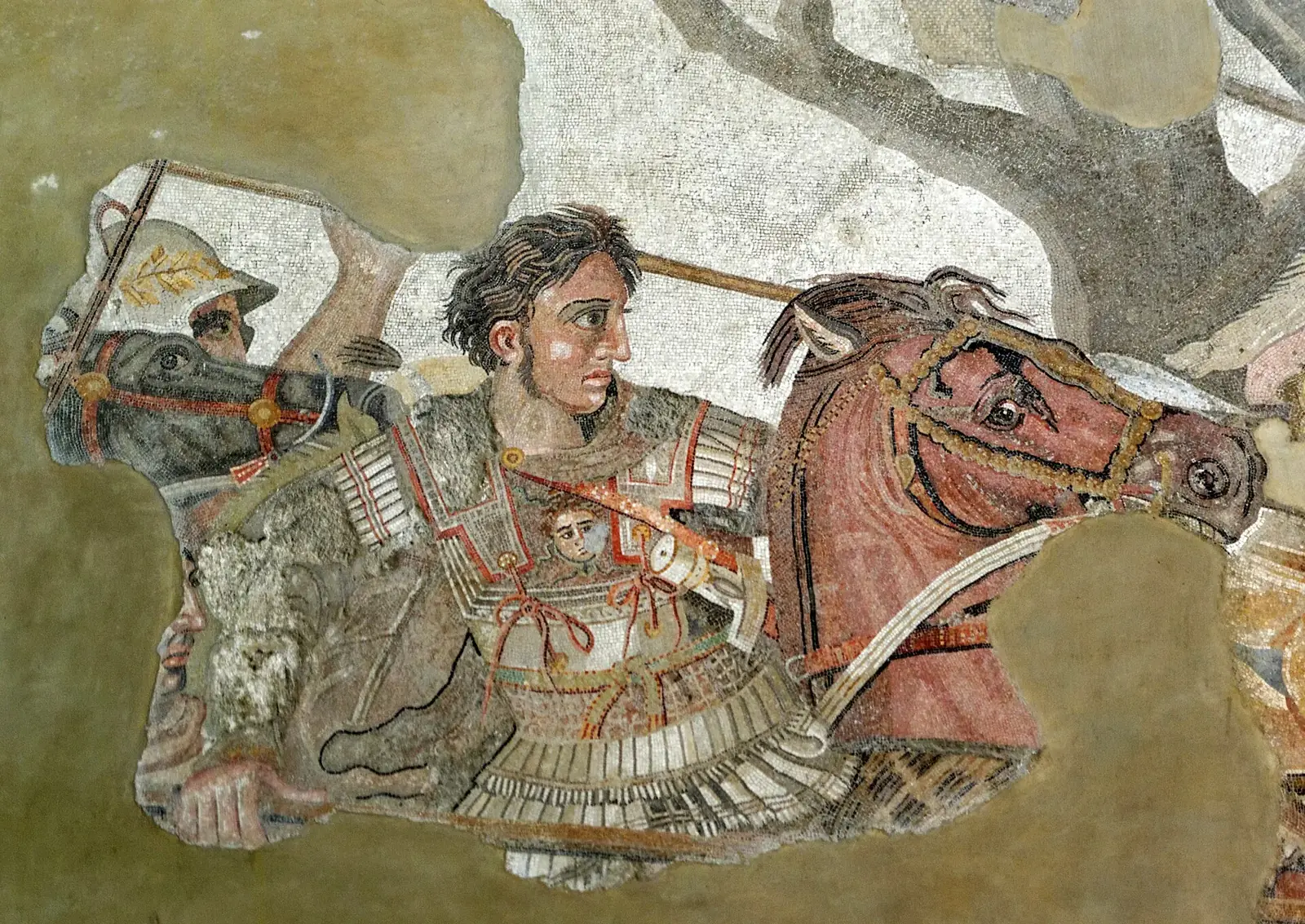
The Alexander Mosaic (detail), House of the Faun, Pompeii, c. 100 BC. National Archaeological Museum, Naples · Public domain · Source page
Murder in the theatre
A wedding, a theatre, a dagger
Dawn at Aegae, the old royal city of Macedon, 336 BC. The theatre is packed. King Philip II is celebrating his daughter's wedding. He walks in alone, in a white cloak, having ordered his bodyguards to keep their distance. He wants the crowd to see a king who needs no protection.
One of those bodyguards, a Macedonian noble named Pausanias, runs forward and drives a dagger into him. Philip falls dead. Soon the army hails his son Alexander as king. He is 20. Thirteen years from now he will be dead too, master of an empire from Greece to India.
The question
Who wanted Philip dead?
Pausanias ran for the horses waiting for him, tripped, and was killed on the spot by Philip's men. Dead men answer no questions.
Aristotle, who knew the court, gave a personal motive: the men of a noble named Attalus had humiliated Pausanias, and Philip had refused to punish him. But Attalus was also the uncle of Philip's new young wife, and at the wedding feast he had hinted that Alexander was not a legitimate heir. So suspicion fell on Alexander's mother, Olympias, and on Alexander himself. Alexander later blamed the king of Persia.
Whoever was behind it, the new king moved fast. Within months his possible rivals for the throne, Attalus among them, were dead.
The army, the tutor and the horse
Background
A kingdom on the edge of Greece
Macedon lies in the north of the Greek world: a land of kings, horsemen and forests. In Athens, many saw it as half-barbarian. When Philip took power in 359 BC, the kingdom was in crisis: his brother the king had just been killed in battle, with some 4,000 of his men.
Philip rebuilt the army. His foot soldiers fought in a phalanx, armed with the sarissa, a pike some five to six metres long. The enemy met a hedge of iron points. His heavy cavalry, the Companions, were nobles who rode and feasted with the king. In 20 years Philip made Macedon the strongest power in Greece.
The boy
A tutor and a horse
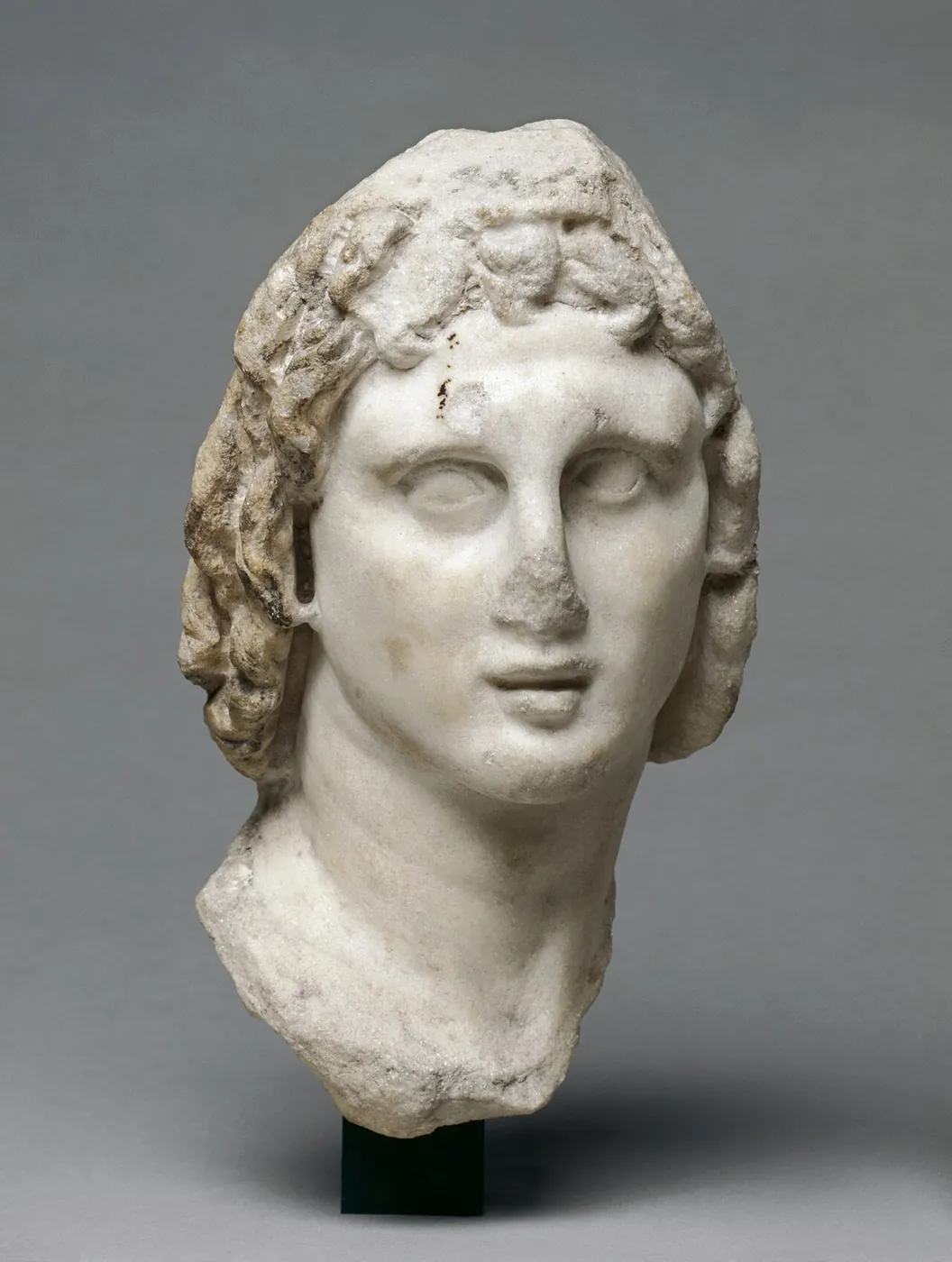
Head of Alexander the Great, marble, Hellenistic, probably c. 300 BC. Cleveland Museum of Art · CC0 · Source page
Alexander was born in 356 BC, the son of Philip and Olympias, a princess from Epirus. From about 13 he was taught by Aristotle. According to Plutarch, he kept a copy of Homer's Iliad under his pillow, next to a dagger.
Plutarch also tells of a fierce horse, Bucephalus, that nobody could ride. The boy noticed that it shied at its own shadow, turned it towards the sun and mounted it. Macedon, Philip said, was too small for such a son.
At 18 Alexander commanded one wing of his father's army at Chaeronea (338 BC), where Philip crushed Athens and Thebes. Philip then bound the Greek cities into a League of Corinth under his leadership, with one declared aim: war on Persia.
A warning
Nobody who was there
0
That is how many histories of Alexander written in his lifetime survive. Men who marched with him, like his general Ptolemy and the engineer Aristobulus, wrote about him. Their books are lost.
The accounts that survive were written by Diodorus, Curtius, Plutarch, Arrian and Justin, three to five centuries after Alexander died. They copied and chose from the lost books. Coins, inscriptions and a few clay tablets survive from his lifetime, but no continuous story. So when this lesson says ‘the sources’, it means writers as far from Alexander as we are from Shakespeare, or further.
Source: A biographer explains himself
“For it is not Histories that I am writing, but Lives; and in the most illustrious deeds there is not always a manifestation of virtue or vice, nay, a slight thing like a phrase or a jest often makes a greater revelation of character than battles where thousands fall…”
Plutarch came from Chaeronea, the very town where Alexander fought at 18. He paired his Alexander with a life of Julius Caesar.
- What does Plutarch say he is not doing? Writing history. He picks small stories that reveal character. The horse and its shadow, the Iliad under the pillow: exactly such stories.
- Plutarch wrote about 400 years after Alexander. Where could his stories come from? From lost books by men who marched with Alexander, and from stories retold over generations. Plutarch often names his sources and admits when they disagree. A good reader asks: whose story is this?
Thebes, then Asia
A decision point
You are Alexander, king of Macedon.
Autumn 335 BC, at Thebes
You have been king for a year. While you fought tribes far to the north, a rumour said you were dead. Thebes, one of the proudest cities in Greece, rose in revolt and besieged your garrison; Athens voted to support it.
You marched south at astonishing speed. You offered a pardon if Thebes handed over two of its leaders. It refused. Now your army and your Greek allies have stormed the city, and the fighting in its streets has been merciless.
Among your allies are Thebes's neighbours, who have hated it for generations. All Greece is watching, and soon you leave for Asia.
What do you do with Thebes?
- Pardon the city and punish only the leaders of the revolt You would look generous, and many Greeks would breathe again. But a garrison did not prevent this revolt. A forgiven Thebes might rise again the moment you are far away in Asia.
- Spare the city, but take hostages and double the garrison Thebes would probably stay quiet while the hostages lived. But you need every soldier for Persia, and a large garrison in Greece is an army you cannot take with you.
- Let your Greek allies, as members of the League of Corinth, decide the city's fate It would look lawful: the league judging a member that broke its oath. But the allies present are Thebes's old enemies. They will almost certainly choose the harshest punishment, and you will not have to pronounce it yourself.
What really happened
Let your Greek allies, as members of the League of Corinth, decide the city's fate
According to Arrian, Alexander left the decision to the allies who had fought beside him. They voted to raze Thebes to the ground and sell its surviving people into slavery. The sources give more than 6,000 Thebans killed and about 30,000 sold. Alexander ordered that the temples be spared, and the house and descendants of the poet Pindar. Athens hurried to congratulate him.
Plutarch says Alexander wanted to frighten the Greeks into obedience, and it largely worked: apart from a Spartan revolt in 331 BC, Greece stayed quiet behind him. Many historians see the allies' vote as a convenient cover. Plutarch adds that Alexander later regretted it.
334–333 BC
Into Asia
In spring 334 BC Alexander crossed into Asia with roughly 35,000 to 40,000 men; the sources give different numbers. Ahead lay the Persian Empire, the largest state the world had yet seen, from Egypt and the Aegean Sea to the river Indus.
He beat an army of Persian governors at the river Granicus. At Issus in 333 BC he faced the Persian king himself, Darius III, crowned in the same year as Alexander. Darius fled the battlefield, leaving behind his camp, his mother, his wife and his children.
Myth
At Gordium, Alexander solved the impossible knot with one bold stroke of his sword.
The truth
At Gordium in 333 BC stood an ancient wagon, its yoke tied on with a knot of bark; whoever undid it, an oracle said, would rule Asia. Some writers say Alexander cut it. Aristobulus, who was there, said he pulled out the pin holding the yoke to the pole and slipped it free. Arrian reports both and admits he cannot say which is true.
The evidence
Arrian, Anabasis 2.3; Plutarch, Life of Alexander 18. The painting, from 1767, shows the sword, because the sword makes the better picture.
Source: Alexander charges
The Alexander Mosaic, House of the Faun, Pompeii, c. 100 BC; probably a copy of a lost Greek painting of about 300 BC
This floor, almost six metres wide and made of more than a million tiny stones, was found in a Pompeii house in 1831. Only Alexander is shown here. In the full scene he charges bareheaded from the left, his spear through a Persian horseman. On the right Darius, in his chariot, stretches an arm towards his fallen men as his driver whips the horses into flight.
- Who is the hero, and how can you tell? Alexander: calm, wide-eyed, riding straight at the king without a helmet, while Darius turns to flee. Yet Darius gets a human gesture, reaching out to a dying man. The winner is glorified; the loser is not a monster.
- The floor was laid more than 200 years after the battle. Can we trust its details? Only with care. It probably copies a lost Greek painting of about 300 BC; a copy can change things, and the original was itself made to celebrate. Scholars still argue whether it shows Issus or Gaugamela.
- Why would a Roman want Alexander on his floor? Every Roman general measured himself against Alexander; Suetonius says Julius Caesar sighed before his statue: at the age when Alexander had conquered the world, he had done nothing memorable. A floor like this displayed taste and ambition: a source tells you about its owner too.
The offer and the fire
Source: The queen who bowed to the wrong man
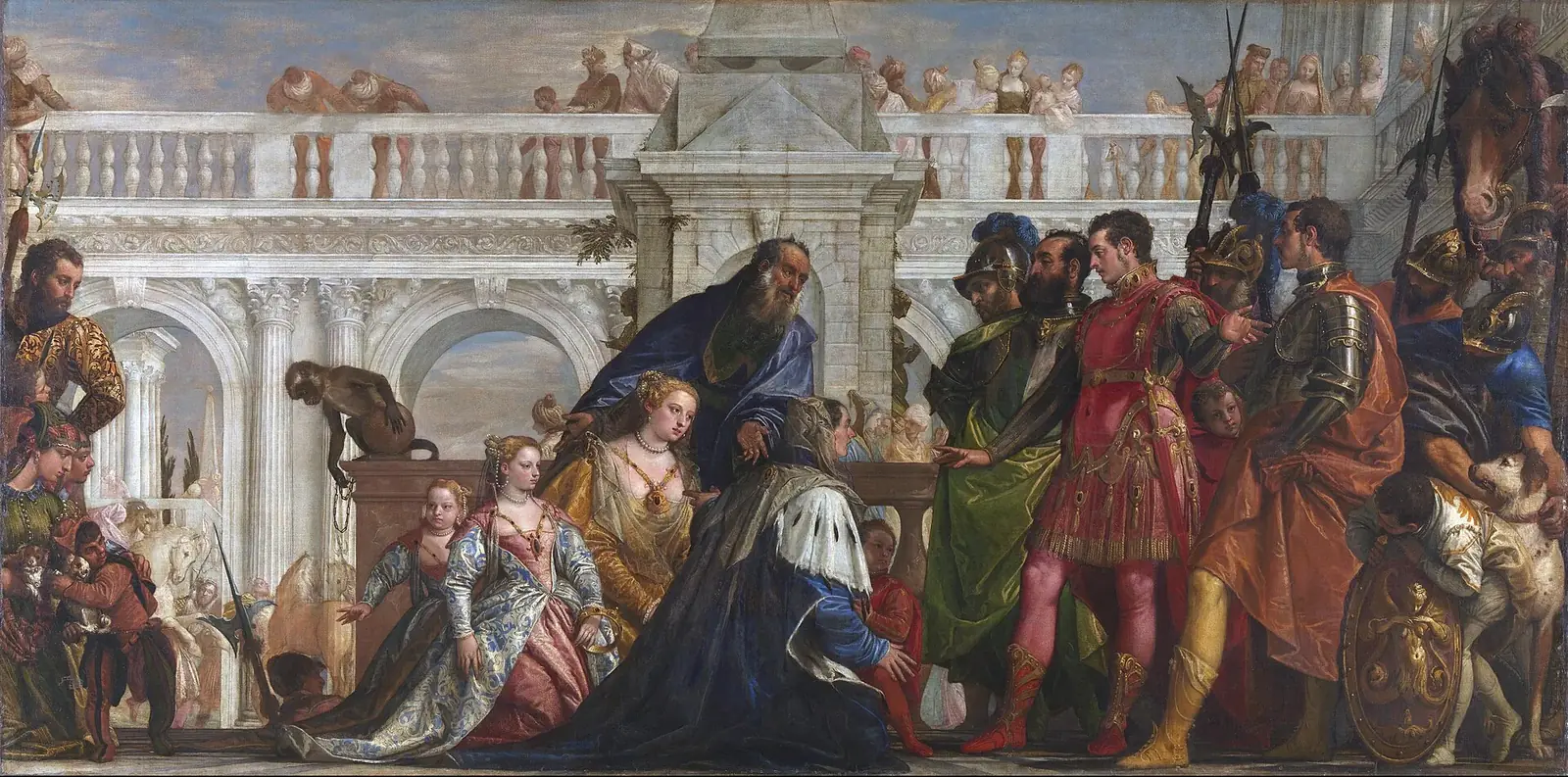
Paolo Veronese, The Family of Darius before Alexander, 1565–1567. National Gallery, London · Public domain · Source page
Paolo Veronese, The Family of Darius before Alexander, 1565–1567. National Gallery, London
After Issus, the story goes, Alexander visited the captive royal women with his closest friend, Hephaestion. Hephaestion was taller, so Darius's mother, Sisygambis, knelt to him by mistake. Alexander told her she had not erred: Hephaestion, too, was Alexander. Arrian tells the story but cannot vouch for it.
- Look at the clothes and the buildings. Where and when are we? In Venice in the 1560s: silk gowns, pearls, Renaissance armour, a marble balustrade, even a monkey. Paintings of the past almost always dress it in the painter's own present.
- Why would a Venetian noble family want this story on its wall? Because it shows a mighty conqueror treating defeated women with mercy and courtesy, virtues a Venetian aristocrat liked to claim. The painting belonged for centuries to the Pisani family of Venice, until London's National Gallery bought it in 1857.
- Which of the men in armour is Alexander? It is not obvious; viewers have long argued. The young man in red stands at the centre, but he could be Hephaestion presenting his king. Without a label, we risk repeating the queen's mistake.
A decision point
You are Alexander.
332 BC, at the siege of Tyre
For months you have besieged Tyre, an island city off the coast of today's Lebanon, building a causeway out to its walls. You hold Asia Minor and most of the Syrian coast. Darius's family are your captives, treated as royalty.
Envoys arrive from Darius. He offers 10,000 talents of silver as ransom for his family, all his lands west of the river Euphrates, his daughter's hand in marriage, and friendship. He still holds Babylon, Persia and the East, and the armies they can raise.
Parmenion, your father's most experienced general, says that if he were Alexander, he would accept.
What do you answer?
- Accept: take half an empire, a royal bride and a fortune, and end the war Probably the richest peace any Greek king had ever made. But Darius would keep the eastern half of his empire and its soldiers, and as your father-in-law he could still come back for the rest.
- Refuse: you want the whole empire, not a share of it The war goes on. You must still take Tyre, then march deep into Asia against a king who now knows there will be no deal.
- Keep negotiating while you finish the siege It buys time, but signals doubt. Your officers and the watching Greek cities would wonder whether you can be bought, and Darius would gain months to raise a bigger army.
What really happened
Refuse: you want the whole empire, not a share of it
Alexander refused. Arrian says he replied that all Darius's land and money were already his, and that he would marry Darius's daughter if he wished, without asking. In Plutarch's telling, Parmenion said he would accept, were he Alexander. “So would I,” Alexander answered, “were I Parmenion.”
The sources disagree about when the offer came and how big it was. Alexander probably believed he could win everything, and he had promised the Greeks revenge, not a bargain. Notice that the famous exchange flatters Alexander and belittles Parmenion, whom Alexander had killed two years later. The winners wrote the stories.
332–331 BC
Egypt, then the decisive battle
Tyre fell after seven months. Egypt surrendered without a fight, and on its coast Alexander founded Alexandria.
In October 331 BC, near Gaugamela in today's northern Iraq, he broke Darius's last great army. Babylon and Susa opened their gates. Then came Persepolis, the ceremonial heart of the Persian kings.
A decision point
You are Alexander.
Spring 330 BC, Persepolis
You have wintered in the palace city of the Persian kings. Its treasury held 120,000 talents of silver and gold, the sources say. Its halls were built by Darius I and his son Xerxes, whom many identify with Ahasuerus of the Book of Esther: the kings who invaded Greece 150 years ago. Xerxes's army burned the temples on the Acropolis of Athens.
You promised the Greeks revenge for that. But Darius III is still alive in the east, and the Persian nobles you need to govern are watching how you treat their kings' greatest monument.
Parmenion advises you to spare it: why destroy what is now your own property?
What do you do with the palace?
- Burn it: a signal to every Greek that the war of revenge is complete The Greeks get their symbol. The Persians see a conqueror rather than a new king, and winning over their nobles becomes harder.
- Keep it as your royal seat, as the new King of Kings Persian nobles might accept you more easily. But the Greeks of your league could ask where their promised revenge went, and some of your Macedonians would see you turning Persian.
- Empty the treasury and move on, leaving the palace standing A practical middle way. The silver pays your army either way, but neither Greeks nor Persians get a clear message about who you are.
What really happened
Burn it: a signal to every Greek that the war of revenge is complete
Before leaving, Alexander had the palace set on fire. The sources disagree about how. Arrian, following writers who were there, presents it as deliberate revenge for Xerxes's burning of Athens. Plutarch, Diodorus and Curtius tell of a drunken feast at which Thais, an Athenian woman, urged the guests to burn the palace, and Alexander threw the first torch.
Arrian, who usually admires Alexander, says it was not wise; Curtius says Alexander soon regretted it. Archaeologists in the 1930s found the burned remains of the treasury and great halls. Planned or drunken, the fire told the Greeks one thing and the Persians another.
Further than anyone
A decision point
You are Alexander.
327 BC, in Bactria
Darius is dead, murdered by his own nobles, and you claim his throne. You rule millions of people with a Macedonian army of a few tens of thousands. To govern, you need Persian nobles who know how the empire works; several are already your satraps. To win battles, you need your Macedonians.
At the Persian court everyone bows low before the king, a gesture the Greeks call proskynesis. To Persians it is ordinary respect. To Greeks and Macedonians it is a gesture for the gods, and a free man does not make it to another man.
How will you rule?
- As a Macedonian king: Macedonians in every top post, Macedonian customs, no Persian ceremony Your army would be content. But a few thousand officers cannot run an empire of millions, and Persian nobles would have little reason to serve a ruler who treats them as conquered subjects. Revolts would probably follow.
- Blend the two: Persian nobles in office, some Persian royal dress, and the bow from everyone, Macedonians too At a banquet the bow is tried. Some Macedonians perform it; others laugh; the court historian Callisthenes openly refuses. The plan for the Macedonians is quietly dropped.
- Rule two peoples two ways: Persians bow to you, Macedonians do not This avoids a clash, for now. But you would run one court with two sets of rules, and each side might suspect that the other is your favourite.
What really happened
Blend the two: Persian nobles in office, some Persian royal dress, and the bow from everyone, Macedonians too
Alexander tried it. Arrian and Plutarch describe a banquet where the guests drank, bowed and received a kiss from the king. Callisthenes drank, but did not bow. Alexander dropped the demand for the Macedonians, but not his anger: soon afterwards Callisthenes was arrested over a plot among the royal pages and died in custody. Ptolemy says he was executed; Aristobulus, that he died of illness in chains.
Alexander needed Persians to rule and Macedonians to fight, and the bow sat exactly on the line between them. Some historians see a vision of partnership between peoples; others, a conqueror who wanted to be more than a man.
Source: A face made to order
Head of Alexander the Great, marble, Hellenistic, probably c. 300 BC. Cleveland Museum of Art
Plutarch says Alexander let only the sculptor Lysippus portray him, because Lysippus alone caught the slight tilt of his neck and the “melting glance” of his eyes. No original by Lysippus survives. Heads like this one, probably carved in Egypt after Alexander's death, spread that official look.
- Is this what Alexander really looked like? Partly, at best. Notice the thick, tousled hair, the turn of the head, the eyes lifted upwards and the parted lips. These belong to an official image, repeated for centuries. A style, not a photograph.
- Who gained from spreading this face? First Alexander, then his successors. Ptolemy of Egypt put Alexander's portrait on his coins. A young, inspired, god-like Alexander made their own power look like his inheritance.
- What does this head leave out? Age, scars and anything ordinary. Alexander was wounded many times; in India an arrow pierced his chest. An idealised portrait shows what a ruler wanted to be. That is evidence too, of a different kind.
A decision point
You are Alexander.
326 BC, on the river Hyphasis (the Beas), in today's Punjab
You have defeated King Porus and his war elephants at the river Hydaspes. Your army has been marching for eight years. For weeks the monsoon rain has not stopped: clothes are in rags, weapons are worn out, horses' hooves are worn thin.
Beyond the river, your informants say, lie a desert and then the Ganges, and a powerful kingdom with thousands of war elephants. You believe the great Ocean, the edge of the world, cannot be much further.
Your soldiers say they will go no further. In Arrian's account, at a council of officers, Coenus, one of your most loyal generals, speaks for them: the men are worn out, many are dead, and the living want to see their families again.
What do you do?
- Order the army across: you have never lost a battle, and the edge of the world is near The army might obey, or it might not. Leading exhausted, unwilling men towards a kingdom with thousands of elephants risked mutiny, or a disaster far from any help.
- Go on with volunteers, and let anyone who wants to go home leave A smaller army, far from home, facing the largest army in India without your best veterans. Arrian says Alexander did threaten this, hoping shame would change their minds. It did not.
- Give in and turn back The army rejoices. But you must find a way home, and a way to turn back without looking beaten.
What really happened
Give in and turn back
Alexander shut himself in his tent for three days, waiting for the army to change its mind. It did not. He then offered sacrifices for the crossing, and the omens, Arrian says, were unfavourable. He announced the return. The soldiers wept and cheered. Before leaving, he had twelve huge altars built on the riverbank to mark the furthest point of his march.
Alexander could beat any enemy, but not his own army. The bad omens let him give way without seeming to give in. The road home, across the Gedrosian desert in 325 BC, cost many lives; how many, the sources do not reliably say.
Death in Babylon, and life after death
323 BC
“The king died”
32
That is how old Alexander was when he died. In spring 323 BC he was back in Babylon, planning new campaigns. After a series of banquets he fell ill with a fever. He grew weaker day by day, until he could no longer speak. In June 323 BC he died.
A Babylonian astronomer, who recorded the sky and the news each night, noted on a clay tablet: “The king died.” It is one of the very few records of Alexander made at the time.
What killed him? The ancient writers mention drinking, fever and rumours of poison that most of them doubted; modern doctors suggest malaria, typhoid and more. His body, once entombed in Alexandria, is lost. Every theory is a guess.
After Alexander
- 323 BC Asked who should inherit, Alexander is said to have answered: “The strongest.” His generals, the Successors, carve up the empire in the name of his half-brother and his baby son.
- 321 BC Ptolemy, governor of Egypt, seizes Alexander's body and takes it to Egypt. The king's body is a claim to power.
- c. 310 BC Alexander's son, Alexander IV, about 13, is murdered with his mother on the orders of Cassander, ruler of Macedon. Alexander's family line ends.
- c. 305 BC The Successors declare themselves kings. Three kingdoms emerge: the Ptolemies in Egypt, the Seleucids in Asia and, later, the Antigonids in Macedon.
- 3rd century BC In Alexandria the Ptolemies build the great Library, which tries to collect every book in the world, and Jewish scholars there translate the Torah into Greek: the Septuagint. A simpler, shared Greek, Koine, is spoken by officials, traders and scholars from Egypt to Afghanistan.
- 167 BC In Judea the Seleucid king Antiochus IV, a descendant of Seleucus, one of Alexander's generals, outlaws Jewish worship. The Maccabean revolt that follows is still remembered at Hanukkah.
- 30 BC Cleopatra VII, the last of Ptolemy's line, dies, and Egypt becomes Roman. Greek remains the language of the eastern Mediterranean; the New Testament will be written in it.
Myth
Alexander wept because there were no more worlds left for him to conquer.
The truth
The ancient story says almost the opposite. In Plutarch's telling, Alexander wept on hearing the philosopher Anaxarchus speak of an infinite number of worlds: there were so many, and he had not yet conquered even one. The popular version, tears because he had run out of worlds, is not in any ancient source we know. It turns a warning about endless ambition into a boast.
The evidence
Plutarch, On Tranquillity of Mind 466D, written around AD 100. Alexander never even reached the Ganges.
“Great”, but for whom?
Was Alexander a visionary who dreamed of uniting peoples, or a conqueror whose greatness others paid for?
- W. W. Tarn, Alexander the Great (1948) Tarn's Alexander is a gentleman and a dreamer. At a banquet at Opis in 324 BC, Alexander prayed for harmony and partnership in rule between Macedonians and Persians. Tarn read this as a vision of the brotherhood of all mankind, and dismissed many of the darker stories as hostile inventions.
- Ernst Badian (from 1958) and A. B. Bosworth, Conquest and Empire (1988) Badian took Tarn's ‘brotherhood of mankind’ apart: the prayer at Opis was about two ruling peoples sharing power, not about humanity. Bosworth stressed the cost: cities destroyed, massacres in Central Asia and India, a king ever more suspicious of his own friends. Their Alexander is a brilliant general and a ruthless autocrat.
- Pierre Briant, and the view from Persia Briant, a historian of the Persian Empire, looks from the other side. Alexander kept much of the Persian system: its governors, roads and taxes. Briant calls him, provocatively, ‘the last of the Achaemenids’. Persian memory is split too: in later Zoroastrian writings he is ‘Alexander the accursed’, who burned holy books; in Ferdowsi's Persian epic, the Shahnameh (about AD 1010), he becomes Eskandar, a half-Persian prince.
Can one man be both a military genius and a catastrophe? Whose memory decides what ‘great’ means: the soldiers who followed him, the cities he destroyed, or the peoples who spoke Greek for a thousand years after him?
What do you know now?
Check yourself
Why can we not be sure why the palace at Persepolis burned?
Answer: Our sources were written centuries later and disagree: Arrian describes deliberate revenge, others a drunken feast. Right. Both stories come from earlier books that are now lost, and the surviving writers chose different versions. Archaeology confirms the fire, not the motive.
Check yourself
What happened to Thebes after it revolted in 335 BC?
Answer: It was razed after a vote of Alexander's allies, and about 30,000 people were sold into slavery; Pindar's house was spared. Right. The allies' vote gave the destruction a legal cover, and the poet's spared house showed that Alexander could also honour Greek culture.
Check yourself
What is Veronese's painting of Darius's family best evidence for?
Answer: How a Venetian of the 1560s imagined a noble, merciful ruler. Right. The silk, the pearls and the Venetian palace show the painter's own world and values. It is excellent evidence about Venice, and weak evidence about Issus.
Check yourself
Why did Alexander's march east end at the river Hyphasis in 326 BC?
Answer: His exhausted soldiers refused to go on, and after three days he gave way. Right. Coenus spoke for the army. Alexander waited in his tent, then used the bad omens as his reason to turn back.
Check yourself
According to Plutarch, why did Alexander weep when he heard about ‘worlds’?
Answer: Because there were infinite worlds, and he had not yet conquered even one. Right. Plutarch uses the story to show a mind that is never satisfied.
Check yourself
Which of these was a lasting result of Alexander's conquests?
Answer: Greek became a shared language from Egypt to Afghanistan, later used for the Septuagint and the New Testament. Right. Koine Greek outlived every kingdom the Successors built.
Terms
- phalanx A block of foot soldiers standing shoulder to shoulder, many ranks deep. Philip's phalanx was often 16 ranks deep and armed with the sarissa.
- sarissa The Macedonian pike, some five to six metres long and held in both hands. The points of the first five ranks stuck out in front of the phalanx.
- Companions The heavy cavalry of the Macedonian kings, drawn from noble families. They fought beside the king, and Alexander usually led their charge himself.
- League of Corinth The alliance of Greek cities that Philip created in 337 BC, after Chaeronea, with himself as leader. Its declared aim was a war of revenge on Persia.
- Persian Empire The empire of the Achaemenid kings, founded by Cyrus the Great around 550 BC. At its height it reached from Egypt and the Aegean to the river Indus.
- satrap The governor of a province of the Persian Empire. Alexander kept the system, and often left Persian nobles in the post.
- talent A unit of weight and of money. A talent of silver weighed about 26 kilograms, so 10,000 talents was roughly 260 tonnes of silver.
- proskynesis The deep bow, sometimes a full prostration, that Persians made before their king. Greeks thought such a gesture was due only to the gods.
- Plutarch Greek writer and priest (c. AD 46 to after 119) from Chaeronea, author of the Parallel Lives. He wrote his Life of Alexander about 400 years after Alexander's death.
- Arrian Greek historian and Roman official (c. AD 86–160) who wrote the Anabasis of Alexander, the most sober surviving history, based mainly on the lost books of Ptolemy and Aristobulus.
- Successors Alexander's generals (in Greek, the Diadochi), who fought one another for his empire for some 40 years after his death and founded the kingdoms that divided it.
- Koine ‘Common’ Greek: the simpler Greek spoken across the eastern Mediterranean and the Middle East after Alexander. The Septuagint and the New Testament are written in it.
- Philip II King of Macedon and father of Alexander. He made Macedon the strongest power in Greece and was murdered at his daughter’s wedding.
- Aegae The old royal city of Macedon, where Philip was murdered. Today the site is called Vergina.
- Macedon A kingdom in the north of the Greek world, a land of kings, horsemen and forests. Many in Athens saw it as half-barbarian.
- Pausanias A Macedonian noble, one of Philip’s bodyguards, who stabbed him in the theatre. He was killed on the spot.
- Attalus A Macedonian noble, uncle of Philip’s new young wife. At the wedding feast he hinted that Alexander was no legitimate heir, and within months he was dead.
- Olympias A princess of Epirus, wife of Philip and mother of Alexander. According to Plutarch, most of the blame for the murder fell on her.
- Aristotle A Greek philosopher who taught Alexander from about the age of 13. In his Politics he commented on the murder.
- Diodorus A historian who wrote three to five centuries after Alexander, copying lost books. He often followed the ‘vulgate’ tradition.
- Curtius A historian who wrote about Alexander centuries after his death, often following the ‘vulgate’ tradition.
- Justin A very late historian who tells how Olympias placed a gold crown on the dead assassin’s head. Most historians see this as hostile gossip.
- Ptolemy A general of Alexander who wrote about him, and later king of Egypt. His book is lost, but Arrian relied on it.
- Chaeronea A town in Greece where Philip crushed Athens and Thebes in 338 BC. Alexander commanded one wing there.
- Thebes A proud city in Greece that rose against Alexander. His allies razed it, and its survivors were sold into slavery.
- Bucephalus A wild horse that nobody could ride, until young Alexander mounted it. According to Plutarch, it shied at its own shadow.
- Granicus A river in Asia Minor where Alexander beat an army of Persian governors.
- Issus The battle site where in 333 BC Alexander faced Darius III himself. Darius fled the field and left his family behind.
- Gaugamela A battle site in what is now northern Iraq, where in 331 BC Alexander broke Darius’s last great army.
- Gordian knot A knot on an ancient wagon at Gordium. An oracle said whoever untied it would rule Asia. Some say Alexander cut it.
- Darius III King of Persia, defeated by Alexander at Issus and Gaugamela. He was murdered by his own nobles in 330 BC as he fled east.
- Persepolis The palace city of the Persian kings and their ceremonial centre. Alexander had its palace set on fire before leaving.
- Tyre An island city off the coast of today’s Lebanon. Alexander built a causeway to it, and it fell after seven months.
- Parmenion Philip’s most experienced general. He said that if he were Alexander he would accept Darius’s offer, and advised sparing Persepolis.
- Thais An Athenian woman who, in some accounts, urged the drunken guests at a feast to burn the Persian palace.
- Homer An ancient Greek poet, author of the Iliad about the Trojan War. According to Plutarch, Alexander kept a copy under his pillow.
Sources
- Arrian, Anabasis of Alexander, trans. E. J. Chinnock (Hodder and Stoughton, 1884)
- Plutarch, Life of Alexander, trans. B. Perrin, Plutarch's Lives vol. VII (Loeb Classical Library, 1919)
- Plutarch, On Tranquillity of Mind 466D, Moralia vol. VI, trans. W. C. Helmbold (Loeb Classical Library, 1939)
- Diodorus Siculus, Library of History 16.91–94 and book 17
- Quintus Curtius Rufus, Histories of Alexander the Great, books 3–10
- Aristotle, Politics 5.10, 1311b
- Suetonius, Divus Iulius 7, trans. J. C. Rolfe (Loeb Classical Library, 1914)
- Josephus, Jewish Antiquities 11.329–339
- Babylonian Astronomical Diary for 323 BC, British Museum BM 45962; ed. A. J. Sachs and H. Hunger, Astronomical Diaries and Related Texts from Babylonia, vol. I (Austrian Academy of Sciences, 1988)
- W. W. Tarn, Alexander the Great, 2 vols (Cambridge University Press, 1948)
- E. Badian, ‘Alexander the Great and the Unity of Mankind’, Historia 7 (1958), 425–444
- A. B. Bosworth, Conquest and Empire: The Reign of Alexander the Great (Cambridge University Press, 1988)
- Pierre Briant, Alexander the Great and His Empire: A Short Introduction, trans. Amélie Kuhrt (Princeton University Press, 2010)
- Robin Lane Fox, Alexander the Great (Allen Lane, 1973)
- Paul Cartledge, Alexander the Great: The Hunt for a New Past (Macmillan, 2004)
Image credits
- The Alexander Mosaic (detail), House of the Faun, Pompeii, c. 100 BC. National Archaeological Museum, Naples · Public domain · Source page
- Head of Alexander the Great, marble, Hellenistic, probably c. 300 BC. Cleveland Museum of Art · CC0 · Source page
- Paolo Veronese, The Family of Darius before Alexander, 1565–1567. National Gallery, London · Public domain · Source page


