Akbar: the emperor who opened a house of worship to debate
In 1575 a Mughal emperor opened a house of worship beside his palace, and clerics and courtiers argued before him there. What did he want, and what was really born there: a "new religion" or something smaller?
Decisions, questions and your own progress, in the app
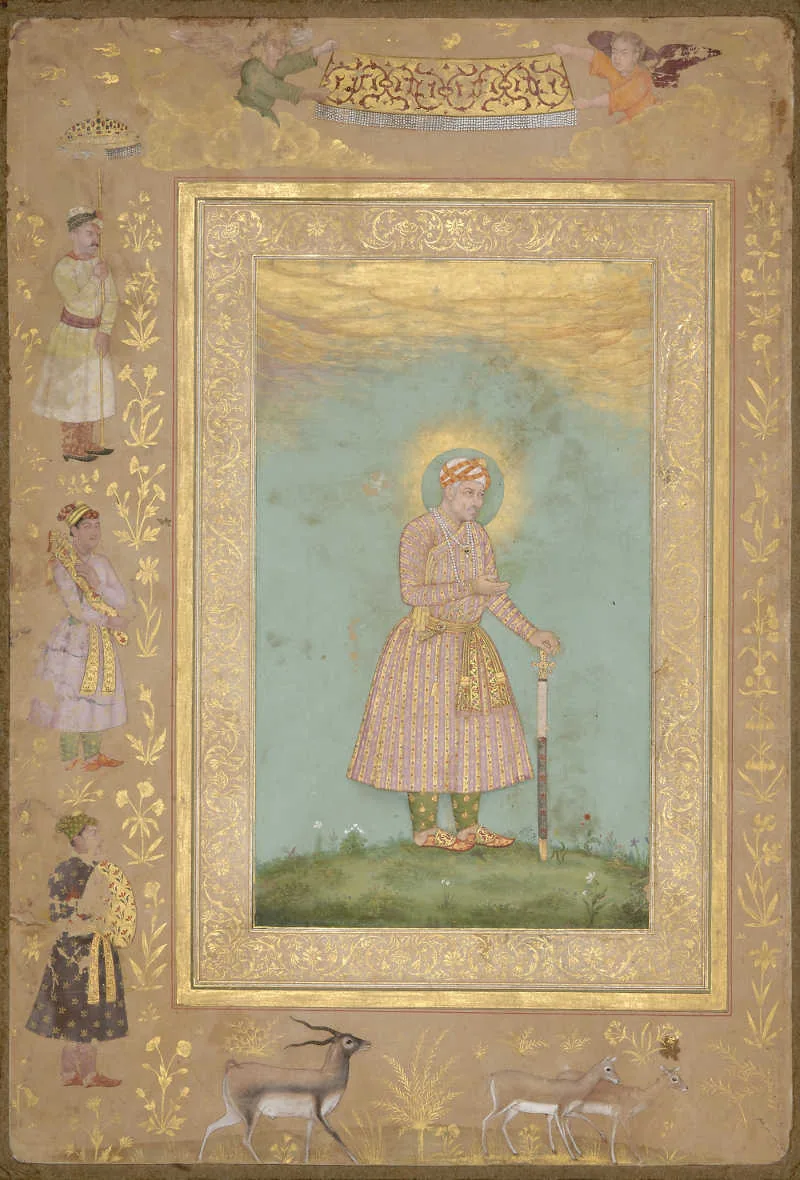
Akbar in old age, c. 1650, probably commissioned by Shah Jahan. Collection of the Aga Khan Museum. · Public domain · Source page
A boy in a war
The emperor who could not read
Akbar, the Mughal emperor, probably could not read or write. Yet in 1575 he had a hall built where scholars of religion came to argue in front of him. What did he want, and what was really born there: a “new religion”, or something smaller?
Background
Born in Sindh
Akbar was born on 15 October 1542 at Umarkot fort, in Sindh, in what is now Pakistan. His father, Humayun, was the second Mughal emperor.
1556
A boy takes the throne
Humayun died in January 1556. The throne passed to Akbar, who was 13. That year Hemu had taken Delhi and Agra, and Akbar’s army marched out to meet him.
Panipat
A victory at Panipat
5 Nov 1556
On 5 November 1556, north of Delhi, the Mughal army fought Hemu at Panipat and won. Akbar was about 14. The victory secured his throne.
The regent
Who held the reins?
A boy could not rule alone. Bairam Khan, his regent, ran the state in his name. The sources date the end of his guardianship to about 1560. Historians think Akbar never learned to read or write, and the attempts to teach him failed.
Check yourself
Who did Akbar’s army defeat at Panipat in 1556?
Answer: Hemu, who had taken Delhi and Agra. Right. Hemu had taken Delhi and Agra, and the Mughal army beat him at Panipat on 5 November 1556.
The pilgrim tax
Family
A Rajput wife
Akbar married a Rajput princess, Harka Bai, daughter of Raja Bharmal of Amber. Popular books and films call her Jodha Bai, but that name is a later label.
Pilgrims
A tax on pilgrims
Hindu pilgrims who travelled to holy places had to pay a tax. In the early 1560s, the young emperor had to decide what to do with it.
A decision point
You are Akbar, the Mughal emperor.
The early 1560s, at court.
Your treasury needs money. Officials have collected the pilgrim tax at the holy places for years.
Many of your subjects are Hindus, and many of them make pilgrimages. Each trip means a payment at the gate.
What do you do?
- Keep the tax. It is the law, and the treasury needs it. Probably the income stays, and pilgrims keep paying at the gates. Some Hindu subjects may feel that the state is taxing their faith.
- Abolish the tax, and let pilgrims go free. Probably the treasury loses that income. Hindu subjects see an emperor who is willing to change a tax for their sake.
What really happened
Abolish the tax, and let pilgrims go free.
Akbar abolished the pilgrim tax in the early 1560s. The sources give different years in that decade.
The sources give no reasons in his own words, so any explanation of his motive is an interpretation.
A second tax
The jizya
The state also ended the jizya, the tax on non-Muslim subjects. Abul Fazl, Akbar’s court historian, dates this to 1564. Other historians date it later, and the question is open.
The house of worship
1575
A hall for debate
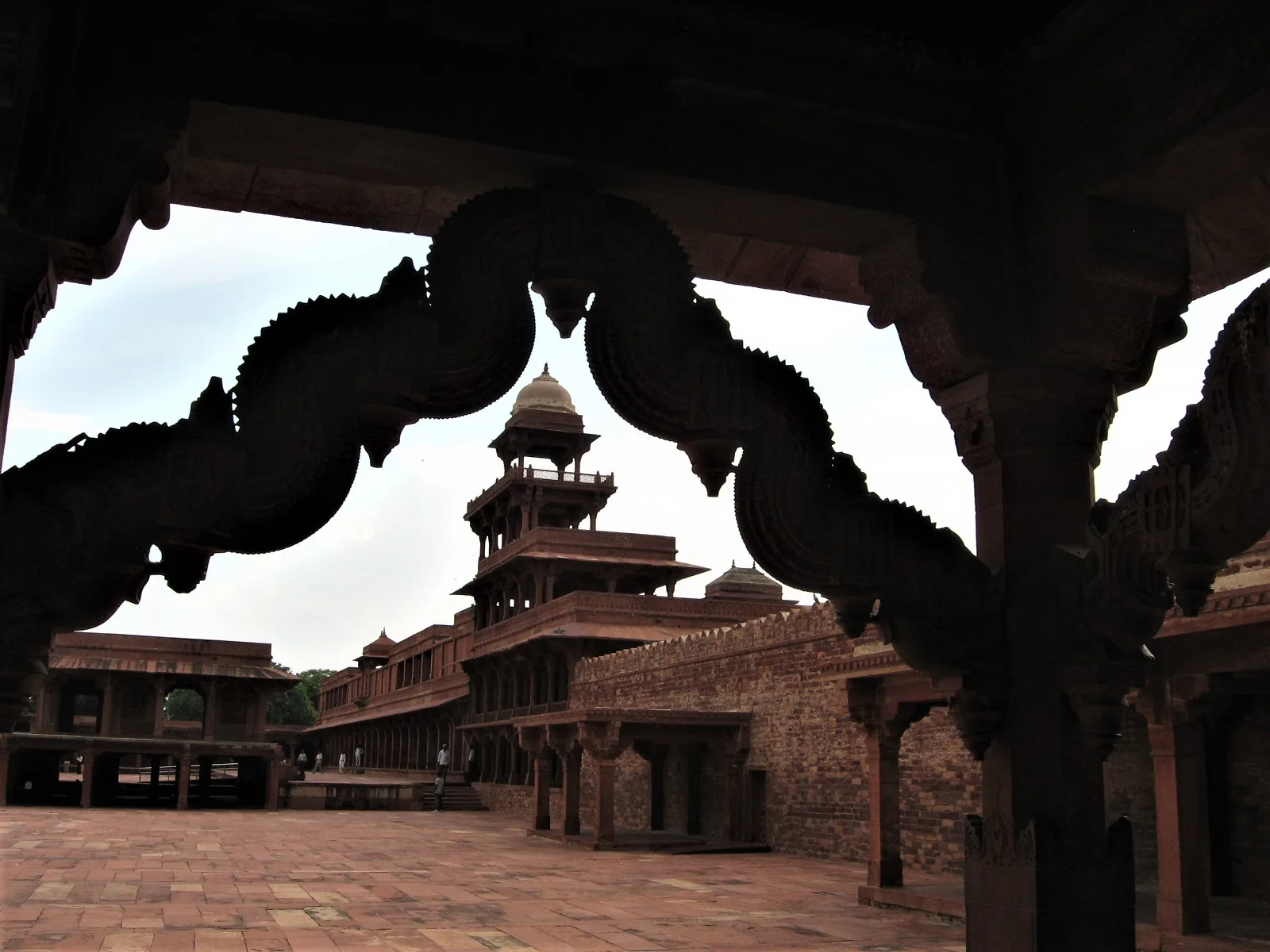
Vasundhara Tomar, Panch Mahal, Fatehpur Sikri, 2017. Own work. · CC BY-SA 4.0 · Source page
In 1575 Akbar had a house of worship built at Fatehpur Sikri, his capital since 1571. The Ibadat Khana was a hall where he heard scholars argue about religion.
Who came first?
Who was invited first?
At first only Sufis, ulama (scholars of Islamic law) and close courtiers took part. The house was not yet open to other faiths.
A decision point
You are Akbar, around 1578.
Around 1578, at Fatehpur Sikri.
For about three years, the house of worship has heard only Sufis, scholars of Islamic law and your courtiers.
Many of your subjects follow other faiths, and none of them take part in the debates.
Do you open the hall to people of other faiths?
- Keep the hall as it is, for the same scholars and courtiers. Probably the debates stay within one tradition. The emperor hears one set of arguments, and other subjects have no voice in the hall.
- Open the hall to scholars of other faiths, and let them speak. Probably the debates get louder and harder to manage. The emperor hears more views, and he must judge between them.
What really happened
Open the hall to scholars of other faiths, and let them speak.
Around 1578 Akbar opened the house of worship to people of other faiths. The exact year is not certain.
The sources do not give his reasons in his own words, so any explanation of his motive is an interpretation.
1579
A document signed by scholars
In 1579 leading scholars signed a document at Fatehpur Sikri, the mahzar. It gave the emperor the final say on a disputed question of law, and the signers agreed to accept his ruling. Its author is disputed: Shaykh Mubarak, his son Faizi and Abul Fazl are all named as possible authors.
Check yourself
Who could speak at the house of worship when it first opened?
Answer: Sufis, Islamic scholars and close courtiers. Right. At first the hall was limited to these groups, not to people of other faiths.
Priests from Goa
1578
A visitor from Bengal
A senior churchman named Francis Julian Pereira came to Akbar’s court from Bengal. Akbar had invited him in 1578, and he explained the Christian faith to the emperor.
A decision point
You are Akbar, in 1579.
1579, at Fatehpur Sikri.
A churchman from Bengal has explained his faith to you, and you have heard only his account.
Far away, in Goa, a Portuguese city on India’s west coast, there are priests who could come. You cannot know what they would say.
Do you send for the priests in Goa?
- Send an envoy to Goa to ask for learned priests. Probably learned priests come within a year or so. They bring their own books and arguments, and the debates at court change shape.
- Keep to your own scholars, and send no one. Probably the debates stay within the empire’s own traditions. Your view of Christianity rests on one visitor’s word.
What really happened
Send an envoy to Goa to ask for learned priests.
In 1579 Akbar sent envoys to Goa. According to the editor’s notes to Monserrate’s book, Pereira had asked for such priests earlier. Two Jesuits, Rodolfo Acquaviva and Enriquez, reached Fatehpur Sikri on 28 February 1580. Antonio Monserrate, the third member of the mission, arrived on 4 March.
Monserrate, one of the three, says Akbar had already heard of the Jesuits from others, so he summoned them as speedily as possible.
Source: The king asks about priests
When he came before him, the King talked about religion and asked him whether there were many priests amongst us. He replied that there were large numbers and that very many of them were much more learned than he was himself.
According to the editor’s notes, the “he” in the quote is Pereira, not Akbar. Monserrate reached the court in 1580.
- Who wrote this, and when? A Jesuit priest who spent the early 1580s at Akbar’s court. The English is a 1922 translation of his Latin account.
- Who is “he”, and what does the writer choose to report? Pereira, a churchman. The writer chose to report this conversation.
- Why would the writer want this story told? A missionary, writing to persuade his superiors in Rome. A king who asks about priests makes the mission look promising.
Check yourself
In the Monserrate quote, who is the visitor who came before the king?
Answer: Francis Julian Pereira. Right. The book’s notes say Akbar invited Pereira in 1578, and he is the visitor who came before him.
Source: The Jesuits in the house of worship
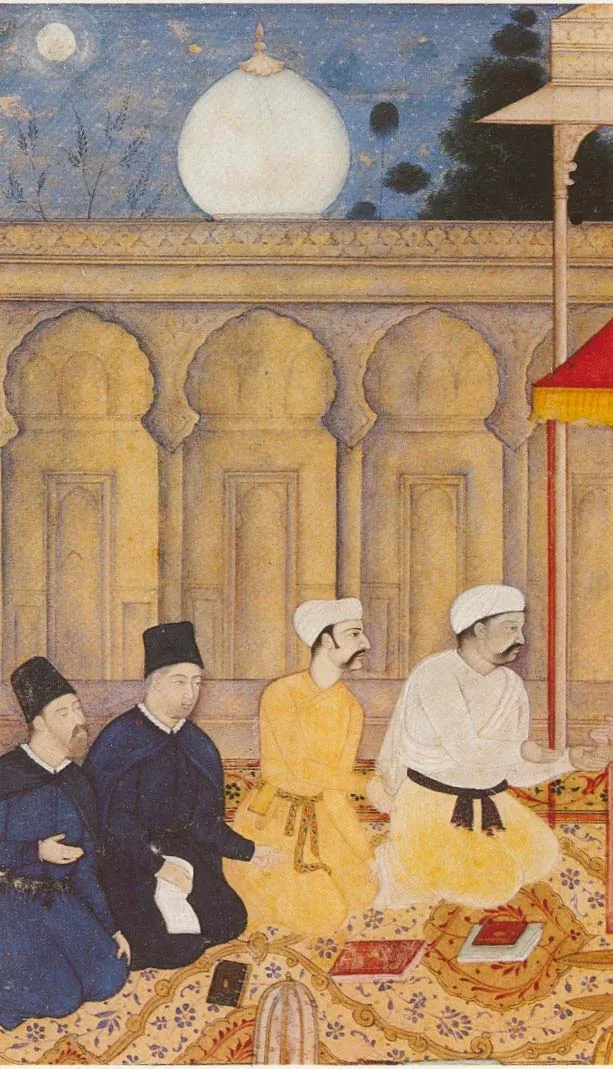
Detail from the Akbarnama, c. 1605, Chester Beatty Library, MS 3, f. 263b. Printed in Rumer Godden, Gulbadan (1980), p. 141. · Public domain · Source page
Detail from the Akbarnama, c. 1605, Chester Beatty Library, MS 3, f. 263b
A detail from the Akbarnama, Abul Fazl’s illustrated history of Akbar, made about 25 years after the Jesuits arrived.
- When was this made, and how far is it from the events? Around 1605. It shows the scene as the court remembered it, not as a camera saw it.
- What does the picture want you to believe? That the priests were received as guests in the emperor’s hall. As an official history, it shows the court’s version.
- What is missing? Any sign of argument. The men sit calmly, though Monserrate describes debates.
Check yourself
What does the painting of about 1605 show?
Answer: Priests seated in the emperor’s house of worship. Right. The caption names two Jesuits seated in the Ibadat Khana.
What came after
Myth
Akbar founded a new religion, and his whole empire followed it.
The truth
Akbar did set up a small circle, the Din-i Ilahi, announced in 1582. Fewer than twenty members are known, and most were court men. Historians still disagree on whether it was a religion at all.
The evidence
The counts vary, but no source reaches the hundreds. The main sources are court histories and accounts by outsiders, such as the Jesuits. A faith the whole empire had joined would leave far more traces.
What happened next
- 1575 The house of worship is built. At first only Sufis, scholars of Islamic law and courtiers speak in it.
- 1579 The mahzar is signed. Envoys set out for Goa.
- 1580 In February two of the three Jesuits reach the court, and in March the third arrives. The sources disagree on when they left.
- 1582 The Din-i Ilahi is announced to a small circle around the emperor.
- 1585 Akbar leaves Fatehpur Sikri. The city is later abandoned, usually blamed on a water shortage.
- 1605 Akbar dies.
Religion or court circle?
Was the Din-i Ilahi a new religion, or something smaller?
- A reading that stresses belief The circle was a discipleship around the emperor’s own ideas about truth and conduct. It was a fellowship of believers, not a religion with set rites for everyone.
- A reading that stresses politics The circle bound the most powerful men to the emperor personally. Its beliefs mattered less than the loyalty it demanded.
Which evidence would settle it? Think about the sources: court histories, the writings of outsiders such as the Jesuits, and a short list of names.
Check yourself
How many known members did the Din-i Ilahi have, according to the sources?
Answer: Fewer than twenty known members, mostly courtiers. Right. The sources name fewer than twenty members, and most were men of the court.
Check yourself
Abul Fazl dates the end of the jizya to 1564. What should a careful reader conclude?
Answer: The date is disputed, and the source must be weighed. Right. Abul Fazl wrote at court, and his date stands against later estimates.
Terms
- regent Someone who rules in the name of a king who is too young to rule alone. Bairam Khan was Akbar’s regent at first.
- jizya A tax on non-Muslim subjects in a Muslim-ruled state. When Akbar ended it is disputed.
- court historian A writer employed to record a ruler’s reign. Court histories tend to praise the ruler, so they must be read with care.
- Ibadat Khana A house of worship: a hall at Fatehpur Sikri where Akbar heard scholars argue about religion. At first its guests were only scholars, Sufis and courtiers.
- mahzar A document of 1579, signed by leading scholars, which gave the emperor the last word on a disputed question of law. Who wrote it is disputed.
- Din-i Ilahi A small circle around Akbar, announced in 1582. Fewer than twenty members are known, most of them court men. Historians disagree whether it was a religion.
- Jesuit A priest or brother of the Society of Jesus, a Catholic religious order. Jesuits were known as teachers and missionaries.
- Humayun Akbar’s father, the second Mughal emperor. He died in 1556, and the throne passed to his son.
- Mughal dynasty A Muslim dynasty that ruled much of India. Akbar was one of its emperors.
- Panipat A battle site north of Delhi. In 1556 the Mughal army won here, and that secured Akbar’s throne.
- Bairam Khan Akbar’s guardian in his early years, who ran the state for him until about 1560.
- Harka Bai A Rajput princess, daughter of Raja Bharmal of Amber. Akbar married her.
- Rajput Warrior lineages of Hindu rulers in northern India.
- Raja A title for a prince or king in India. Raja Bharmal was the ruler of Amber.
- Amber A city and fort in India, ruled by Raja Bharmal, whose daughter married Akbar.
- Umarkot A fort in Sindh, in what is now Pakistan, where Akbar was born in 1542.
- Sindh A region in what is now southern Pakistan, where Umarkot fort stands.
- Fatehpur Sikri The city Akbar built, which was his capital from 1571. The house of worship was set up there.
- Sufis Members of a mystical movement within Islam, who seek closeness to God through prayer and meditation.
- Francis Julian Pereira A senior churchman from Bengal, whom Akbar invited to court in 1578. He explained Christianity to the emperor.
- Bengal A region in eastern India. Pereira came to Akbar’s court from there.
- Goa A Portuguese city on India’s west coast. In 1579 Akbar sent envoys there.
- Monserrate A Jesuit priest, the third member of the mission from Goa to Akbar’s court. He wrote a book about the mission.
- Rodolfo Acquaviva A Jesuit who reached Fatehpur Sikri in 1580, together with Enriquez.
- Enriquez A Jesuit who reached Fatehpur Sikri in 1580, together with Rodolfo Acquaviva.
- Abul Fazl Akbar’s court-historian, who wrote the Akbarnama. He dates the end of the jizya to 1564.
- Akbarnama Abul Fazl’s illustrated history of Akbar, made about 25 years after the Jesuits arrived at court.
- Shaykh Mubarak A Muslim scholar, father of Faizi. He is named as a possible author of the mahzar of 1579.
- Faizi The son of Shaykh Mubarak, named as a possible author of the mahzar.
Sources
- Antonio Monserrate, The Commentary of Father Monserrate, S.J., on his Journey to the Court of Akbar, trans. J. S. Hoyland, annotated S. N. Banerjee (Oxford University Press, 1922)
- Abul Fazl, The Akbarnama, trans. H. Beveridge, vol. 1 (Calcutta, 1907)
- Rumer Godden, Gulbadan: Portrait of a Rose Princess at the Mughal Court (New York: Viking, 1980)
- Wikimedia Commons, file page “Jesuits in the ‘Ibadat-Khanah’” (Chester Beatty Library Akbarnama, MS 3, f. 263b, c. 1605)

Image credits
- Akbar in old age, c. 1650, probably commissioned by Shah Jahan. Collection of the Aga Khan Museum. · Public domain · Source page
- Vasundhara Tomar, Panch Mahal, Fatehpur Sikri, 2017. Own work. · CC BY-SA 4.0 · Source page
- Detail from the Akbarnama, c. 1605, Chester Beatty Library, MS 3, f. 263b. Printed in Rumer Godden, Gulbadan (1980), p. 141. · Public domain · Source page

