Ain Jalut, 1260: where the Mongols stopped
Cairo, 1260: envoys of the Mongols bring a letter that demands submission, tribute or war. On 3 September 1260 the armies met at a spring under Mount Gilboa, and the Mongols were defeated. Was it a turning point, or one battle in a long war?
Decisions, questions and your own progress, in the app
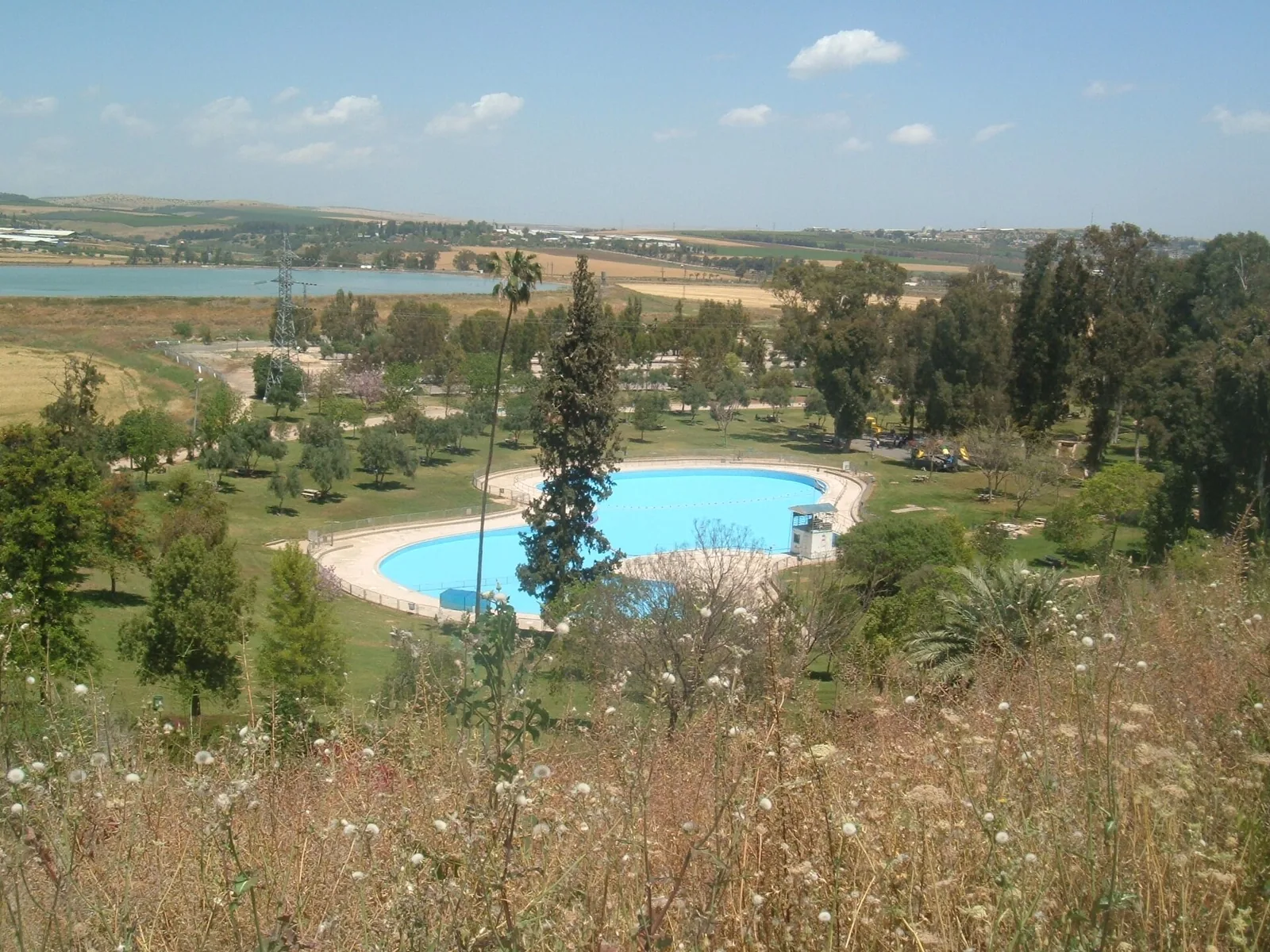
Photo: Almog, Maayan harod, 2009. Own work; public domain. · Public domain · Source page
The scene
Cairo, 1260: the envoys arrive
Cairo, 1260. Envoys arrive from the court of Hulagu, the Mongol ruler of Persia. They carry a letter with a short message: submit and pay tribute, or face battle.
Behind the letter stands an army that took Baghdad two years earlier and now holds Damascus and Aleppo. The sultan of Egypt has to answer. What would you say?
Why it matters
A spring at the foot of a mountain
Mount Gilboa rises above the Jezreel Valley, in the north of what is now Israel. At its north-west foot a spring rises. Hebrew speakers know it as Ma’ayan Harod. In Arabic it is Ain Jalut.
On 3 September 1260 (26 Ramadan 658 in the Muslim calendar) a battle was fought here. The Mongol commander, Kitbuqa, died there. Historians still disagree about what the battle meant: a turning point, or one battle in a long war.
Hulagu
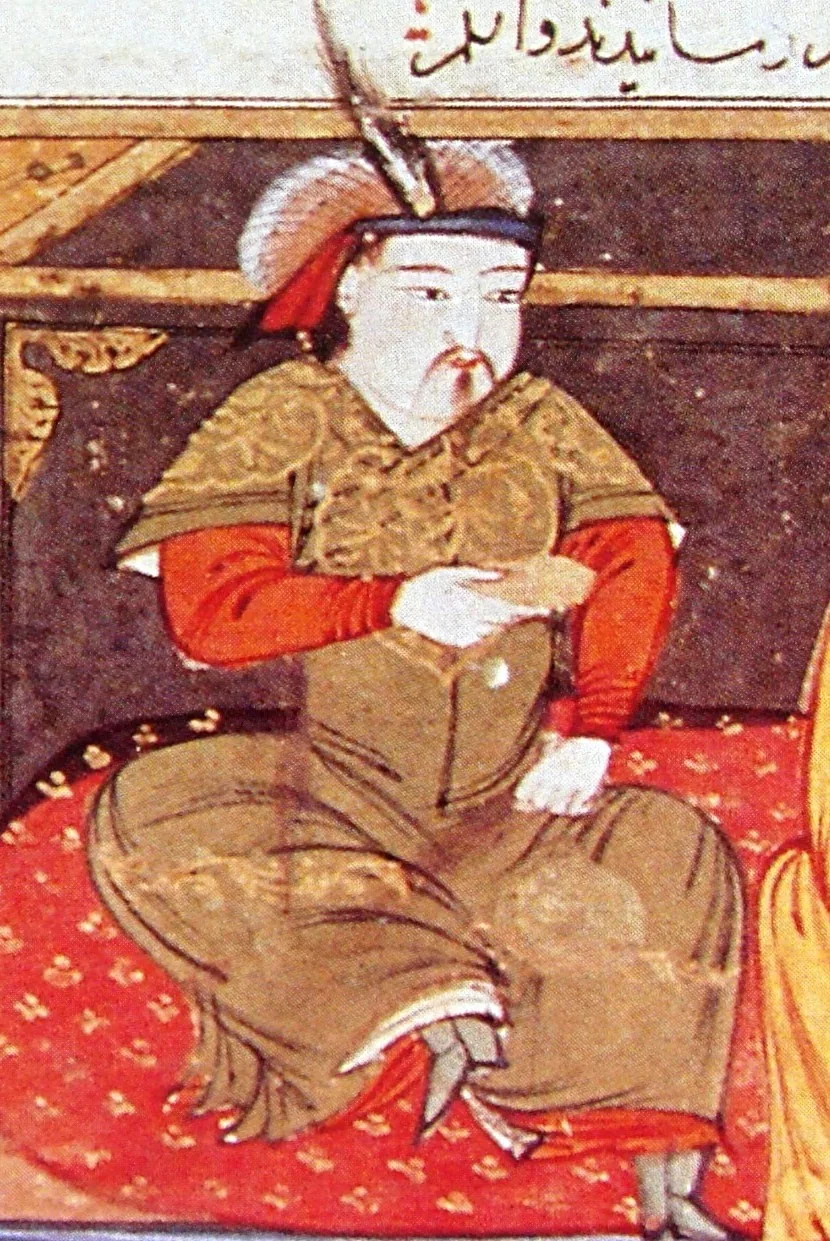
Miniature from a 14th-century Persian manuscript, cropped on Wikimedia Commons. Public domain. · Public domain · Source page
The Mongol ruler of Persia. He took Baghdad in early 1258. In 1260 he was far from home, with his army in Syria.
- Born: Uncertain; one source gives about 1217
- Died: About 1265
- Won: Baghdad taken, early 1258
- Lost: Ain Jalut, 1260: the Mongol army in Syria is beaten
Submit, pay tribute, or fight. (A paraphrase, not his exact words.)
The road to it
Background
Baghdad, early 1258
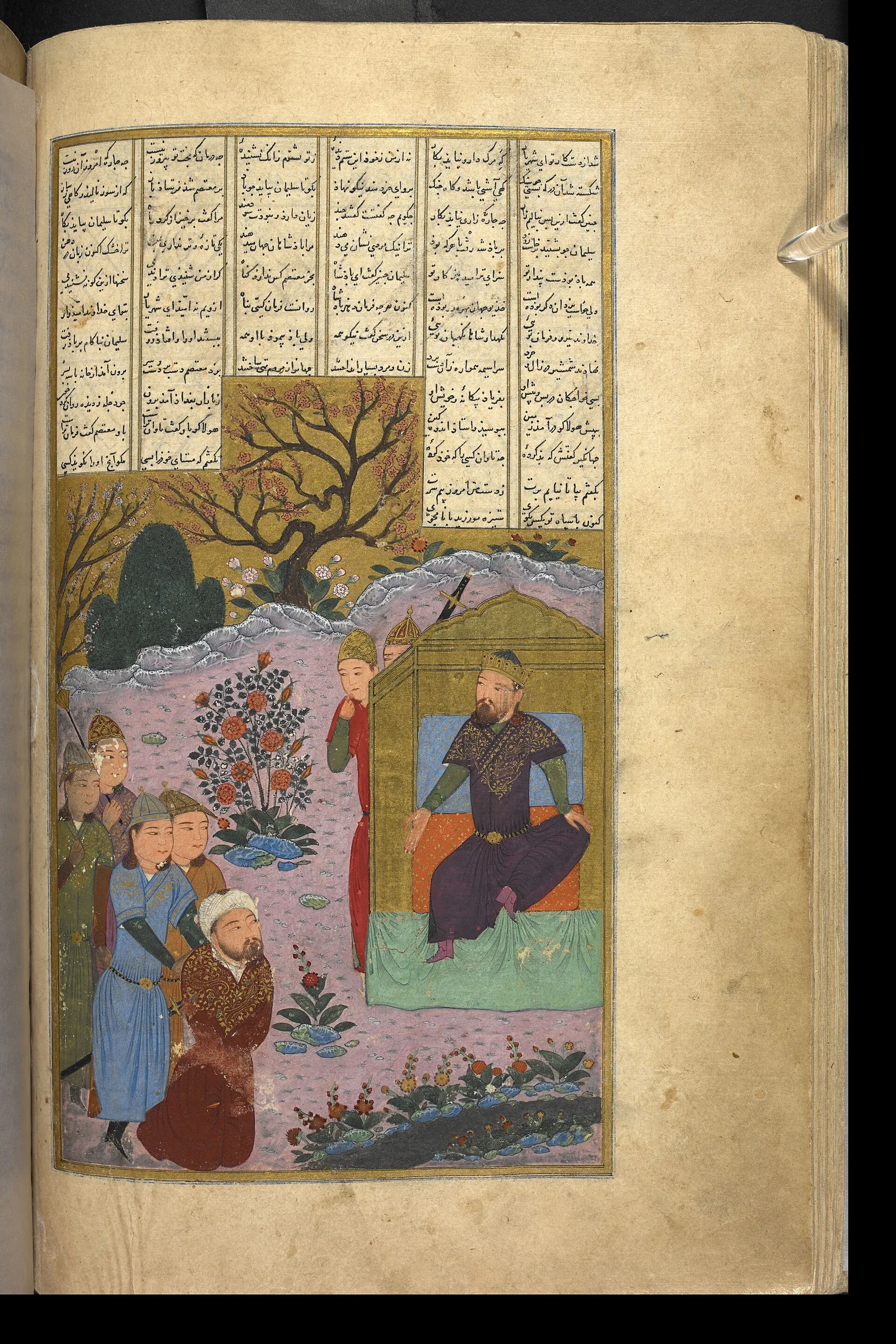
The caliph al-Musta’sim brought before Hulagu Khan, folio 89v, Persian manuscript dated 1398. British Library, Or. 2780. Public domain. · Public domain · Source page
In early 1258 Hulagu’s army besieges Baghdad, seat of the caliph, the head of the Muslim community. The city falls about mid-February. The caliph is captured and killed.
Accounts of the siege and of the caliph’s death differ in their details. What they agree on is that the Mongols took the city and that the caliph died. Persia was now Hulagu’s to rule, and the road into Syria lay open.
1259
A khan dies far away
In 1259 the Great khan Mongke, ruler of the whole Mongol Empire, died on campaign in China. Hulagu was his brother, and he was far away. Who would inherit the title was not clear.
In Cairo the same year, a Mamluk commander named Qutuz removed the young sultan al-Mansur Ali and took power for himself. Accounts of Mongke’s death differ: some give illness, others a death in battle.
A decision point
You are Qutuz, sultan of Egypt.
Cairo, 1260
Hulagu’s envoys are waiting in Cairo for your answer. Their letter demands submission and tribute, or war.
The Mongols have taken Baghdad, and they now hold Damascus and Aleppo. You took the throne from a boy sultan only months ago, and your emirs, the commanders of the army, will judge you by what you do next.
You can stay in Egypt and wait, offer tribute, or march north, into Palestine, and look for the Mongols in the open field.
What do you do?
- Keep the army in Egypt, wait, and send a polite reply. Probably you buy time, but the Mongols stay in Syria, and the question of what they do next stays open.
- Send tribute and a letter of submission, and accept the demand. Probably you keep the throne as a vassal of Hulagu, for a time. But your emirs would see weakness, and the payments would go on.
- March the army north, into Palestine, and seek battle. Probably you meet the Mongols in the open field. It is a gamble, but it could end the threat.
What really happened
March the army north, into Palestine, and seek battle.
Qutuz chose the third. The army left Egypt in the summer of 1260; one source gives 26 July. Sources differ on who led it: one names Baybars as its commander, another says Qutuz made Baybars commander of the advance guard. Al-Maqrizi also says Qutuz had Hulagu’s envoys executed.
No words of his own explain the choice. Historians record a promise he is said to have made to the emirs: if he won, they could choose another sultan. How that shaped his decision can only be guessed.
The event
The Mongol side
The Mongol army in Syria
After Mongke’s death, the Mongol army is in Syria.
Kitbuqa was an “Eastern Christian”, a Christian of an Eastern church, from the Naiman people of Central Asia. Now he commands the Mongol army in Syria, which holds Damascus and Aleppo, far from home.
The march
The road north
In the summer of 1260 the Mamluk army marches north from Egypt. An army on the move needs food, water and fodder for its horses. The road north runs through Palestine, past the lands of the Franks who still hold the coast.
The army’s envoys reach Acre, the seat of the Franks, and ask for two things: safe passage through their lands, and food on the road. The answer will matter to both armies.
Their neighbours have already chosen a side. According to a 2020 article, Antioch and the Armenian kingdom of Cilicia accepted Mongol overlordship and marched with the Mongols. Acre has not yet answered.
A decision point
You are one of the lords of the Frankish kingdom, in Acre.
Summer 1260
The envoys of the Mamluk army stand at your gate in Acre. They ask for passage through your lands and food along the road.
You are the lords of what is left of the crusader kingdom. You hold a few cities on the coast, and both armies are near. According to a 2020 article, your neighbours at Antioch and in Cilicia have already accepted Mongol overlordship.
If you refuse, you become an enemy of an army marching to meet the Mongols. If you help the Mongols, you risk Egypt’s anger. If you let the army pass and stay out of the matter, you take no side.
What do you do?
- Join the Mongols, as a 2020 article says Antioch and Cilicia did, and give them a base on the coast. Probably the Mongols gain a base and supplies, but Egypt would see Acre as an enemy, and the danger to Acre would grow sharply.
- Close the road and refuse passage. Probably the Mamluk army forces its way through, or finds another road. You risk a war you are not sure to win.
- Give passage and food, and stay out of the war. Probably the army passes and moves on, and you stay out of a war that could reach your walls. But you gain no friend on either side.
What really happened
Give passage and food, and stay out of the war.
The Franks of the kingdom, based at Acre, let the Mamluk army pass, fed it on the plain of Acre, and stayed neutral. The sources record the decision, not the reasoning, and do not say who made it.
No words of theirs explain the choice. One guess is that they did not want to face both armies at once. That is a guess, not a fact.
3 September 1260
At the spring
The Mamluk army comes up from the south, and on 3 September 1260 it meets the Mongol army under Kitbuqa at the spring under Mount Gilboa.
Rashid al-Din, a senior official at the Mongol court in Persia, describes a feint by Qutuz: a pretended move, meant to fool the enemy about what the Mamluks would do next.
By the end of the day the Mongol army has been beaten. Its commander is dead, and the Mamluk army has won the battle it came to fight.
After the battle
Kitbuqa’s end
Kitbuqa dies at Ain Jalut. Accounts differ on how. One says he was captured and then executed; another says he was killed in the fighting. Both agree that he died there.
Rashid al-Din puts Kitbuqa’s force at several thousand cavalry. In the same passage, Kitbuqa boasts of a far larger army, Hulagu’s. A boast is not a count, and this account is a Mongol one.
The Mongol advance towards Egypt has stopped.
What we really know
Source: Rashid al-Din, Compendium of Chronicles
Paraphrase: In this account, the letter the envoys carry says the Mongols rule by divine favour, and tells Qutuz to submit.
Rashid al-Din was a senior official at the Mongol court in Persia, and he wrote after the events, for the rulers who employed him.
- Who wrote this, and for whom? A senior official at the Mongol court in Persia, writing for his rulers after the events.
- What does the writer want us to believe? That Mongol rule comes from heaven. In this account, the envoys’ letter says exactly that.
- What is missing? The Mamluk side of the story, and any real explanation of why the Mongol army lost.
Myth
Ain Jalut saved Europe from the Mongols.
The truth
Not as it is put. The Mongol push into Central Europe ended in 1242, when the army withdrew. The 1260 campaign went south, into Syria and Egypt, not Europe.
The evidence
The Great Khan Ogedei died in December 1241, and the Mongol army left Central Europe by mid-1242. Why it left is disputed. Ogedei’s death is often given as the reason, but that explanation is now often called too simple. In 1260 Christian states were on both sides: according to a 2020 article, Antioch and the Armenian kingdom of Cilicia accepted Mongol overlordship and marched with the Mongols, while the Franks of Acre stayed neutral.
Source: Al-Maqrizi, Kitab al-Suluk
Paraphrase: The sultan answers Hulagu’s envoys with their execution. The historian also names the emirs who later struck Qutuz down.
Al-Maqrizi wrote in Cairo in the 15th century, about 150 years after the battle, from the viewpoint of the Mamluk sultans’ court.
- Who wrote this, and when? A Cairo historian of the 15th century, writing about 150 years after the battle. He was not a witness to it.
- Whose side is the writer on? The Mamluk court. The chronicle tells the story of the sultans of Cairo.
- What is missing? Eyewitness reports, and the Mongol voice. A chronicle written 150 years on has to be weighed against other accounts.
A decision point
You are Hulagu, the Mongol ruler of Persia.
Syria, 1260
The Great Khan Mongke has died. You are his brother, and the succession is not yet settled. You are far from home.
Your army is in Syria. It holds Damascus and Aleppo, and the Mamluk army of Egypt is marching north to meet it.
Feeding and fodder an army this far from home is a constant worry. You can keep the whole army here, leave part of it, or take all of it east.
What do you do?
- Keep the whole army in Syria and fight the Mamluks. Probably you face the Mamluks with the whole army, but it stays far from home and supplies remain hard to find.
- Take most of the army east, and leave about 10,000 men in Syria. Probably the force left in Syria is weak against the Mamluks, and the battle is dangerous for it. But you reach home in time to take part in the succession.
- Take the whole army east and leave Syria to its fate. Probably Damascus and Aleppo are left without a real army, and the Mamluks take Syria almost without a fight. The whole army stays together on the road home.
What really happened
Take most of the army east, and leave about 10,000 men in Syria.
Hulagu chose the second. After Mongke’s death in 1259 he took most of the army east, and left about 10,000 men in Syria under Kitbuqa. Sources disagree on whether he went to Persia or to Mongolia, where a council of princes would choose the next Great Khan.
Modern accounts give two reasons: the succession after Mongke’s death, and shortages of food and fodder. No words of Hulagu’s own explaining the choice are quoted here.
What followed, and the quiz
October 1260
On the road back
Qutuz does not enjoy the victory for long. In October 1260, on the road back to Cairo in the eastern Nile Delta, he is killed.
Al-Maqrizi names three emirs who struck him. Some historians say Baybars was involved. Whatever the truth, Baybars becomes sultan. He was a Kipchak Turk who had once been sold as a slave, and he had risen to high command in the Mamluk army.
What followed
- October 1260 Qutuz is killed on the road back to Cairo. Baybars becomes sultan.
- About 1262 Open war breaks out between Berke, ruler of the Golden Horde, and Hulagu. Their quarrel over Baghdad was older.
- About 1265 Hulagu dies.
- 1277 Baybars dies in Damascus.
- 1312 According to a 2020 article, between 1260 and 1312 the Mongols mounted six large offensives against Syria.
Was Ain Jalut a turning point?
Did the battle stop the Mongols, or was it one fight in a long war?
- Visoni (EBSCO research starter, 2022) Ain Jalut ended the Mongol advance in the Middle East. For this view the battle was decisive, and popular accounts treat it as a turning point.
- Reuven Amitai-Preiss (1995) It was one battle in a long war between the Mamluks and the Ilkhanate, which ran from 1260 to 1281. The Mongols won some of the fights and lost others, and the war went on long after Ain Jalut.
Both views hold something true. The battle was real and important, but the war did not end there. The open question is how much the Mongols’ own problems (succession, supply and distance) decided the outcome.
Check yourself
Which of these happened last?
Answer: War between Berke and Hulagu begins.. This came about 1262, two years after the battle, so it is the last of the four. It is easy to take it for a cause of 1260, but it came after.
Check yourself
Did the battle of Ain Jalut save Europe from the Mongols?
Answer: No: the Mongols left Central Europe in 1242.. This is correct. The Mongol push into Central Europe ended in 1242, and the 1260 campaign was aimed at Egypt, not Europe.
Check yourself
What did the Franks of Acre do when the Mamluk army asked for passage?
Answer: They let the army pass and stayed neutral.. This is correct. The sources agree on the outcome, though not on the reasons or on who decided.
Check yourself
Why should a reader treat al-Maqrizi’s account with care?
Answer: He wrote about 150 years later, for the Mamluk court.. This is correct. A chronicle written so late, for its own court, has to be weighed against other accounts.
Check yourself
Which reasons do modern accounts give for Hulagu taking most of his army east?
Answer: The succession, and shortage of supplies.. This is correct. Modern accounts give these two reasons, and this lesson does not claim either is proven.
Check yourself
Which statement about the armies at Ain Jalut is best supported?
Answer: Kitbuqa’s force is put at about 10,000 to 20,000.. This is supported. Modern estimates run from about 10,000 to 12,000 up to about 20,000, and the lesson names sources for the Mongol figures.
Terms
- Mamluk A soldier bought as a boy, trained as a warrior and later freed. The Mamluks were the military ruling class of Egypt.
- sultan A Muslim ruler with political and military power. In Cairo the sultan was the head of the state.
- emir A senior commander or noble at the Mamluk court. The emirs were the commanders who backed a sultan or removed him.
- Ilkhanate The Mongol state in Persia, founded by Hulagu and ruled by his heirs. Its rulers were, in theory, subordinate to the Great Khan.
- khan The title of a Mongol ruler. The Great Khan was the supreme ruler of the Mongol Empire.
- kurultai A council of Mongol princes and leaders, called to choose a new Great Khan or to decide on war.
- caliph A Muslim leader who claimed succession to the Prophet Muhammad. In this lesson, the caliph was based in Baghdad.
- tribute A yearly payment that a weaker ruler makes to a stronger one so that he will not be attacked.
- feint A move meant to fool the enemy about what you will do next, such as a pretended retreat.
- envoy An official sent by one ruler to another, usually to negotiate or to deliver a demand.
- Franks The name Muslim and other writers of the time used for Western Christians, especially the crusaders and their states in the Levant. At Acre sat the lords of what was left of the crusader kingdom.
- Hulagu The Mongol ruler of Persia and brother of the Great Khan Mongke. His army took Baghdad and sent envoys to Cairo.
- Mongke The Great Khan, ruler of the whole Mongol Empire. He died on campaign in China in 1259, and it was not clear who would inherit his title.
- Kitbuqa The Mongol commander in Syria, an Eastern Christian. He died at Ain Jalut.
- Qutuz A Mamluk commander who removed the young sultan of Egypt. He chose to march north to battle and was killed in October 1260 on the road back to Cairo.
- Baybars A Mamluk commander, a Kipchak Turk who had once been sold as a slave. He later became sultan.
- al-Maqrizi A historian who wrote in Cairo in the 15th century, about 150 years after the battle, from the viewpoint of the Mamluk sultans’ court.
- Rashid al-Din A senior official at the Mongol court in Persia, who wrote about these events for the rulers who employed him.
- al-Mansur Ali The young sultan of Egypt, removed in 1259 by the Mamluk commander Qutuz.
- Baghdad The city where the caliph, head of the Muslim community, had his seat. Hulagu took it in 1258.
- Damascus A city in today’s Syria. At the time of the battle the Mongols held it.
- Acre A port city on the coast, seat of the Franks. They let the Mamluk army pass and stayed neutral.
- Antioch A city in the north, a neighbour of the Franks. According to a 2020 article, it accepted Mongol overlordship.
- Cilicia An Armenian kingdom to the north, a neighbour of the Franks. According to a 2020 article, it accepted Mongol overlordship.
- Golden Horde A Mongol khanate in the north, ruled by Berke. He quarrelled with Hulagu, partly over Baghdad.
- Berke Ruler of the Golden Horde. About two years after the battle at Ain Jalut, open war broke out between him and Hulagu.
- Naiman A people of Central Asia, the people Kitbuqa came from.
- Kipchak A Turkic people of the steppe in Central Asia. Baybars came from this people.
- Mongol Empire The huge empire built by the Mongols. After Mongke died, it was not clear who would inherit his title.
- Mongolia The homeland of the Mongols. There a council of princes would choose the next Great Khan.
- Ma’ayan Harod A spring at the foot of Mount Gilboa. In Arabic it is called Ain Jalut, and the battle was fought there.
- Mount Gilboa A mountain in what is now northern Israel. The spring where the battle took place rises at its foot.
- Jezreel Valley A valley in what is now northern Israel. Mount Gilboa rises above it.
- Eastern Christian A Christian of an Eastern church, not the Church of Rome. This is how Kitbuqa is described.
- Muslim calendar The calendar of the Muslim world, which starts with the Prophet Muhammad’s journey from Mecca. The battle is also dated by it.
Sources
- Rashid al-Din, Jami al-Tawarikh (Compendium of Chronicles), trans. W. M. Thackston, Sources of Oriental Languages and Literatures 45 (1998–99)
- Al-Maqrizi, Kitab al-Suluk (Arabic chronicle, 15th century)
- Reuven Amitai-Preiss, Mongols and Mamluks: The Mamluk-Ilkhanid War, 1260–1281 (Cambridge University Press, 1995)
- G. Visoni, “Battle of Ain Jalut”, EBSCO Research Starters (2022)
Image credits
- Photo: Almog, Maayan harod, 2009. Own work; public domain. · Public domain · Source page
- Miniature from a 14th-century Persian manuscript, cropped on Wikimedia Commons. Public domain. · Public domain · Source page
- The caliph al-Musta’sim brought before Hulagu Khan, folio 89v, Persian manuscript dated 1398. British Library, Or. 2780. Public domain. · Public domain · Source page


