The Hundred Years’ War II: Henry V and Agincourt
A sick and hungry English army, a muddy field in October, and the flower of French chivalry in front of it.
Decisions, questions and your own progress, in the app
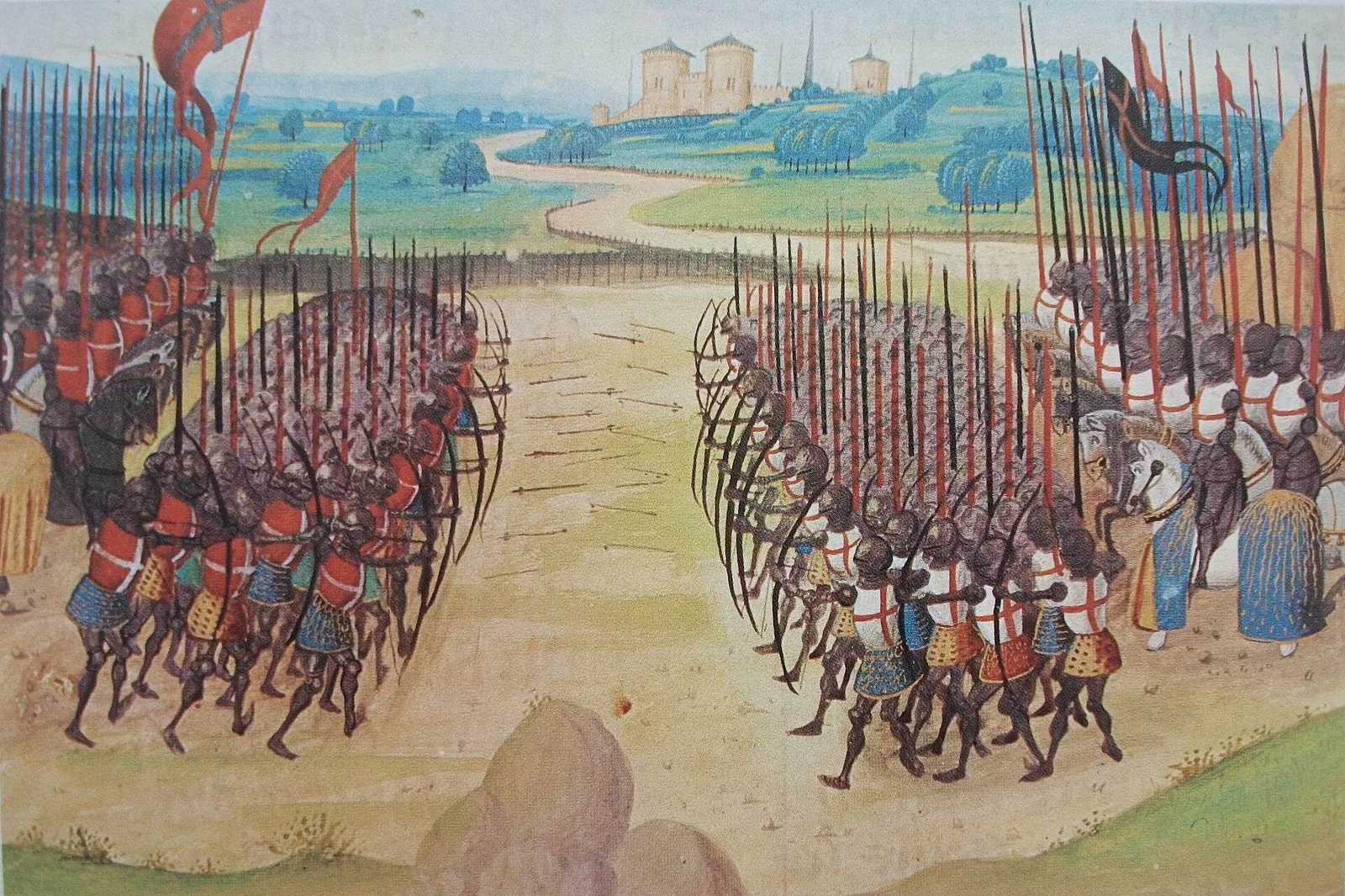
The battle of Agincourt, miniature in an abridgement of the chronicle of Enguerrand de Monstrelet, c. 1470–80. Bibliothèque nationale de France, Français 2680, f. 208 · Public domain · Source page
Mud and banners
A wet morning in Picardy
Friday, 25 October 1415. Dawn on a ploughed field in northern France, between two woods. It has rained all night. To the south stand a few thousand Englishmen, soaked, hungry and sick. To the north, blocking their road to Calais, stands the army of France, far larger, with dukes and counts in its front rank.
The English king has heard mass three times and told his men that he came to recover his rightful inheritance. Most French leaders expect him to be their prisoner by evening.
By evening thousands of Frenchmen are dead, and their dukes are his prisoners. Yet England’s most famous medieval victory will not win Henry a single town. How did it happen, and what did it win?
Henry V
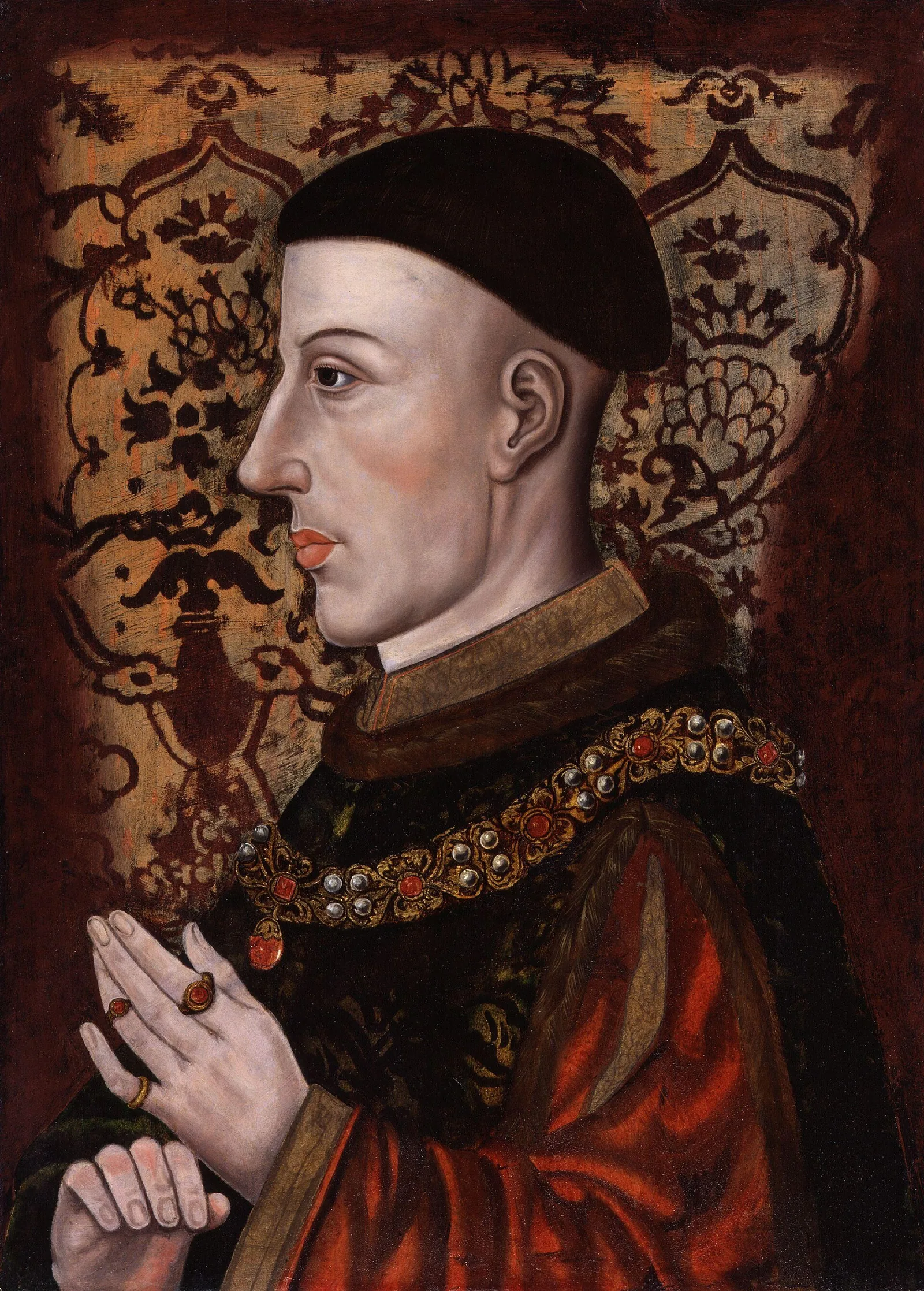
Henry V, unknown artist, late 16th or early 17th century. National Portrait Gallery, London (NPG 545) · Public domain · Source page
A king with a doubtful title who made war on France to prove that God was on his side, won Agincourt, and died, not yet 36, as heir to the French crown.
- Born: 16 September 1386 (or 1387), Monmouth Castle, Wales
- Died: 31 August 1422, Castle of Vincennes, near Paris, probably of dysentery, caught at the siege of Meaux
- Won: Shrewsbury, 1403 (wounded, aged 16); The siege of Harfleur, 1415; Agincourt, 1415; Caen, 1417; The siege of Rouen, 1418–1419
- Lost: Baugé, 1421: his brother Clarence defeated and killed, while Henry was in England
“…he had come into France to recover his rightful heritage, and … he had good and just cause for so doing…”
France recovers, France breaks
Background, 1369–1380
The French learn not to fight
After Crécy and Poitiers the French had learned a hard lesson: do not give the English the pitched battle they want. When war resumed in 1369, Charles V and his commander Bertrand du Guesclin let English raiders ride through the country, burning and growing hungry, while French forces retook castles and towns one by one.
It worked. By 1380, when Charles V and du Guesclin both died, England held little in France beyond Calais, Bordeaux and Bayonne.
1396–1403
A deposed king and a usurper’s son
Edward III’s grandson, Richard II, wanted peace. In 1396 he married Isabella, the six-year-old daughter of the French king, and agreed a 28-year truce. In 1399 his cousin Henry Bolingbroke, John of Gaunt’s son, took his crown and reigned as Henry IV, the first king of the House of Lancaster. Richard died in prison early in 1400, probably starved.
A king who seizes the crown must keep proving that he deserves it. Henry IV faced a Welsh rising under Owain Glyndŵr and a rebellion by the mighty Percy family. At Shrewsbury, in July 1403, his eldest son, the 16-year-old Prince Henry, was hit in the face by an arrow. He was lucky in his surgeon.
1392–1393
The king who thought he was made of glass
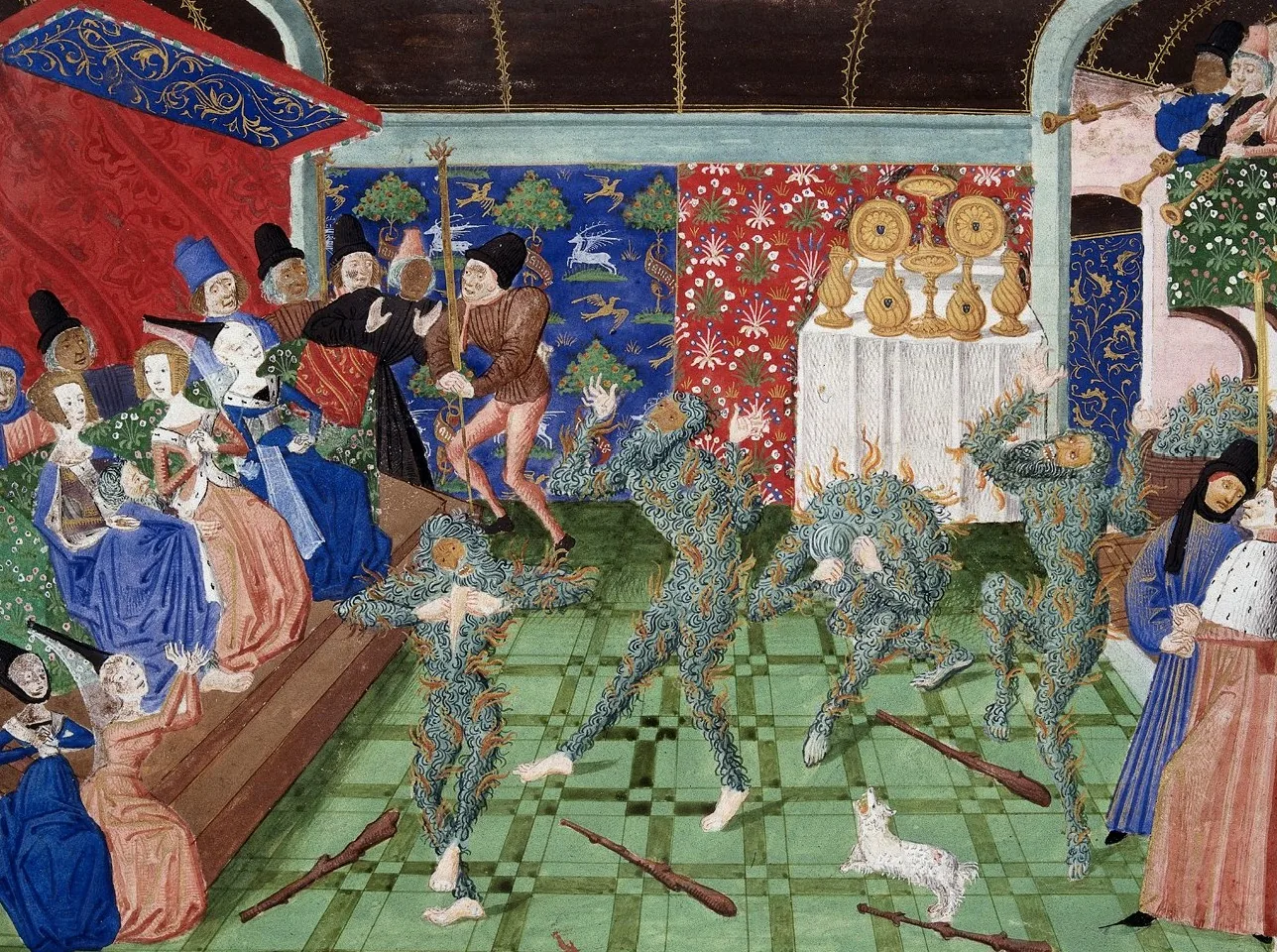
The Bal des Ardents, by the Master of the Harley Froissart (perhaps Philippe de Mazerolles), c. 1470–72, in Jean Froissart’s Chronicles. British Library, Harley MS 4380 · Public domain · Source page
In France a worse disaster struck the crown. In August 1392, riding through a forest near Le Mans, the young Charles VI drew his sword on his own escort and killed several men before he could be held. For thirty years attacks of madness came and went: at times he did not know his wife or his own name, and at times, it was said, he believed he was made of glass.
Six months later, at a masked ball in Paris, the king and five courtiers danced as ‘wild men’ in costumes of linen and resin. A torch set them alight, and four died. The king was saved, says the chronicler Jean Froissart, because the young Duchess of Berry covered him with her skirts. It became known as the Ball of the Burning Men.
Charles VI
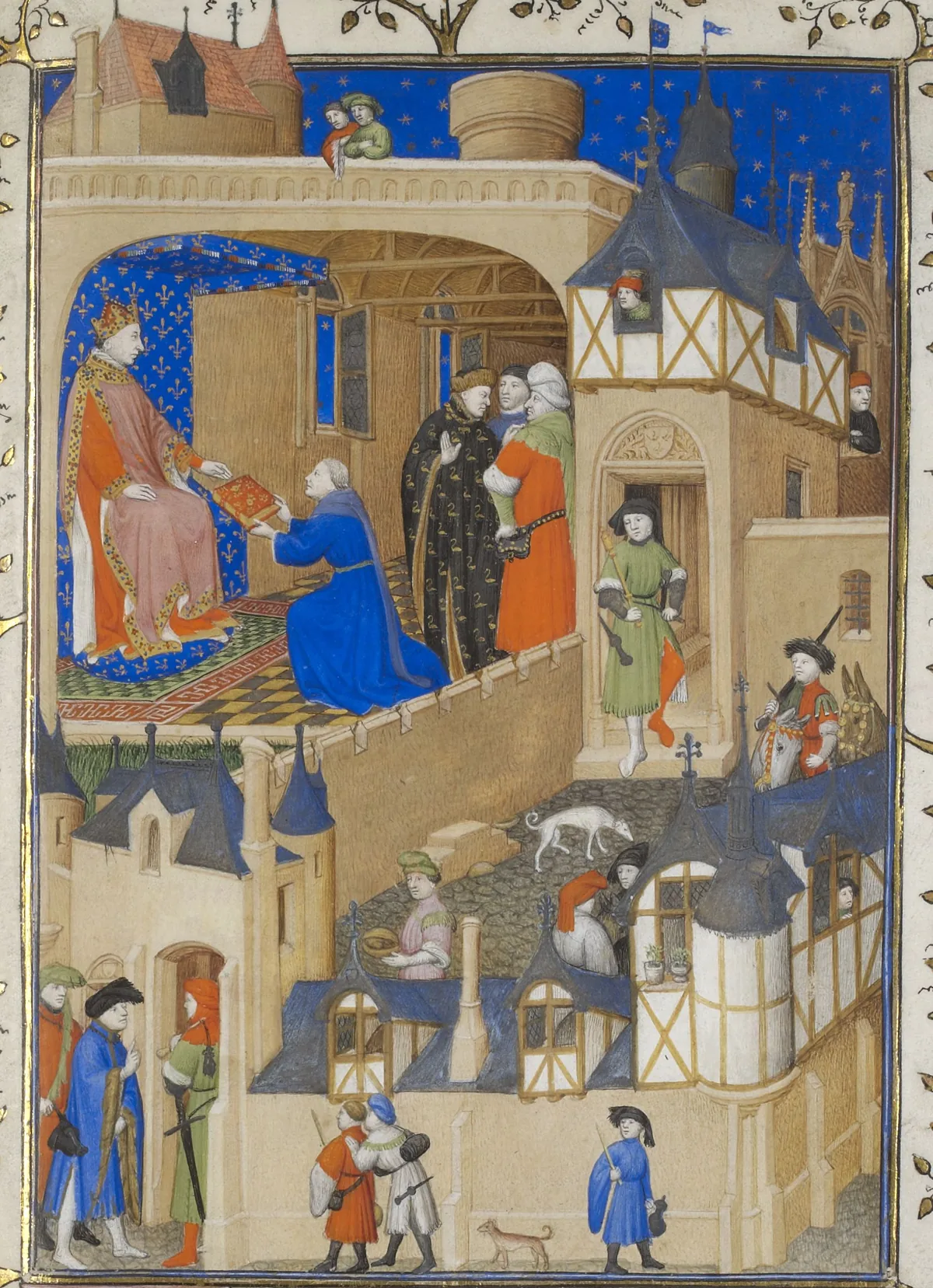
Charles VI and Pierre Salmon, Dialogues of Pierre Salmon, by the Mazarine Master, c. 1409. Bibliothèque nationale de France, Français 23279, f. 53 · Public domain · Source page
Crowned at eleven and struck by madness at 23, he reigned for 42 years over a kingdom his own relatives tore apart.
- Born: 3 December 1368, Paris
- Died: 21 October 1422, Hôtel Saint-Pol, Paris, seven weeks after Henry V
- Won: Roosebeke, 1382 (aged 13; Constable Olivier de Clisson commanded)
- Lost: Agincourt, 1415 (kept away from the battle); Normandy, 1417–1419; The Treaty of Troyes, 1420: his own son disinherited
“…immediately on our decease, and from thenceforward, our crown and kingdom of France, with all its rights and appurtenances, shall devolve for ever to our said son, king Henry, and to his heirs.”
1407–1412
Murder in a Paris street
With the king so often mad, his relatives fought over the government and its money: above all his brother Louis, Duke of Orléans, and his cousin John the Fearless, Duke of Burgundy. On 23 November 1407 Louis was hacked to death in a Paris street by John’s hired men. John admitted it, and had a theologian argue in public that killing a tyrant was lawful.
France split into two parties, the Burgundians and the Armagnacs, named after the Count of Armagnac, father-in-law of Louis’s son. Both asked England for help, and in 1411 and 1412 both got English soldiers. To an ambitious English king, it was an invitation.
1413–1415
Henry claims France
Henry IV died in March 1413, and Henry V was crowned at Westminster in a snowstorm. In his mid-twenties, pious, hard-working and severe, he crushed a rising of the Lollards, religious dissenters, within a year.
Then he turned to France. As Edward III’s great-grandson he revived Edward’s claim to the French crown, and demanded at the least the lands of the Treaty of Brétigny and of his Angevin ancestors, with Charles VI’s daughter Catherine and a huge dowry. The French offered much of Aquitaine, Catherine and a large sum; Henry treated it as a refusal. Many historians think he wanted war all along: victory abroad would show that God favoured the shaky Lancastrian title, and unite his nobles behind him.
Harfleur and the road to Calais
August–September 1415
Five weeks at Harfleur
c. 12,000
Just before sailing, Henry uncovered a plot to put his cousin, the Earl of March, on the throne; three conspirators were executed. On 11 August 1415 about 12,000 men sailed for Normandy.
Henry’s first target was Harfleur, the port at the mouth of the Seine. His guns battered it for five weeks, but the army camped among marshes in the late summer heat, and dysentery spread. When Harfleur surrendered on 22 September, the Bishop of Norwich and the Earl of Suffolk were dead of it, and thousands more were sick. At least two thousand died, one chronicler says, and more were shipped home.
A decision point
You are Henry V, King of England.
Early October 1415, in captured Harfleur
Harfleur is yours, but the five-week siege has cost you much of your army. After leaving a garrison and sending the sick home, you have perhaps 6,000 to 9,000 men fit to fight. The autumn rains have begun, and a French army is gathering at Rouen.
The campaign has cost a fortune in loans and pawned crown jewels, and has won one small port. Calais, England’s fortress on the Channel, lies about 200 kilometres to the north-east, through French land. Most of your council says: go home.
What do you do?
- Garrison Harfleur and sail home for the winter Safe and sensible. But you would face Parliament with one costly port and a sick army, and the French would say that the English king came, saw and ran away. Your claim to France would look like an empty boast.
- March overland to Calais A show of strength: the ‘rightful heir’ marching through his own land, daring the French to stop him. It is also a gamble. If the French force a battle on their terms, a small, tired army could be destroyed.
- Winter in Harfleur and campaign again in spring You keep your foothold, but disease would go on eating the army in a crowded, battered town, and every week costs money you do not have.
- Strike up the Seine at Rouen or Paris Bold, but far beyond the strength of a few thousand sick men. A winter siege of a great city would probably have ended in disaster.
What really happened
March overland to Calais
Henry marched. On 8 October he left Harfleur with food for about eight days, heading for Calais by the shortest route, along the coast and across the Somme.
The chaplain who wrote the Gesta Henrici Quinti (‘The Deeds of Henry V’), and marched with the army, says most of the council opposed the march and Henry overruled them, trusting in God. Historians still argue about his aim. Clifford Rogers thinks he hoped for battle, a trial in which God would show whose cause was just; Anne Curry and Christopher Allmand think he meant to reach Calais without a fight.
8–24 October 1415
Seventeen days on the road
The plan failed within a week. At the ford of Blanchetaque, where Edward III had crossed the Somme before Crécy, Henry learned that the ford was staked and the far bank guarded. The English had to march upstream, with a French army keeping pace on the other bank, and food ran out. Only on 19 October did they cross, far to the east.
Hearing that French cavalry meant to ride down his archers, Henry ordered each archer to cut a stake about six feet long, sharpened at both ends, to plant in front of him. Discipline was harsh: a soldier who stole a pyx, a box for the communion bread, from a church was hanged. On 24 October, across the little river Ternoise, the scouts saw the French army ahead, astride the road to Calais. That night the English camped at Maisoncelle, in the rain and in silence.
A decision point
You are Charles d’Albret, Constable of France.
Dawn, 25 October 1415, between the woods of Azincourt and Tramecourt
You are the constable, commander of the king’s army, at least in name. The dukes of Orléans, Bourbon, Alençon and Bar outrank you, and all of them want a place in the front line. The king and his heir have been kept away, for fear of another Poitiers.
Your army is far larger than the English one, and more men are coming. The English are tired, hungry and wet, and you stand across their road to Calais. Your plan has your men-at-arms fight on foot, while cavalry on the wings rides down the English archers.
But the ground between the woods is narrow, freshly ploughed and soaked by a night of rain.
What do you do?
- Hold your ground and let hunger force the English to attack Probably the wisest course. Every hour you wait makes the English hungrier and brings your reinforcements closer. But your proud lords may not wait patiently, and if Henry moves first, he chooses the moment.
- Attack at once, while the English are worn out Your men-at-arms would cross nearly a kilometre of mud under arrows, straight into the English position. Numbers might carry it; or the narrow field might turn your strength into a crush.
- Avoid battle, as Charles V did: shadow them and starve them Safe, and it had worked before. But the dukes would call it cowardice, the English might slip away to Calais, and your lords’ honour, and yours, would suffer.
What really happened
Hold your ground and let hunger force the English to attack
The French waited, for three or four hours, while heralds discussed terms. Then Henry moved first: his army walked forward to long bowshot, and the archers replanted their stakes. Now the French had to attack, or be shot where they stood.
Waiting was sound: in this war the defender usually won. But it handed the initiative to Henry. Historians blame the command more than the plan: the lords crowded into the front line, many horsemen were missing from the wings, and, Jean de Waurin says, the archers and crossbowmen were not allowed to shoot, because the field was too narrow.
Agincourt
Agincourt: who fought whom
Friday 25 October 1415, the feast of Saints Crispin and Crispinian
Between the woods of Azincourt and Tramecourt, about 55 km south of Calais
The English army
- Commanders: Henry V, Edward, Duke of York (right), Thomas, Lord Camoys (left), Sir Thomas Erpingham (the archers)
- Strength: 900 men-at-arms and 5,000 archers (Gesta Henrici Quinti, a chaplain in the army); at least 13,000 archers, plus men-at-arms (Monstrelet, a Burgundian, 1440s); about 8,700–9,000 (Anne Curry, from the pay records (2005)); about 6,000 (Clifford Rogers, Juliet Barker)
- Losses: about 1,600 (Monstrelet, Waurin); a few hundred at most; about a hundred known by name (Modern estimate)
Among the dead: the Duke of York, the king’s cousin, and the Earl of Suffolk, son of the earl who had died at Harfleur.
The French army
- Commanders: Charles d’Albret, the constable, Jean Le Maingre, ‘Boucicaut’, the marshal, The dukes of Orléans, Bourbon, Alençon and Bar
- Strength: more than 60,000 (Gesta Henrici Quinti); 150,000 (Monstrelet); at least 50,000 (Jean de Waurin, who was in the French army); about 12,000 at most (Anne Curry (2005)); 24,000 or more, counting armed servants (Clifford Rogers (2008)); about 36,000 (Juliet Barker (2005), following Waurin)
- Losses: more than 10,000 dead (Monstrelet, from the heralds); 5,800 (Monstrelet: buried in three pits); several thousand, perhaps about 6,000, and hundreds taken prisoner (Modern estimate)
Killed: the constable, the dukes of Alençon, Bar and Brabant, and many counts. Captured: the dukes of Orléans and Bourbon, and Marshal Boucicaut.
Outcome: A crushing English victory, but no territory: Henry marches on to Calais and sails home.
The chroniclers counted by eye and swelled the figures to explain the result: a miracle for the English, an unavoidable disaster for the French. Modern historians count from pay and muster records, and disagree about whom to count.
Myth
Henry’s ‘happy few’ beat a French host of 60,000 or more, ten times their number.
The truth
Those numbers come from the chroniclers: the Gesta sets about 6,000 English against more than 60,000 French, and Monstrelet reaches 150,000. Historians working from records give far smaller numbers and still disagree widely: Anne Curry about 9,000 English against at most 12,000 French; Clifford Rogers about 6,000 against 24,000 or more; Juliet Barker, trusting Waurin’s ‘six times as many’, about 6,000 against 36,000. The English were certainly outnumbered, perhaps four to three, perhaps six to one, but not ten to one.
The evidence
Gesta Henrici Quinti (1416–17); Waurin and Monstrelet (from the 1440s); Curry (2005); Rogers (2008); Barker (2005).
The battle of Agincourt
25 October 1415, from dawn to early afternoon
At dawn on 25 October 1415, Henry V’s English army stands north of Maisoncelle on the road to Calais, while about a kilometre away the French fill the ground between Azincourt and Tramecourt in three great battles, one behind another. For three or four hours nobody moves, and at stake is the English march to Calais.
One common reconstruction of the traditional site, after Anne Curry (2005) and Clifford Rogers (2008), based on Waurin, Monstrelet, Le Fèvre and the Gesta. North is up. The width of the field between the woods (about 700 to 900 metres where the English stood), the edges of the woods, the numbers in each French battle, and where the English archers stood (only on the wings, or also in wedges between the men-at-arms) are all disputed.
Some historians, among them Tim Sutherland and Michael Livingston, place the battle further south and west. The positions here are approximate.
Phases of the battle
- Dawn: two armies, one road At dawn the English stand north of Maisoncelle, across the road to Calais: three small blocks of men-at-arms, with archers on the wings. A kilometre away the French fill the ground between Azincourt and Tramecourt in three great battles, one behind another. For three or four hours, nobody moves.
- Henry moves first Around eleven Henry orders the advance. The line walks forward to long bowshot, the archers hammer in their stakes again, and Sir Thomas Erpingham throws his baton into the air: the longbows begin to shoot. The French cavalry charges the archers on both wings, but with fewer horsemen than planned; horses are hit, slip in the mud or impale themselves on the stakes, and the survivors bolt back into their own vanguard.
- The vanguard enters the funnel Now the French vanguard advances on foot, heavy in its armour, across ploughed ground churned into mud, under arrows from both flanks. As the field narrows, the men press towards the English banners in the centre and crowd together until many cannot raise their arms. They push the English back a few paces, but men fall, and others stumble over them.
- The crush The archers drop their bows and fall on the flanks of the packed French with swords, axes and mallets. The heaps of the fallen, the English chaplain writes, rose higher than a man. The French main battle is drawn in and breaks too. Hundreds of French lords surrender, hoping to be ransomed.
- The alarm In the early afternoon two alarms come at once: raiders are plundering the baggage at Maisoncelle, and the French rearguard is rallying. Henry orders the prisoners killed. The last French charge breaks, the rest of the rearguard rides away, and the killing stops. The battle has lasted about three hours.
The strategy
- English: The English advance to long bowshot and drive in stakes against the horse. The archers shoot the French as they are forced to come through the narrowing field, while the men-at-arms hold the line. Historians disagree on where the archers stood: on the wings only, or also among the men-at-arms.
- French: The French plan to break the English line with three great battles, one behind another: cavalry charges the archers on both wings, though with fewer horsemen than planned, and the vanguard advances on foot, heavy in armour, towards the English centre. The reconstruction does not explain the choice to fight on foot.
What decided it: The ground decided it: the French were crowded into a narrowing field, heavy in armour and on ploughed land turned to mud, under arrows from both flanks. Unable to raise their arms, the French main battle broke too.
A decision point
You are judging Henry V by the laws of war of his own time.
25 October 1415, early afternoon
The first two French battles are broken. Behind the English line stand hundreds of prisoners, many of them lords worth a fortune in ransom. Only their helmets have been taken, and weapons lie everywhere.
Then two alarms reach Henry at once: his baggage at Maisoncelle is being plundered, and in front the French rearguard is rallying to attack. His men are exhausted and few.
Custom protected a man who had surrendered, but a commander might kill prisoners in real danger. Henry ordered every man to kill his prisoner.
Was the order within the laws of war, as Henry’s own age understood them?
- Yes: in real danger, prisoners who could fight again might be killed This is how almost every writer of the time saw it, French ones included. It also shows how thin a prisoner’s protection was: it lasted only as long as his captor felt safe.
- No: a man who had surrendered was protected, whatever happened This is close to the modern Geneva Conventions. In 1415 few people put it so strongly; the protest that day came from Henry’s own men, and mostly because a dead prisoner pays no ransom.
- Only if the danger was real, and we cannot be sure it was The careful historian’s answer. The baggage was raided and the rearguard did rally, but nobody can measure how close the prisoners came to taking up arms again.
What really happened
Yes: in real danger, prisoners who could fight again might be killed
His men refused, Waurin says, ‘for they expected to get great ransoms for them’. So Henry sent a squire with 200 archers to do it. The killing stopped when the French attack melted away, and many great lords, among them Orléans and Bourbon, survived. How many died we do not know: perhaps hundreds.
No chronicler of the time, English or French, condemned Henry: Monstrelet blamed the French who raided the baggage, Waurin those who rallied. Modern historians divide: Anne Curry stresses that Henry kept to the rules of his day; Ian Mortimer sees here the ruthlessness that marked his whole career.
After the battle
A field of dead, and a castle’s name

The battlefield of Agincourt from the tower at Maisoncelle, March 2026. Photo: Patrimoine7vallees · CC BY-SA 4.0 · Source page
Among the French dead were the constable and three dukes; among the prisoners, the dukes of Orléans and Bourbon and Marshal Boucicaut, who died a captive in England in 1421. Charles of Orléans was held for twenty-five years, and in English castles became one of the finest French poets of his age.
After the battle Henry asked the name of the nearest castle. ‘Azincourt,’ they said. According to Waurin, the king declared that ‘every battle ought to be named after the fortress nearest to the place where it was fought’. Four days later the army reached Calais, and on 23 November London welcomed its king with pageants.
What the sources say
Source: A boy in the French army remembers the mud
“The place was narrow, and very advantageous for the English, and, on the contrary, very ruinous for the French, for the said French had been all night on horseback, and it rained, and the pages, grooms, and others, in leading about the horses, had broken up the ground, which was so soft that the horses could with difficulty step out of the soil.”
Waurin was about 15 at Agincourt, in the French army. He wrote decades later as a knight in Burgundian service, borrowing heavily from Monstrelet and from the memoirs of Jean Le Fèvre, a herald who had marched with the English.
- Waurin says he was there. Why should we still be careful? He was a teenager in a huge army, writing twenty-five years or more later and copying much of his account. ‘I was there’ does not make every line a memory.
- Whom does this passage blame for the defeat? The ground, the rain and the grooms, not the French lords. Writing for noble readers, he explains a shameful defeat by things nobody controlled. The detail is probably true; what he stresses is his choice.
Source: A Burgundian explains the massacre
“He therefore caused instant proclamation to be made by sound of trumpet, that every one should put his prisoners to death, to prevent them from aiding the enemy, should the combat be renewed. This caused an instantaneous and general massacre of the french prisoners, occasioned by the disgraceful conduct of Robinet de Bournouville, Ysambart d’Azincourt, and the others…”
Monstrelet, a Burgundian official at Cambrai, was not at the battle; he wrote in the 1440s, continuing Froissart. In his account, the order came when news arrived that the French were plundering Henry’s baggage, while French troops were regrouping on the plain.
- Whom does Monstrelet blame for the killing of the prisoners? Not Henry, but three French lords and their peasants, who plundered the baggage. Henry’s order appears as a reasonable precaution.
- Why might a Burgundian writer go easy on an English king? His Burgundian masters had been England’s allies until 1435, and the duke himself jailed the raiders. A handful of disobedient men made convenient scapegoats.
- Waurin tells the same moment differently. How? He blames the French rearguard that rallied, ‘this accursed company’, and calls the killing ‘a most pitiable thing’. Neither chronicler condemns Henry.
Source: Shakespeare’s band of brothers
WESTMORLAND: “O that we now had here / But one ten thousand of those men in England / That do no work today!”
KING HENRY: “We few, we happy few, we band of brothers.”
Shakespeare wrote the play in 1599, 184 years after the battle, from Raphael Holinshed’s chronicle, for London audiences at war with Spain.
- Did Henry say these words? No. The speech is Shakespeare’s poetry. Henry did address his army, but nobody recorded his words; Waurin gives only the gist.
- Is anything in the scene historical? The wish for more men is. In the Gesta, Sir Walter Hungerford wishes for ten thousand more archers, and Henry rebukes him: God can win with these few. Shakespeare gave the wish to the Earl of Westmorland, who was not even in France.
- Why did the speech matter later? Because every age rewrote it for its own war. Laurence Olivier’s film of Henry V, made as the Allies prepared to land in France and released in 1944, was dedicated to the commandos and airborne troops.
Myth
The rude V-sign comes from English archers at Agincourt, waving the fingers the French had threatened to cut off.
The truth
Its only basis is a line in Waurin: the French, Henry told his men, were boasting ‘that they would cut off three fingers of the right hand of all the archers that should be taken prisoners’. Three fingers, not two, and no source mentions a gesture. As the Crécy lesson showed, the first sure evidence of the insult is a film of 1901.
The evidence
Waurin, trans. Hardy (1887), vol. 2, p. 203; Curry (2005).
Heir of France
1416–1419
Normandy, town by town
Agincourt won Henry no land, but it won him money and support at home, and a France with many of its leaders dead or captive. In August 1417 he landed in Normandy to stay. Caen was stormed in September; town after town surrendered.
Rouen, capital of Normandy, held out from the summer of 1418 into the winter. When food ran out, it drove out its ‘useless mouths’: the poor, the old, women and children. Henry would not let them through, and they starved in the ditch below the walls, as an English soldier-poet, John Page, saw and described. At Christmas, Page says, Henry let them be fed. Rouen surrendered in January 1419.
1418–1419
Murder on the bridge
France’s civil war now did Henry’s work for him. In May 1418 the Burgundians seized Paris and massacred the Armagnacs there; the king’s last surviving son, the 15-year-old Dauphin Charles, escaped south. In September 1419 the Dauphin met John the Fearless on a bridge at Montereau to settle their quarrel and unite against the English. In the middle of the meeting the Dauphin’s men struck the duke down with an axe. Twelve years after the murder of Louis of Orléans, the Armagnacs had their revenge.
The new Duke of Burgundy, Philip the Good, turned to England.
A decision point
You are Henry V.
Spring 1420, at Troyes
Normandy is yours. Philip of Burgundy, burning for revenge on the Dauphin, has joined you and controls Paris and the court. Queen Isabeau speaks for Charles VI, who is too ill to rule.
They offer more than any English king was ever offered: Charles VI stays king for life, but you govern France as regent, marry his daughter Catherine and inherit his crown. The Dauphin is disinherited for the murder at Montereau.
But the Dauphin is alive, holds most of France south of the Loire, and has an army, with Scottish soldiers in it.
What do you do?
- Accept: become heir and regent of France, and marry Catherine You would win the crown of France by treaty, not by conquest alone, with Burgundy and Paris on your side. But the treaty makes the Dauphin’s half of France your enemy: now you must conquer that too.
- Settle for Normandy and Aquitaine in full sovereignty This was the old English goal, and the French might well have agreed. You would keep what you hold. But you would give up the claim to the crown, the reason for the whole war.
- Sign nothing, and keep conquering town by town Your hands stay free, but without a treaty every town must be taken by force, and Burgundy, an unreliable ally, might change sides again.
What really happened
Accept: become heir and regent of France, and marry Catherine
Henry accepted. The Treaty of Troyes was sealed on 21 May 1420. On 2 June he married Catherine of Valois at Troyes, and in December he rode into Paris beside Charles VI. The two crowns were to be united in one person, but each kingdom would keep its own laws: a dual monarchy.
To Henry the treaty crowned his claim: at Agincourt, he believed, God had shown whose cause was just. Christopher Allmand sees it as the high point of his policy; others see an overreach that bound England to conquer the rest of France against a living rival, and depended on Henry living long enough to enforce it.
1420–1422
The heir who never reigned
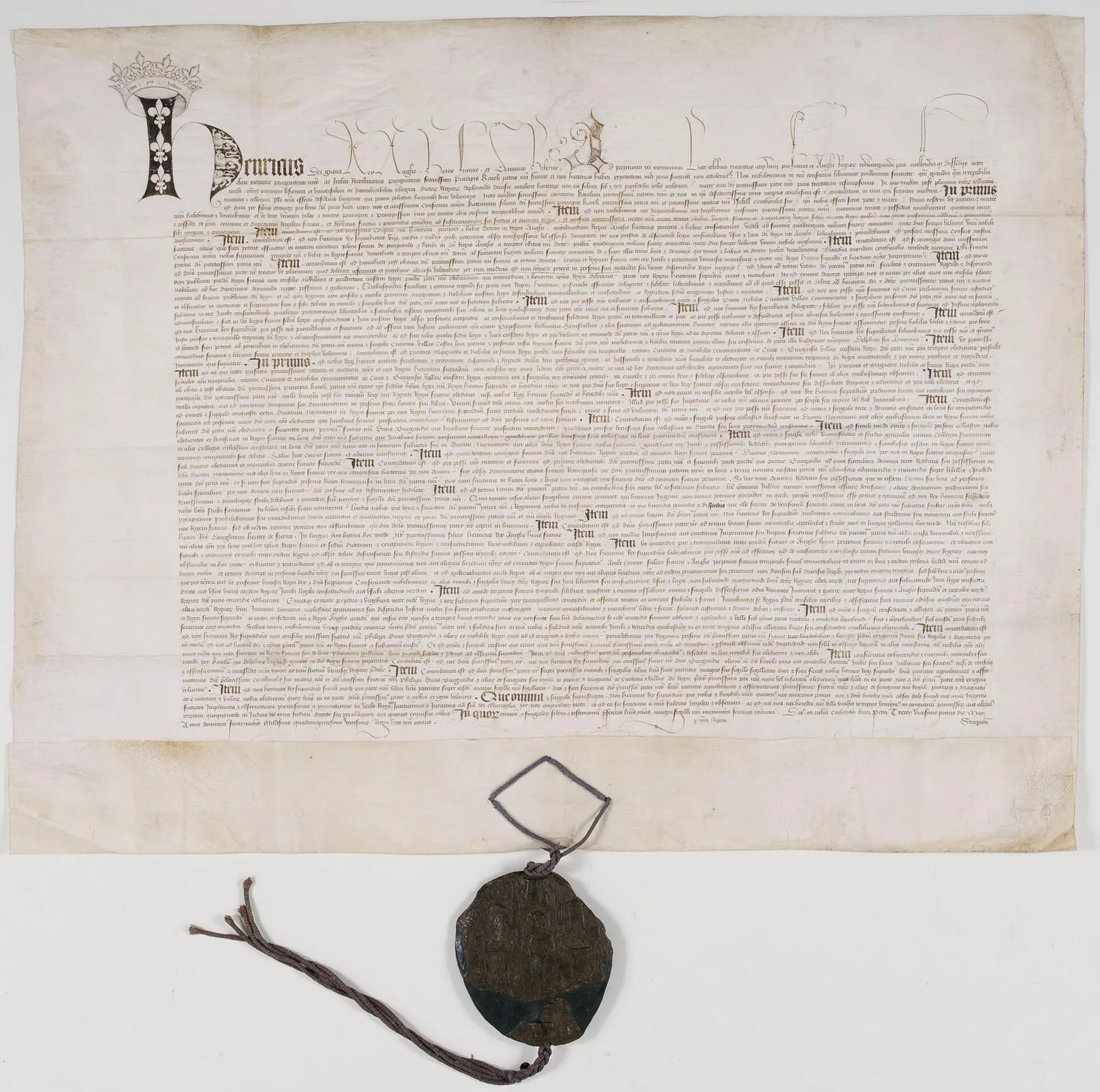
Ratification of the Treaty of Troyes, 21 May 1420. Archives nationales, Paris, AE/III/254 · Public domain · Source page
The war went on. In March 1421 a French and Scottish army killed Henry’s brother Thomas, Duke of Clarence, at Baugé. Henry returned and laid siege to Meaux, east of Paris; in December Queen Catherine gave birth in England to a son, Henry.
At Meaux Henry fell ill, probably with dysentery, the disease that had haunted his army since Harfleur. He died at Vincennes on 31 August 1422, not yet 36. Seven weeks later Charles VI died too. Henry had been heir of France for two years and never became its king. By the Treaty of Troyes, the new king of both realms was a baby not yet a year old.
Where Agincourt led
- 1415 Harfleur and Agincourt. France loses much of its nobility.
- 1417–1419 Henry conquers Normandy by siege, and Rouen falls.
- 1419 John the Fearless is murdered at Montereau; Burgundy joins England.
- 1420 The Treaty of Troyes: Henry becomes heir and regent of France, and marries Catherine.
- 1422 Henry V dies in August, Charles VI in October. The infant Henry VI is proclaimed king of both realms; in the south the Dauphin proclaims himself Charles VII.
- 1429–1453 Joan of Arc, Charles VII crowned, and everything lost except Calais: the next lesson.
- 1599 Shakespeare’s Henry V gives the battle the shape most people still remember.
A miracle, or arithmetic?
Was Agincourt a victory of the few over the many, and what kind of king was Henry?
- Anne Curry, Agincourt: A New History (2005) The pay records show about 9,000 English against no more than 12,000 French. The ‘miracle of the few’ was made by chroniclers who needed God, or bad luck, to explain the result. The French plan was sound; crowding, mud and quarrelling lords wrecked it.
- Clifford Rogers (2005, 2008) and Juliet Barker (2005) The records include men who were sick, dead or left in garrisons, and leave out the French armed servants. The English were probably about 6,000; Rogers puts the French at 24,000 or more, four to one, and Barker, trusting Waurin, at about 36,000, six to one. Rogers adds that Henry wanted a battle: he marched out of Harfleur to invite God’s judgement.
- Ian Mortimer, 1415 (2009) Look past the battle at the whole year: a king driven by religious certainty and by the need to prove his family’s right to rule, who did not hesitate to hang, burn and starve when it served him. His admirers, such as the historian K. B. McFarlane, once called him the greatest man ever to rule England.
Even the field itself is now argued over. Archaeologists have found surprisingly little at the traditional site, and Tim Sutherland and Michael Livingston have argued that the fighting took place somewhat further south and west. Nobody yet knows for certain exactly where Agincourt was fought.
What do you know now?
Check yourself
What method did Charles V and du Guesclin use against the English after 1369?
Answer: Avoiding pitched battle and retaking castles and towns one at a time. Right. They let the English raids burn and wear themselves out while they took the country back. By 1380 England held little more than Calais and the coast of Gascony.
Check yourself
What weakened France most in the years before 1415?
Answer: Charles VI’s madness and the civil war between Armagnacs and Burgundians. Right. A king who could not rule left power to his relatives, and from the murder of Louis of Orléans in 1407 the two parties fought each other, both asking England for help.
Check yourself
How do historians today judge the chroniclers’ figures, such as the Gesta’s 60,000 French against about 6,000 English?
Answer: They are far too high; modern estimates of the French range from about 12,000 to 36,000. Right. The chroniclers counted by eye and swelled the numbers. Modern historians put the French at about 12,000 (Anne Curry, from records), 24,000 (Rogers) or 36,000 (Barker, following Waurin).
Check yourself
Whom did the Burgundian chronicler Monstrelet blame for the killing of the French prisoners?
Answer: The French lords who plundered the English baggage. Right. In his view the ‘disgraceful conduct’ of Robinet de Bournonville, Ysambart d’Azincourt and their companions caused the massacre, and the Duke of Burgundy even jailed them.
Check yourself
What is true of the ‘band of brothers’ speech?
Answer: Shakespeare wrote it in 1599; Henry’s own words were not recorded. Right. Henry did speak, but the chroniclers give only the gist. The famous speech is Shakespeare’s poetry, 184 years after the battle.
Check yourself
What did the Treaty of Troyes give Henry V?
Answer: The right to inherit the French crown when Charles VI died, the regency, and Catherine’s hand. Right. Charles VI stayed king for life, and the Dauphin was disinherited. But Henry died seven weeks before Charles and never reigned in France.
Terms
- longbow A bow of yew about as tall as a man. A trained archer could shoot perhaps ten aimed arrows a minute. English armies of the time had far more archers than men-at-arms.
- man-at-arms A soldier in full plate armour, a knight or a squire. At Agincourt most men-at-arms on both sides fought on foot.
- battle In medieval usage, a division of an army. Armies usually formed three: the vanguard, the main battle and the rearguard.
- constable The commander of the French royal army, the highest military office in France. In 1415 it was held by Charles d’Albret.
- Dauphin The title of the French king’s eldest son and heir. From 1417 the Dauphin was Charles, the future Charles VII.
- Armagnacs The party of Louis of Orléans’s family after his murder in 1407, named after its strongest leader, Bernard, Count of Armagnac. It controlled Paris and the court from 1413 to 1418.
- Burgundians The party of the dukes of Burgundy, John the Fearless and then his son Philip the Good, who also ruled much of the Low Countries. From 1419 they were England’s allies.
- ransom The price paid to free a prisoner of war. A captured lord could be worth a fortune to the man who took him, so knights tried to capture each other rather than kill.
- herald An officer who knew every noble coat of arms. Heralds carried messages between armies and, after a battle, identified and counted the noble dead.
- dysentery A gut infection spread by dirty water and food, called the ‘bloody flux’ in Henry’s day. In medieval wars it often killed more soldiers than battle did.
- dual monarchy Two kingdoms under one king, each keeping its own laws. This was the Treaty of Troyes’ plan for England and France.
- House of Lancaster The branch of the English royal family descended from John of Gaunt, Duke of Lancaster, a son of Edward III. It ruled England from 1399 to 1461: Henry IV, Henry V and Henry VI.
- Falstaff A fictional character in Shakespeare's plays, a tavern companion of Prince Hal.
- Tito Livio Frulovisi A Latin writer who wrote the first biography of Henry V.
- John Bradmore A surgeon who described, himself, the operation to remove an arrow from beside Prince Henry's nose, in a Latin treatise.
- Shrewsbury A battle site in England, July 1403, where Prince Henry was hit by an arrow in the face.
- Owain Glyndŵr The leader of the Welsh rising against King Henry IV.
- The Percy family A mighty family of nobles that rebelled against King Henry IV.
- Lollards A religious movement in England opposed to the Church. Henry V crushed their rising within a year.
- Catherine of Valois Daughter of Charles VI of France. Henry V married her in 1420.
- Charles VI King of France who suffered attacks of madness for about thirty years and was too ill to rule.
- Charles of Orléans A duke captured in battle and held in England for twenty-five years. There he became one of the finest French poets of his age.
- John the Fearless Duke of Burgundy. He hired the killers of his cousin Louis in 1407, and was himself murdered in 1419.
- Philip the Good The new Duke of Burgundy after John the Fearless was murdered. He turned to England and wanted revenge on the Dauphin.
- Harfleur A port at the mouth of the Seine in northern France. Henry V took it after a five-week siege.
- Calais An English fortress on the Channel coast, about 200 kilometres north-east of Harfleur.
- Rouen The capital of Normandy. It held out against Henry V until it surrendered in January 1419, after its food ran out.
- Blanchetaque A ford across the Somme where Edward III crossed the river before Crécy.
- Maisoncelle The place where the English camped the night before the battle, in the rain and in silence.
- Crécy A great battle in northern France, lost by the French to the English. Afterwards the French learned not to give the English an open battle.
- Poitiers A battle in France where the king of France was captured by the English. The French learned a hard lesson from it.
- Bertrand du Guesclin Commander for Charles V. In his time the French gave the English no open battle, and retook towns and castles.
- The Treaty of Troyes An agreement sealed in 1420 under which Henry V would marry Catherine and inherit the French crown.
- Montereau A town in France, where John the Fearless was murdered on a bridge in 1419.
- Monstrelet A Burgundian chronicler who continued Froissart. He was not at Agincourt.
- Waurin A chronicler who was about 15 at the battle on the French side, and wrote decades later.
- John Page An English soldier-poet who described the people starving in the ditch below the walls of Rouen.
Sources
- Gesta Henrici Quinti: The Deeds of Henry the Fifth, ed. and trans. Frank Taylor and John S. Roskell (Oxford: Clarendon Press, 1975); written by a royal chaplain with the army, 1416–17
- Henrici Quinti, Angliae Regis, Gesta, ed. Benjamin Williams (London: English Historical Society, 1850): the Latin text of the Gesta
- Jean de Waurin, A Collection of the Chronicles and Ancient Histories of Great Britain, now called England, vol. 2 (1399–1422), trans. William Hardy and Edward L. C. P. Hardy, Rolls Series 40 (London, 1887), pp. 180–216 (the 1415 campaign)
- Enguerrand de Monstrelet, The Chronicles of Enguerrand de Monstrelet, trans. Thomas Johnes (London, 1809–10): the Agincourt campaign
- Jean Le Fèvre de Saint-Rémy, Chronique, ed. François Morand, 2 vols (Paris: Société de l’histoire de France, 1876–81)
- Chronique du Religieux de Saint-Denys, ed. and trans. L. Bellaguet, 6 vols (Paris, 1839–52)
- John Page, The Siege of Rouen (c. 1419), in The Historical Collections of a Citizen of London in the Fifteenth Century, ed. James Gairdner (London: Camden Society, 1876)
- William Shakespeare, The Life of King Henry the Fifth (1599), act 4, scene 3
- Treaty of Troyes, ratification of 21 May 1420. Archives nationales, Paris, AE/III/254
- Anne Curry, Agincourt: A New History (Stroud: Tempus, 2005)
- Anne Curry, The Battle of Agincourt: Sources and Interpretations (Woodbridge: Boydell Press, 2000)
- Juliet Barker, Agincourt: The King, the Campaign, the Battle (London: Little, Brown, 2005)
- Clifford J. Rogers, ‘The Battle of Agincourt’, in L. J. Andrew Villalon and Donald J. Kagay (eds), The Hundred Years War (Part II): Different Vistas (Leiden: Brill, 2008)
- Clifford J. Rogers, ‘Henry V’s Military Strategy in 1415’, in L. J. Andrew Villalon and Donald J. Kagay (eds), The Hundred Years War: A Wider Focus (Leiden: Brill, 2005)
- Christopher Allmand, Henry V (London: Methuen, 1992; new edn, New Haven: Yale University Press, 1997)
- Jonathan Sumption, The Hundred Years War IV: Cursed Kings (London: Faber & Faber, 2015)
- Ian Mortimer, 1415: Henry V’s Year of Glory (London: Bodley Head, 2009)
- John Keegan, The Face of Battle (London: Jonathan Cape, 1976), ch. 2
- Christopher Phillpotts, ‘The French Plan of Battle during the Agincourt Campaign’, English Historical Review 99 (1984), 59–66
- S. J. Lang, ‘John Bradmore and his Book Philomena’, Social History of Medicine 5 (1992), 121–30
- Tim Sutherland, ‘The Battle of Agincourt: An Alternative Location?’, Journal of Conflict Archaeology 1 (2005)
- R. C. Famiglietti, Royal Intrigue: Crisis at the Court of Charles VI, 1392–1420 (New York: AMS Press, 1986)
- K. B. McFarlane, Lancastrian Kings and Lollard Knights (Oxford: Clarendon Press, 1972)
- Michael Livingston, ‘A Battle Is Its Ground: Conflict Analysis and a Case Study of Agincourt, 1415’, Journal of Medieval Military History 21 (2023)
Image credits
- The battle of Agincourt, miniature in an abridgement of the chronicle of Enguerrand de Monstrelet, c. 1470–80. Bibliothèque nationale de France, Français 2680, f. 208 · Public domain · Source page
- Henry V, unknown artist, late 16th or early 17th century. National Portrait Gallery, London (NPG 545) · Public domain · Source page
- The Bal des Ardents, by the Master of the Harley Froissart (perhaps Philippe de Mazerolles), c. 1470–72, in Jean Froissart’s Chronicles. British Library, Harley MS 4380 · Public domain · Source page
- Charles VI and Pierre Salmon, Dialogues of Pierre Salmon, by the Mazarine Master, c. 1409. Bibliothèque nationale de France, Français 23279, f. 53 · Public domain · Source page
- The battlefield of Agincourt from the tower at Maisoncelle, March 2026. Photo: Patrimoine7vallees · CC BY-SA 4.0 · Source page
- Ratification of the Treaty of Troyes, 21 May 1420. Archives nationales, Paris, AE/III/254 · Public domain · Source page


