Octavian against Antony and Cleopatra: Actium
A sickly 18-year-old inherits Caesar’s name. Thirteen years later he is master of the Roman world.
Decisions, questions and your own progress, in the app
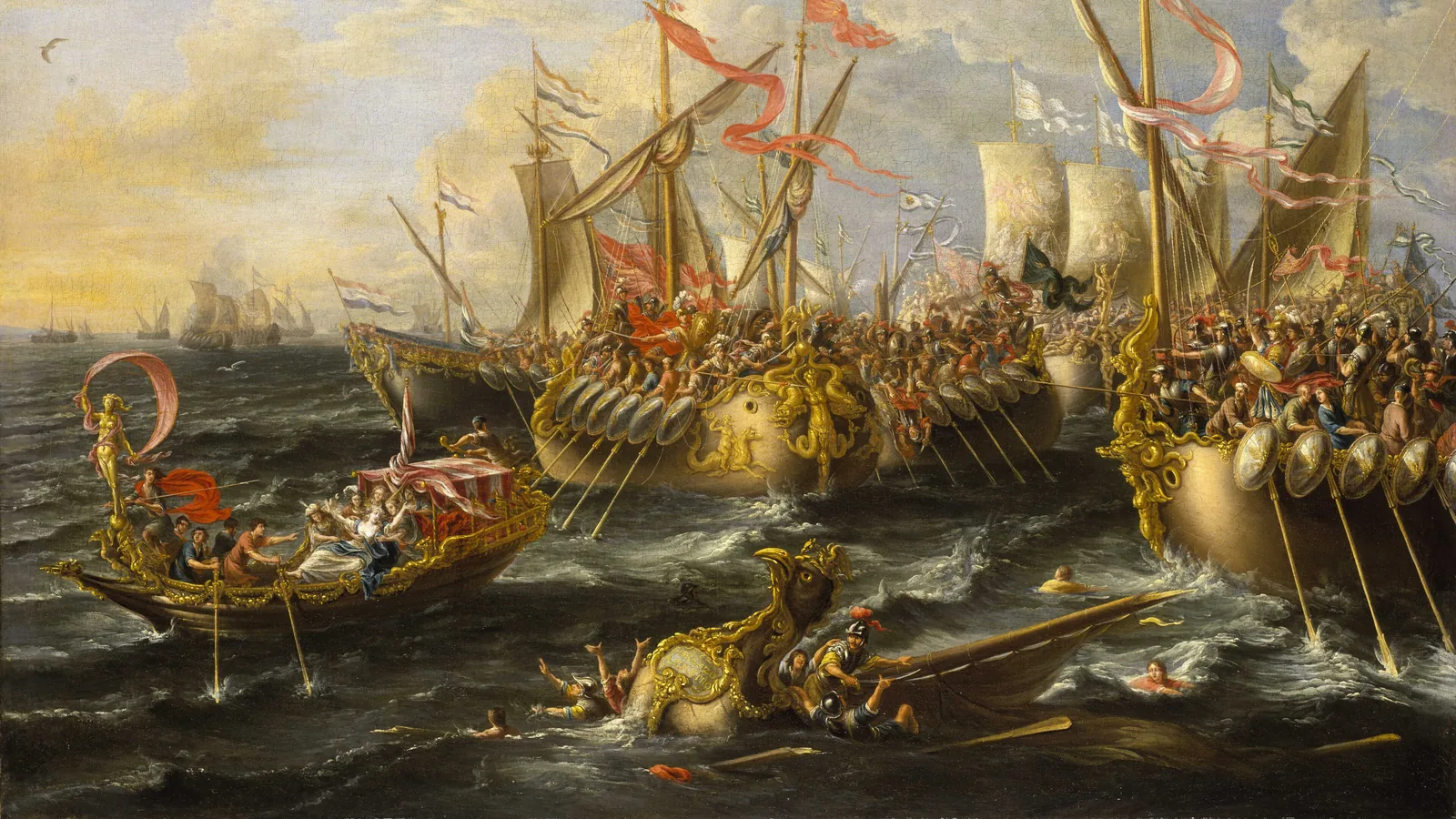
Laureys a Castro, The Battle of Actium, 2 September 31 BC, 1672. National Maritime Museum, Greenwich, London · Public domain · Source page
A boy and a name
Noon, and a wind from the sea
2 September 31 BC, off western Greece. At noon a breeze rises from the north-west, and sixty ships at the back of one fleet suddenly hoist their sails.
They are Cleopatra’s. They cut through the battle and run south. A smaller galley follows them, carrying Mark Antony, once Caesar’s right hand and master of the Roman East.
Watching from the other fleet is a man of 31. Thirteen years earlier he was a sickly student of 18, and all he had was a dead man’s name. How did he get here?
Background · March 44 BC
The letter at Apollonia
Gaius Octavius is 18, thin and often ill. He is studying at Apollonia, across the Adriatic in today’s Albania, waiting to join his great-uncle Julius Caesar’s war on Parthia. With him is his friend Marcus Agrippa, from a family nobody has heard of.
In March 44 BC a letter comes from his mother: Caesar has been murdered by senators, as we saw in the last lesson. Then more news: Caesar’s will adopts Octavius as his son and leaves him three-quarters of his fortune, and his name.
Octavian, later Augustus
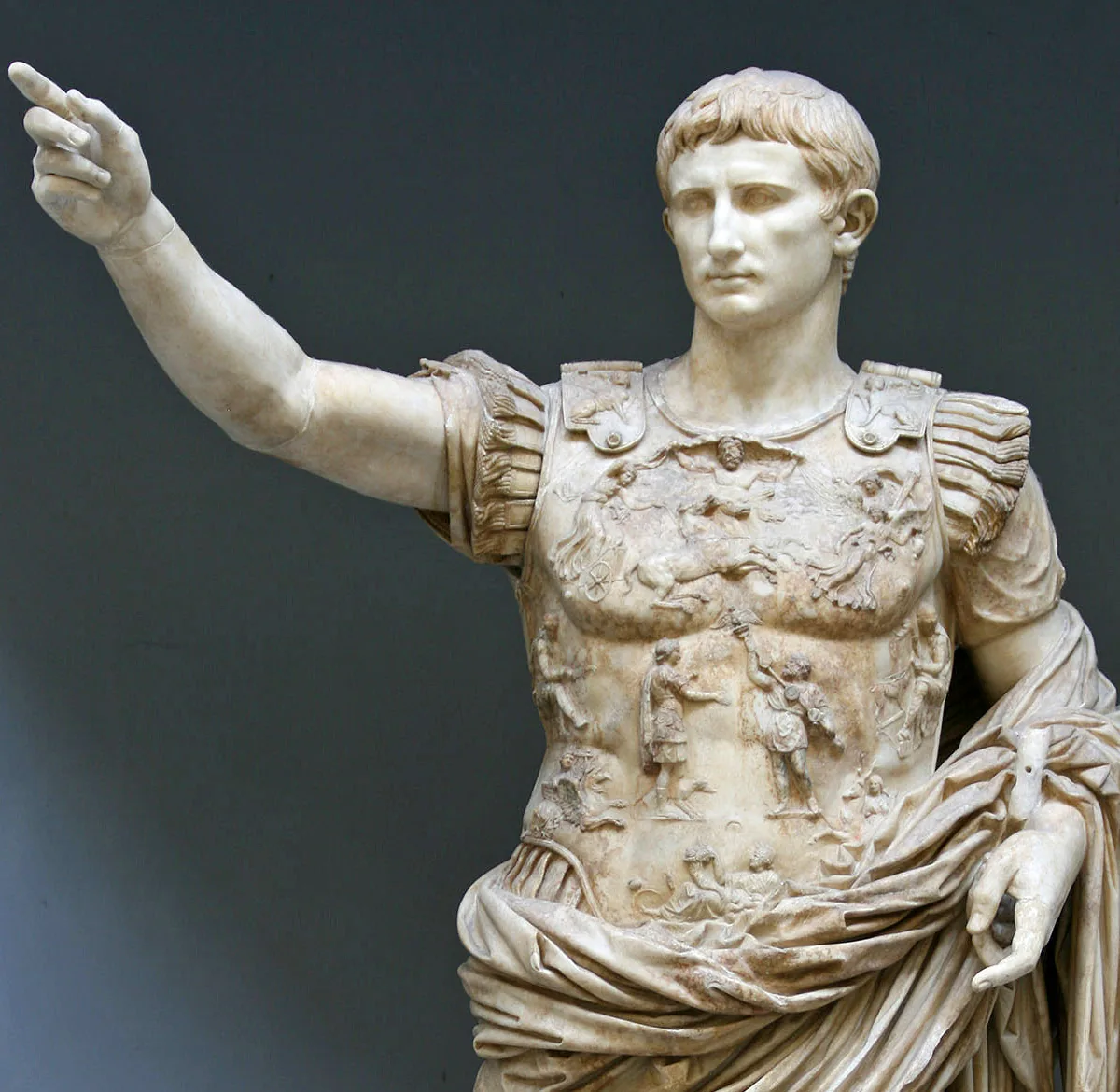
Augustus of Prima Porta. Vatican Museums, Braccio Nuovo. Photo: Till Niermann, 2007 · Public domain · Source page
An 18-year-old with nothing but a name, who outlived every rival and turned the Republic into a monarchy while saying he had restored it.
- Born: 23 September 63 BC, Rome, on the Palatine
- Died: 19 August AD 14, Nola, in Campania, of illness, aged 75
- Won: Mutina, 43 BC (with the consuls); Philippi, 42 BC (mostly Antony’s victory); Naulochus, 36 BC (Agrippa’s victory); Actium, 31 BC (Agrippa commanded); Alexandria, 30 BC
- Lost: First battle of Philippi, 42 BC (his camp taken); Sea battles against Sextus Pompey, 38 and 36 BC
“After that time I took precedence of all in rank, but of power I possessed no more than those who were my colleagues in any magistracy.”
A decision point
You are Gaius Octavius, aged 18.
April 44 BC, southern Italy, a few days after crossing from Apollonia
The will makes you Caesar’s son. But the Senate has pardoned his killers. Mark Antony, consul and Caesar’s old officer, holds Caesar’s papers and money, and treats you as a boy.
Caesar’s veterans and the city crowd loved him, and they are angry. You have no office, no army and no experience. Your stepfather, a former consul, tells you to refuse the name.
What do you do?
- Refuse the name and live as a rich private man Probably safe for a while. But the veterans would look for another leader, and a man once named Caesar’s heir would stay a suspect in the eyes of whoever ruled.
- Accept the money, but stay out of politics You would be rich for a while. But Antony controls Caesar’s funds, and an heir without power cannot even collect his inheritance.
- Take the name and march on Rome at once with the soldiers who cheer you The soldiers might follow Caesar’s son. But you would be starting a civil war against a sitting consul with a handful of men, and the Senate could declare you a public enemy within weeks.
- Take the name, claim the inheritance by law in Rome, and pay Caesar’s gifts to the people yourself You would win the crowd and the veterans’ goodwill without breaking the law. But you would make Antony your enemy, and you would need money you do not have.
What really happened
Take the name, claim the inheritance by law in Rome, and pay Caesar’s gifts to the people yourself
He accepted the inheritance and the name Gaius Julius Caesar, ‘in spite of the doubts of his mother and the strong opposition of his stepfather’, writes Suetonius. Octavian sold property to pay every citizen the 300 sesterces the will had promised. By the autumn he had raised a private army of Caesar’s veterans, illegally, and two of Antony’s legions had come over to him.
The name ‘Caesar’ was worth more than any office: soldiers followed it. Refusing would have made him nobody. Ronald Syme saw cold ambition here from the start; Adrian Goldsworthy stresses the risk: at 18, he bet his life on a name.
44–43 BC
Consul at nineteen
Cicero, Rome’s great orator, thinks he can use the young man against Antony. In speeches called the Philippics he brands Antony a public enemy, and the Senate gives Octavian legal command of his army.
In April 43, at Mutina in northern Italy, Antony is beaten and retreats over the Alps. Both consuls are dead, and now the Senate tries to drop the young man. Octavian marches his legions on Rome, and in August 43, not yet twenty, he is elected consul.
Three men and a list
November–December 43 BC
Three men on a river island
Instead of fighting Antony, Octavian joins him. On a river island near Bononia (Bologna) he meets Antony and Lepidus, commander of the legions in southern Gaul and Spain.
Unlike the private pact of Caesar, Pompey and Crassus in 60 BC, this is official: on 27 November 43 a law of the people makes the three a legal triumvirate ‘for setting the state in order’, for five years, with power to make laws and name magistrates.
Their first act is a proscription: hundreds of senators and some two thousand knights are listed. Antony demands Cicero. On 7 December soldiers catch and kill him near his villa at Formiae; his head and right hand are put on show in the Forum.
Mark Antony
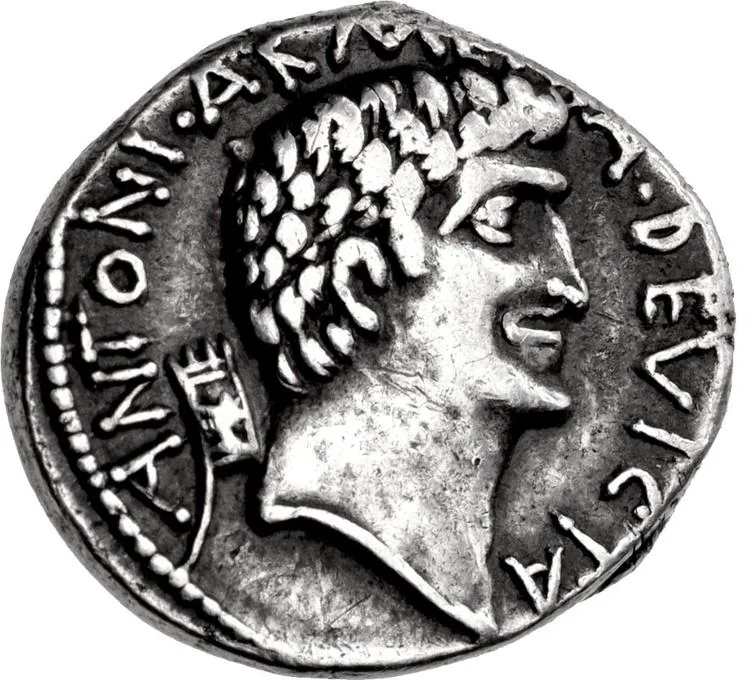
Denarius of Mark Antony and Cleopatra, 34–32 BC, Antony’s side. Private collection. Photo: Classical Numismatic Group (CNG) · CC BY-SA 2.5 · Source page
Caesar’s best officer and the real victor of Philippi, who bet the Roman East on Egypt, and lost.
- Born: 14 January 83 BC (or 86), Rome
- Died: 1 August 30 BC, Alexandria, stabbed himself after a false report that Cleopatra was dead, and died in her arms
- Won: Pharsalus, 48 BC (Caesar’s left wing); Philippi, 42 BC; Armenia, 34 BC
- Lost: Mutina, 43 BC; The Parthian campaign, 36 BC; Actium, 31 BC; Alexandria, 30 BC
“He had become most illustrious of men, had won greatest power, and now had been not ignobly conquered, a Roman by a Roman.”
Philippi: who fought whom
October 42 BC: two battles about three weeks apart
The plain west of Philippi, in eastern Macedonia (northern Greece today)
The triumvirs
- Commanders: Mark Antony, Octavian (ill for most of the campaign)
- Strength: 19 full legions, 13,000 horse (Appian); perhaps 50,000–100,000 men (Modern estimate)
- Losses: more than twice the Liberators’ losses, in the first battle (Messalla, one of Brutus’s officers, in Plutarch)
Appian gives both sides 19 legions and calls the triumvirs’ legions full; modern historians doubt that any legion of 42 BC was at full strength.
The Liberators
- Commanders: Marcus Junius Brutus, Gaius Cassius Longinus
- Strength: 17 or 19 legions (his figures disagree), about 80,000 foot, 20,000 horse (Appian); about the same as the triumvirs (Modern estimate)
- Losses: 8,000 in the first battle, camp servants included (Plutarch); the day after the second battle, fewer than four full legions were still with Brutus (Appian)
Outcome: A victory for the triumvirs, in two rounds. Cassius and Brutus both took their own lives, and most of their soldiers went over to the victors.
Every figure comes from partisans or from Appian, writing two centuries later. The losses cannot be checked.
The battles of Philippi
September–October 42 BC
In September 42 BC, at Philippi on the Via Egnatia, the Liberators Brutus and Cassius hold two hills with their fleet and supplies behind them. Facing them, the triumvirs Antony and Octavian camp on the open plain, short of food.
Positions follow the traditional reconstruction from Appian’s description (Civil Wars 4.105–131) and the surveys of P. Collart and J. Kromayer: the Liberators on two hills astride the Via Egnatia about 3 km west of Philippi, the triumvirs on the open plain. C. J. Butera and M. A. Sears (2017) place the camps in the south-east of the plain instead. The marsh has since been drained. Positions and line lengths are schematic.
Phases of the battle
- Hills against plain Brutus and Cassius hold two hills astride the Via Egnatia, joined by a wall, with their fleet and supplies behind them. Antony and Octavian camp on the open plain, short of food. The Liberators only have to wait.
- A road through the marsh For about ten days Antony’s men secretly build a causeway through the marsh, to get round Cassius and cut him off from the sea. Cassius sees it and builds a cross-wall.
- One wing wins, one wing loses In early October Antony storms Cassius’s wall and camp. Meanwhile Brutus’s men, without orders, overrun Octavian’s camp. Cassius sees only his own defeat and has his freedman kill him.
- The second battle Three weeks later Brutus’s impatient officers force a battle. Octavian’s and Antony’s legions break his line, and the retreat becomes a rout. Brutus escapes into the hills and kills himself.
The strategy
- Triumvirs: Antony’s men secretly build a causeway through the marsh to get round Cassius and cut him off from the sea. The triumvirs cannot simply wait, because they are short of food.
- Liberators: Brutus and Cassius hold two hills across the Via Egnatia, joined by a wall, with their fleet and supplies behind them. They do not need to attack: the triumvirs are on open ground and short of food, so waiting is enough.
What decided it: The Liberators’ waiting broke from within. Brutus’s men, without orders, overran Octavian’s camp; Cassius, seeing only his own defeat, asked his freedman to kill him; and Brutus’s impatient officers forced a second battle.
42–40 BC
Dividing the world
The winners divide the empire. Antony takes the rich East. Octavian takes the hardest job: seizing land in Italy for tens of thousands of veterans.
In 41 Antony’s brother Lucius and Antony’s wife Fulvia raise Italy against Octavian. He and Agrippa starve Lucius out at Perusia (Perugia). Suetonius says Octavian met every plea for mercy with one reply: ‘You must die.’ In 40, with Fulvia dead, the two triumvirs make peace at Brundisium, and Antony marries Octavian’s sister, Octavia.
The queen and the admiral
41 BC
Venus on the river
In 41 Antony, now master of the East, summons the queen of Egypt to Tarsus, in southern Turkey, to explain why she helped Cassius. She arrives up the river Cydnus in ‘a barge with gilded poop, its sails spread purple, its rowers urging it on with silver oars to the sound of the flute’, dressed as Venus. So Plutarch describes it, 150 years later.
The meeting becomes an alliance. At her request Antony has her sister and rival, Arsinoe, put to death, and spends the winter with her in Alexandria.
Cleopatra VII
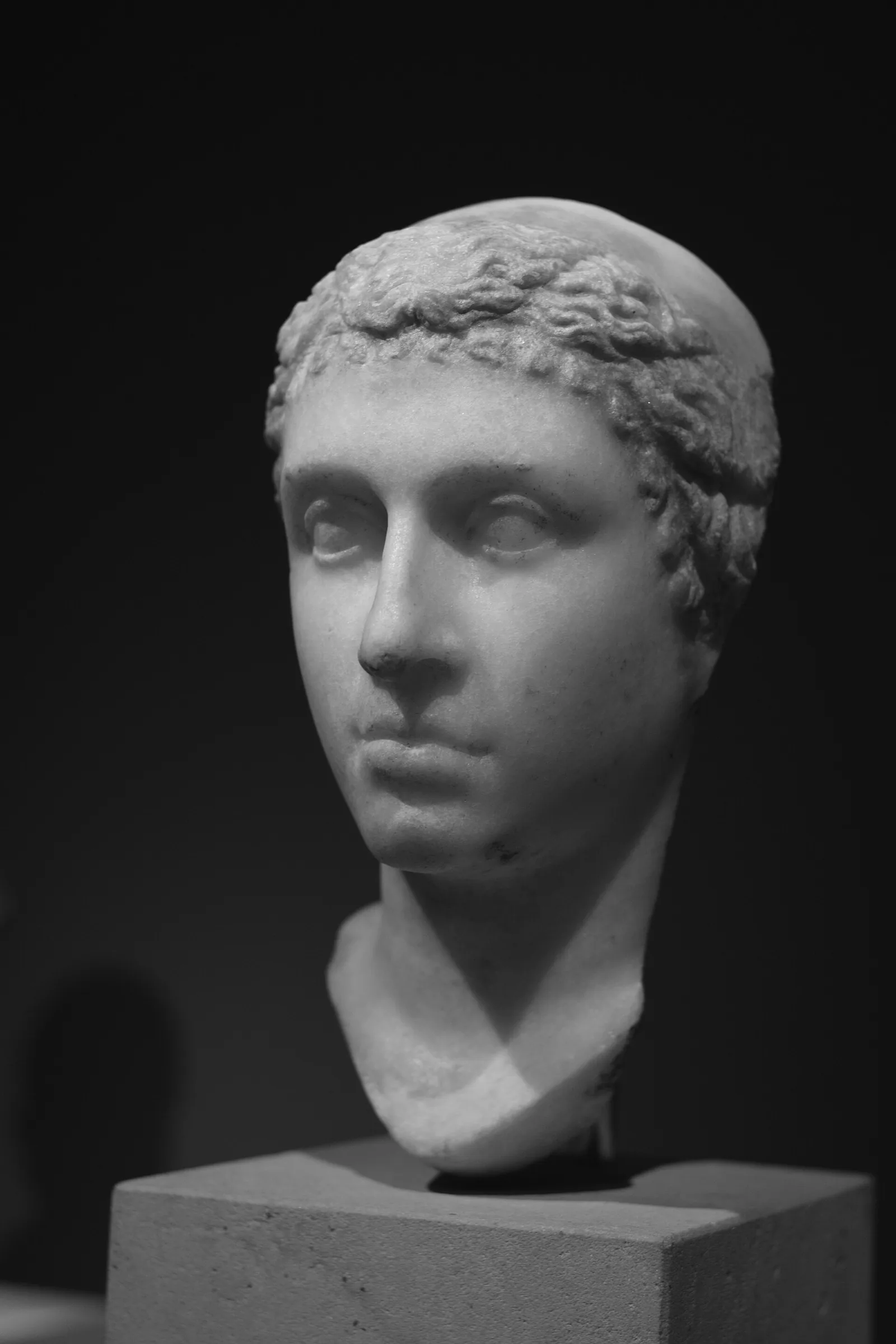
Head of Cleopatra VII, c. 50–30 BC. Antikensammlung, Altes Museum, Berlin. Photo: Marco21274, 2010 · Public domain · Source page
The last of the Ptolemies, the heirs of Alexander the Great, who kept Egypt independent for twenty years by allying with two Roman generals, and lost it with the second.
- Born: 70 or 69 BC, Probably Alexandria
- Died: About 10 August 30 BC, Alexandria, by her own hand, by an asp or by poison; ‘the truth of the matter no one knows’, writes Plutarch
- Won: Her throne regained with Caesar’s help, 47 BC; Large lands in Syria and the Levant from Antony, 37 and 34 BC; Twenty years of an independent Egypt
- Lost: Driven out by her brother’s party, 49–48 BC; Actium, 31 BC; The loss of Egypt, 30 BC
“Her tongue, like an instrument of many strings, she could readily turn to whatever language she pleased.”
Myth
Cleopatra was the most beautiful woman in the world, and that is how she won Caesar and Antony.
The truth
We do not know what she looked like. Plutarch writes that ‘her beauty, as we are told, was in itself not altogether incomparable, nor such as to strike those who saw her; but converse with her had an irresistible charm’.
The evidence
Her real assets were Egypt’s wealth and a sharp mind; Plutarch says she was the first of her Macedonian Greek dynasty to learn Egyptian. Cassius Dio does call her very beautiful: the ancient writers disagree. Her coins show a hooked nose and a strong chin, but coins are political images. The legend grew later, from Pascal’s remark on ‘Cleopatra’s nose’ (1670) to Hollywood.
38–36 BC
The admiral
One danger is left in the West: Sextus Pompey, son of Pompey the Great, holds Sicily with a strong fleet and can starve Rome of grain. Octavian loses fleets to him and to storms.
So he hands the sea war to Agrippa, who builds a new harbour and trains fresh crews all winter. On 3 September 36, off Naulochus in Sicily, Agrippa destroys Sextus’s fleet. Lepidus then tries to seize Sicily; his soldiers desert him, and he is pushed out of power. Now there are two.
36 BC
Twenty-seven days
The same year Antony invades Media, Parthia’s ally, with perhaps 100,000 men. His siege train is ambushed, the king of Armenia goes home with his cavalry, and the siege of Phraaspa fails.
The retreat lasts twenty-seven days. Plutarch counts ‘twenty thousand of the infantry and four thousand of the cavalry’ lost, ‘more than half by disease’. Caesar’s war of revenge on Parthia has failed, and Antony needs Egypt’s money more than ever.
35–34 BC
Queen of Kings
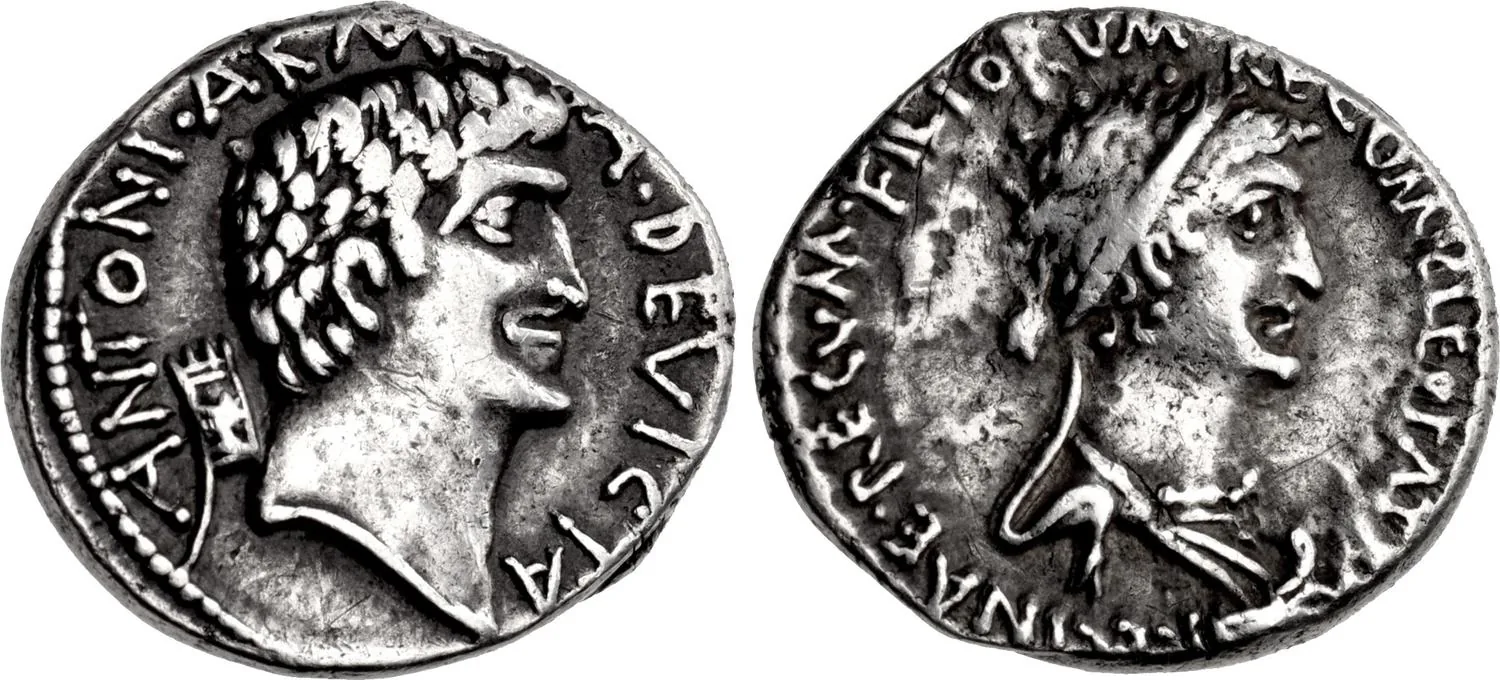
Denarius of Mark Antony and Cleopatra, 34–32 BC. Private collection. Photo: Classical Numismatic Group (CNG) · CC BY-SA 2.5 · Source page
In 35 Octavia sails east with money and 2,000 picked soldiers for her husband. Antony tells her to go home from Athens.
In 34 Antony seizes Armenia and celebrates in Alexandria with a parade that looks to Romans like a triumph held outside Rome. Then, on golden thrones, he proclaims Cleopatra ‘Queen of Kings’, hands Roman lands in the East to her children, and declares Caesarion the true son of Julius Caesar. If Caesar had a real son, what was the adopted one worth? Antony even puts her head on Roman silver, the denarius his soldiers are paid with.
War on a queen
33–32 BC
Words as weapons
Now the two men fight with words. Octavian says Antony is bewitched by an Egyptian queen and gives Roman land away; Antony calls Octavian a low-born coward.
Then two of Antony’s officers change sides and tell Octavian about Antony’s will. The Vestal Virgins, who keep it, tell him to take it himself. He does, and reads it out: Antony calls Caesarion Caesar’s true son, leaves gifts to Cleopatra’s children, and asks to be buried in Alexandria, beside her.
32 BC
A war on Cleopatra
‘The whole of Italy voluntarily took oath of allegiance to me,’ Octavian wrote later. Suetonius lets slip that Bononia, full of Antony’s clients, was excused: the oath was organised, not spontaneous.
In the autumn the Senate strips Antony of his coming consulship and declares war, not on him, but on Cleopatra. Octavian revives the ancient fetial rite and hurls a spear in front of the temple of the war goddess Bellona. The war was, as Cassius Dio put it, ‘nominally directed against Cleopatra, but really against Antony’. A foreign war is easier to sell than a civil one.
Spring–summer 31 BC
The trap closes
Antony and Cleopatra gather their fleet and army in western Greece. Most of the fleet lies inside the Ambracian Gulf, behind a strait less than a kilometre wide, by the cape of Actium.
Agrippa strikes first. He storms the base of Methone in the far south and preys on the grain ships from Egypt. Octavian lands his army north of the strait and fortifies a hill above it, and over the summer Agrippa takes Leucas, Patrae and Corinth.
Antony’s camp, on low ground south of the strait, bakes all summer. Disease, probably malaria and dysentery, kills his rowers. Allies and officers desert.
A decision point
You are Mark Antony.
Late August 31 BC, your council of war at Actium
Agrippa holds the bases to your south, and your grain is running out. Disease has emptied the rowing benches, and allies desert every week.
You still have nineteen legions, many big warships and Cleopatra’s treasure. Canidius, your land commander, urges you to send the queen home and fight on land, where you are strongest. Cleopatra wants the war decided at sea.
What do you do?
- Fight a full sea battle to win If it worked, the war would be over in a day. But you are outnumbered and short of rowers, and Agrippa has beaten your squadrons all summer; a lost battle would cost you the fleet, and probably the war.
- Canidius’s plan: give up the fleet and fight on land You would fight where you are strongest, as Plutarch thought you should. But you would abandon the fleet and leave Egypt and its treasure open, and Octavian need not accept battle. An army already deserting might melt away on the march.
- Cleopatra’s plan: break out to Egypt by sea with the best ships and the treasure, while the army marches away by land You would save the queen, the money and the core of the fleet to fight again. But the breakout must look like a battle or your allies will panic, and many ships may not get out.
- Hold the camp and wait Octavian has no reason to attack. Every week of waiting means more disease, more hunger and more deserters.
What really happened
Cleopatra’s plan: break out to Egypt by sea with the best ships and the treasure, while the army marches away by land
Antony burned the ships he could not man. The treasure was loaded at night, and the ships took their sails, which warships normally left ashore before a battle. As he went aboard, a scarred centurion begged him: ‘Imperator, why dost thou distrust these wounds and this sword and put thy hopes in miserable logs of wood?’ Antony only signed to him to take heart.
Without the fleet, Egypt was lost; without Cleopatra’s money, he could not pay his army. Cassius Dio says plainly that the council chose to break out to Egypt, sailing out ‘as if they were making preparations for a naval battle’ so as not to frighten the allies.
Actium: who fought whom
2 September 31 BC, from about noon to late afternoon
The sea just outside the strait of the Ambracian Gulf, western Greece
Octavian
- Commanders: Octavian, Marcus Agrippa, commanding at sea, Arruntius and Lurius (the sources differ on their posts), Statilius Taurus, the army ashore
- Strength: 250 warships; 80,000 foot and about 12,000 horse (whole campaign) (Plutarch); 230 ships with rams and 30 without; 8 legions aboard (Orosius); more than 400 ships (Florus); about 400 ships, most of them lighter (Modern estimate)
- Losses: not recorded (Ancient sources)
Antony and Cleopatra
- Commanders: Mark Antony, Cleopatra VII, with her own squadron of 60 ships (blue on the map), Gellius Publicola (right wing); Sosius or Coelius (left), Canidius Crassus, the army ashore
- Strength: 500 warships, many of them ‘eights’ and ‘tens’; 100,000 foot and 12,000 horse (whole campaign) (Plutarch); fewer than 200 ships (Florus); 170 ships (Orosius); about 230 warships in the battle, including Cleopatra’s 60; Plutarch says 20,000 legionaries and 2,000 archers were put aboard (Modern estimate)
- Losses: no more than 5,000 dead; 300 ships captured (Augustus, quoted by Plutarch); 12,000 dead and 6,000 wounded (Orosius)
Plutarch’s 500 ships is the fleet before a winter of disease; Antony burned what he could not man.
Outcome: A victory for Octavian. Cleopatra’s 60 ships, and Antony with a few more, broke out and reached Egypt. The rest of the fleet surrendered or fled back into the gulf by evening; the army, nineteen legions, surrendered a week later.
Writers on the winning side liked to make Antony’s ships huge, so that the victory looked harder. The ram sockets on Octavian’s victory monument show ships from ‘fours’ to ‘tens’.
The battle of Actium
Summer 31 BC, and the battle on 2 September
In summer 31 BC the fleet of Antony and Cleopatra is gathered in the Ambracian Gulf, behind a narrow strait by the cape of Actium, and Antony’s army is in a low camp south of the strait. Agrippa shuts the sea, and Octavian holds a hill to the north.
Coastline from a modern map (OpenStreetMap). The sea was then about a metre lower and the sandbar off the strait has shifted, but the shape is much the same. Positions follow the reconstruction of J. Kromayer and W. W. Tarn as refined by W. M. Murray and B. Strauss: Antony’s line just outside the strait, Octavian’s about 1.5 km to the west (Plutarch). No ancient writer gives the lengths of the lines or the exact track of the breakout; they are estimates. Whether Antony meant to fight or to escape is disputed.
Phases of the battle
- The blockade Antony’s fleet lies inside the gulf, his army in the low camp south of the strait. Octavian holds the hill to the north and the beach at Comarus. Agrippa’s ships close the sea and cut the grain route from Egypt.
- Morning: two lines On the morning of 2 September Antony’s fleet rows out and forms a curved line just outside the strait, its ends near the shore. Octavian’s fleet waits about a kilometre and a half to the west. For hours, nobody moves.
- Noon: the wind and the gap Around noon the sea breeze rises from the north-west. Antony’s left moves forward and Octavian’s right backs away, drawing it into open water. Agrippa stretches north to outflank Antony’s right; Publicola follows him, and a gap opens in Antony’s line. Ships grapple and fight ‘like the storming of a walled town’.
- The breakout Cleopatra’s sixty ships hoist their sails, cut through the gap and run south with the wind, for the Peloponnese and Egypt. Antony leaves his flagship for a quinquereme and follows with a few ships. Some of Octavian’s liburnians give chase and take two ships, but not Antony.
- Evening: the fleet left behind The ships left behind fight on until about four in the afternoon; in Cassius Dio’s account Octavian’s men finally use fire. By evening most have surrendered or fled back into the gulf; Augustus claimed 300 ships taken. Antony’s army waits seven days, then surrenders.
The strategy
- Octavian: Agrippa shuts the sea and cuts the grain from Egypt, so that Antony’s supplies run out. In battle Octavian’s right wing gives ground, drawing Antony’s left into open water, while Agrippa stretches north to outflank.
- Antony: Antony, who still has many big warships, forms his fleet in a curved line just outside the strait, its ends near the shore. Whether he meant to win at sea or to escape is disputed.
- Cleopatra (Antony’s side): Cleopatra wants the war decided at sea, and to keep her best ships and the treasure. Sixty of her ships are set to break through the line and run south with the wind, for Egypt.
What decided it: The battle was decided by the gap: when Agrippa outflanked Antony’s right and Publicola followed him, a way opened, and Cleopatra and Antony slipped through it. The ships left behind fought until evening, and most surrendered or fled into the gulf.
Myth
At Actium Cleopatra panicked and fled, and Antony, mad with love, followed her and threw the battle away.
The truth
Most historians think the flight was the plan. What failed was the rest of the fleet getting out behind her.
The evidence
The council had chosen to break out, and the treasure and sails went aboard. Even Plutarch says Cleopatra placed her forces ‘where they could most easily get away if the cause was lost’, and her squadron stood at the back. She left at noon, when the sea breeze rises. A minority of scholars still thinks Antony meant to fight; but a panicking queen suited the victor’s story.
The last queen, the first princeps
A decision point
You are Cleopatra VII, queen of Egypt.
Winter 31/30 BC, Alexandria
Antony’s army in Greece has surrendered, his legions in Libya have gone over, and Octavian will come in the spring.
You still have Egypt’s treasury and four children; the eldest, Caesarion, 16, is called Caesar’s true son: a mortal danger to Octavian. Rome declared war on you, not on Antony. Octavian needs your gold to pay his soldiers, and wants you in his triumph.
What do you do?
- Escape east with the treasure, by way of the Red Sea You might keep your freedom and your gold. But a queen without a kingdom has little to bargain with, and the peoples along the way are not your friends.
- Offer to give up the crown if your children may keep Egypt It might save the dynasty, if Octavian can be trusted. He has every reason to promise much and give little.
- Hand Antony over to Octavian, as he demands It might buy you your throne for a while. But it would cost you your one ally and your honour, and once Antony was gone, Octavian would owe you nothing.
- Defend Egypt at Pelusium and Alexandria In theory Egypt is easy to defend. But your troops are few and wavering, and every defeat so far has come through desertion.
What really happened
Offer to give up the crown if your children may keep Egypt
She tried almost everything. The first ships dragged towards the Red Sea were burned by the Nabataeans of Petra. She offered to give up the crown for her children; Octavian answered with vague promises: fair treatment, if she killed or banished Antony. She did not give him up. In the summer of 30 Pelusium fell, and Octavian’s army reached Alexandria.
Plutarch and Dio paint a schemer ready to betray Antony. The historian Duane Roller sees a ruler doing what rulers do: trying every road to save her dynasty. What she could not change was Octavian’s need for Egypt’s treasure, and for her, alive, in his triumph.
August 30 BC
Alexandria
On 1 August Antony’s fleet and cavalry go over to Octavian. Told that Cleopatra is dead, Antony stabs himself; he is carried to the tomb where she has shut herself in, hauled up through a window, and dies in her arms.
Octavian’s men take her alive. Days later she bathes, dines and receives a basket of figs. She is found dead with her two maids. How she died, nobody knew even then: ‘The truth of the matter no one knows,’ writes Plutarch.
Octavian had Caesarion, 17, hunted down and killed. Antony’s three children by Cleopatra were spared and raised by Octavia. Egypt became a province under a governor Octavian chose.
A decision point
You are Octavian, Caesar’s son, aged 35.
January 27 BC, Rome
Every rival is dead. Some twenty-eight legions are yours, and Egypt’s gold pays them. Rome is exhausted after twenty years of civil war, and the Senate is full of your men.
But you remember why Caesar died: he ruled openly as dictator for life. And you need the old noble families to govern the provinces and command the armies.
What do you do with your power?
- Rule openly as dictator for life, as Caesar did Honest, and simple. But it is exactly what got Caesar killed, and it would turn the nobles you need into enemies.
- Give the state back for real, and retire Your name would be clean. But generals with armies would soon fight again, and your own life would be in danger. Suetonius says you twice thought of it.
- Restore the forms of the Republic, but keep the armies and Egypt by legal grants Elections, laws and the Senate would go on, and Rome could call it freedom. Real power would stay with you, but only as long as people agreed to see it the way you described it.
- Share supreme power openly with Agrippa Two rulers would be safer than one against assassins. But Rome’s pairs, Caesar and Pompey, Antony and you, ended in war every time.
What really happened
Restore the forms of the Republic, but keep the armies and Egypt by legal grants
On 13 January 27 he told the Senate he was handing the republic back. The senators begged him to stay, and gave him for ten years the provinces where most legions stood, Egypt among them. Three days later they named him Augustus, ‘the revered’. He called himself princeps, first citizen, claiming more auctoritas than others, not more power.
He wanted to be the opposite of Caesar: everything legal, nothing called a crown. Cassius Dio, 250 years later, was not fooled: ‘from his time there was, strictly speaking, a monarch’. Modern historians still argue over how much the disguise mattered.
27 BC–AD 14
More than forty years
Augustus ruled for more than forty years after 27 BC, far longer than anyone would have guessed of the sickly boy from Apollonia.
Poets wrote the official story. In Virgil’s Aeneid, Augustus stands at Actium with the Senate, the people and Rome’s gods against Antony, the barbaric East and ‘his Egyptian spouse’. When he died in AD 14, he left his own account of his deeds, the Res Gestae. We read it next.
What came after
- 2 September 31 BC Actium. Cassius Dio counts the years of Augustus’s sole rule from this day.
- 1 August 30 BC Alexandria falls and Antony dies; Cleopatra dies about ten days later. The last kingdom of Alexander’s successors ends.
- 29 BC A triple triumph. The gates of Janus close: ‘peace’ becomes the regime’s slogan.
- 27 BC The name Augustus and the ‘restored republic’: the principate begins.
- 23 BC Tribunician power for life: the legal core of every later emperor’s rule.
- AD 14 Augustus dies; his stepson Tiberius succeeds him. Power stays in one family down to Nero, a descendant of Antony.
- AD 285 The next lesson: one ruler is no longer enough, and Diocletian divides the empire.
How do we know?
Source: Augustus writes his own story
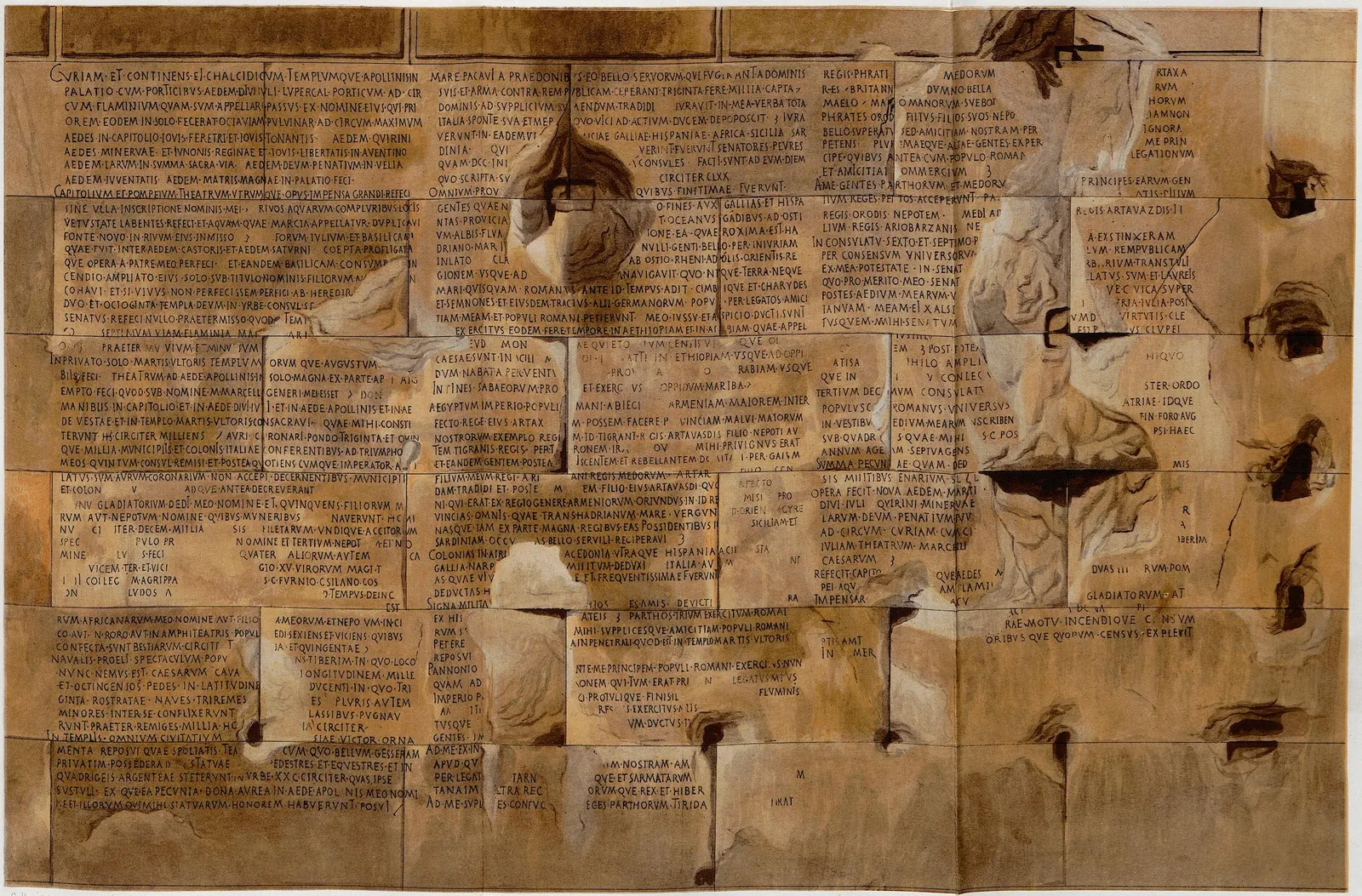
Georges Perrot, Edmond Guillaume and Jules Delbet, the Res Gestae at Ankara, plate from Exploration archéologique de la Galatie et de la Bithynie, Paris, 1872 · CC0 · Source page
“At the age of nineteen, on my own initiative and at my own expense, I raised an army by means of which I restored liberty to the republic, which had been oppressed by the tyranny of a faction. … In my sixth and seventh consulships, when I had extinguished the flames of civil war, after receiving by universal consent the absolute control of affairs, I transferred the republic from my own control to the will of the senate and the Roman people.”
Augustus finished this in the last year of his life, 44 years after Actium, for bronze tablets at his tomb.
- Who is ‘a faction’? And who is the enemy at Actium in this text? Antony. The Res Gestae never names him, nor Cleopatra, Brutus or Cassius. The civil war becomes ‘the war in which I was victorious at Actium’.
- What is left out of this story? The proscriptions and Perusia are missing. The private army and the oath are there, but reframed: the illegal army rescues liberty, and the organised oath becomes voluntary. A text can mislead without one false word, by what it tells and how.
Source: Two Greeks explain the flight
Plutarch: “Antony made it clear to all the world that he was swayed neither by the sentiments of a commander nor of a brave man, nor even by his own … he was dragged along by the woman.”
Cassius Dio: “Cleopatra prevailed with her advice that they should entrust the best strategic positions to garrisons, and that the rest should depart with herself and Antony to Egypt.”
Both were Greeks writing under the emperors, Plutarch about 140 years after Actium and Dio about 250, using accounts from the winning side.
- Plutarch himself says Antony ordered the ships to take their sails. Why does that detail weaken his own story? Antony said the sails were for the pursuit, yet Plutarch himself admits Antony ‘had no good hopes’. A man ready to sail away is not a man suddenly carried off by love. Notice when a writer’s own facts undercut his explanation.
- Dio states the plan, yet later blames the panic of ‘a woman and an Egyptian’. How can both stories survive? Writers inherited facts and propaganda together. The war had been declared on Cleopatra, and a Roman general who lost had to have been bewitched.
Source: The poet celebrates
“Now drink we deep, now featly tread / A measure; … ’Twas shame to broach, before today, / The Caecuban, while Egypt’s dame / Threaten’d our power in dust to lay / And wrap the Capitol in flame.”
And at the end: “Nor to our ships the glory gave, / That she, no vulgar dame, should grace / A triumph, crownless, and a slave.”
Horace wrote this when news of Cleopatra’s death reached Rome. Twelve years earlier he had fought against Octavian at Philippi; pardoned, he became one of his poets.
- The poem never mentions Antony. Why? A Roman enemy would make this a civil war. A foreign queen threatening the Capitol makes it a foreign war, exactly as Octavian had declared it.
- The ending admires her proud death. Why would a court poet do that? A worthy enemy makes a greater victory. And the poem forgets that she never came near Italy: poetry turned propaganda into memory.
What really happened at Actium?
Did Antony plan to escape, or did he lose a battle he meant to win?
- Johannes Kromayer (1899), followed by most scholars, such as Christopher Pelling (1996) and Barry Strauss (2022) A planned breakout. Agrippa’s blockade had beaten Antony before the battle; on 2 September he tried to save the core of the fleet, the treasure and Cleopatra, and partly succeeded. Cleopatra’s ‘betrayal’ is Augustan propaganda.
- Carsten Hjort Lange, ‘The Battle of Actium: A Reconsideration’ (2011) Apart from Cassius Dio, almost every ancient writer says Antony fought to win until Cleopatra’s squadron withdrew. The breakout theory leans too heavily on one late author; the ancient account should not be thrown out so easily.
- Robert Gurval, Actium and Augustus (1995) Actium was a messy end to a civil war. The glorious, god-given victory of Virgil and the monuments was built in the years that followed.
Two things are hardly disputed: Agrippa’s blockade had put Antony in a desperate position before the battle, and the story we inherited was written by the winners. Whether Antony’s sails meant a plan or only a hope, the sources cannot settle.
What do you know now?
Check yourself
How was the Second Triumvirate different from the pact of Caesar, Pompey and Crassus in 60 BC?
Answer: It was a legal office, created by a law of the people for five years. Right. The law of November 43 made the three ‘triumvirs for setting the state in order’, with power to make laws and name magistrates.
Check yourself
Who commanded Octavian’s fleet and won his sea wars at Naulochus and Actium?
Answer: Marcus Agrippa. Right. His friend from Apollonia built a harbour, trained crews and beat Sextus Pompey, and then Antony.
Check yourself
Why did Rome declare war on Cleopatra rather than on Antony?
Answer: A war on a foreign queen looked like a just foreign war, and let Antony’s men change sides without shame. Right. In Cassius Dio’s words, the war was nominally against Cleopatra, but really against Antony.
Check yourself
Which detail in the ancient sources suggests that Cleopatra’s departure from Actium was planned?
Answer: Antony’s ships took their sails into battle. Right. Warships normally left their sails ashore before a battle. Antony said they were for chasing the fleeing enemy, but Plutarch himself took them as a sign that Antony had little hope of winning and was ready to sail away.
Check yourself
How did Cleopatra die, according to Plutarch and Cassius Dio?
Answer: They say nobody knew for certain: perhaps an asp, perhaps poison. Right. ‘The truth of the matter no one knows,’ writes Plutarch. The asp became official thanks to Octavian’s triumph.
Check yourself
What did Octavian claim he had done in January 27 BC?
Answer: Handed the republic back to the Senate and the Roman people. Right: that is his own claim in the Res Gestae. In fact he kept the armies, Egypt and the decisive power.
Terms
- legion The main unit of the Roman army: about 5,000 foot soldiers on paper. In the civil wars legions were often under strength, and loyal to their general more than to Rome.
- denarius Rome’s standard silver coin. Generals struck denarii to pay their soldiers, and used the designs to remind those soldiers whose men they were.
- triumvirate A board of three. The Second Triumvirate (Octavian, Antony and Lepidus) was a legal office voted by the people in 43 BC, with almost unlimited powers for five years; it was renewed in 37.
- proscription A published list of ‘enemies of the state’. Anyone could kill them for a reward, and their property was seized and sold. Sulla invented it in 82 BC.
- son of the god Divi filius in Latin: Octavian’s title from 42 BC, when the Senate declared Julius Caesar, his adoptive father, a god.
- quinquereme A ‘five’: a heavy warship rowed by five men to each unit of oars. ‘Eights’ and ‘tens’ were bigger still: floating fortresses, strong and slow.
- liburnian A light, fast warship, named after the Liburni, a people of Illyria. Agrippa used them widely.
- fetial rite The ancient priestly ceremony for declaring a ‘just war’: a spear thrown towards enemy land. Octavian revived it against Cleopatra in 32 BC.
- princeps ‘First citizen’: Augustus’s informal title. Historians call his system the principate: one man ruling inside the forms of the Republic.
- auctoritas Personal authority and influence, beyond legal power. It is the word Augustus himself chose to describe his position.
- tribunician power The powers of a tribune of the people: veto, inviolability and proposing laws. Augustus held them for life from 23 BC, and so did every emperor after him.
- Cicero Rome's great orator. He attacked Antony in fierce speeches, and was killed after Antony demanded his death.
- Lepidus One of the three rulers of the triumvirate, and a commander of legions. When he tried to seize Sicily his soldiers deserted him and he was pushed out of power.
- Mutina A town in northern Italy. Antony was beaten there and retreated over the Alps.
- Fulvia Antony's wife. With Lucius, Antony's brother, she raised Italy against Octavian.
- Octavia Octavian's sister. Antony married her after the two men made peace.
- Agrippa Octavian's friend from their student days and his best general. He destroyed Sextus Pompey's fleet and built the first Pantheon.
- Apollonia A city across the Adriatic, in today's Albania, where Octavian studied as a young man.
- Sextus Pompey Son of Pompey the Great. He held Sicily with a strong fleet and could starve Rome of grain.
- Naulochus A place off Sicily where Agrippa destroyed Sextus Pompey's fleet.
- Parthia A great kingdom east of Rome. Caesar had planned a war against it, and Antony invaded its ally and failed.
- Tarsus A city in southern Turkey where Antony summoned Cleopatra to explain why she had helped Cassius.
- Arsinoe Cleopatra's sister and rival. At Cleopatra's request, Antony had her put to death.
- Caesarion Cleopatra's son, whom Antony declared to be the true son of Julius Caesar.
- Canidius Antony's land commander. He urged Antony to send Cleopatra home and fight on land.
- The Ambracian Gulf A gulf in western Greece, where most of Antony's fleet lay behind a narrow strait near Actium.
- Nicopolis A city Octavian founded after the battle. Its name means Victory City.
- The Vestal Virgins Roman priestesses who guarded the city's sacred fire. They also kept Antony's will.
- Bellona The Roman goddess of war. Octavian threw a spear before her temple when war on Cleopatra was declared.
- Plutarch A Greek writer of biographies of famous Greeks and Romans, about 140 years after Actium.
- Suetonius A Roman historian who wrote about the emperors around AD 120. By his account, Octavian was harsher than his partners in the proscriptions.
- Cassius Dio A Greek historian who wrote about Rome under the emperors, using accounts from the winning side.
- Horace A Roman poet. He fought against Octavian at Philippi, was pardoned, and later wrote a poem on Cleopatra's death.
- Virgil A Roman poet who wrote the Aeneid. In it Augustus stands at Actium against Antony and the East.
- Ronald Syme A historian who wrote The Roman Revolution in 1939. In his view Augustus seized power by violence.
- Philippi A place in northern Greece where the poet Horace fought against Octavian.
Sources
- Plutarch, Life of Antony 16–87, trans. Bernadotte Perrin, Plutarch’s Lives IX (Loeb Classical Library, 1920)
- Plutarch, Life of Brutus 38–52 and Life of Cicero 46–49, trans. Bernadotte Perrin, Plutarch’s Lives VI and VII (Loeb Classical Library, 1918–1919)
- Cassius Dio, Roman History 45–53, trans. Earnest Cary (Loeb Classical Library, 1917)
- Augustus, Res Gestae Divi Augusti, trans. Frederick W. Shipley (Loeb Classical Library, 1924)
- Suetonius, The Deified Augustus 8–28, 99–101, trans. J. C. Rolfe (Loeb Classical Library, 1913)
- Appian, The Civil Wars 3–5, trans. Horace White (1899; Loeb Classical Library, 1913)
- Velleius Paterculus, Roman History 2.59–91, trans. Frederick W. Shipley (Loeb Classical Library, 1924)
- Horace, Odes 1.37, trans. John Conington, The Odes and Carmen Saeculare of Horace (London: George Bell and Sons, 1882)
- Virgil, Aeneid 8.671–713, trans. Theodore C. Williams (1910)
- Strabo, Geography 7.7.5–6, trans. H. L. Jones (Loeb Classical Library, vol. III, 1924)
- Ronald Syme, The Roman Revolution. Oxford: Clarendon Press, 1939.
- C. B. R. Pelling, Plutarch: Life of Antony. Cambridge Greek and Latin Classics. Cambridge University Press, 1988.
- Christopher Pelling, ‘The Triumviral Period’, in A. K. Bowman, E. Champlin and A. Lintott (eds), The Cambridge Ancient History X, 2nd ed. Cambridge University Press, 1996, 1–69.
- Robert Alan Gurval, Actium and Augustus: The Politics and Emotions of Civil War. Ann Arbor: University of Michigan Press, 1995.
- Karl Galinsky, Augustan Culture: An Interpretive Introduction. Princeton University Press, 1996.
- Werner Eck, The Age of Augustus. Oxford: Blackwell, 2003 (German original 1998).
- Josiah Osgood, Caesar’s Legacy: Civil War and the Emergence of the Roman Empire. Cambridge University Press, 2006.
- Adrian Goldsworthy, Antony and Cleopatra. New Haven: Yale University Press, 2010; Augustus: First Emperor of Rome. Yale University Press, 2014.
- Duane W. Roller, Cleopatra: A Biography. Oxford University Press, 2010.
- Carsten Hjort Lange, ‘The Battle of Actium: A Reconsideration’, Classical Quarterly 61.2 (2011), 608–623.
- William M. Murray, The Age of Titans: The Rise and Fall of the Great Hellenistic Navies. Oxford University Press, 2012.
- William M. Murray and Photios M. Petsas, Octavian’s Campsite Memorial for the Actian War. Transactions of the American Philosophical Society 79.4. Philadelphia, 1989.
- Barry Strauss, The War That Made the Roman Empire: Antony, Cleopatra, and Octavian at Actium. New York: Simon & Schuster, 2022.
- J. Kromayer, ‘Der Feldzug von Actium und der sogenannte Verrath der Cleopatra’, Hermes 34 (1899); W. W. Tarn, ‘The Battle of Actium’, Journal of Roman Studies 21 (1931), 173–199.
- C. Jacob Butera and Matthew A. Sears, ‘The Camps of Brutus and Cassius at Philippi, 42 B.C.’, Hesperia 86.2 (2017), 359–377.
- Si Sheppard, Philippi 42 BC: The Death of the Roman Republic. Osprey Campaign 199. Oxford: Osprey, 2008.
Image credits
- Laureys a Castro, The Battle of Actium, 2 September 31 BC, 1672. National Maritime Museum, Greenwich, London · Public domain · Source page
- Augustus of Prima Porta. Vatican Museums, Braccio Nuovo. Photo: Till Niermann, 2007 · Public domain · Source page
- Denarius of Mark Antony and Cleopatra, 34–32 BC, Antony’s side. Private collection. Photo: Classical Numismatic Group (CNG) · CC BY-SA 2.5 · Source page
- Head of Cleopatra VII, c. 50–30 BC. Antikensammlung, Altes Museum, Berlin. Photo: Marco21274, 2010 · Public domain · Source page
- Denarius of Mark Antony and Cleopatra, 34–32 BC. Private collection. Photo: Classical Numismatic Group (CNG) · CC BY-SA 2.5 · Source page
- Georges Perrot, Edmond Guillaume and Jules Delbet, the Res Gestae at Ankara, plate from Exploration archéologique de la Galatie et de la Bithynie, Paris, 1872 · CC0 · Source page


