Baibars and the fall of Acre, 1291
Friday 18 May 1291, before dawn: drums on three hundred camels, and Acre falls. The men who took it had been bought as slave boys.
Decisions, questions and your own progress, in the app
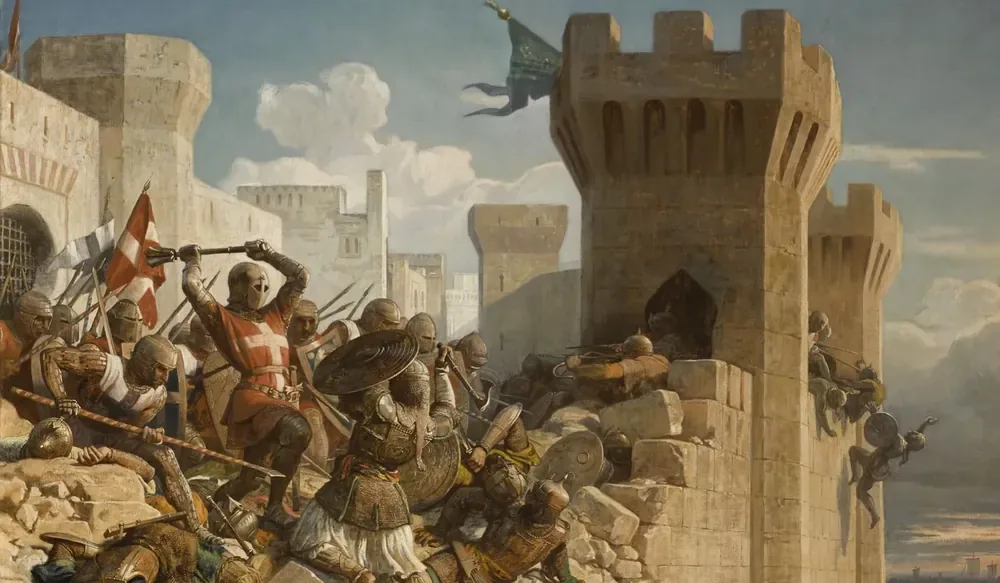
Dominique Papety, Guillaume de Clermont defending Ptolemais (Acre), 1845. Palace of Versailles, Salles des Croisades · Public domain · Source page
Slaves who became sultans
Drums before dawn
Acre, Friday 18 May 1291, before dawn. Outside the walls, drums carried on three hundred camels begin to beat all at once. So says al-Maqrizi, an Egyptian historian who wrote some 140 years later.
For six weeks the sultan al-Ashraf Khalil has hurled stones at the walls. Before sunrise his banners fly on them. Within three months the Franks have left the coast of Syria for good.
The men who did it were the Mamluks: soldiers bought as slave boys. How did former slaves end almost two hundred years of crusader states?
Who’s who, and who tells it
Three powers and their witnesses
The Franks, the Latin Christians, had ruled the coastal cities of Syria and Palestine since the First Crusade; by 1291 their capital was Acre. Among them were the military orders, monks who fought: the Templars and the Hospitallers. Facing them stood the Mamluks, and behind both sides, the Mongols.
For the last siege we have two Frankish eyewitnesses: Jean de Villiers, head of the Hospitallers, who wrote days after the fall, and “the Templar of Tyre”, secretary to the head of the Templars, who wrote about twenty years later. The Muslim side comes mostly from chroniclers in Cairo.
Background
Bought to be soldiers
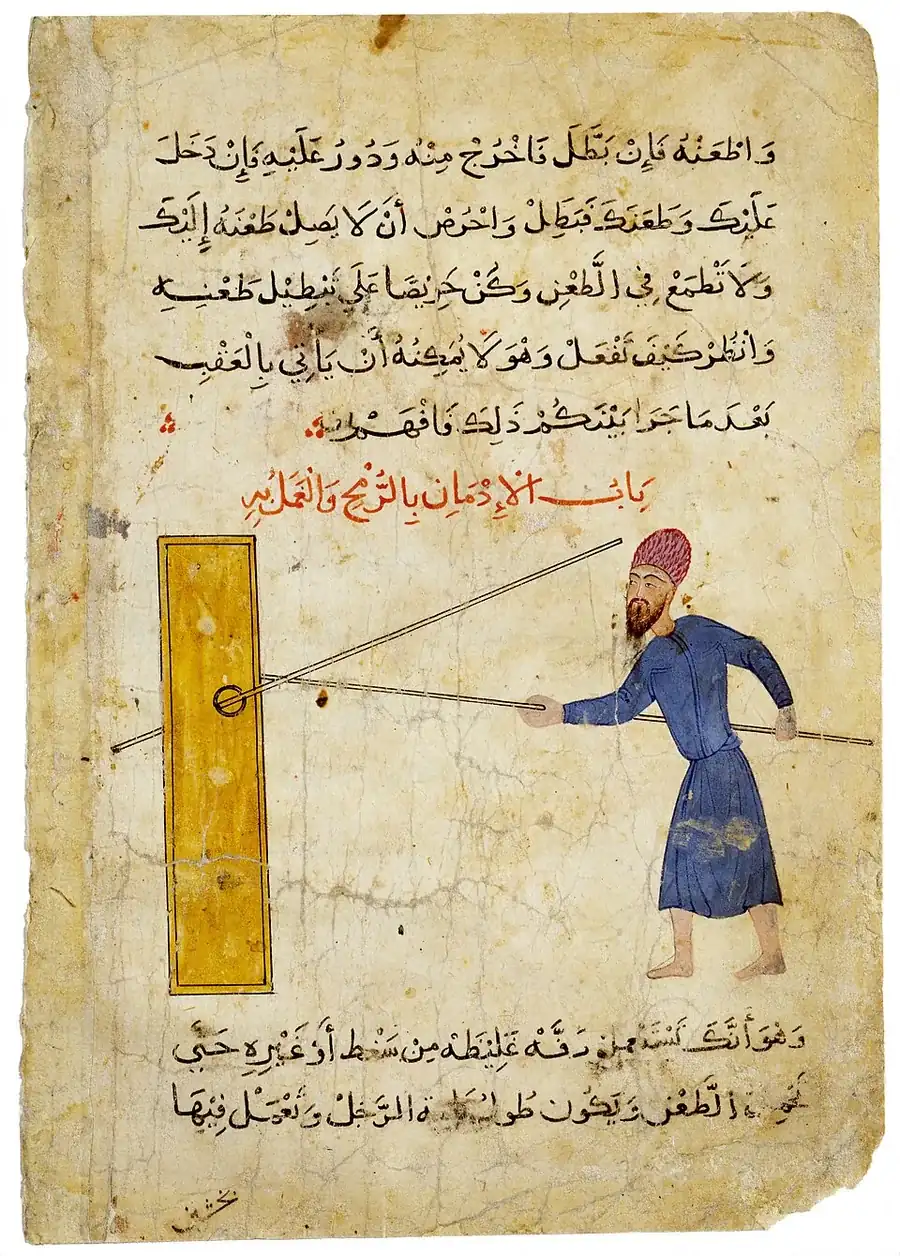
A Mamluk training with a lance, miniature in a furusiyya manuscript, Egypt or Syria, about 1500. The David Collection, Copenhagen · Public domain · Source page
In the 13th century most Mamluks came from the Kipchaks, Turkish tribes of the steppe north of the Black Sea, sold by merchants after the Mongol invasions had scattered their people.
In Egypt the boys were taught Islam, riding, archery and the lance, and then freed. Their loyalty was to the master who had bought them and to their comrades of the same household.
The sultan al-Salih Ayyub, of Saladin’s family, built a regiment of them on an island in the Nile: the Bahri Mamluks, from bahr, “sea”. One of them was a tall, blue-eyed Turk named Baibars.
Source: A crusader explains the Mamluks
“… they had formed the main part of their chivalry of foreigners, whom merchants had brought for sale out of strange lands, and whom they bought right willingly and at a high price. [...] As to the children, the soldan brought them up in his own house till their beards began to grow [...]”
Joinville, a French knight, was a prisoner of the Mamluks in Egypt in 1250. He dictated his memoirs more than fifty years later.
- Joinville calls them “chivalry”, his word for knights. Why? He explains a strange system in words his readers know. The comparison hides the main difference: these knights had been bought as slaves.
- He wrote more than fifty years after what he saw. What can we trust? The outline, which Muslim sources describe too. What he did not see, such as where the slaves came from, stays vague: “strange lands”.
1250
The guard kills the sultan
In 1249 Louis IX of France invaded Egypt. At Mansurah, in February 1250, his knights were cut down in the streets; al-Maqrizi credits the Bahri Mamluks, “led by Bibars”. In April Louis was captured.
The new sultan, Turanshah, began giving his father’s posts to his own men. On 2 May 1250 the Bahri guard killed him, and Baibars, says al-Maqrizi, struck first. “Better is it that we should slay thee than that thou shouldst slay us!” the guard answered, writes Joinville.
Myth
The Mamluks were Arabs.
The truth
Most of the early Mamluks were Kipchak Turks; later many came from the Circassians of the Caucasus. Qalawun, wrote a historian in 1901, was “a thorough Turk, and spoke very little Arabic”. The Arabic speakers of Egypt and Syria were their subjects, not their army, and Arabic writers called their state “the state of the Turks”.
The evidence
Joinville; Stanley Lane-Poole, A History of Egypt in the Middle Ages (1901), pp. 263, 278.
The Mongols
1258–1260
A storm from the east
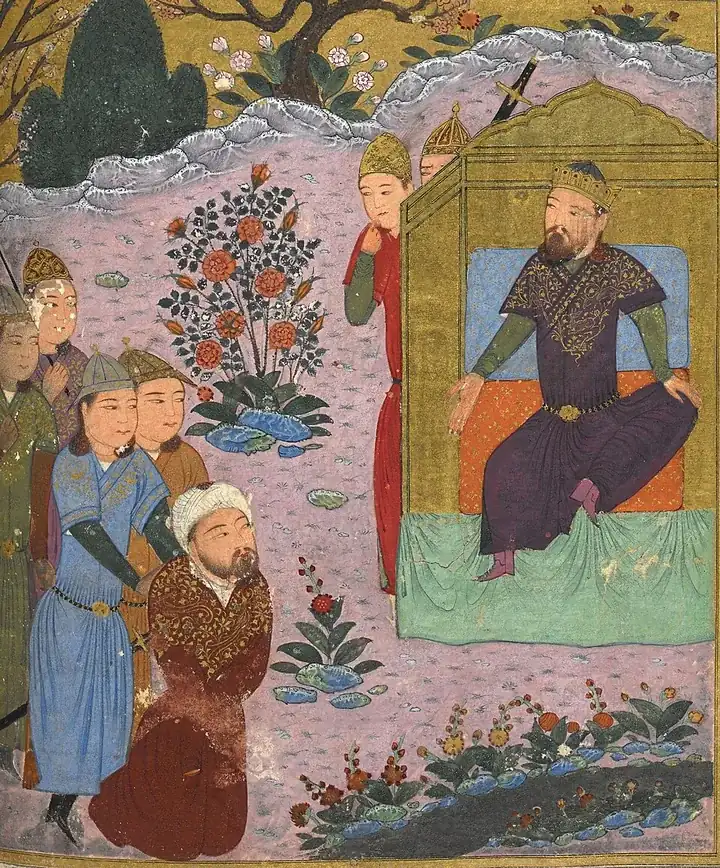
The caliph al-Musta’sim before Hulagu, miniature in the Shahanshahnama of Ahmad Tabrizi, Persia, 1398. British Library, Or. 2780, fol. 89v · Public domain · Source page
In February 1258 Hulagu, grandson of Genghis Khan, took Baghdad. The last Abbasid caliph, symbolic head of Sunni Islam, was put to death.
In 1260 Aleppo and Damascus fell. Some Christians of the East welcomed the Mongols: Hethum I, king of Cilician Armenia, and Bohemond VI, prince of Antioch, rode with them. To Cairo came a demand: submit.
The Mamluk sultan Qutuz had the envoys put to death. Then Hulagu heard that the Great Khan had died, and went back east with most of his army. In Syria he left Kitbuqa with a smaller force.
A decision point
You are Qutuz, sultan of Egypt.
August 1260, on the plain of Acre
You have been sultan for less than a year, and you put Hulagu’s envoys to death: now you must beat his army or lose everything. Your vanguard is led by Baibars, a Bahri emir and a dangerous man.
Your road north passes Acre. The Franks there have a truce with you, but Antioch and Armenia have joined the Mongols. Now the lords of Acre ride out with gifts and offer to march with you.
What do you do?
- Accept: let their knights ride with you You gain armoured knights. But your emirs distrust them, and Franks in your camp could change sides in the middle of a battle. And victory would have to be shared.
- Thank them, and ask only for sworn neutrality Your rear is quiet and the army is all your own. If you win, the glory is yours alone. But if the Franks break their word, you could be caught between two enemies.
- Attack the Franks first, so no enemy is left behind you You would lose weeks and men against strong walls while the Mongols gather, and you might push the Franks of Acre to ask the Mongols for help.
What really happened
Thank them, and ask only for sworn neutrality
“He thanked them and made them promise to keep strict neutrality in this war,” writes al-Maqrizi (our translation); he swore to strike them first if they harmed his army. Latin writers tell it the other way round: the sultan asked for help and the Franks refused.
Qutuz needed a quiet rear, not allies he could not control.
Ain Jalut: who fought whom
Friday 3 September 1260
By the spring of Ain Jalut (Ein Harod), at the foot of Mount Gilboa
The Mamluk army
- Commanders: Sultan Qutuz, Baibars, commanding the vanguard
- Strength: about 15,000–20,000 (Modern estimates); no reliable figure (Sources of the time)
- Losses: unknown (All sources)
The Mongol army
- Commanders: Kitbuqa, with Georgian and Armenian troops and Syrian allies
- Strength: about 10,000–20,000 (Modern estimates); 100,000, almost certainly too many (A later Arabic chronicle (al-Yunini))
- Losses: heavy; Kitbuqa killed or executed (Modern estimates)
Outcome: A Mamluk victory. The Mongols fled east, rallied near Baysan (Beit She’an) and were beaten again. Within days the Mamluks held Damascus.
The Mongol force was what Hulagu had left behind, not his whole army.
The battle of Ain Jalut
Friday 3 September 1260, from the morning
Hulagu went back east and left Kitbuqa in Syria with a smaller force. Sultan Qutuz had the Mongol envoys, who had demanded submission, put to death, and now his army comes from the west into the valley of Harod, at the foot of Mount Gilboa, to meet the Mongols.
One reconstruction, after al-Maqrizi (in Quatremère’s French translation, 1837) and modern summaries. The landscape follows a modern map: the spring (Ein Harod) at the north-western foot of Mount Gilboa, the Hill of Moreh to the north, and the valley of Harod running east to Beit She’an. North is up; 5 km = 190 map units.
Where the armies stood, where the main Mamluk force waited out of sight, the order of the attacks and which wing broke are all guessed. The sources say only that Baibars’s vanguard skirmished “now advancing, now falling back”, that one of the sultan’s wings was broken, and that the Mongols fell back to Baysan and were beaten again. The size of the armies is disputed too. Colours as in the rest of the series: Mamluks red, Mongols blue.
Phases of the battle
- Morning: two armies in the valley The Mongols reach the spring first. The Mamluks come from the west: Baibars in front, the main force behind.
- Baibars draws them on Baibars skirmishes, “now advancing, now falling back”, writes al-Maqrizi. The Mongols follow him west.
- A wing breaks; “O Islam!” One of the sultan’s wings breaks. Qutuz throws his helmet to the ground, cries “O Islam!” and charges.
- Kitbuqa falls; flight to Baysan The Mongol centre collapses and Kitbuqa is killed. The Mongols flee east, and are beaten again near Baysan.
The strategy
- Mamluks: Baibars, at the head of the vanguard, advances and falls back by turns, drawing the Mongols west towards the main force behind him. The sources give no full battle order, and where the main force stood is only a guess.
- Mongols: The sources do not say what Kitbuqa intended. The Mongols reach the spring first and follow Baibars west. Kitbuqa's force includes Georgian and Armenian troops and Syrian allies.
What decided it: Baibars drew the Mongols west, and one of the sultan's wings broke. Qutuz did not fall back but charged, and the Mongol centre collapsed. What decided it was the charge at the very moment the line broke.
October 1260
A sultan made by murder
On the way home, in October 1260, Qutuz was murdered by a group of his own emirs. Baibars was among the killers, and the army made him sultan the same day.
Baibars
Baibars
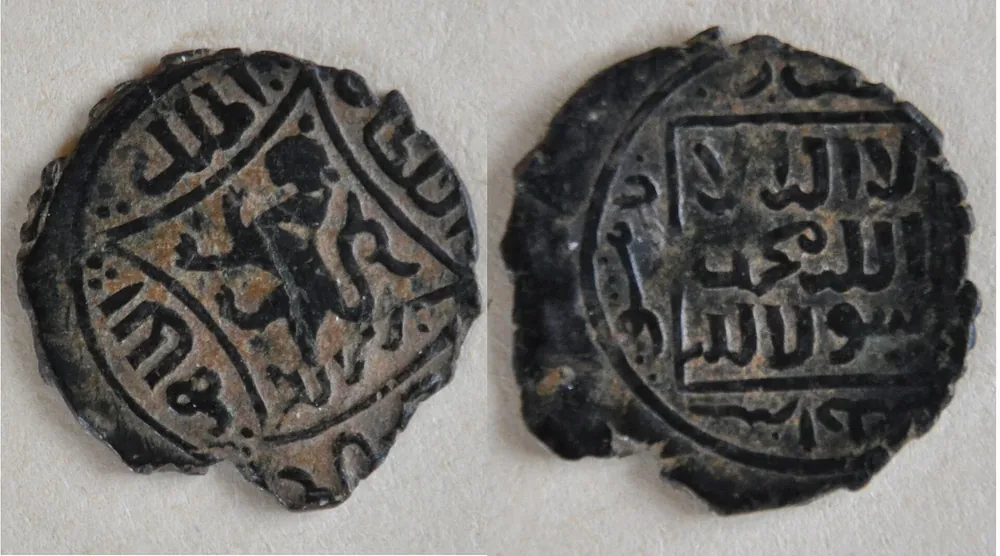
Fals of Baibars, Damascus, 13th century. Photo: Jean-Michel Moullec, 2012 · Jean-Michel Moullec from Vern sur Seiche (35, Bretagne), France · CC BY 2.0 · Source page
A Kipchak boy sold into slavery who became sultan of Egypt and Syria, and took castle after castle from the Franks.
- Born: between about 1223 and 1232 (sources differ), the Kipchak steppe, north of the Black Sea
- Died: 30 June or 1 July 1277 (sources differ), Damascus, probably of poison, from a cup meant, the story goes, for someone else
- Won: Mansurah, 1250 (as a Bahri officer); Ain Jalut, 1260 (the vanguard); Caesarea and Arsuf, 1265; Safed, 1266; Jaffa and Antioch, 1268; Krak des Chevaliers, 1271; Elbistan, against the Mongols, 1277
- Lost: Acre: raided in 1263, never taken; A fleet sent against Cyprus wrecked off Limassol, 1271
“Hadst thou been there, now wouldst thou be slain or a prisoner, wounded or disabled.”
1263–1271
Castle after castle
Baibars marched against the Franks almost every spring. In 1265 he took Caesarea and Arsuf and razed them, so that no crusader army could use them again. At Safed in 1266 the Templars surrendered on a promise of their lives; “in spite of his promise”, writes the historian W. B. Stevenson, Baibars had them executed.
In May 1268 he stormed Antioch, a crusader city for 170 years; the chronicles describe a massacre. In 1271 the Hospitallers’ great castle, Krak des Chevaliers, fell.
Source: A sultan writes to a prince who lost his city
“Hadst thou but seen [...] thy knights trodden under the hoofs of the horses! [...] thy ladies bought and sold with thine own gear, at four for a dinar! [...] This letter holds happy tidings for thee: it tells thee that God watches over thee to prolong thy days, inasmuch as in these latter days thou wert not in Antioch!”
Bohemond was in Tripoli, in Lebanon, when Antioch fell. The letter was written in the sultan’s name, probably by the head of his chancery.
- Why tell the defeated prince all this? To terrify. The letter is a weapon: it shows Bohemond, and every Frank who heard of it, what resisting the sultan costs. It is propaganda, not a report.
- Is “four for a dinar” a count of the captives? No. It is a price, meant to humiliate. It says nothing about how many were killed or taken.
A decision point
You are Edward, eldest son of King Henry III of England.
Winter 1270–71, Sicily
You took the cross to join your uncle by marriage, King Louis IX of France, but he has died outside Tunis and the French are going home.
Your father is ill, and England wants you back. You have perhaps a thousand men. Baibars takes castles every spring, and the Ilkhan Abaqa, Mongol ruler of Persia, has promised help against him.
What do you do?
- Go home with the French: England needs its heir Your crusade vow stays unfulfilled, but the heir will be at home when the moment comes. Acre faces Baibars alone.
- Sail on to Acre with the men you have A thousand men cannot defeat the Mamluks. But your arrival may make Baibars more cautious, and you might bring the Mongols into the war.
- Wait in Sicily for more knights and for word from the Mongols A larger army might achieve more. But no more knights may come, and every month in Sicily costs money you do not have.
What really happened
Sail on to Acre with the men you have
Edward landed at Acre on 9 May 1271. Baibars, about to attack Tripoli, made peace with it. Edward’s envoys reached the Ilkhan, and some 10,000 Mongol horsemen raided as far as Aleppo, then rode home. In spring 1272 (on 22 April, by some chronicles) Acre made a ten-year truce with Baibars.
He could not win a war, but he could buy time: the truce, renewed in 1283, kept Acre safe for almost twenty years. In June 1272 an assassin nearly killed him; who sent the man is unknown.
Myth
The Franks and the Mongols were close allies against Islam.
The truth
There were many letters and embassies. In 1260 Antioch and Armenia did ride with the Mongols, but Acre stayed neutral, and the Mongols and the crusaders from the West never fought a joint campaign in Syria. The Mongols expected allies to submit; the Franks remembered Baghdad.
The evidence
Historians still argue whether there was ever a real alliance; most describe many proposals, and no joint campaign with the Franks of Acre or the West.
The truce breaks
1279–1289
Qalawun, the thousand-dinar sultan
1,000 dinars
In 1279 the throne went to Qalawun, another Kipchak Turk, who had been bought for a thousand dinars and so was nicknamed al-Alfi, “the thousand man”.
He beat the Mongols at Homs in 1281 and signed truces with the Franks, among them Acre in 1283, while he took their castles one by one. In April 1289 he stormed Tripoli in Lebanon. In Cairo he built a great hospital that treated rich and poor free of charge.
A decision point
You sit on the council that governs Acre.
August–September 1290, Acre
Last month new crusaders landed from Italy, sent by the pope. They killed Muslim peasants who were bringing their produce to market under the truce, and some Syrian Christians whom they took for Muslims.
Sultan Qalawun, who took Tripoli last year, demands that you hand over the killers. But your walls are strong, and, one historian writes, the sultan’s own emirs feared them.
What do you answer?
- Hand the killers over to the sultan’s justice The truce might be saved. But handing Christians to a Muslim ruler would cause outrage in Europe, and the armed crusaders might fight you in the streets.
- Try and punish them yourselves, and pay compensation Justice is done without surrender. The sultan may accept it, or call it too little. And can you even arrest so many armed newcomers?
- Refuse: the crusaders are foreigners, not under your law It is legally sound, and nobody in the city is offended. But to the sultan it is an answer that says the truce protects no one.
What really happened
Refuse: the crusaders are foreigners, not under your law
The council was divided. In the end, as far as he could learn, it sent word, writes the Templar of Tyre, “that the crusaders who had done it were foreigners from overseas and not under their justice” (our translation). Qalawun began cutting timber for siege engines. A Muslim emir warned the head of the Templars, but the lords of Acre would not believe it.
“This was the thing for which Acre was taken,” wrote the Templar of Tyre (our translation). Other sources tell the incident differently: merchants murdered in the city, a quarrel over a woman, a drunken riot. Either way, the killings gave the sultan a lawful reason for war.
November 1290 – March 1291
A new sultan, an old plan
Qalawun died before he could march, in the night of 10–11 November 1290. His son al-Ashraf Khalil inherited the throne and the plan.
Acre sent envoys to Cairo with gifts; Khalil threw them into prison. To the head of the Templars he wrote that he was coming “to right the wrongs done” (our translation). In March 1291 the army left Cairo.
al-Ashraf Khalil
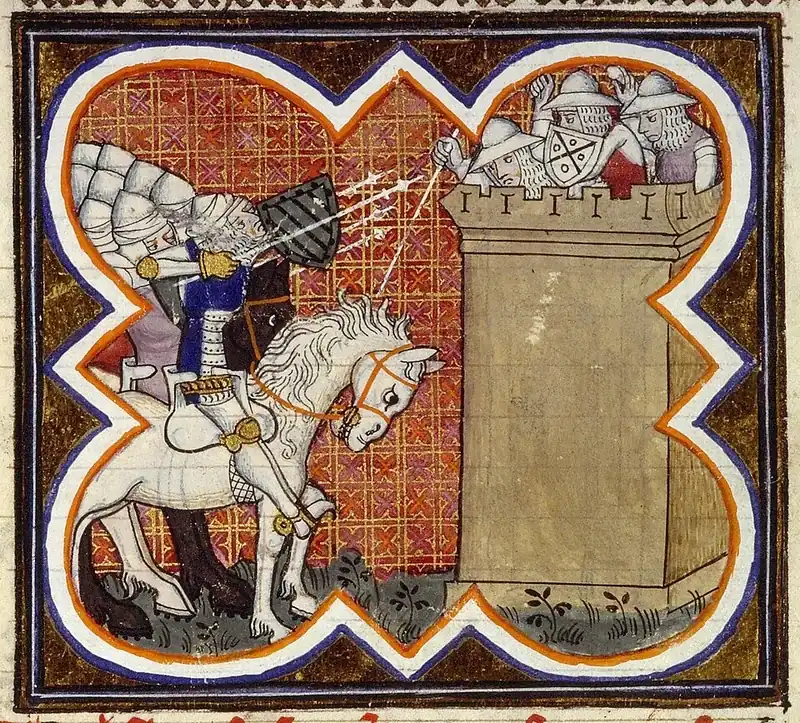
The siege of Acre by the Mamluk sultan al-Ashraf, miniature, France, 14th century. Bibliothèque municipale de Lyon, MS 880, fol. 342v · Public domain · Source page
Qalawun’s son, who in one campaign ended the crusader states on the mainland, and was murdered by his own emirs less than three years later.
- Born: between about 1260 and 1264 (sources differ)
- Died: December 1293, in the Nile Delta, on a hunting trip, murdered by his own emirs
- Won: Acre, 1291; Qal’at al-Rum on the Euphrates, 1292
“The sultan of sultans, the king of kings, the lord of lords [...] the mighty, the dreaded, chastiser of rebels, driver-out of the Franks and the Tatars and the Armenians.”
William of Beaujeu
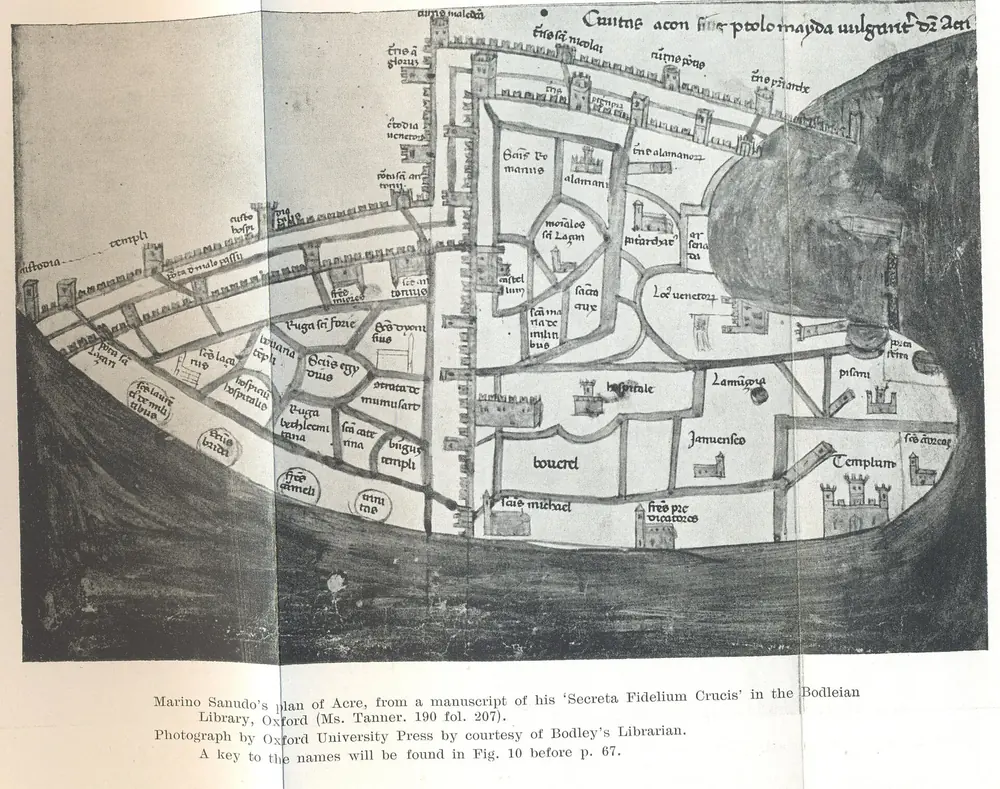
Marino Sanudo Torsello, plan of Acre, about 1321. Bodleian Library, Oxford, MS Tanner 190, fol. 207 (photograph of 1944) · Public domain · Source page
A French noble who led the Templars for eighteen years; his secretary says he warned Acre of the coming storm. He died of a wound received in its defence.
- Born: about 1230 (uncertain), France, into the Beaujeu family
- Died: 18 May 1291, Acre, a javelin under his arm, where his armour did not cover him
- Won: His warnings to the lords of Acre in 1290–91, who did not believe him
- Lost: The night sortie against the sultan’s engines, April or May 1291; The defence of Acre, 1291
“Lords, I can do no more, for I am dead; see the blow.”
Forty-three days
5 April 1291
A city of walls
A pilgrim who saw Acre about 1283 found it “triangular in shape like a shield, whereof two sides look upon the Mediterranean Sea, and the third upon the plain round about it” (Burchard of Mount Sion). On the land side stood a double wall, and north of the old city a walled suburb, Montmusard. Inside lived, says the Templar of Tyre, 30,000 to 40,000 people.
On Thursday 5 April 1291 the sultan’s army camped before the city “from one sea to the other”, wrote the head of the Hospitallers.
Acre: who fought whom
5 April – 28 May 1291
Acre and the plain of Acre
The defenders of Acre
- Commanders: King Henry II of Cyprus (from 4 May), and his brother Amalric, William of Beaujeu, head of the Templars, Jean de Villiers, head of the Hospitallers, Otto de Grandson and John of Grailly
- Strength: 700–800 horse and about 14,000 foot, in a city of 30,000–40,000 people (The Templar of Tyre); 18,000 foot and 900 knights; later 12,000 men, 800 of them knights (De excidio Acconis (a Latin account)); 200 knights and 500 foot (The relief from Cyprus, per Stevenson (1907))
- Losses: “we lost, bit by bit, the whole convent of our order” (Jean de Villiers); more than 10,000 people in the Templars’ fortress at the end (The Templar of Tyre); 106,000 killed or taken at Acre and other places: too many for a city of 30,000–40,000 (Ludolph of Sudheim, some fifty years later)
Nobody counted the dead or the enslaved.
The Mamluk army
- Commanders: Sultan al-Ashraf Khalil, his emirs, with the armies of Egypt and Syria
- Strength: over 70,000 horse and 150,000 foot (The Templar of Tyre, “it is said”); no figure for the army; 92 siege engines (The Arabic chronicles)
- Losses: five emirs and an unknown number of soldiers (al-Maqrizi); more than 2,000 horsemen when the Templars’ tower collapsed (The Templar of Tyre)
For scale: Lane-Poole (1901) gives Baibars about 12,000 regular troops and Qalawun about 12,000 mamluks, apart from levies. 220,000 is not a credible figure.
Outcome: A Mamluk victory. The city was stormed on 18 May and the Templars’ fortress fell on 28 May.
Almost every number here is a rhetorical number.
April – early May
Engines, mines and a night raid
The engines hurled stones day and night; the Templar of Tyre names two of them: “the Furious” and “the Victorious”. Behind wicker shields the Mamluks crept up to the ditch, and diggers drove mines under the towers.
One moonlit night the head of the Templars, William of Beaujeu, led about 300 men out to burn the timber screen of a great engine. The fire fell short, the horses tripped on tent ropes, and eighteen riders were lost.
On Friday 4 May the young King Henry II arrived from Cyprus with reinforcements.
A decision point
You sit on the council of Acre, beside the young King Henry.
A few days after 4 May 1291, Acre
The sultan’s engines are breaking the outer wall. Your envoys are back from his tent. “Have you brought me the keys?” he asked, and offered: “I will do you the grace that you empty out the stones only, and carry away all the rest” (our translation).
You remember Safed, where a garrison was promised its life and the promise was broken.
What do you answer?
- Accept: evacuate the city by sea with all you can carry If the sultan keeps his word, thousands live. But there are not enough ships for everyone at once, and a promise can be broken once the gates are open. And Europe will call you traitors.
- Refuse, and hold the walls The walls are strong, and help may still come by sea. But if they fall, the city will be stormed, and a city taken by storm has no terms.
- Play for time: send more envoys while you beg Cyprus, Venice and the pope for ships Every day helps. But the sultan has already jailed envoys; delay may only harden his terms.
What really happened
Refuse, and hold the walls
The envoys refused: “the people overseas would hold us for traitors” (our translation). While they talked, a stone from a Frankish engine landed near the sultan’s tent. He put his hand to his sword; an emir calmed him, and the envoys went back alive.
Acre was the crusaders’ last capital, the city Richard the Lionheart and Philip II had won back in 1191; to give it up without a fight meant shame. We know of the offer from one source only, the Templar of Tyre, who heard of it from the envoys.
A decision point
You are al-Ashraf Khalil, sultan of Egypt and Syria.
Thursday 17 May 1291, the camp before Acre
Your father wanted this city and died before he could march. Yesterday evening your men laid sacks of sand across the ditch and took the tower in front of the Accursed Tower.
Today a storm drives the women and children, who had boarded ships, back ashore. Some of your emirs feared these walls from the start. Tomorrow is Friday.
What do you order?
- A general assault at dawn tomorrow If it works, Acre is yours in a day and your name is made. If it fails, your best men die in the breach, and the emirs will remember who sent them.
- Wait for the mines and engines to widen the breaches Fewer of your men die. But every day gives the Franks time to rebuild and bring ships, and your army grows restless.
- Offer terms once more The city might open its gates without a fight. But the Franks have already refused, and a second offer could look like weakness.
What really happened
A general assault at dawn tomorrow
“On Friday, the seventeenth day of the month, the sultan resolved to give the general assault,” writes al-Maqrizi (our translation; the 17th of the Muslim month, 18 May). Before dawn the drums sounded, and the Mamluks came on foot behind great shields, with fire-throwers and clouds of arrows.
The sources give no reason beyond his resolve. But a young, new sultan needed a great victory to bind his father’s emirs to him, and waiting risked everything: storms, ships and doubt.
The siege of Acre
5 April – 28 May 1291
In April 1291 the Mamluk sultan's army camps on the plain before Acre. According to the Templar of Tyre, between 30,000 and 40,000 people live inside its walls, and according to the sources ninety-two engines face the walls. Each stretch of wall is held by its own order or community.
One reconstruction. The coastline and the harbour are drawn from OpenStreetMap; north is up, and 500 m = 135 map units. The events follow the Templar of Tyre (the Gestes des Chiprois), Jean de Villiers’s letter and al-Maqrizi. The order of the sectors follows Marino Sanudo’s plan of the city (about 1321), which is turned about 45 degrees: the Templars at the northern end of the Montmusard wall, by the sea, and the Accursed Tower at the north-east corner of the old city.
The Mamluks razed the city, and the walls seen today are Ottoman; the corner of the Ottoman wall stands in here for the site of the Accursed Tower. Not known for certain: the tower’s exact site, the line and depth of the Montmusard walls (drawn here approximately), which order held which stretch of the Montmusard wall (some accounts name the Knights of St Lazarus there), where the gates stood, where the engines, the camps and the sultan’s tent were, and through which gate the Mamluks first broke in (the Accursed Tower, says the Templar of Tyre; “King Hugh’s Gate”, says Villiers). On the walls see B. Z. Kedar (1997). Pins mark two of the engines the Templar of Tyre names.
Phases of the battle
- 5–11 April: the ring closes The sultan’s army camps on the plain, and ninety-two engines face the walls. Each stretch of wall is held by its own order or community.
- April – early May: shields, mines and a sortie Behind wicker shields the Mamluks reach the ditch. About 300 Templars ride out by night to burn an engine, and fail.
- 4–16 May: the king’s ships and the King’s Tower King Henry arrives from Cyprus on 4 May. On 16 May the Mamluks fill the ditch with sandbags and take the King’s Tower, in front of the Accursed Tower.
- Friday 18 May: the storm Before dawn the Mamluks break in by the Accursed Tower and spread into the city. William of Beaujeu is mortally wounded near the Gate of St Anthony. Ships carry to Cyprus whoever can get aboard.
- 18–28 May: the last tower Only the Templars’ fortress by the sea still holds, crowded with refugees. On 28 May the undermined tower collapses.
The strategy
- Defenders of Acre: Each order holds its own stretch of wall. To stop the engines, which hurl stones day and night, about 300 Templars ride out by night to burn the timber screen of a great engine.
- Mamluks: The Mamluks advance step by step: behind wicker shields up to the ditch, mines under the towers, and engines hurling stones. Then they fill the ditch with sandbags and take the King's Tower. The sources disagree on where they first broke in.
What decided it: The walls were strong, but what decided it was what happened beneath them: mines dug under the towers and a ditch filled with sandbags. A strong wall was not enough against men digging beneath it.
Source: Two witnesses, two sides
Jean de Villiers, head of the Hospitallers: “We and our brethren resisted them at the Gate of St Anthony, where there were so many Saracens that they could not be counted.”
al-Maqrizi: “The sun had not yet risen over the horizon when the banners of Islam were already flying on the walls of Akka.”
Villiers wrote within days, wounded. Al-Maqrizi wrote in Cairo about 140 years later. “Saracens” was the Latin name for Muslims.
- Villiers escaped by ship while most of his brethren died. Why might he stress how many enemies there were? A head of an order who escaped while his brethren died has every reason to stress how hopeless it was. “Too many to count” defends him. It is probably also true; but it is the voice of a man explaining himself.
- Al-Maqrizi wrote 140 years later. Why trust his timing anyway? His day and hour match the Frankish sources: Friday, before sunrise. When two hostile sides agree on a detail, it is probably right.
18–28 May 1291
The last tower
King Henry and the wounded head of the Hospitallers escaped by ship, and so did those who could pay or push their way aboard. Many could not. The victors, writes al-Maqrizi, killed “an immense number” and carried off “an incalculable multitude of women and children” (our translation).
Thousands crowded into the Templars’ fortress. The Marshal of the Temple came out to negotiate and was beheaded with his men. On 28 May the tower collapsed, killing defenders and attackers alike.
By August Tyre, Sidon, Beirut, Tortosa and Athlit had been abandoned or taken. “Christians did not hold a palm’s breadth of land in Syria,” wrote the Templar of Tyre (our translation).
What remained
Source: A letter from Jerusalem, 1267
“Jerusalem is the most ruined of all, and Judah more than the Galilee. Yet for all its ruin it is very good [...] For since the Tartars came, [the Jews] fled from there, and some of them were killed by their sword. Only two brothers, dyers, who buy the dyeing from the governor; and a quorum gathers to them to pray in their house on Sabbaths.”
Nachmanides, a great rabbi of Catalonia, left Spain after a public disputation with Christian scholars in Barcelona. In 1267 he went up to Jerusalem; later he taught in Acre.
- Who, according to the letter, emptied Jerusalem of its Jews? Not the Franks and not the Mamluks, but, the letter says, the coming of the Tartars: most likely the Mongol raid of 1260. Seven years later a single family remained: two brothers, dyers.
- What can this letter tell us about the Jews of Acre in 1291? Directly, nothing: it is 24 years earlier. We have no Jewish eyewitness of the fall of Acre.
1291
The others in the city
Acre was never only a crusader city. Syrian and Greek Christians lived there, Armenians and a Jewish community with its scholars. What became of most of them in May 1291 is almost unknown: no Jewish or Eastern Christian eyewitness of the fall has been found. A 2021 study of the Jews of Safed and Jerusalem in the 14th century, by Michael Ehrlich, says that Acre’s Jewish community ceased to exist, and that some survivors reached Safed and Jerusalem.
For Muslims, the victory closed a war of almost two hundred years.
Myth
The Templars were wiped out at Acre in 1291.
The truth
The order survived: the remaining brothers elected a new head at Sidon and moved to Cyprus. It was Christians who destroyed it: King Philip IV of France had the Templars arrested in 1307, the pope dissolved the order in 1312, and its last head, Jacques de Molay, was burned in Paris in 1314.
The evidence
The Templar of Tyre, writing from Cyprus about Molay’s death (Gestes des Chiprois, § 697).
Myth
When Acre fell, the Templars hid a fabulous treasure that has never been found.
The truth
No source we read mentions a hidden treasure. The money story the sources do tell is in France: the Templar of Tyre writes that the order’s treasurer lent the French king a sum “people say” was 400,000 gold florins (“I do not know whether it was less”), and was dismissed for it (our translation). Philip IV owed the order money, and he had its members arrested; historians still ask how much the debt mattered.
The evidence
Les Gestes des Chiprois (the Templar of Tyre), §§ 501 and 695.
Myth
The fall of Acre ended the Crusades.
The truth
It ended Frankish rule on the mainland, not the idea of crusade. Popes and kings planned for decades to win the Holy Land back, the kings of Cyprus kept the title “King of Jerusalem”, and crusades were preached against the Ottomans into the 16th century.
The evidence
Sylvia Schein, Fideles Crucis (1991), on the plans for recovery, 1274–1314; Norman Housley, The Later Crusades, 1274–1580 (1992).
After Acre
- 1300–1302 Hoping for Mongol help, the Cypriots and the Templars hold the island of Ruad; the Mamluks retake it in 1302.
- 1306–1310 The Hospitallers conquer Rhodes.
- 1321 The Venetian Marino Sanudo gives the pope a plan to recover the Holy Land, with a map of Acre.
- 1517 The Ottomans conquer Egypt and end the Mamluk sultanate, which had ruled the Holy Land since 1260.
The Crusades in six lessons
- 1095–1099 Clermont and the First Crusade: a speech nobody wrote down, and Jerusalem stormed four years later.
- 1096 The Jews and the First Crusade: the Rhineland communities are attacked, and many of their people killed.
- 1187 Hattin: Saladin destroys the army of the kingdom of Jerusalem and takes the Holy City.
- 1189–1192 Richard and Saladin: the Third Crusade wins back Acre and the coast, but not Jerusalem.
- 1204 The Fourth Crusade: crusaders sack Constantinople, a Christian city.
- 1250–1291 The Mamluks: former slave soldiers beat the Mongols and drive the Franks from the mainland.
End of the series
What remained?
From Urban’s call in 1095 to the fall of Acre, almost two hundred years passed. What remained? Castles in stone. One military order on Rhodes. A Christian kingdom on Cyprus. Plans that never set sail. And a Mamluk state until 1517.
And memory. In the 1840s halls at the palace of Versailles were filled with paintings of the crusades, like the one at the start of this lesson. That is why we always ask: who is telling it, and why?
Why did the crusader states fall?
The strength of the Mamluk state, the quarrels of the Franks, or Europe’s indifference?
- The strength of the Mamluk state A state built for war: some 12,000 regular troops under Baibars, plus levies; a fast postal service; a policy of razing captured towns so that crusaders could not use them again; ninety-two siege engines at Acre. From 1265 to 1291 the sultans attacked almost every year. On this view, no Frankish unity could have saved the coast.
- Frankish quarrels (the older view) Victorian historians blamed a divided, pleasure-loving city: “there were in one city seventeen independent powers”, wrote Archer and Kingsford in 1894. Genoese fought Venetians in the streets of Acre in 1256–60, Templars and Hospitallers were rivals, and the king lived in Cyprus. In 1290 the council could not even agree how to answer the sultan.
- Europe stayed away “At every stage in the history of the crusading colonies their very existence depended on the amount of support they received from the west,” wrote W. B. Stevenson in 1907, and by the end that support had “dwindled away to almost nothing”. Kings and popes fought one another; Aragon and Sicily even signed a treaty with Qalawun in 1290. Edward came with a thousand men; the crusaders of 1290 did more harm than good.
These answers do not exclude one another. The real question is how much each weighed, and historians still argue about that. What do you think: could anything the Franks did after 1260 have changed the end?
What do you know now?
Check yourself
Who were the Mamluks?
Answer: Soldiers bought as boys, mostly Turks, trained and freed. Right. “Mamluk” means “owned”. Joinville, who saw them in 1250, describes foreigners brought by merchants and raised in the sultan’s house.
Check yourself
What did Qutuz ask of the Franks of Acre in August 1260, according to al-Maqrizi?
Answer: That they swear to stay neutral. Right. He thanked them for their offer, made them swear strict neutrality, and threatened to strike them first if they harmed his army.
Check yourself
In his letter to Bohemond, Baibars writes of women sold “at four for a dinar”. What does the line mainly tell us?
Answer: That the letter was meant to terrify and humiliate. Right. It is propaganda: the sultan shows the prince, and everyone who hears of it, what resisting him costs.
Check yourself
What led Qalawun to treat the truce as broken in 1290?
Answer: New crusaders killed Muslim peasants protected by the truce. Right, according to the Templar of Tyre. Other sources tell it differently, but most agree that Muslims protected by the truce were killed and that the sultan found Acre’s answer unsatisfactory.
Check yourself
How and when did Acre fall?
Answer: Stormed on 18 May; the Templars’ fortress held out until 28 May. Right. Frankish and Muslim sources agree on Friday 18 May, before sunrise. The fortress fell ten days later.
Check yourself
Who brought the Order of the Temple to an end?
Answer: The king of France and the pope, in 1307–1314. Right. Philip IV arrested the Templars in 1307, the pope dissolved the order in 1312, and Jacques de Molay was burned in 1314.
Terms
- Mamluks From the Arabic for “owned”: soldiers bought as boys, mostly Turks from the steppe, raised as Muslims, trained for war and then freed. From 1250 their commanders ruled Egypt, and from 1260 Syria too.
- sultan Arabic for “power”: the title of a Muslim ruler. The Mamluk sultans ruled Egypt and Syria from the Citadel of Cairo.
- emir Arabic for “commander”. Among the Mamluks: a senior officer who commanded his own troop of mamluks.
- Franks What Muslims and Byzantines called all Western Europeans (in Arabic, Ifranj). In this lesson: the Latin Christians of the crusader states.
- military order A brotherhood of knights who took monks’ vows of poverty, chastity and obedience and fought for the Church: the Templars, the Hospitallers and the Teutonic Knights. In the East they held castles and great wealth.
- caliph The successor of the Prophet Muhammad as head of the Muslim community. The Abbasid caliphs of Baghdad had long lost real power; from 1261 a caliph of the same family lived in Cairo under the sultans’ protection.
- Ilkhan The title of Hulagu and his heirs, the Mongol rulers of Persia and Iraq.
- truce An agreement to stop fighting for a fixed time: years, months, even days and hours. Under its protection Muslims and Christians traded with each other.
- engines Great siege engines: a long beam on a pivot, pulled down at one end by a team of men or by a counterweight, so that the other end hurled heavy stones at walls.
- mines Tunnels dug under a wall or a tower and propped with timber. When the props were set on fire, whatever stood above fell.
- al-Maqrizi An Egyptian historian who wrote some 140 years after the fall. He copied many earlier writers.
- Ibn ‘Abd al-Zahir Head of the chancery of Baibars and Qalawun. He drafted the sultans' letters and wrote an official life of Baibars.
- Abu’l-Fida A young prince of Hama who fought at Acre and wrote briefly about what he saw.
- Joinville A French knight taken prisoner in Egypt in 1250. He dictated his memoirs more than fifty years later.
- Burchard of Mount Sion A pilgrim who saw Acre about 1283 and described its shape: triangular, like a shield.
- Baibars A Mamluk commander who became sultan. He took crusader castles almost every spring.
- Qalawun A Mamluk sultan who took Tripoli and the Franks' castles one by one. Father of al-Ashraf Khalil.
- al-Ashraf Khalil Son of Qalawun, a sultan who led the army that took Acre in 1291.
- Qutuz A Mamluk sultan who had Hulagu's envoys put to death. His own emirs murdered him in 1260.
- Kipchak Turkish tribes from the steppe north of the Black Sea. Most early Mamluks came from them.
- Circassians A people of the Caucasus. In later years many Mamluks came from them.
- Dirham A silver coin of the Muslim world. According to al-Maqrizi, a young girl was sold for five dirhams.
- Hulagu Grandson of Genghis Khan and a Mongol leader. In February 1258 he took Baghdad.
- Genghis Khan Founder of the Mongol empire and grandfather of Hulagu.
- Mongols A people of horse riders from the steppes of Asia who conquered many lands in the East. In Syria they fought the Mamluks.
- Baghdad Capital of the Abbasid caliphs, the symbolic heads of Sunni Islam. Hulagu took it in 1258.
- Antioch A crusader city in northern Syria. Baibars stormed it in May 1268, after 170 years under crusader rule.
- Krak des Chevaliers The great castle of the Hospitallers in Syria. It fell in 1271.
- Templars An order of fighting monks, one of the great military orders of the Franks. The pope dissolved it in 1312.
- Hospitallers An order of fighting monks, founded to care for the sick and the poor.
- Jean de Villiers Head of the Hospitallers during the siege of Acre. He wrote about the fall within days.
- William of Beaujeu Head of the Templars during the siege of Acre. He died on 18 May, the day of the general assault.
- Ain Jalut A battle in which the Mamluks beat the Mongols. Afterwards the Mamluks got Syria.
- The Templar of Tyre A Frankish writer, secretary to the head of the Templars. He wrote about the siege some twenty years later.
- Nachmanides A great Jewish scholar from Catalonia. In 1267 he went up to Jerusalem, and later taught in Acre.
Sources
- Les Gestes des Chiprois (the part by the “Templar of Tyre”), ed. Gaston Raynaud (Geneva: Fick, 1887), §§ 480–513 and 693–697. Translations in this lesson are our own.
- Jean de Villiers, Master of the Hospital, letter to Guillaume de Villaret (May 1291), in J. Delaville Le Roulx, Cartulaire général de l’Ordre des Hospitaliers, vol. III (Paris, 1899), no. 4157. Our translation.
- al-Maqrizi, Kitab al-suluk, French trans. Étienne Quatremère, Histoire des sultans mamlouks de l’Égypte, vol. I (Paris, 1837–40) and vol. II part 1 (1842). Our English translation.
- Jean de Joinville, Life of Saint Louis, in Memoirs of the Crusades, trans. Frank T. Marzials (London: Dent, Everyman’s Library, 1908).
- Baibars to Bohemond VI (May 1268), in Stanley Lane-Poole, A History of Egypt in the Middle Ages (London: Methuen, 1901), pp. 268–269; also William of Tripoli as quoted there, p. 263.
- Nachmanides (Moses ben Nahman), letter to his son from Jerusalem, 9 Elul 5027 (1267), Hebrew text.
- Burchard of Mount Sion, A Description of the Holy Land (about 1283), trans. Aubrey Stewart (Palestine Pilgrims’ Text Society, vol. XII, 1896), ch. II.
- W. B. Stevenson, The Crusaders in the East (Cambridge: Cambridge University Press, 1907), ch. VI.
- T. A. Archer and C. L. Kingsford, The Crusades: The Story of the Latin Kingdom of Jerusalem (London: T. Fisher Unwin, 1894).
- Peter Thorau, The Lion of Egypt: Sultan Baybars I and the Near East in the Thirteenth Century, trans. P. M. Holt (London: Longman, 1992).
- Reuven Amitai-Preiss, Mongols and Mamluks: The Mamluk-Ilkhanid War, 1260–1281 (Cambridge: Cambridge University Press, 1995).
- John Masson Smith Jr., “ʿAyn Jālūt: Mamlūk Success or Mongol Failure?”, Harvard Journal of Asiatic Studies 44/2 (1984), 307–345.
- Sylvia Schein, Fideles Crucis: The Papacy, the West, and the Recovery of the Holy Land 1274–1314 (Oxford: Clarendon Press, 1991).
- Norman Housley, The Later Crusades, 1274–1580: From Lyons to Alcazar (Oxford: Oxford University Press, 1992).
- Benjamin Z. Kedar, “The Outer Walls of Frankish Acre”, ʿAtiqot 31 (1997), 157–180.
- Michael Ehrlich, “The Jewish communities of Safed and Jerusalem during the fourteenth century”, Journal of the Royal Asiatic Society 31/4 (2021), 711–720.
- Further reading: Roger Crowley, The Accursed Tower: The Fall of Acre and the End of the Crusades (New York: Basic Books, 2019); David Nicolle, Acre 1291: Bloody Sunset of the Crusader States (Oxford: Osprey, Campaign 154, 2005).
Image credits
- Dominique Papety, Guillaume de Clermont defending Ptolemais (Acre), 1845. Palace of Versailles, Salles des Croisades · Public domain · Source page
- A Mamluk training with a lance, miniature in a furusiyya manuscript, Egypt or Syria, about 1500. The David Collection, Copenhagen · Public domain · Source page
- The caliph al-Musta’sim before Hulagu, miniature in the Shahanshahnama of Ahmad Tabrizi, Persia, 1398. British Library, Or. 2780, fol. 89v · Public domain · Source page
- Fals of Baibars, Damascus, 13th century. Photo: Jean-Michel Moullec, 2012 · Jean-Michel Moullec from Vern sur Seiche (35, Bretagne), France · CC BY 2.0 · Source page
- The siege of Acre by the Mamluk sultan al-Ashraf, miniature, France, 14th century. Bibliothèque municipale de Lyon, MS 880, fol. 342v · Public domain · Source page
- Marino Sanudo Torsello, plan of Acre, about 1321. Bodleian Library, Oxford, MS Tanner 190, fol. 207 (photograph of 1944) · Public domain · Source page


