The birth of the World Wide Web
Decisions, questions and your own progress, in the app
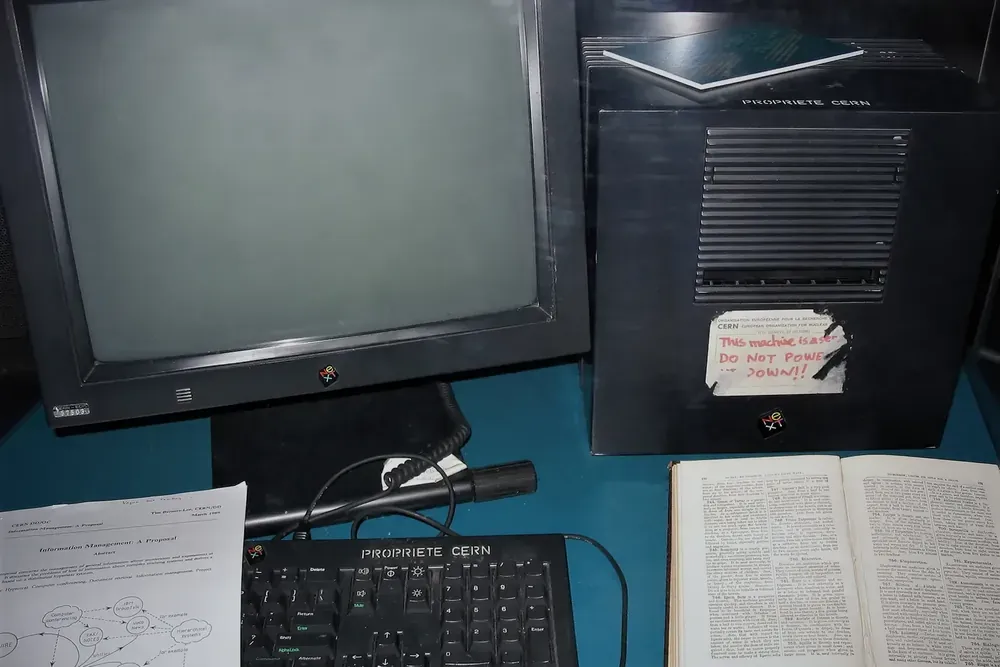
The NeXT computer that served as the first web server · User:Coolcaesar at en.wikipedia · CC BY-SA 3.0 · Source page
A lab full of lost notes
In the 1980s, thousands of scientists worked at CERN, a physics lab near Geneva. They used many different computers. Sharing information between them was slow and frustrating.
A proposal is born
Vague but exciting...
In March 1989, British scientist Tim Berners-Lee proposed a system of linked documents. His boss wrote these words on the cover and let him keep working.
Three key ideas
Berners-Lee created HTML to write pages, HTTP to send them, and URLs to find them. He also built the first web browser. The first web server ran on a NeXT computer.
The first website
The first website went live at CERN at the end of 1990. It explained what the web was and how to use it. In 1991, people outside CERN began using it too.
Free for everyone
about 1 billion
In April 1993, CERN released the web's software free for anyone to use. Growth exploded. Today there are about 1 billion websites, though most are inactive.
Why it still matters
Berners-Lee never patented the web. Because it was free and open, anyone could build on it. Online shopping, news, video and social media all grew from that choice.
Review question
Where was the World Wide Web invented?
Answer: CERN, near Geneva. Tim Berners-Lee developed the web while working at CERN, a physics laboratory near Geneva in Switzerland.
Why did the web spread so quickly after 1993?
Answer: CERN made its software free to use. CERN released the web's software with no fees. Anyone could set up a website or build a browser.
Image credits
- The NeXT computer that served as the first web server · User:Coolcaesar at en.wikipedia · CC BY-SA 3.0 · Source page
