Vasco da Gama and the sea route to India
Decisions, questions and your own progress, in the app
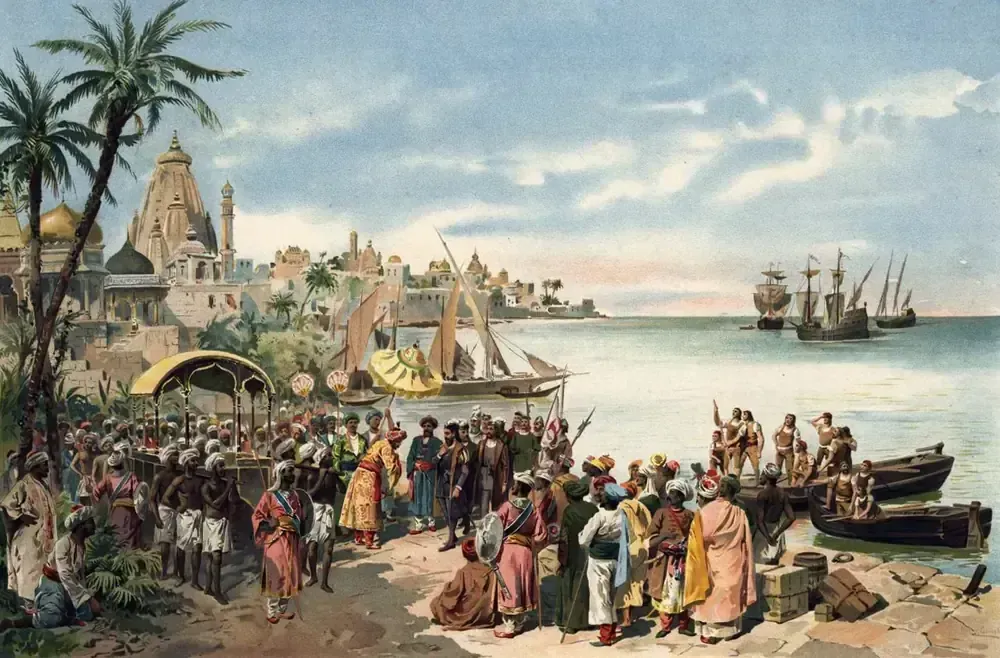
Vasco da Gama's arrival at Calicut in 1498, painting by Roque Gameiro · Public domain · Source page
Why sail to India
In the 1400s, spices from Asia reached Europe through long land and sea routes, and many middlemen raised the price. Portugal wanted a direct sea route around Africa.
Down the African coast
Portuguese captains had crept down the African coast for decades. In 1488 Bartolomeu Dias rounded its southern tip, the Cape of Good Hope, and showed that the way to the Indian Ocean was open.
Four ships
4 ships
In July 1497 Vasco da Gama left Lisbon with four ships and about 170 men. He sailed far out into the Atlantic to catch the winds, and spent about three months without sight of land.
A pilot from East Africa
At Malindi, in East Africa, he found a local pilot who guided the fleet across the Indian Ocean. On 20 May 1498 the ships anchored near Calicut, on the south-west coast of India.
A hard return
The ruler of Calicut was not impressed by the gifts, and the trade was small. Many sailors died of scurvy on the way home. Fewer than 60 men came back in 1499.
Why it still matters
The ships brought back spices that sold for a large profit. Portugal built forts and trading posts across the Indian Ocean and grew rich. Europe, Africa and Asia were now linked by a sea route.
Review question
Where did Vasco da Gama land in India in 1498?
Answer: Calicut. Calicut was a spice port on the south-west coast. Portugal took Goa only in 1510.
Whose voyage around the southern tip of Africa came ten years earlier?
Answer: Bartolomeu Dias. Dias rounded the Cape in 1488. Columbus sailed west in 1492, and Magellan's voyage came in 1519.
Image credits
- Vasco da Gama's arrival at Calicut in 1498, painting by Roque Gameiro · Public domain · Source page
