Charles Martel and the Battle of Tours
Decisions, questions and your own progress, in the app
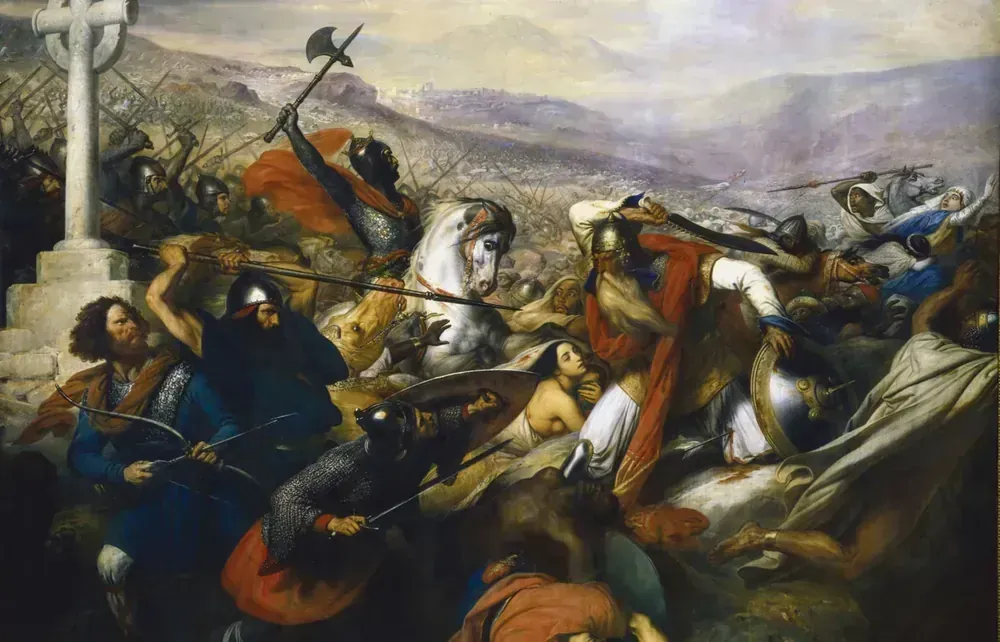
The Battle of Poitiers, painting by Charles de Steuben, 1837 · Public domain · Source page
Raiders from the south
By 732, Muslim armies ruled most of Spain and had crossed the Pyrenees into Frankish Gaul. Their governor, Abd al-Rahman, led a large raid north toward the rich city of Tours.
The mayor of the palace
The Frankish kings of that time were weak. Real power belonged to the mayor of the palace, Charles, later nicknamed Martel, "the hammer". He gathered an army of foot soldiers from across the Frankish lands.
A week of waiting
about a week
The armies faced each other for about a week. The Franks stood in a tight formation on high, wooded ground. When the Muslim cavalry finally charged, the Frankish line held.
A death and a retreat
Abd al-Rahman was killed in the fighting. During the night the Muslim army withdrew southward, and the Franks did not follow.
A family of kings
Charles's son Pepin became king of the Franks in 751, and his grandson was Charlemagne. Their family, the Carolingians, ruled much of Western Europe for generations.
Why it still matters
Some old books call Tours the battle that saved Europe. Many historians today see it as one raid among many, whose main result was the rise of Charles's family. Both views are worth knowing.
Review question
What was Charles Martel's title at the time?
Answer: Mayor of the palace. The Frankish kings were weak. Charles held real power as mayor of the palace and never took the crown himself.
Which famous emperor was Charles Martel's grandson?
Answer: Charlemagne. Charlemagne was Charles Martel's grandson. Clovis lived about two centuries earlier.
Image credits
- The Battle of Poitiers, painting by Charles de Steuben, 1837 · Public domain · Source page
