Guru Nanak and the Sikh faith
Decisions, questions and your own progress, in the app
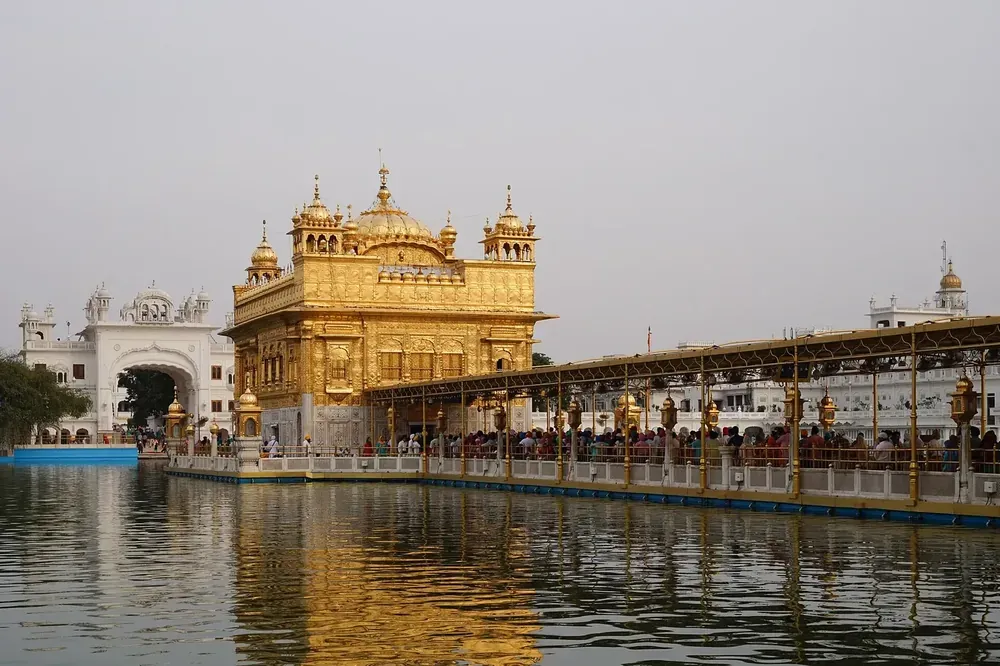
The Golden Temple, Amritsar · Bernard Gagnon · CC BY-SA 4.0 · Source page
A teacher in Punjab
Guru Nanak was born in 1469 in Punjab, in what is now Pakistan. He grew up among Hindus and Muslims, and he questioned the rules that divided them.
A message of one God
Sikh tradition says that around 1499 Nanak began to teach that there is one God, and that all people are equal before God. He travelled widely and shared his ideas in hymns.
Everyone eats together
His followers shared free meals in a communal kitchen called the langar. Rich and poor, of any caste or religion, sat on the floor and ate side by side.
The Golden Temple kitchen
about 50,000
The langar at the Golden Temple in Amritsar serves free meals to about 50,000 people on an ordinary day, and many more at festivals.
Ten Gurus and a book
Nine more Gurus led the Sikhs after Nanak. The fifth, Guru Arjan, gathered their hymns into a holy book in 1604. Sikhs treat this book, the Guru Granth Sahib, as their living Guru.
Why it still matters
About 25 million people follow the Sikh faith today. Sikh temples on every continent still run a langar that feeds anyone who comes.
Review question
What is the langar?
Answer: A communal kitchen where everyone eats for free. In the langar, people of every background sit together and share the same free meal, as a sign that all are equal.
Which Guru gathered the Sikh hymns into a holy book in 1604?
Answer: Guru Arjan. Guru Arjan, the fifth Guru, compiled the book in 1604. Later, Guru Gobind Singh declared it the eternal Guru.
Image credits
- The Golden Temple, Amritsar · Bernard Gagnon · CC BY-SA 4.0 · Source page
