Peter the Great and the Battle of Poltava
Decisions, questions and your own progress, in the app
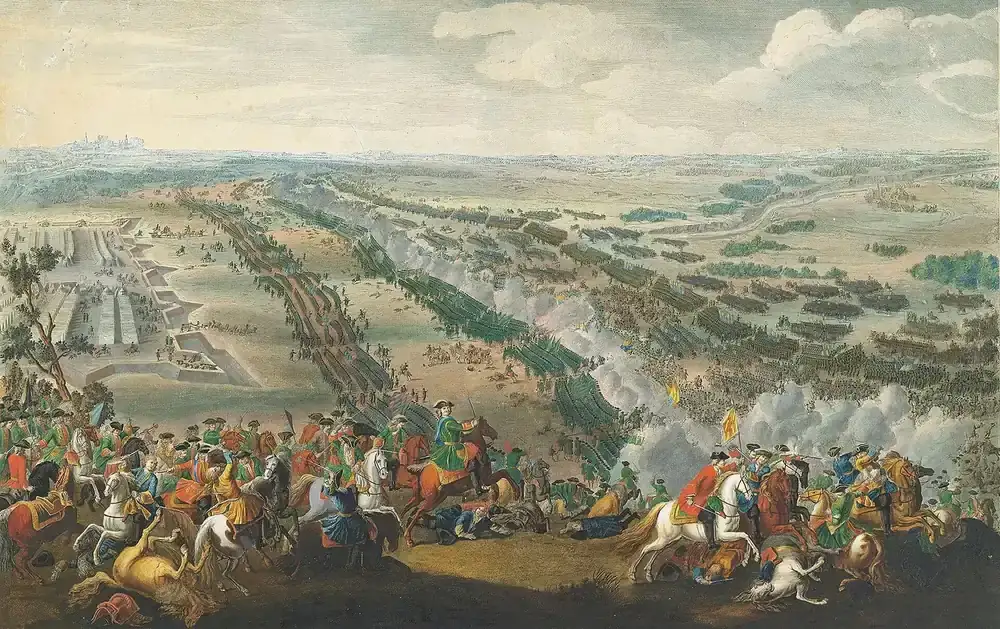
The Battle of Poltava, painting by Pierre-Denis Martin, 1726 · Public domain · Source page
A young tsar with big plans
Peter I became tsar of Russia in 1682. He travelled to western Europe, studied shipbuilding, and came home to modernise the army, the navy and the government. In 1703 he founded a new capital, Saint Petersburg, on the Baltic Sea.
War with Sweden
Peter wanted a coast on the Baltic. In 1700 he went to war against Sweden, led by the young king Charles XII. At Narva in 1700 the Swedes crushed the Russian army, but Peter rebuilt it.
Into Ukraine
about 42,000
In 1709 Charles's army, weakened by a terrible winter, laid siege to Poltava in Ukraine. Peter arrived with about 42,000 men, more than twice as many as the Swedes. Charles had been wounded in the foot and was carried on a stretcher.
A day of battle
On 8 July 1709 (27 June in the Russian calendar) the Swedes attacked. Russian cannons and fortified positions broke their lines. Within hours the Swedish army was destroyed or captured.
A king on the run
Charles escaped south to the Ottoman Empire and stayed there for years. Russia took Swedish lands on the Baltic, and in 1721 Sweden signed the Peace of Nystad.
Why it still matters
In 1721 Peter took the title Emperor, and Russia was counted among Europe's great powers. Sweden's age as a great power ended. Poltava is remembered in Ukraine, Russia and Sweden alike.
Review question
Why did Peter the Great found Saint Petersburg?
Answer: To have a Russian port on the Baltic Sea. Peter wanted a "window to Europe" on the Baltic coast, which the war against Sweden helped him win.
Which king lost at Poltava?
Answer: Charles XII of Sweden. Charles XII lost his army at Poltava. Frederick the Great lived later, and Louis XIV was not there.
Image credits
- The Battle of Poltava, painting by Pierre-Denis Martin, 1726 · Public domain · Source page
