Justinian and Belisarius
Decisions, questions and your own progress, in the app
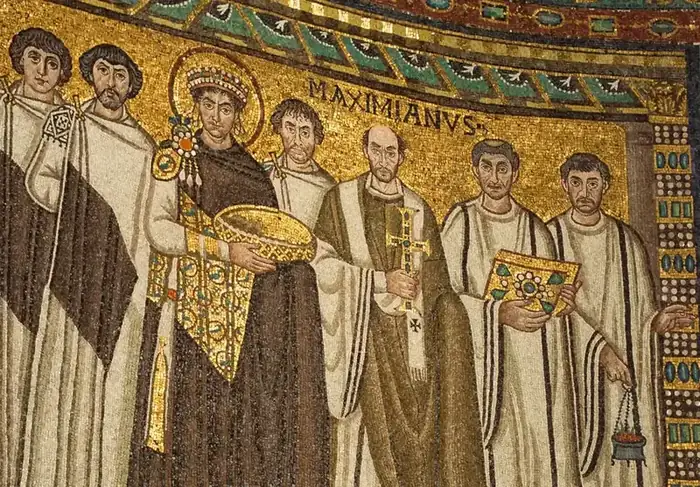
Justinian and his retinue, mosaic in San Vitale, Ravenna · Username.Ruge · CC BY-SA 4.0 · Source page
A peasant's nephew
Justinian came from a poor family in the Balkans. His uncle Justin rose from soldier to emperor and brought him to Constantinople. Justinian became emperor in 527 and wanted to restore the old Roman Empire.
Fire in the city
In January 532, chariot-racing fans rioted in Constantinople in the Nika revolt and burned much of the city. Justinian thought of fleeing. His wife Theodora is said to have told him that royal purple makes a fine burial shroud.
The Hippodrome
about 30,000
Belisarius and other generals sent soldiers into the Hippodrome, where the rebels had gathered. Procopius, a historian of the time, says that about 30,000 people were killed. The revolt was over.
Belisarius in Africa and Italy
In 533 Belisarius sailed to North Africa with about 15,000 men and destroyed the Vandal kingdom in a few months. Next he attacked Italy, held by the Ostrogoths, and took Rome and Ravenna.
Hagia Sophia
After the revolt Justinian rebuilt the great church of Constantinople, Hagia Sophia, with an enormous dome. It was finished in 537, in under six years, and it was the largest church in the world for nearly a thousand years.
Why it still matters
Justinian's lawyers collected Roman law in a huge code, the Corpus Juris Civilis, which still underlies the legal systems of many countries. But the wars drained his treasury, and a plague in 541 killed many people. After he died in 565 much of Italy was lost again.
Review question
What did Belisarius conquer in 533 and 534?
Answer: The Vandal kingdom in North Africa. Belisarius landed near Carthage and defeated the Vandals quickly.
What lasting work did Justinian's lawyers produce?
Answer: A code of Roman law. The Corpus Juris Civilis shaped European law for centuries.
Image credits
- Justinian and his retinue, mosaic in San Vitale, Ravenna · Username.Ruge · CC BY-SA 4.0 · Source page
