Edward I “Longshanks”
He conquered Wales, crushed Scotland twice, and died marching north to do it a third time.
Decisions, questions and your own progress, in the app
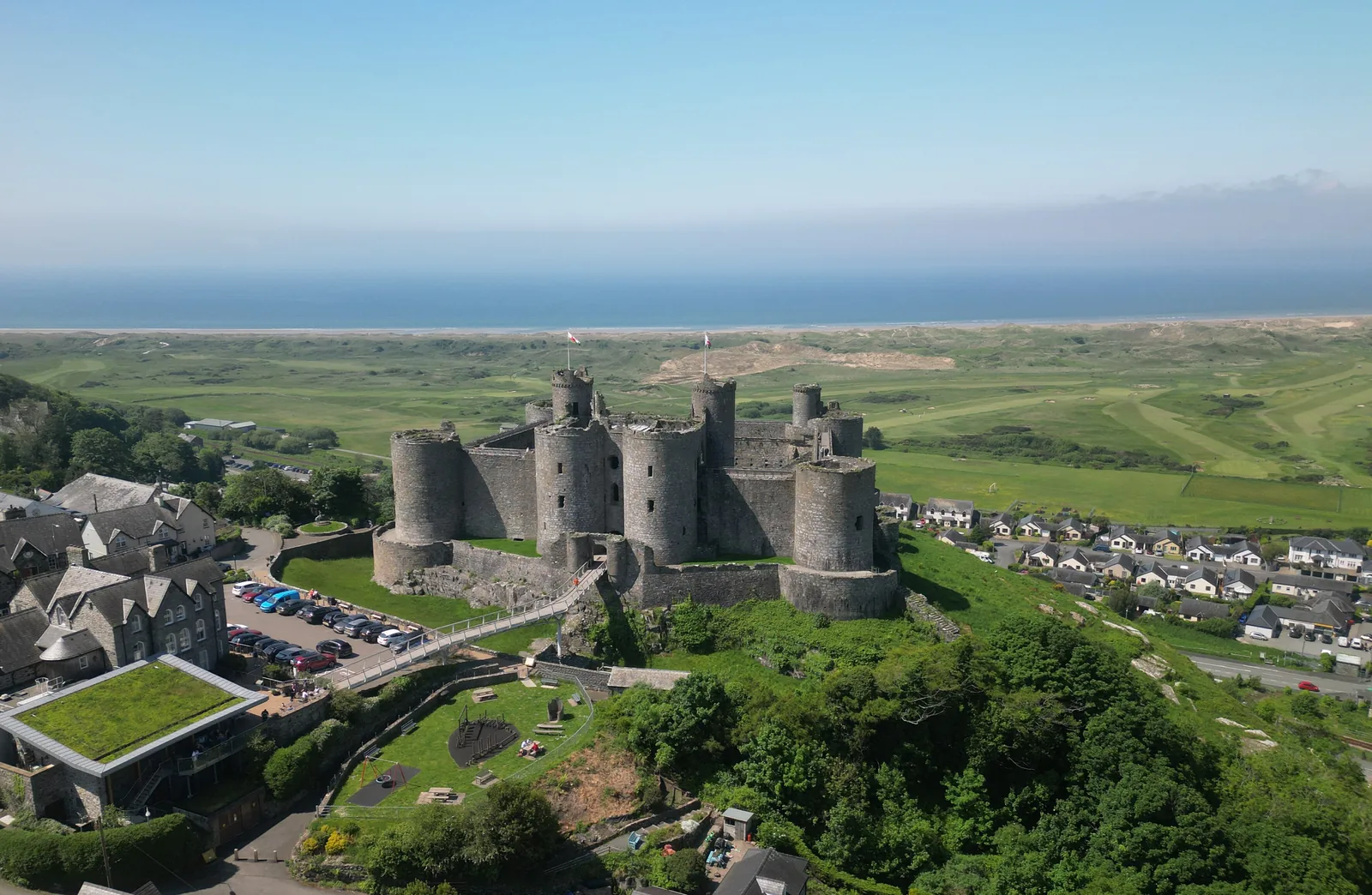
Harlech Castle and Morfa Harlech, Gwynedd, Wales, May 2024. Photo: Llywelyn2000 · CC BY-SA 4.0 · Source page
A castle on a rock
One conquered country, one castle, six years
North Wales, 1283. On a rock above the sea, hundreds of masons, quarrymen and labourers begin a castle. In about six years Harlech stands complete: walls within walls, built for a king who has just conquered Wales.
The same king beat the greatest rebel of his age at 26, killed an assassin with his own hands at Acre, made written laws on a scale no English king had tried, and expelled every Jew from England. He crushed Scotland twice, and died in 1307 marching north to do it a third time.
His name was Edward. Was he a great king, a terrible one, or both?
Edward I
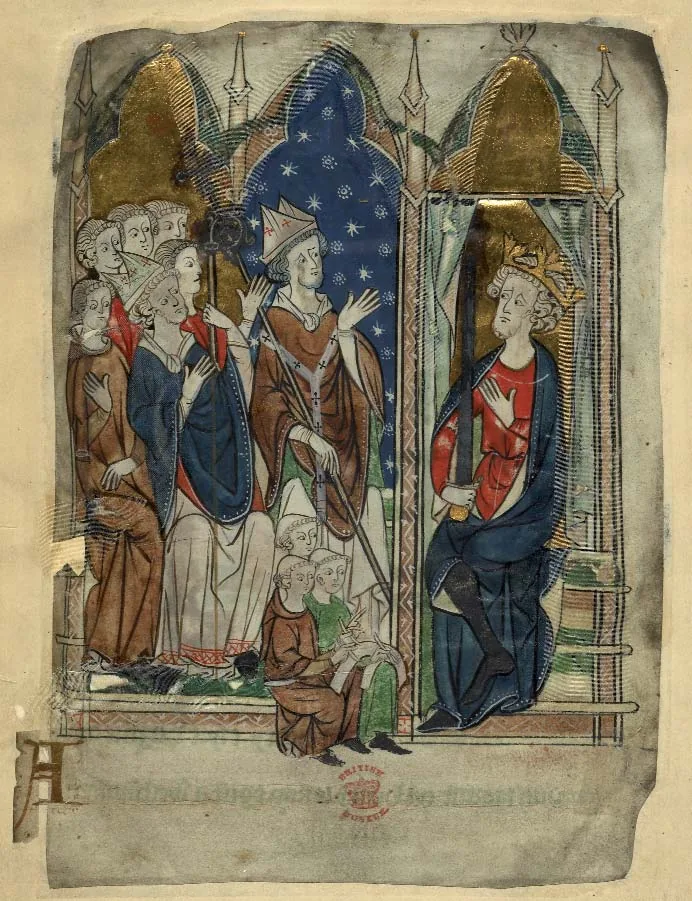
Edward I enthroned. British Library, Cotton MS Vitellius A XIII, fol. 6v · Public domain · Source page
A soldier-king who made laws in parliament and wars in Wales and Scotland, and drove the Jews out of England.
- Born: Night of 17–18 June 1239, Westminster, London; eldest son of Henry III
- Died: 7 July 1307, Burgh by Sands, on the Solway shore near Carlisle, of dysentery, on campaign against Robert Bruce
- Won: Evesham, 1265; Conquest of Wales, 1277 and 1282–83; Berwick and Dunbar, 1296; Falkirk, 1298; Stirling Castle, 1304
- Lost: Lewes, 1264 (then a hostage); Stirling Bridge, 1297 (his army, without him)
“What affects all, by all should be approved.”
A prince between king and barons
Background
A boy named after a saint
Edward was born at Westminster in June 1239, the eldest son of King Henry III and Eleanor of Provence. Henry named him after the Anglo-Saxon saint he adored, Edward the Confessor: a very English name for a French-speaking royal family.
At 15 Edward married Eleanor of Castile, a Spanish princess of about 13, and was given Gascony in south-west France, Ireland and lands in Wales. They had at least 14 children.
His father, pious and extravagant, showered lands and offices on relatives from across the Channel. In 1258 England’s great lords, the barons, forced him to accept the Provisions of Oxford: a council would govern beside him, and a parliament would meet three times a year. Their boldest leader was Simon de Montfort, earl of Leicester. In 1264 the quarrel became civil war.
Simon de Montfort
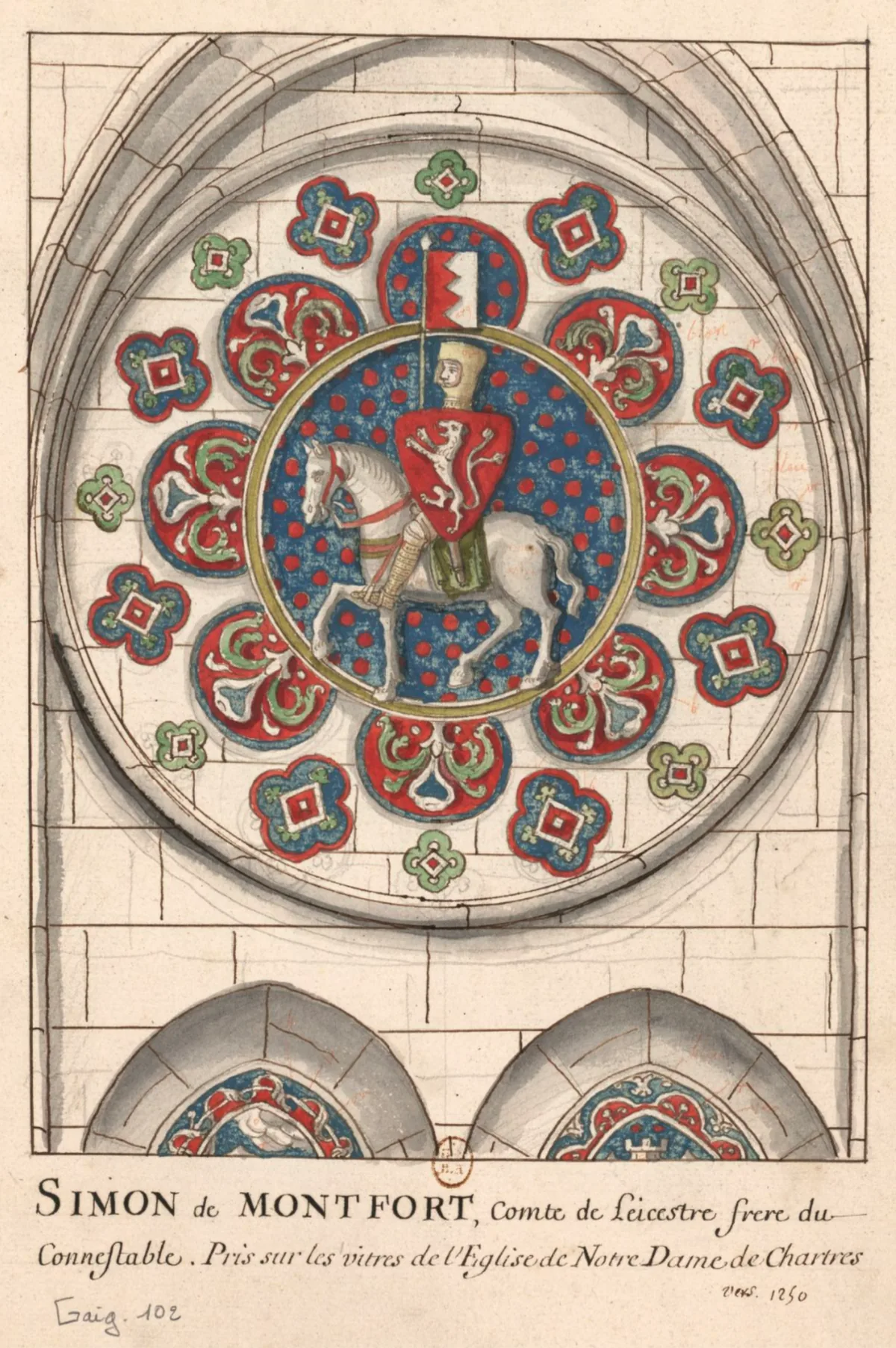
Copy of a window at Chartres Cathedral, c. 1700. Gaignières Collection, Bibliothèque nationale de France · Public domain · Source page
A French-born earl who married the king’s sister, led the barons against him, ruled England in his name for fifteen months, and was cut down at Evesham.
- Born: c. 1208, France; son of the elder Simon de Montfort, leader of the crusade against the Cathars
- Died: 4 August 1265, Evesham, Worcestershire, killed in battle; his body was cut to pieces
- Won: Lewes, 1264
- Lost: Evesham, 1265
“May God have mercy on our souls, for our bodies are theirs.”
1264–1265
The charge that lost a battle
At Lewes, on 14 May 1264, Edward charged Montfort’s left wing, a mass of Londoners on foot, and chased them for miles. When he rode back, the battle was lost. His father was Montfort’s prisoner, and soon Edward was a hostage.
Montfort ruled in the king’s name. His parliament of January 1265 summoned not only lords and churchmen but two knights from every shire and men from the towns.
In May 1265, at Hereford, Edward asked to try out his guards’ horses, rode each until it tired, mounted the freshest and galloped away. Gilbert de Clare, earl of Gloucester, had changed sides; with him and Roger Mortimer, a great lord of the Welsh border, Edward had an army.
Evesham and Acre
A decision point
You are Edward, the king’s eldest son, aged 26.
3 August 1265, at Worcester
For two months you have kept Montfort penned in the west. Two nights ago you marched in the dark and fell on the army of his son, young Simon, asleep outside Kenilworth castle, taking his banners and many knights.
Now scouts report that Montfort, with the captive king, has crossed the Severn south of Worcester and is marching east, probably to join his son. Your men are tired. Montfort is the most experienced soldier in England.
What do you do?
- Rest your men at Worcester and fight later, on ground of your choosing Your army would be fresh, but father and son would probably unite. Montfort would face you with a bigger army, and with the king still in his hands.
- March again through the night and close the road north of Evesham, where the river Avon loops round the town A gamble on tired legs. If you arrive first, Montfort is caught between your army and the river, with one bridge behind him and his son still miles away.
- Go back and besiege young Simon in Kenilworth castle Kenilworth is one of the strongest castles in England; a siege could take months. Meanwhile Montfort would be free to move, and to use the king’s name as he pleased.
What really happened
March again through the night and close the road north of Evesham, where the river Avon loops round the town
Edward marched through the night and reached Evesham from the north on the morning of 4 August. According to Walter of Guisborough, his men raised young Simon’s captured banners, and Montfort’s lookout on the abbey tower at first took them for friends. Before the fight, Edward and Gloucester picked twelve men for one task: to find Montfort and kill him.
Edward had learned from Lewes: move fast, strike each enemy separately, keep your men together. But the death squad broke a custom: since 1066, English nobles beaten in battle had usually been captured and ransomed, not killed. Historians such as David Carpenter see Evesham as the start of a harsher age.
Evesham: who fought whom
4 August 1265, morning
Green Hill, north of Evesham, Worcestershire
The royal army
- Commanders: Prince Edward, Gilbert de Clare, earl of Gloucester, Roger Mortimer
- Strength: at least three times Montfort’s army (Melrose chronicle (a Scottish abbey, pro-Montfort)); perhaps 8,000–10,000 (Modern estimate)
- Losses: light (The chronicles)
Montfort and the barons
- Commanders: Simon de Montfort, Henry de Montfort, his son, Hugh Despenser
- Strength: more than 6,000 foot, many of them Welsh (Evesham Abbey chronicle); perhaps 5,000–6,000 (Modern estimate)
- Losses: nearly 4,000 (English Heritage battlefield report (1995)); more than 30 knights and lords known by name (Firm evidence)
Many of the Welsh foot fled before the fighting, and many drowned in the river.
Outcome: A crushing royal victory. Montfort, his son Henry and Hugh Despenser are killed; Henry III is freed.
The chroniclers’ totals are symbolic and inflated. The firmest evidence is the list of knights who died.
The battle of Evesham
4 August 1265, from morning to midday
Simon de Montfort and the captive king, Henry III, are at Evesham, inside a loop that the River Avon makes round the town. The royal army under Prince Edward comes from the north, and three of its divisions block the neck of the loop. Montfort faces a much larger army.
One reconstruction, after the ‘new account’ published by Laborderie, Maddicott and Carpenter (2000), as mapped by Glenn Foard for the Battlefields Trust, and Walter of Guisborough’s chronicle. River and town follow modern maps; the medieval town was smaller. Where the first clash happened, whether Mortimer stood in the line or guarded the bridge, and the route of the royal approach are all disputed; positions are approximate.
Phases of the battle
- Closing the loop Morning, 4 August. Montfort and the captive king are in Evesham, inside a loop of the Avon. From the north, three royal divisions close the neck of the loop.
- Up Green Hill Montfort will not hide in the abbey or try the bridge. He leads his men up Green Hill and forms on top as the royal army comes over the brow.
- Montfort’s charge Montfort’s knights charge in a wedge at the royal centre, which gives ground. But many of his Welsh foot are already slipping away.
- The ring closes Gloucester and Mortimer swing round both flanks; Montfort’s men fight in a ring as a dark storm breaks. Montfort, his son Henry and Hugh Despenser are killed; the wounded king is saved.
- Slaughter Fugitives run for the river and back into the town. Many drown; others are cut down inside the abbey church. Young Simon, still on the road, hears the news and turns back.
The strategy
- Royal army: Edward marches through the night to block the road north of Evesham, where the Avon loops round the town. Three divisions close the neck of the loop, so that Montfort is shut inside it. The exact route of the royal approach is disputed.
- Montfort: Montfort will not hide in the abbey or try to escape over the bridge. He leads his men up Green Hill to form on its top, to meet the royal army from above as it comes over the crest from the north.
What decided it: Montfort was caught inside the loop, with the royal army blocking its neck. Many of his Welsh foot had fled before the fighting, the royal wings swung round both of his flanks, and those who stayed fought in a ring. The fugitives drowned or were cut down.
4 August 1265
“Murder, not battle”
Montfort fought on foot after his horse was killed. Guisborough says he asked for mercy and was told there was none for traitors. His body was hacked apart. The old king, put into armour by his captors, was wounded by his own side and saved only when he cried out: “I am Henry of Winchester, your king!”
Robert of Gloucester, an English verse chronicler writing about 1300, called it “the murder of Evesham, for battle it was none.”
1270–1274
Acre: the poisoned dagger
In 1270 Edward set out on crusade. He landed at Acre in May 1271 with about 1,000 men, a tiny force against the Mamluk sultan Baybars, and in May 1272 the crusader kingdom, by then a strip of coast around Acre, made a ten-year truce.
In June 1272 a man who had come to him before as an envoy found him resting and struck at him with a poisoned dagger. Edward, wounded in the arm, kicked him down and killed him. A surgeon cut away the blackened flesh, and Edward survived.
Henry III died that November. Edward heard the news in Sicily and was crowned in Westminster Abbey in August 1274.
Myth
Queen Eleanor saved Edward’s life at Acre by sucking the poison from his wound.
The truth
The earliest accounts know nothing of it. Guisborough, writing around 1300, says an English surgeon cut away the blackened flesh, and that Eleanor was led out of the room in tears so that she would not watch. The story of the wife sucking out the poison first appears decades later, in the work of an Italian friar, Ptolemy of Lucca.
The evidence
Guisborough’s chronicle (ed. Hamilton, I 335–337); Ptolemy of Lucca, early 14th century.
Law, conquest and expulsion
1274–1290
A king who wrote laws
In 1274–75 the new king’s commissioners rode through every county asking who held what, by what right, and which officials took bribes.
Then came the statutes, written laws for the whole kingdom issued in parliament: Westminster in 1275, Gloucester in 1278, Westminster and Winchester in 1285 and more, on land, debt, crime and the rights of lords. Later lawyers called Edward the English Justinian.
War cost more than the crown’s income, and custom said a large tax needed consent. So Edward called parliaments often, more and more with knights from the shires and burgesses from the towns.
Source: A king asks for consent
“As a most just law … exhorts and decrees that what affects all, by all should be approved, so also, very evidently should common danger be met by means provided in common.” … The king of France “now proposes to destroy the English language altogether from the earth.”
In 1294–95 Edward faced war with France, a Welsh revolt and Scots turning to France. He summoned the largest parliament yet: lords, bishops, abbots, the lower clergy, two knights from every shire and two burgesses from every town.
- Why does a king who wants money quote a rule about consent? Because he needs the money given, not taken. The Roman-law maxim flatters those summoned and binds them too: whoever approved the tax shares in the war.
- The writ is in Latin, to French-speaking bishops. Why warn about the English language? Propaganda: Edward’s own court spoke French. The writ turns a quarrel over Gascony into a threat to the whole nation. And notice who was not summoned: women, peasants, most townspeople.
1277–1284
The conquest of Wales
Llywelyn ap Gruffudd, Prince of Wales, the strongest Welsh ruler in generations, owed Edward homage and refused again and again to give it. In 1277 an English army advanced along the north coast while troops landed on Anglesey to seize the harvest that fed his mountains. Llywelyn submitted.
In 1282 his brother Dafydd rose, and Llywelyn joined him. That December Llywelyn was killed in a skirmish near Builth, and his head was displayed on the Tower of London. Dafydd, caught the next year, was put to the traitor’s death: hanged, drawn and quartered.
Edward annexed Wales and ringed Gwynedd with castles: Conwy, Caernarfon, Harlech, later Beaumaris. James of St George, from Savoy, built them: Harlech and Beaumaris concentric, Conwy and Caernarfon with walled towns for English settlers. His son, born at Caernarfon in 1284, was made Prince of Wales in 1301. The tale that Edward promised the Welsh “a prince born in Wales who spoke no English” and showed them a baby is a legend first printed in 1584.
A decision point
You sit on King Edward’s council.
Summer 1290, Westminster
The king is deep in debt after three years in Gascony and a new crusade vow. The knights of the shires in parliament will grant a very large tax, and want something in return.
England’s Jews, perhaps 2,000 to 3,000 people, belong by law to the king, who taxes them at will; little is left. Since 1275 they may not lend at interest, for generations their main living, and since 1218 must wear a badge. In 1278–79 about 270 were hanged in London after mass arrests for clipping coins. The Church presses for their conversion, and three years ago Edward expelled the Jews of Gascony.
What do you advise the king?
- Keep the 1275 law: the Jews stay, lending stays banned Little money would come from a community already drained, and the knights’ grant would probably shrink or vanish. Pressure from the Church and the shires would go on.
- Accept the bargain: expel every Jew, seize their houses and debts, take the tax The crown gets the largest tax of the age, and the debts. A whole community, settled in England for more than two centuries, loses its home.
- Push harder for conversion, with sermons and the royal house for converts Few would convert; for years very few had. The knights would see nothing gained, and the money problem would remain.
- Let the Jews lend again, under strict royal control Money might flow again, but the knights and the Church would be furious. You would lose the tax, and probably parliament’s goodwill.
What really happened
Accept the bargain: expel every Jew, seize their houses and debts, take the tax
On 18 July 1290 writs went to every sheriff: all Jews must leave England by 1 November. They could take movable goods; their houses and the debts owed to them passed to the crown. The same parliament granted about £116,000, perhaps the largest single tax of medieval England. The Edict of Expulsion fell on the Ninth of Av, the fast for the destruction of the Temple.
Robert Stacey sees a deal: the Jews traded for the knights’ consent to a tax. Robin Mundill stresses the failure of the 1275 attempt to turn moneylenders into merchants; others, Edward’s piety and Church pressure. It was the first permanent expulsion of a whole Jewish community by a European kingdom.
November 1290
Twelve crosses for a queen
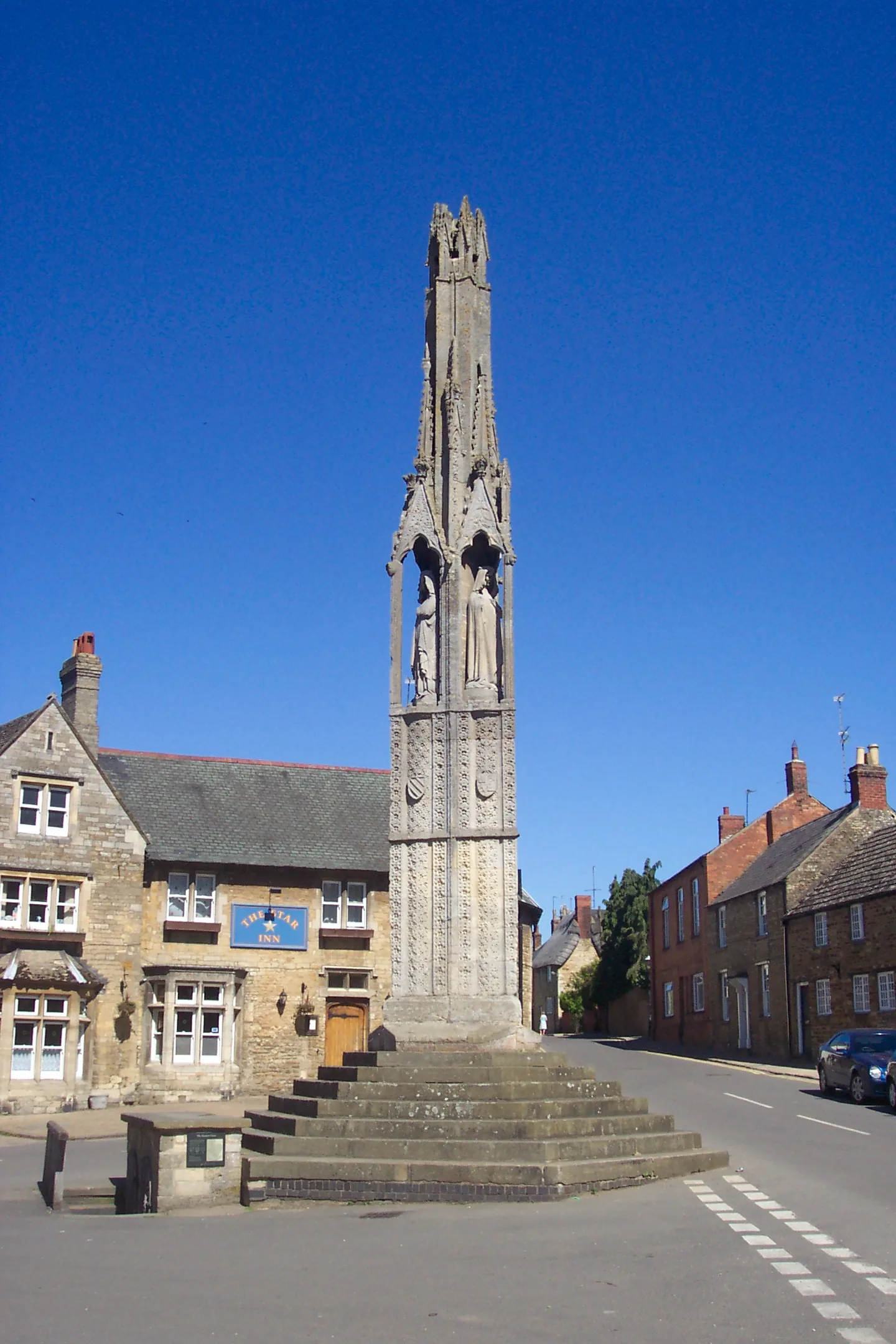
The Eleanor Cross at Geddington, 2006. Photo: Lofty at English Wikipedia · CC BY 2.5 · Source page
Four months later Queen Eleanor died near Lincoln. Wherever her body rested on the way to Westminster, Edward later raised a tall stone cross. Of the twelve, three survive; Geddington’s is the best preserved.
Edward wrote that he had loved her in life and could not cease to love her in death. Yet the queen herself had grown rich buying up debts owed to Jews and taking the debtors’ lands. One year shows both faces of the reign: deep grief, and a cold use of power.
Scotland
1286–1291
A kingdom without a king
In March 1286 King Alexander III of Scotland fell from his horse on a stormy night and was found dead on the shore near Kinghorn. His heir was his granddaughter Margaret, the Maid of Norway, not yet three. In 1290 the Scots agreed that she would marry Edward’s son, if Scotland remained a separate kingdom.
In September 1290 she died in Orkney on her way to Scotland. Now thirteen men claimed the crown. The two strongest, Robert Bruce, grandfather of the future king, and John Balliol, gathered armed followers. Scotland’s Guardians and bishops asked Edward to help keep the peace.
A decision point
You are Edward I, king of England, aged 51.
May 1291, at Norham castle, on the river Tweed
You have summoned the Scottish nobles and the claimants to Norham, on the English bank of the border river. Old English chronicles say English kings were once overlords of Scotland; the Scots deny it, and the agreement of 1290 promised that their kingdom would stay separate.
The Scots need a judge, and you have an army close by.
On what terms do you act?
- Judge the case as a friendly neighbour, with no conditions The Scots would get their king and keep their independence, as promised in 1290. You might win gratitude, but no real power north of the border.
- First make the claimants recognise you as overlord of Scotland, then judge Every claimant has a reason to agree, since refusing means losing. Whoever wins will owe you homage. But the Scots will feel their kingdom was taken by a lawyer’s trick.
- Claim the crown yourself, or impose a candidate who owes you everything Most of the Scottish nobles would unite against you. You would have a war at once, and a weak claim to justify it.
- Stay out and let the Scots settle their own quarrel Perhaps a civil war in Scotland. A divided neighbour is no threat, but it might turn to France, England’s enemy.
What really happened
First make the claimants recognise you as overlord of Scotland, then judge
In June 1291 the claimants accepted Edward as overlord. After eighteen months of hearings, later called the Great Cause, he awarded the crown on 17 November 1292 to John Balliol, whose claim through the senior line was the strongest. Then he kept pressing: he heard appeals against Balliol’s judgments, summoned him before an English parliament, and in 1294 demanded Scottish soldiers for his war in France.
Michael Prestwich judges the verdict fair but what followed provocative: Edward treated a king as a vassal. G. W. S. Barrow saw his legalism as a lever for domination. In 1295 the Scots made a treaty with France, later called the Auld Alliance. War came within months.
1296
Berwick, Dunbar and the Stone
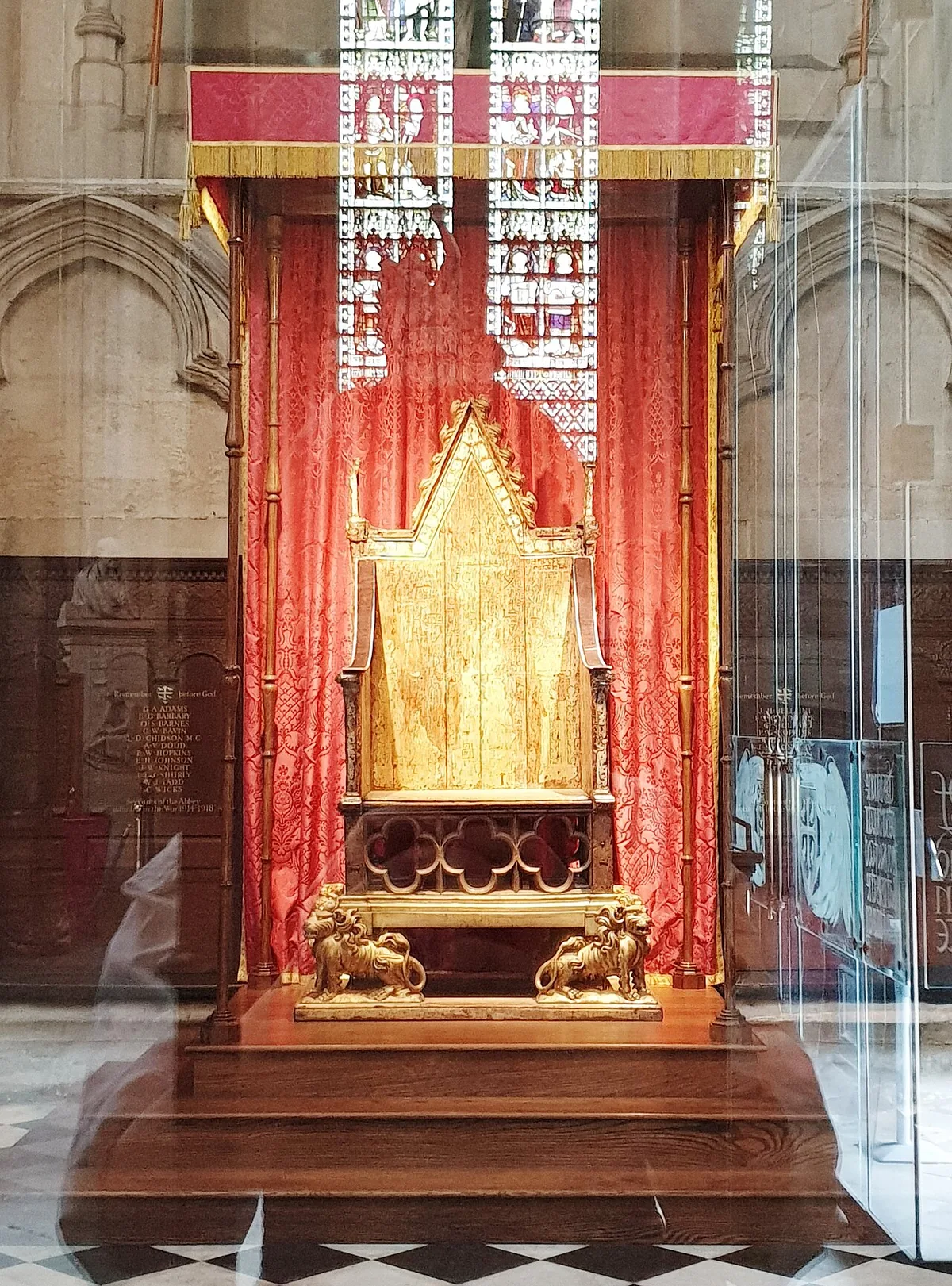
The Coronation Chair, Westminster Abbey, 2021. Photo: JRennocks · CC BY-SA 4.0 · Source page
On 30 March 1296 Edward’s army stormed Berwick, Scotland’s richest town. The killing of its people went on, the chroniclers say, for a day and a half. A month later at Dunbar, John de Warenne, earl of Surrey, routed the Scottish nobles’ cavalry.
In July Balliol surrendered. The royal arms were torn from his coat, and Scots remembered him as Toom Tabard, ‘empty coat’. Edward carried off the Stone of Scone, on which Scottish kings had been made, and had a chair made at Westminster to hold it. Scotland, it seemed, was finished.
Source: An eyewitness at Berwick
“… no fewer than fifteen thousand of both sexes perished … in the space of a day and a half … Nevertheless this most clement prince exhibited towards the dead that mercy which he had proffered to the living; for I myself beheld an immense number of men told off to bury the bodies of the fallen…”
The friar who wrote this part lived near the border and admired Edward. The Scottish writer Walter Bower, some 150 years later, gave 7,500 dead.
- Who is the “most clement prince”, and why call him merciful? Edward. The friar is on his side, and his praise turns attention from the killing to the burials Edward ordered.
- What can an eyewitness of the burials really know? He saw many men burying many bodies, but he could not have counted fifteen thousand; Berwick may not even have had so many people. ‘I myself beheld’ makes the whole passage feel reliable, but it supports only part of it. Historians accept the massacre, not the numbers.
William Wallace
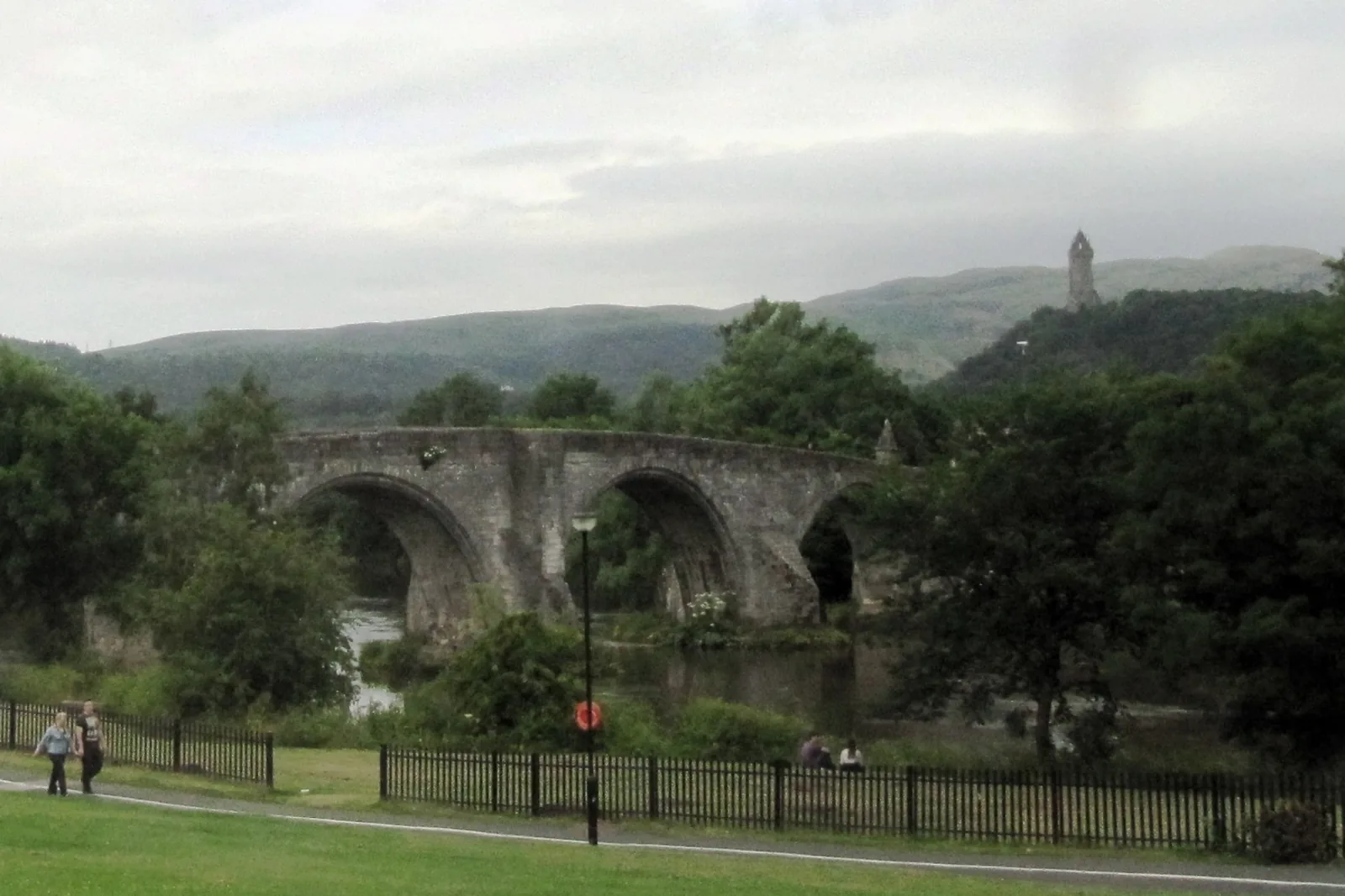
Stirling Old Bridge and the Wallace Monument, 2013. Photo: Palickap · CC BY-SA 4.0 · Source page
A small landholder’s son who beat an English army at Stirling Bridge, lost at Falkirk and was executed in London.
- Born: Perhaps c. 1270, Unknown; by tradition Elderslie, in the west of Scotland
- Died: 23 August 1305, Smithfield, London, hanged, drawn and quartered as a traitor, after a trial in Westminster Hall
- Won: Stirling Bridge, 1297 (with Andrew Murray)
- Lost: Falkirk, 1298
“A certain bloody man, William Wallace, who had formerly been a chief of brigands in Scotland.”
11 September 1297
Stirling Bridge
In May 1297 William Wallace killed the English sheriff of Lanark, while Andrew Murray raised the north. In September their army waited on Abbey Craig, above the river Forth at Stirling, where a narrow wooden bridge carried the road north. Edward was away in Flanders.
His commanders, Earl Warenne and the treasurer Hugh Cressingham, began to send their men across, two horsemen abreast. A knight offered to take sixty men at a time over a nearby ford, but Cressingham would hear of no more delay.
The Scots waited until as many had crossed as they could beat, then seized the end of the bridge. The vanguard was trapped against the river and destroyed, Cressingham with it. Murray died of his wounds; in 1298 Wallace, now a knight, became sole Guardian of Scotland.
A decision point
You are Sir William Wallace, Guardian of Scotland.
22 July 1298, at dawn, near Falkirk
Edward has come north himself with thousands of men-at-arms and tens of thousands of foot. You stripped the land of food in his path, and it is working: his army is hungry, and his Welsh soldiers have rioted.
But last night his army camped near Linlithgow, half a day’s march away. Your strength is your spearmen; the horsemen belong to the nobles, many of whom resent a knight of no great family ruling in the name of an absent king.
What do you do?
- Withdraw north of the Forth, refuse battle and keep starving the English Edward’s army would probably have to turn back within days, for hunger was already biting. But your leadership would be questioned: the nobles would say you ran from the king.
- Stand and fight on ground of your choosing: spearmen in schiltrons on a slope, with boggy ground in front Your spearmen can stop horsemen, and the bog will break up a charge. But if the English bring up archers, the spearmen are a packed target that cannot reach them.
- Fall back to Stirling and hold the crossings of the Forth, where you won last year Good ground and a famous name. But Edward is no Cressingham: he would not cross a narrow bridge into a trap, and he could wait for supplies.
What really happened
Stand and fight on ground of your choosing: spearmen in schiltrons on a slope, with boggy ground in front
Wallace stood and fought, on a slope with a burn and a bog in front of him. He drew up his spearmen in four schiltrons, rings of men with long spears slanting outwards, and put the archers of Selkirk Forest in the gaps. The horsemen stood behind.
Historians such as Andrew Fisher and Fiona Watson suggest Wallace needed a victory to keep the nobles behind him, and could not rely on their horsemen in a long war. Robert Bruce, who learned from this day, would fight differently at Bannockburn.
Falkirk: who fought whom
22 July 1298
Near Falkirk, between Edinburgh and Stirling; the exact site is disputed
The English army
- Commanders: Edward I, The earls Bigod, Bohun and Lacy (first line), Antony Bek, bishop of Durham (second line)
- Strength: about 25,700 foot in pay for the campaign, almost 11,000 of them Welsh (The king’s pay records); perhaps 2,000–3,000 horse; on the field perhaps 15,000–18,000 in all (Modern estimates)
- Losses: the Master of the Templars and five or six squires (Lanercost); compensation for 111 warhorses (Royal accounts)
The pay records count only the men in the king’s pay, at the campaign’s peak; not all of them reached the field.
The Scottish army
- Commanders: Sir William Wallace, Guardian, Sir John Stewart, commanding the archers, The Scottish nobles, with the horse
- Strength: about 1,000 horse and 300,000 foot (Guisborough, from prisoners’ reports); between about 5,000 and 14,000 (Modern estimates)
- Losses: 50,000 foot (Guisborough); 60,000, others say 80,000 or 100,000 (Lanercost); several thousand at least; no reliable figure (Modern view)
The chroniclers’ Scottish figures are more men than Scotland could have put in the field.
Outcome: A crushing English victory. The schiltrons are broken; Wallace escapes. But Edward, short of food, cannot hold the country, and within weeks he withdraws.
The battle of Falkirk
22 July 1298, morning
In the morning of 22 July 1298, near Falkirk, the Scottish army under Wallace stands on a slope: four schiltrons of spearmen, with archers between them and a bog in front. Edward I's army approaches, hungry after a march through land stripped of food along the way.
A schematic reconstruction after Walter of Guisborough (c. 1300) and Pete Armstrong (2003), who puts the Scots on rising ground south of Callendar Wood, facing south across the valley of the Glen Burn. The site is disputed: Glenn Foard for the Battlefields Trust (2005) prefers ground north of the old town, now built over. Guisborough’s bog, with the first line riding round its west end and Bek’s round its east, fits either. Positions and distances are approximate.
Phases of the battle
- Rings of spears Morning, 22 July. Wallace’s four schiltrons stand on the slope, archers between them, horsemen behind. The English arrive hungry, but Edward decides to attack.
- Round the bog The first line rides straight into the bog and swings round its western end. Bishop Bek’s line goes round the east; when Bek wants to wait for the king, a knight tells him to go and say mass.
- The spears hold The Scottish horsemen ride off almost without a blow. The English knights cut down the archers and their commander, Sir John Stewart. But the spears hold, and horses die on them.
- Arrows and stones The king’s line brings up archers and crossbowmen. They shoot into the packed rings, men hurl stones, and gaps open.
- The rings break The horsemen burst into the gaps and the slaughter begins; many Scots drown in the burn and bog. Wallace escapes towards the Torwood.
The strategy
- English army: Edward decides to attack although his men are hungry. Two lines of horse ride round the bog on either side to hit the schiltrons from every direction, and the king's line brings up archers and crossbowmen to shoot into the packed rings.
- Scottish army: Wallace chooses to stand and fight on ground of his choosing: four schiltrons of spearmen on the slope, archers between them, and the bog in front, which makes an attack hard. His strength is his spearmen; the horsemen belong to the nobles, many of whom resent him.
What decided it: The spears held against the English horse, but the Scottish horsemen had already ridden off almost without a blow, and arrows and stones opened gaps in the packed rings. The English horse rode through the gaps, and many Scots drowned in the burn and bog.
Source: How to explain a defeat
“For, on account of the ill-will, begotten of the spring of envy, which the Comyns had conceived towards the said William, they, with their accomplices, forsook the field, and escaped unhurt.” … “we seldom, if ever, read of the Scots being overcome by the English, unless through the envy of lords, or the treachery and deceit of the natives…”
Fordun, a priest in Aberdeen, wrote some seventy years after Falkirk, under kings descended from Robert Bruce.
- Whom does Fordun blame for the defeat? Scottish lords, never Wallace: the Comyns, the Bruces’ bitter rivals, and, in lines cut from this extract, young Robert Bruce, said to have fought for England (historians reject this).
- What does the last sentence say about how a nation tells its defeats? That the Scots are beaten only when betrayed. Every defeat becomes a story of treachery, and the nation’s courage stays unstained.
1298–1306
The end of Wallace
After Falkirk Wallace gave up the guardianship and sought help in France. Edward came back north year after year, and in 1304 most Scottish nobles submitted.
In August 1305 Wallace was captured near Glasgow, condemned as a traitor in Westminster Hall and executed at Smithfield; by tradition he answered that he had never sworn loyalty to Edward, so could be no traitor. Parts of his body were displayed in four towns.
In February 1306 Robert Bruce, grandson of the claimant of 1291, killed his rival John Comyn in a church at Dumfries and was crowned at Scone. Edward, now 66, swore revenge. In June his army routed Bruce at Methven; three of Bruce’s brothers were executed, and his sister Mary and the Countess of Buchan, who had crowned him, were kept in cages.
The hammer and its marks
July 1307
Within sight of Scotland
After a winter of illness, Edward set out once more against Bruce in July 1307. On 7 July he died at Burgh by Sands, on the shore of the Solway, within sight of Scotland.
He was buried in Westminster Abbey in a plain tomb of dark marble. In the 16th century someone painted on it, in Latin: ‘Here is Edward the First, Hammer of the Scots. Keep faith.’ Antiquaries who opened the tomb in 1774 measured him at 6 feet 2 inches (188 cm). ‘Longshanks’ was no exaggeration.
His son, Edward II, turned back from Scotland within weeks. Seven years later he would face Bruce at Bannockburn.
What came after
- 1301 Edward’s son is made Prince of Wales, a title since given only to heirs to the throne.
- 1314 Robert Bruce crushes Edward II at Bannockburn.
- 1328 In the Treaty of Edinburgh–Northampton, England recognises Scotland’s independence.
- 1337 The Hundred Years’ War begins. Among its roots: the quarrel over Gascony and the alliance between France and Scotland.
- 1656 Under Oliver Cromwell, after Menasseh ben Israel’s petition, Jews again live openly in England.
- 1996 The Stone of Scone returns to Scotland. Since 2024 it has been shown in the Perth Museum.
Myth
Braveheart (1995) shows it as it was: Wallace in a kilt, Edward claiming the lord’s ‘right of the first night’, and Wallace in love with Princess Isabella.
The truth
No ‘right of the first night’ is recorded in England or Scotland; the Scottish tale comes from Hector Boece, writing in 1527. The kilt belongs to the 16th century. Isabella of France was about ten when Wallace died. And the film’s Stirling Bridge has no bridge.
The evidence
The film follows The Wallace, a verse romance by ‘Blind Harry’ from around 1477, some 170 years after Wallace’s death.
Great king or terrible king?
How should we judge Edward I?
- William Stubbs, The Constitutional History of England (1875) Edward was a great lawgiver who shaped the English constitution: his statutes and his ‘Model Parliament’ of 1295 laid the foundations of government by king and parliament together.
- G. W. S. Barrow, Robert Bruce (1965), and R. R. Davies, The First English Empire (2000) Seen from Wales and Scotland, Edward was a conqueror building the first English empire in the British Isles. His legal arguments were a lever for domination, and resistance to him strengthened the Scots’ sense of nationhood.
- Michael Prestwich, Edward I (1988), and Marc Morris, A Great and Terrible King (2008) Able, energetic and often successful, he also overreached: the wars in Scotland left huge debts, a resentful nobility and an unfinished conquest. Morris’s title says it: a great and terrible king. The expulsion of the Jews weighs heavily against him.
Few historians now call him simply great or simply terrible. The questions are which achievements you weigh against which harms, and whose point of view you stand in: English, Welsh, Scottish or Jewish.
What do you know now?
Check yourself
At Lewes Edward lost; at Evesham he won. What had he changed?
Answer: He moved fast, struck the enemy armies one at a time and kept his men together. Right. The night march to Kenilworth and then to Evesham caught father and son apart, and this time there was no wild pursuit.
Check yourself
Why is the parliament of 1295 called the ‘Model Parliament’?
Answer: A 19th-century historian, William Stubbs, named it so because it held every element of later parliaments. Right. The name is late, and reflects Stubbs’s view of how the constitution grew, not what anyone thought in 1295.
Check yourself
According to historians such as Robert Stacey, what lay behind the expulsion of 1290?
Answer: A bargain: parliament granted a huge tax, and the Jews were expelled. Right. The tax of about £116,000 was granted in the same parliament, in July 1290. Others add the king’s piety and the pressure of the Church.
Check yourself
Balliol was the lawful choice in 1292. Why did the Great Cause still lead to war?
Answer: Edward used his overlordship to hear appeals against Balliol, summon him to England and demand Scottish soldiers. Right. The verdict was fair; what followed humiliated a king and pushed the Scots into alliance with France.
Check yourself
What broke the Scottish schiltrons at Falkirk?
Answer: Archers, crossbowmen and stone-throwers thinned the ranks, then the horsemen broke in. Right. Packed spearmen cannot answer missiles. Once gaps opened, the horsemen finished the work.
Check yourself
When were the words ‘Hammer of the Scots’ put on Edward’s tomb?
Answer: In the 16th century, some 250 years after his death. Right. The inscription is usually credited to an abbot of Westminster in the 1550s. The name tells us what later generations thought of him.
Terms
- barons The great lords of England, who held their lands directly from the king and owed him military service. In the 13th century they demanded a share in government.
- parliament A meeting of the king with the lords and churchmen, and more and more often with elected knights and townsmen. Under Edward it granted taxes, heard petitions and made laws.
- statute A written, general law issued by the king in parliament, valid in the whole kingdom. Edward issued dozens.
- crusade A war proclaimed by the Catholic Church as a holy duty, above all against Muslim rulers in and around the Holy Land. Those who joined ‘took the cross’ with a vow.
- concentric castle A castle with a high inner ring of walls inside a lower outer ring, so that two lines of defenders can shoot at once. Harlech and Beaumaris are built this way.
- overlord A ruler to whom another lord, even a king, swore loyalty (homage) and owed service. Edward demanded that the king of Scots recognise him as overlord.
- Edict of Expulsion The writs of 18 July 1290 in which Edward ordered the sheriffs that all Jews must leave England by 1 November.
- Guardian The title of those who ruled Scotland when there was no king in charge. In 1286–92 several Guardians ruled together; in 1298 Wallace was sole Guardian.
- schiltron A dense block, sometimes a ring, of Scottish spearmen with their long spears pointing outwards like a hedgehog. Strong against horsemen; against archers, a target.
- men-at-arms Mounted warriors in full armour: knights and the armoured men who rode with them. They were the core of the armies of the age, and very expensive.
- Stone of Scone A block of sandstone on which Scottish kings were made at Scone. Edward took it to Westminster in 1296; it went back to Scotland only in 1996.
- hanged, drawn and quartered The death England reserved for traitors: the condemned man was dragged to the gallows and hanged, and his body was cut into pieces and sent to be displayed in towns as a warning.
- Llywelyn ap Gruffudd Prince of Wales, the strongest Welsh ruler in generations. He refused again and again to swear loyalty to Edward, and was killed in 1282.
- Gilbert de Clare Earl of Gloucester, who switched sides to the king during the civil war. Thanks to him, Edward had an army.
- Roger Mortimer Great lord of the Welsh border, who sided with Edward. He is usually credited with the blow that killed Montfort.
- Walter of Guisborough Augustinian canon in Yorkshire, who wrote a chronicle many years after the events. He added the scene in the abbey tower at Evesham.
- Robert of Gloucester English chronicler who wrote a history in rhyme around 1300. He called Montfort's killing a murder, not a battle.
- Walter Bower Scottish writer who wrote about 150 years after the events. He gave a death toll of 7,500.
- Hector Boece Scottish historian who wrote in 1527 a story with no record behind it: the right of the first night.
- Hugh Cressingham The king's treasurer in Scotland, killed in the battle by Stirling Bridge.
- John de Warenne Earl of Surrey and English commander in Scotland. At Dunbar in 1296 he routed the Scottish nobles' cavalry.
- John Balliol Claimant to the Scottish crown, to whom Edward awarded it in 1292. He surrendered in 1296, and the Scots mocked him with a nickname meaning empty coat.
- Robert Bruce Claimant to the Scottish crown and grandfather of the next king. In 1306 he killed his rival in a church and was crowned.
- Dafydd Brother of Llywelyn. He rose against Edward in 1282, was captured the next year and died as a traitor.
- Eleanor of Castile Spanish princess, about 13, who married Edward when he was 15. She became queen and died near Lincoln.
- Louis IX King of France who led a crusade. He died at Tunis in 1270.
- Baybars Mamluk sultan who ruled Egypt and Syria and stood against the crusaders.
- Gascony Region in south-west France that was held by the English kings.
- Gwynedd Region in north-west Wales, the heart of the Welsh kingdom. Edward ringed it with castles.
- Harlech Castle on a rock above the sea in north Wales, completed in about six years.
- Savoy Region in the Alps. James of St George brought his experience of castle building from there.
- Berwick Scotland's richest town, near the border with England. Edward's army stormed it in 1296 and many of its people were killed.
- Bannockburn Battle in Scotland where Robert Bruce defeated the army of Edward II.
- Eleanor crosses Tall stone crosses that Edward raised where his wife's body rested on the way to Westminster. Three of the twelve survive.
- Hammer of the Scots Nickname of Edward I, who crushed Scotland twice. The nickname appears in Latin on his tomb.
- Falkirk Battle in Scotland in 1298, where Edward's army defeated Wallace's spearmen.
- Evesham English town where Simon de Montfort was killed in battle in 1265.
Sources
- Walter of Guisborough, Chronicon domini Walteri de Hemingburgh, ed. H. C. Hamilton, 2 vols (London: English Historical Society, 1848–49), I 323–337 (Evesham, Acre) and II 136–181 (Stirling Bridge, Falkirk)
- The Chronicle of Lanercost, 1272–1346, trans. Sir Herbert Maxwell (Glasgow: James Maclehose, 1913)
- John of Fordun’s Chronicle of the Scottish Nation, trans. F. J. H. Skene, ed. W. F. Skene (Edinburgh: Edmonston and Douglas, 1872), Annals ch. 101
- Writs of summons to the Parliament of 1295, trans. E. P. Cheyney, in G. B. Adams and H. M. Stephens (eds), Select Documents of English Constitutional History (New York: Macmillan, 1901), no. 46
- The Metrical Chronicle of Robert of Gloucester, ed. W. Aldis Wright, Rolls Series 86, vol. II (London, 1887), lines 11,731–11,748
- The Statutes of the Realm, vol. I (London: Record Commission, 1810)
- Michael Prestwich, Edward I (London: Methuen, 1988; new ed. New Haven: Yale University Press, 1997)
- Marc Morris, A Great and Terrible King: Edward I and the Forging of Britain (London: Hutchinson, 2008)
- J. R. Maddicott, Simon de Montfort (Cambridge: Cambridge University Press, 1994)
- D. A. Carpenter, The Battles of Lewes and Evesham 1264/65 (Keele: Mercia Publications, 1987)
- O. de Laborderie, J. R. Maddicott and D. A. Carpenter, ‘The Last Hours of Simon de Montfort: A New Account’, English Historical Review 115 (2000), 378–412
- G. W. S. Barrow, Robert Bruce and the Community of the Realm of Scotland (London: Eyre & Spottiswoode, 1965; 4th ed. Edinburgh: Edinburgh University Press, 2005)
- Fiona Watson, Under the Hammer: Edward I and Scotland, 1286–1307 (East Linton: Tuckwell Press, 1998)
- Andrew Fisher, William Wallace (Edinburgh: John Donald, 1986; 2nd ed. Edinburgh: Birlinn, 2002)
- Pete Armstrong, Stirling Bridge and Falkirk 1297–98: William Wallace’s Rebellion (Oxford: Osprey, 2003)
- R. R. Davies, The First English Empire: Power and Identities in the British Isles, 1093–1343 (Oxford: Oxford University Press, 2000)
- Arnold Taylor, The Welsh Castles of Edward I (London: Hambledon Press, 1986)
- Robin R. Mundill, England’s Jewish Solution: Experiment and Expulsion, 1262–1290 (Cambridge: Cambridge University Press, 1998)
- Robert C. Stacey, ‘Parliamentary Negotiation and the Expulsion of the Jews from England’, in Thirteenth Century England VI (Woodbridge: Boydell, 1997), 77–101
- Richard Huscroft, Expulsion: England’s Jewish Solution (Stroud: Tempus, 2006)
- J. R. Maddicott, The Origins of the English Parliament, 924–1327 (Oxford: Oxford University Press, 2010)
- Seymour Phillips, Edward II (New Haven: Yale University Press, 2010)
- Michael Prestwich, ‘Edward I’s armies’, Journal of Medieval History 37 (2011), 233–244
- Glenn Foard, Battlefields Trust resource centre: Evesham 1265 and Falkirk 1298 (2005)
Image credits
- Harlech Castle and Morfa Harlech, Gwynedd, Wales, May 2024. Photo: Llywelyn2000 · CC BY-SA 4.0 · Source page
- Edward I enthroned. British Library, Cotton MS Vitellius A XIII, fol. 6v · Public domain · Source page
- Copy of a window at Chartres Cathedral, c. 1700. Gaignières Collection, Bibliothèque nationale de France · Public domain · Source page
- The Eleanor Cross at Geddington, 2006. Photo: Lofty at English Wikipedia · CC BY 2.5 · Source page
- The Coronation Chair, Westminster Abbey, 2021. Photo: JRennocks · CC BY-SA 4.0 · Source page
- Stirling Old Bridge and the Wallace Monument, 2013. Photo: Palickap · CC BY-SA 4.0 · Source page


