An Lushan, 755: the revolt that broke the Tang
In the winter of 755 an emperor learned that the general he loved had rebelled. Within about seven months the emperor fled his capital. Who was to blame, the army, the emperor or his consort, and what really happened to the population?
Decisions, questions and your own progress, in the app
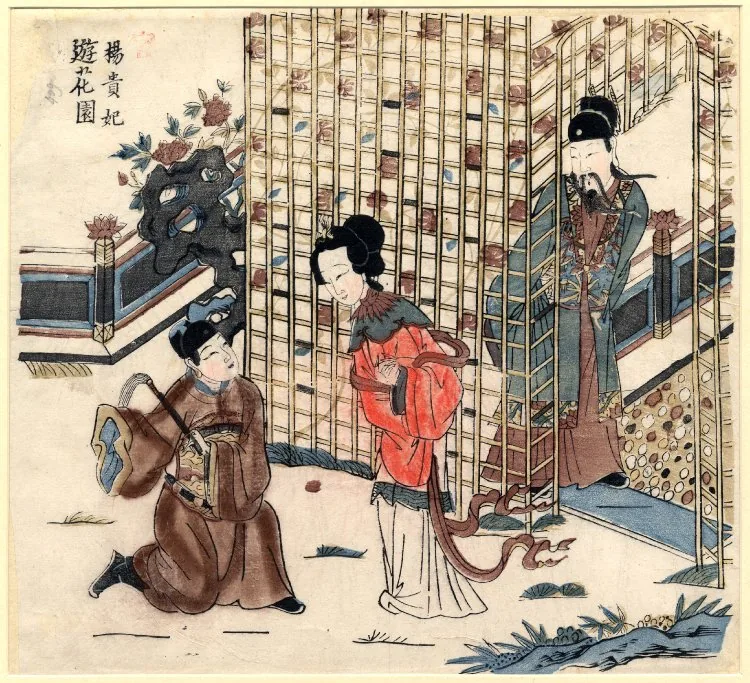
Anonymous, Yang Guifei in a Flower Garden, woodblock print, about 1644–1753. British Museum, London. · Public domain · Source page
The frontier and the court
Winter 755: a general turns on the emperor
In December 755 an army marches out of the frontier near modern Beijing. Its commander, An Lushan, has rebelled against the Tang emperor.
Within seven months the war reaches the area around the capital, and the court is in danger. Who is to blame: the general, the emperor, his favourite consort, or the way the empire was run?
Background
A general from the north-east
about 164,000
An Lushan commanded three garrisons on the north-eastern frontier. According to the sources we checked, the three together held about 164,000 soldiers.
Where he came from is unclear. He is thought to have been adopted by a Sogdian father, and his mother came from a Turkic family. Later stories about his adoption are tradition, not proof.
The court
An emperor and his consort
712
Emperor Xuanzong had ruled since 712, for more than forty years. His favourite consort was Yang Guifei, who lived from 719 until July 756. Her cousin Yang Guozhong held high office at court.
Four years before the revolt, in 751, a Tang army lost the battle of Talas, far to the west. An Abbasid army won it, with Karluk mercenaries on its side. Talas is a distant defeat, not the start of this story.
The pass at Tongguan
755 to 756
From the frontier to Luoyang
5 Feb 756
On 16 December 755 An Lushan marched out of the frontier with his army. On 18 January 756 Luoyang fell to him.
On 5 February 756, at Luoyang, he proclaimed himself emperor of a new state. He called it Great Yan.
A decision point
You are Emperor Xuanzong.
July 756, in Chang'an, the capital
Luoyang has been in rebel hands since January. Your army is gathering at Tongguan, a pass on the road to the capital.
General Geshu Han commands the pass. He wants to hold the strong position and wait. Yang Guozhong, Yang Guifei's cousin, wants the army to leave the pass and attack now.
The army will move on your word.
What do you order?
- Order the army out of the pass to attack the rebels now, as Yang Guozhong urges. Probably the army would leave its strong position and fight in open ground. If the attack failed, the road to the capital would be open.
- Let Geshu Han hold the pass and wait for reinforcements. Probably the pass would hold for a while, and more troops would arrive. But waiting also gives the rebels time to bring up their own forces.
What really happened
Order the army out of the pass to attack the rebels now, as Yang Guozhong urges.
The sources we checked say the emperor ordered the attack, against Geshu Han's objections. On 7 July 756 the Tang army was defeated at Tongguan.
Our sources are secondary summaries. They say Yang Guozhong pushed for the attack and feared a coup, so treat these reasons as uncertain.
July 756
The pass falls
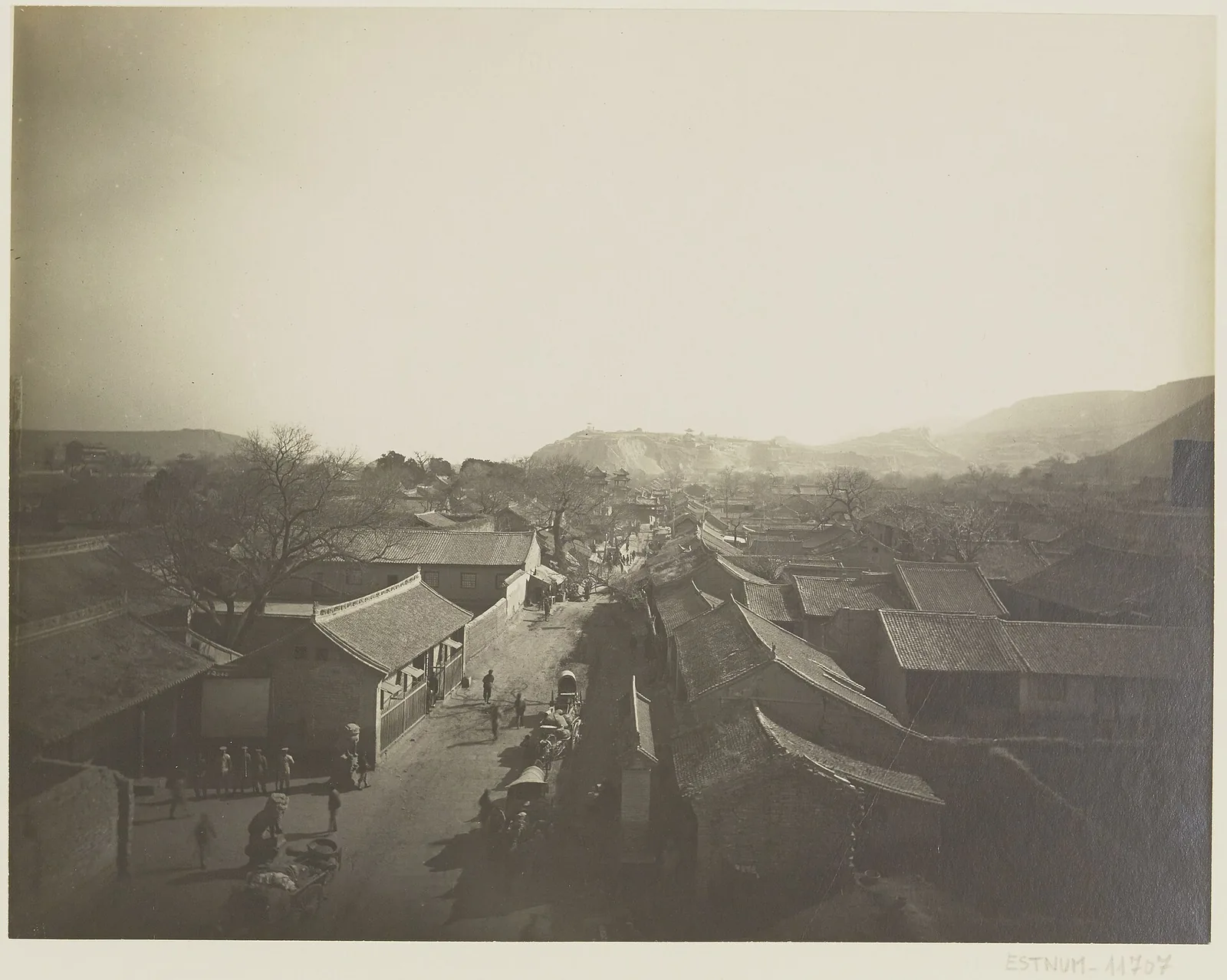
Victor Segalen, Auguste Gilbert de Voisins and Jean Lartigue, Tongguan, 1914. Bibliothèque nationale de France, via Wikimedia Commons. · Public domain · Source page
The Tang army is defeated at Tongguan on 7 July 756. The sources do not give clear army sizes, so we do not count them.
Within days the emperor's party leaves Chang'an. On 15 July, eight days after the defeat, it reaches Mawei station, near the capital.
At Mawei
A decision point
You are still the emperor, but not in your capital.
15 July 756, at Mawei station, near Chang'an
Your escort has turned mutinous. The guards blame your consort's family, above all her cousin, Yang Guozhong.
They demand that Yang Guifei be put to death.
You must answer them now.
What do you do?
- Refuse, and order the guards to obey you. The guards might not obey. Their anger could turn on you as well, and you could be left with no escort.
- Ask the guards to wait while you think, and put off the decision. The guards might read the delay as a refusal. It might buy minutes, but it could also set off the violence you wanted to avoid.
- Agree, and let the guards take her. The guards might calm down, and the journey would go on. The cost would be her life.
What really happened
Agree, and let the guards take her.
The sources we checked say the emperor ordered his consort to die. They disagree on how it was carried out, so we do not say it here. Yang Guozhong was killed at Mawei by the escort, according to a summary we checked.
The sources do not record the emperor's reasons in his own words. What they describe is mutinous guards who blamed her family and demanded her death.
Myth
A beautiful consort brought down the Tang dynasty.
The truth
Some old writings do blame her for much of the disaster. Others see her as a scapegoat: a person blamed for what other people did.
The sources name several causes: a general with a large army, a court whose choices are still argued over, and a long war. Blaming one woman is a neat story, but not the whole one.
The evidence
An online encyclopaedia article on Yang Guifei. It says that some writings blame her and others treat her as a scapegoat, and it warns that its own account of her death is disputed.
Two sources
Source: A print made some 900 to 1,000 years later
Anonymous Chinese woodblock print, dated about 1644–1753. British Museum, London (via Wikimedia Commons)
The print shows Yang Guifei in a garden, with a man in a long robe, who may be meant as the emperor, behind a lattice screen. Its artist is unknown.
- Who made it, and when? An unnamed artist, in the 1600s or early 1700s, roughly 900 to 1,000 years after the events.
- What does it want you to feel? A quiet, romantic scene. There are no soldiers, no rebels and no war.
- What is missing? The war itself, and the question of blame. It shows a love story, not a record.
Source: A poem written during the war
國破山河在,城春草木深。
Our paraphrase: the state is broken, yet the mountains and rivers remain. In the spring city, grass and trees grow thick.
Du Fu wrote this in 757, while the revolt was still going on. It is a poem, not an official report.
- Who wrote this, and when? Du Fu, in 757, during the war.
- What does the poet want us to believe? That the ruin of the state is painful, and that nature carries on regardless.
- What is missing? Any name. The line does not say who started the war or who is to blame.
What came after
A decision point
You are one of the court's ministers.
756, after Mawei
The rebels hold Luoyang. The court is in talks with the Uyghur khaganate, a Turkic power to the north.
The talks turn to a marriage alliance, in which princesses are exchanged between the two courts.
What do you advise?
- Accept the alliance, and ask the Uyghurs for troops. Probably the troops would come at a price, and the court would need a foreign army to win back its own cities.
- Refuse the alliance, and try to retake the cities with Tang troops alone. Probably the force would be too small for the task, and the rebels would hold the cities longer.
- Keep the talks going without a promise, and send the troops you already have first. Probably the Uyghurs would press for a clear answer, and the delay would cost time the court did not have.
What really happened
Accept the alliance, and ask the Uyghurs for troops.
The sources we checked record that the two sides exchanged princesses in 756. The help that followed is in the timeline below.
The sources we checked record the exchange, but not what the ministers argued. Any account of their reasons is guesswork.
How the revolt ran, in order
- 16 Dec 755 An Lushan marches out of the frontier near modern Beijing.
- 7 July 756 The Tang army is defeated at Tongguan.
- 15 July 756 At Mawei the guards demand Yang Guifei's death, and she is ordered to die. The sources disagree on how.
- 29 Jan 757 An Lushan is killed by his son, An Qingxu.
- Late 757 With help from the Uyghurs, Tang forces retake Chang'an and Luoyang.
- 17 Feb 763 Shi Chaoyi, another rebel leader, takes his own life when intercepted. The sources call this the end of the eight-year revolt.
The count
A census that shrank
52.9 million
The last census before the revolt, in 755, counted 52,919,309 people in 8,914,709 households.
The census of 764, after the revolt, counted 16,900,000 people in about 2,900,000 households.
That is a fall of about 68 per cent in the register. These are counts of registered people, not deaths. The sources call the post-revolt figures unreliable.
Deaths, or a count that stopped?
Does the fall in the census mean that millions died, or that the state could no longer count them?
- Reading A: the count broke down When the record-keeping broke down, the numbers fell even if people stayed. On this reading the fall comes from losing control of the register, not necessarily from losing lives.
- Reading B: war and flight War, flight and dispersal could have killed or scattered many people, and the registered count would fall with them. On this reading death is part of the story, not only failed records.
The question is open. The sources we checked do not decide between the two readings, and the numbers themselves are not fully reliable.
Check yourself
At Tongguan the emperor had two pieces of advice. What did he do, according to the sources we checked?
Answer: He ordered the attack on the rebels.. Right. The sources we checked say he ordered the attack, and the army was defeated on 7 July 756.
Check yourself
What is the best-supported statement about Yang Guifei's death?
Answer: She was ordered to die; the method is disputed.. Right. The order is clearly reported, while the method is not agreed on.
Check yourself
What do the census figures of 755 and 764 show, according to the lesson?
Answer: A fall in the registered population.. Right. The figures count registered people. Historians still argue whether that means deaths, or a state that stopped counting.
Check yourself
Why is the woodblock print of Yang Guifei a weak source for what happened in 756?
Answer: It was made centuries later, and it shows a romantic garden.. Right. A later garden scene shows what later readers liked to imagine, not what happened in 756.
Check yourself
Which reading of Du Fu's first couplet is most faithful to the lines?
Answer: The poet mourns the broken state, while nature carries on.. Right. The couplet says the state is broken, yet the mountains, rivers, grass and trees go on. This is our reading, not a fact recorded elsewhere.
Check yourself
Which statement best sums up this lesson?
Answer: Several causes; the sources argue over blame.. Right. The lesson shows a general's revolt, a court's choices and a long war, and the sources disagree on blame.
Terms
- Tang dynasty The Chinese dynasty whose capital was Chang'an. In 755 it was ruled by Emperor Xuanzong.
- garrison A military force posted in a fortress or on a border to hold that place.
- consort A ruler's partner who was not his main wife. At the Chinese court a consort could hold a high rank.
- Sogdian From Sogdiana, a region of Central Asia. Its traders spoke an Iranian language, and many of them worked in the Silk Road trade.
- census An official count of people and households, kept by the state. It shows who is on the register, not necessarily who is alive.
- mutiny A revolt by soldiers or guards against their commanders, or against the person they are meant to protect.
- scapegoat A person blamed for what others did, so that the criticism is turned away from them.
- Uyghurs A Turkic people of Central Asia. In 757 the Uyghur khaganate helped the Tang retake Chang'an and Luoyang.
- Luoyang A large city in central China, one of the old capitals of the empire. In An Lushan's revolt it fell to the rebels.
- Chang'an The capital of the Tang dynasty. The court left it when the revolt came close to the capital.
- Tongguan A mountain pass on the road to the capital. In 756 the Tang army was defeated there.
- Mawei A post station near the capital, where the emperor's party arrived after the defeat. According to one summary, Yang Guozhong was killed there.
- Great Yan The name of the new state set up by An Lushan. He proclaimed himself emperor of it.
- Yang Guifei The favourite consort of Emperor Xuanzong, who lived from 719 until July 756. Some old writings blame her for the disaster.
- Yang Guozhong A cousin of Yang Guifei who held high office at court. According to one summary, he was killed at Mawei by the escort.
- Xuanzong Emperor of the Tang dynasty, who ruled from 712 for more than forty years. An Lushan's revolt broke out in his reign.
- Talas A battle in Central Asia, far from China. In 751 a Tang army lost it to the Abbasid army.
- Abbasids A dynasty of Muslim caliphs. Its army beat a Tang army at the battle of Talas in 751.
- Karluk A Turkic people of Central Asia. Karluk mercenaries fought at Talas on the Abbasid side.
- Bai Juyi A Chinese poet who wrote a poem about the emperor and his consort in 806, about fifty years after the revolt.
- Du Fu A Chinese poet who wrote a poem in 757, while the revolt was still going on.
- Geshu Han The general who commanded the Tongguan pass. He wanted to hold the strong position and wait.
- khaganate A state ruled by a supreme khan. The Uyghur khaganate was a Turkic power to the north.
- mercenaries Soldiers who fight for pay rather than out of loyalty to their own state.
- marriage alliance A political agreement in which two courts strengthen their bond through marriage. Princesses are exchanged between the two courts.
Sources
- Du Fu, 春望 (Spring View, Chunwang), 757. Chinese text from cn-poetry.com.
- Bai Juyi, 長恨歌 (Song of Everlasting Regret), 806. Chinese text in any standard edition of his poems.
- 'An Lushan rebellion', Wikipedia, English edition (consulted October 2026).
- 'Yang Guifei', Wikipedia, English edition (consulted October 2026).
- 'Battle of Talas', Wikipedia, English edition (consulted October 2026).
- Anonymous, Yang Guifei in a Flower Garden, woodblock print, about 1644–1753, British Museum, London. Image via Wikimedia Commons.

Image credits
- Anonymous, Yang Guifei in a Flower Garden, woodblock print, about 1644–1753. British Museum, London. · Public domain · Source page
- Victor Segalen, Auguste Gilbert de Voisins and Jean Lartigue, Tongguan, 1914. Bibliothèque nationale de France, via Wikimedia Commons. · Public domain · Source page
